
Peak Oil is You

Donate Bitcoins ;-) or Paypal :-)


Page added on April 14, 2014

How Big Oil Clings to Billions in Government Giveaways

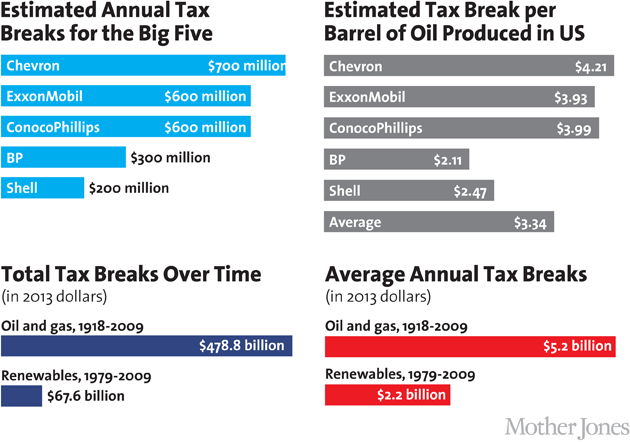
Over the past century, the federal government has pumped more than $470 billion into the oil and gas industry in the form of generous, never-expiring tax breaks. Once intended to jump-start struggling domestic drillers, these incentives have become a tidy bonus for some of the world’s most profitable companies.
Taxpayers currently subsidize the oil industry by as much as $4.8 billion a year, with about half of that going to the big five oil companies—ExxonMobil, Shell, Chevron, BP, and ConocoPhillips—which get an average tax break of $3.34 on every barrel of domestic crude they produce. With Washington looking under the couch cushions for sources of new revenue, oil prices topping $100 a barrel, and the world feeling the heat from its dependence on fossil fuels, there’s been a renewed push to close these decades-old loopholes. But history suggests that Big Oil won’t let go of its perks without a brawl.

There Will Be Subsidies
How the oil companies hit a gusher of tax breaks
Writing Off Drilling Expenses: A century ago, drilling for oil was risky business. Start-up costs were high, and prospectors couldn’t be sure they’d find crude. To encourage the nascent industry, in 1916 Congress approved the expensing of “intangible drilling costs”—pretty much any equipment used or work done—in the first year of a well’s life. Today, prospectors rarely hit dry holes, but the century-old tax break remains a gusher. Oil companies can expense 70 percent of their drilling costs and depreciate the rest. Annual cost to taxpayers: $700 million to $3.5 billion
The Depletion Allowance: When you sunk a well 90 years ago, you didn’t know how much it would yield or for how long. That was the idea when oil producers argued that the tax code should account for the “depletion” of their reserves. In 1926, Congress introduced the “excess of percentage over cost depletion deferral,” a.k.a. the depletion allowance. Since 1975, only small companies may claim it, but the price tag is still big. Under the allowance, an oil producer may deduct 15 percent (originally 27.5 percent) of any gross income from a well. And unlike normal depreciation, this deduction may be claimed indefinitely. Annual cost to taxpayers: $612 million to $1.1 billion
Domestic Manufacturing Deduction: In 2004, ostensibly to prevent jobs from being shipped overseas, Congress extended a tax break for stateside manufacturers to cover the oil industry. Never mind that most US oil jobs are nearly outsourcing-proof, since a well in Alaska or a refinery in Louisiana can’t be sent to China. Annual cost to taxpayers: $574 million
Cash Flow
Why Washington won’t touch oil subsidies, Part One
Oil and gas companies and their employees have pumped more than $357 million into federal candidates’ campaigns since 1990, with $4 out of every $5 going to Republicans. And that’s nothing compared to what they’ve spent on lobbying: more than $1.4 billion in the past 15 years. Last year, the industry employed 796 lobbyists, nearly 60 percent of them ex-members of Congress and staffers who’d come through the revolving door from Capitol Hill.
“It’s a pretty damn good investment,” says Sen. Sherrod Brown (D-Ohio), who has tried to end the industry’s perks. Outside groups, some with oil industry connections, spent $23.5 million to defeat him in 2012. “If you’re thinking about taking on oil companies, be ready for that kind of onslaught,” he says.
Stepping on Big Oil’s toes has always been risky, but in the post-Citizens United era, oil and gas executives can pour unlimited money (sometimes anonymously) into races. In 2012, Chevron gave $2.5 million to the Congressional Leadership Fund, a super-pac devoted to expanding the Republican majority in the House. And oil-backed dark-money groups like the American Petroleum Institute, the American Energy Alliance, and the Chamber of Commerce spent tens of millions on ads attacking President Obama’s energy policies.
This makes many lawmakers wary of crossing Big Oil, explains a senior aide to another Democratic senator. “We have a lot of members who are willing to vote the right way, but they’re not out there fighting the fight on this,” he says. “Do you really want to stick your neck out and attract enormous amounts of money?”

Beverly Drillbillies

Facing Marginal tax rates of more than 90 percent, some Hollywood stars of the ’40s and ’50s sought shelter in oil. A 1959 newspaper article explained their tax scheme:
Jimmy Stewart, Bing Crosby and Bob Hope take their salary and invest it immediately in oil. If oil is hit, cost of drilling is deducted and 27.5 percent depletion is taken off the top with no taxes. If the well is dry, cost of drilling is deducted before taxes. This is called “drilling with tax money.”
In the 1956 petro-epic Giant, the depletion allowance is described as “the best thing to hit Texas since we whupped Geronimo,” prompting Elizabeth Taylor to quip, “How about an exemption for depreciation of first-class brains, Senator?” Screenwriter Ivan Moffat said that “oil interests” pressured studio head Jack Warner to kill Taylor’s line.
Testifying against high tax rates before Congress in 1958, Screen Actors Guild president Ronald Reagan noted the similarity between actors and oil wells: “We feel we are about as short-lived as an oil well and twice as pretty.” Yet, he added, “we have no depletion allowance to compensate for the diminishing market value.” When Reagan recut the federal tax code three decades later, oil’s tax loopholes stayed in the picture.
Gassy Knoll Theory
Did Texas Oilmen kill JFK over oil subsidies?!

John F. Kennedy made noises about ending the depletion allowance during his 1960 presidential campaign, much to the consternation of his running mate, Texas Sen. Lyndon Johnson. When an LBJ staffer handed Bobby Kennedy a neutral-sounding statement on the tax break for his big brother to read, Bobby literally tore it to shreds. Jack Kennedy was assassinated before he could take action, prompting some conspiracy theorists to contend that he was offed to protect Johnson’s petroleum constituency. Longtime Republican operative Roger Stone advances this notion in his recent book, The Man Who Killed Kennedy: The Case Against LBJ. “That was the difference between Lyndon and me. I wasn’t willing to kill for it,” Stone claims his mentor Richard Nixon told him over martinis. (All evidence suggests that President Gerald Ford, who oversaw the end of the depletion allowance for big oil companies in 1975, died from natural causes.)

“Presidents Come and Go”
Why Washington won’t touch oil subsidies, Part Two
The oil and gas industry insists that it doesn’t receive any government handouts. Technically, it’s got a point: Its favorite giveaways are tax expenditures buried in the tax code. So the government isn’t actually giving oil companies much money—it’s just losing money it otherwise could be collecting from them.
To protect these tax breaks, the oil industry doesn’t have to convince lawmakers to do something; it has to convince them to do nothing. As a Republican senatorial aide explains, “Once you get it in the code, it is really, really hard to change.” Besides, few politicians want to untangle the wonkiness of decades-old tax loopholes. “When you get into the weeds with it, it’s tax policy,” says Autumn Hanna, an analyst at Taxpayers for Common Sense. “Who’s excited and interested in tax policy?”
Industry officials, environmentalists, and reps from both parties say the best shot at curbing the tax breaks is to tackle the entire tax structure. Within the industry, former Shell head John Hofmeister says, the thinking goes like this: “Let’s do comprehensive tax reform, and if these incentives disappear during the course of that discussion, okay.” Lowering corporate taxes could easily compensate for the loss of the current tax breaks. And if a tax overhaul never gets off the ground, the oil industry will be content with the status quo. As former Exxon ceo Lee Raymond once said, “Presidents come and go; Exxon doesn’t come and go.”


Texas Hold ‘Em
Seven Lone Star State politicians who gave the oil industry full service
Lyndon Johnson: In 1949, Johnson, then a junior senator, accused Federal Power Commission head Leland Olds of being a communist and torpedoed his reconfirmation. Olds’ crime: He’d testified against the deregulation of the oil industry. As president, LBJ held off any discussion of tweaking oil subsidies.
Sam Rayburn: The long-serving Democratic speaker of the House blocked any prospective member of the Ways and Means Committee who wanted to trim or eliminate the depletion allowance. He once convinced oilmen to make a large campaign donation by warning them that congressional Republicans would “tear your depletion allowance and intangible-drilling write-offs to pieces.”
George H.W. Bush: After President Nixon signaled that he wanted to end oil import quotas, Bush, then a House freshman, met with industry leaders and Treasury Secretary David Kennedy. Kennedy changed Nixon’s mind, prompting Bush to write to the secretary: “I was so appreciative of your telling them [the industry reps] how I bled and died for the oil industry. That might kill me off in the Washington Post but it darn sure helps in Houston.”
James A. Baker III: As the Reagan White House shot down tax loopholes during the “showdown at Gucci Gulch,” Treasury Secretary James Baker drew fire away from the oil industry. The final cuts, the Wall Street Journal‘s Jeffrey Birnbaum and Alan Murray wrote, were “a very mild swipe, designed only to enable Baker to say publicly that no special interest was spared the tax-reform knife.”

Lloyd Bentsen: The day after he finished crafting the 1986 tax reform bill, then-Sen. Bob Packwood (R-Ore.) got a call from Texas Sen. Lloyd Bentsen. Bentsen said he and seven senators would block the massive bill unless Packwood kept a special tax break for oil and gas companies. Packwood relented and the bill sailed through.
Joe Barton: Barton, the climate-change-denying representative who famously apologized to BP after the Deepwater Horizon disaster, defended the tax incentives for big oil companies in 2011, arguing that “they’ll go out of business” without them.
Ted Cruz: Though Cruz was born in Canada, his parents met at a Texas oil company. The junior senator from the Lone Star State has shown his loyalty to the family biz by proposing to end the ban on offshore drilling, allow unrestricted fracking, abolish the Energy Department, slash corporate taxes, and block cap-and-trade.
Rolling in the Deep
As crude prices dipped in 1995, the oil industry cried poverty. A sympathetic President Bill Clinton signed the Deep Water Royalty Relief Act, a five-year deal where companies could drill in US waters without paying any royalties. If oil prices rose, royalties would kick in.
Yet the Interior Department didn’t include the price trigger on more than 1,000 leases in the Gulf of Mexico. The bungled deals weren’t disclosed until several years later. In a series of testy hearings, Rep. Darrell Issa (R-Calif.) grilled agency lawyers on what went wrong; clerical error was their best answer. The leases amounted to a de facto subsidy of as much as $14.7 billion. In 2007, a federal court in Louisiana challenged Interior’s ability to impose price triggers on any deep-water leases signed under the act, potentially depriving the government of $38 billion in future royalties. The Justice Department has appealed, and the case slogs on.

So What About Solyndra?
Yes, renewable energy now gets more federal money than oil and gas. But don’t feel bad for the oilmen just yet.
THE SOLYNDRA SCANDAL was just the most recent flare-up in a growing controversy over subsidies for renewable energy, with fossil fuel fans taking aim at taxpayer help for solar and wind startups. “It is not the role of government to pick winners and losers,” Rep. Fred Upton (R-Mich.) griped about the failed solar company that left taxpayers on the hook for a $535 million loan.
It’s true that the renewable-energy industry currently snags a bigger chunk of the subsidy pie—$7.3 billion a year, compared to $4.8 billion for oil. (Plus, renewables received another $6.2 billion in direct subsidies, research and development funding, loan guarantees, and other help in 2010; fossil fuels got just 2 percent of that.) The difference is that renewables are at the stage where oil was a century ago: a promising yet not fully developed technology that needs a government boost to come to scale. That’s what motivated the original tax giveaways to what would become Big Oil.
Oil subsidies haven’t gone away as the industry has matured because they are locked into the tax code. However, the more recent incentives for renewables expire every few years, forcing producers to scramble for support on Capitol Hill and injecting uncertainty into the market. Two of the biggest breaks for renewables expire at the end of 2013 and 2016. An investment credit for advanced energy research is capped at $300 million.
And the renewables industry is still playing catch-up. An analysis by DBL Investors found that the early subsidies for oil and gas development dwarfed those given to renewables in the past two decades. Subsidizing promising new sources of energy, the report’s authors write, is as “American as apple pie.”
What Else Could $4.8 Billion Buy?
THE $4.8 BILLION in tax breaks that go to oil companies annually are a drop in the barrel for them, but it could go a long way toward spurring the clean-energy economy. Some other things we could do with it:
Guarantee loans for renewable-energy projects that could generate $24 billion in private-sector investment and as much as $475 billion in economic activity.
Fund a 17-fold increase in the budget of the Department of Energy’s Advanced Research Projects Agency, which supports cutting-edge energy R&D.
Hire 109,000 workers to manufacture and install clean-power generators, retrofit buildings, and do other green jobs.
“Green retrofit” 1.9 million homes, decreasing their energy use up to 30 percent.
Expand federal lending authority for high-efficiency auto projects like Tesla Motors by nearly 20 percent.
Increase doe spending on developing solar technology by more than 1,500 percent. Increase spending on fuel cell research by 4,500 percent.
Install between 1,200 and 1,600 two-megawatt wind turbines, enough to power 620,000 homes.
Quintuple the Army Corps of Engineers’ budget for flood and storm damage reduction and shore protection—needed to cope with threats from climate change.
Your Taxes Funded the Fracking Boom

Not all oil subsidies date back to the early years of the 20th century. The industry is also reaping massive benefits from the federal money that set off the explosion of hydraulic fracturing, or fracking, the controversial technology used to squeeze gas and oil from shale deposits.
In the 1970s, Presidents Nixon and Ford launched an urgent effort to boost domestic oil and gas production. In 1977, the Department of Energy oversaw the first large-scale demonstration of hydraulic fracturing to produce shale gas; it also funded the development of new drilling techniques for reaching these previously hard-to-tap deposits. According to an investigation by the Breakthrough Institute, over the next two decades the feds spent $137 million on key research that led to the $283-billion-a-year gas boom. Thanks to this taxpayer-backed investment, notes the group, “shale gas went from inaccessible deposits locked in unfamiliar geologic formations to the fastest growing contributor to the nation’s energy portfolio.”
“As far as shale is concerned, I don’t know that industry would ever have taken a look at it without the federal program,” Alex Crawley, former associate director for research at the National Petroleum Technology Office, told Breakthrough. It didn’t happen overnight, explained Terry Engelder, a Penn State University geosciences professor and an expert on shale gas. “This really took 20 to 30 to 40 years before it really worked. In terms of solar, it’s going to be the same.”
Capping the Well
What would happen if the oil industry’s subsidies dried up?
If tax breaks for oil companies were cut off, the industry and its allies warn, gas prices would soar, domestic oil production would tank, and the entire economy would take a hit. When Democrats targeted the subsidies for oil in 2011, Continental Resources ceo and Mitt Romney megadonor Harold Hamm said it would kill “thousands of American jobs.” Senate Republican leader Mitch McConnell declared, “Raising taxes on American energy production will increase the price of gas. Oh, and it would also make us even more dependent on foreign sources of oil.”
The data suggests otherwise. Research by economist Stephen Brown found that the average American consumer would spend an extra 60 cents a year on petroleum products if Congress eliminated the oil industry’s main tax perks. Even an American Petroleum Institute tax expert has said that ending tax breaks “would not affect the global economics underpinning oil supply and demand, which explain today’s gasoline prices.” Alan Krueger, the Treasury Department’s chief economist, told Congress in 2009 that cutting oil and gas subsidies would shrink domestic production by less than 0.5 percent and wouldn’t significantly change how much we import. The oil companies’ costs would increase 2 percent and some jobs would be lost, but the industry would be more efficient in the long run.
And there’s an added benefit from killing aid to oil companies: protecting the planet. According to the International Energy Agency, governments worldwide spent $523 billion subsidizing fossil fuel consumption in 2011. Ending that spending would cut global CO2 emissions nearly 6 percent by 2035. And it would free up money for addressing the environmental costs of fossil fuels, mitigate the effects of climate change, and remove what the IEA calls a “hand brake” slowing the development of clean energy.

Oil icon: Christopher Classens/Noun Project
6 Comments on "How Big Oil Clings to Billions in Government Giveaways"
Davy, Hermann, MO on Mon, 14th Apr 2014 1:07 pm
Wow what a great counter culture ad flashy well graphed and exciting! If you are going to bash the giver of life please offer a possible reasonable alternative plan B. Since I have seen none that can prevent the end of status quo BAU then I am keeping allegiance to a dying fossil fuel industry to buy me 5 more years. Sounds like a person with cancer begging for a few more years so he can complete his bucket list. Well I admit that is what I am doing and you can bash big oil all you want but it buys life for most of us for a short time. Get a grip MOM Jones you offer no reasonable alternative now to replace Big Oil so you are more morning Sci-Fi. We can Monday morning quarterback all day long about the evils of Oil but that is not going to change the here and now one bit. Let us realize a massive predicament and push forward through existing status quo BAU some bottom up plan B’s and a thousand good transition activities and ideas. That is all we have. We might want to produce a whole lot of body bags while we have all the excess ethylene on the market while we are at it.
Makati1 on Mon, 14th Apr 2014 2:30 pm
Actually, you are begging for the time it will take to assure the extinction of man on this planet. But, that is ok. You have a lot of company. Personally, I would like it to end tomorrow. Then there would still be a chance for us to survive. Not so if the temps rise 3C -5C by 2100. Of course, I will not be here, but my descendants may be. So, bring on the financial crash that will end the bloated consumption due to lack of finances to recover and process it and lack of consumers on the other end.
The above article does not mention the hundreds of other subsidies that made it possible for the demand for oil to grow so fast and so wide, like subsidies for highways, subsidies for truck and car manufacturing like tax breaks and special loan write-offs, etc.
We are using hydrocarbons to build our own hell here on earth. Or at least a hell for our descendents, if any.
GregT on Mon, 14th Apr 2014 3:19 pm
“We might want to produce a whole lot of body bags while we have all the excess ethylene on the market while we are at it.”
Sounds like Plan A wasn’t such a good plan after all. Maybe we should shift our entire focus to producing body bags, and digging burial plots. Or maybe we would be wiser, if we just used the remaining fossil fuels to cremate ourselves, because the longer we continue on with Plan A, the more of us that will ultimately suffer the consequences. It most certainly appears that we have more than enough fossil fuels to kill most everything, so why stop now, there’s still plenty left to kill.
rockman on Mon, 14th Apr 2014 3:19 pm
One can’t deny the tax laws governing the energy industry. But these aren’t “loopholes” implying some form of trickery. They were specifically designed and implemented to do exactly what they are doing: encouraging drilling/production. And those rules have an effect on the number of wells drilled regardless of what oil is selling for…$30/bbl or $100/bbl. My company’s makes decisions to drill based upon the net income potential of a project. Eliminate the current tax benefits, net income decreases and the same number of wells won’t be drilled because they won’t reach the required return. As I said: it doesn’t matter if oil is selling for $40, $100 or $200…lose the tax benefits and few wells will be drilled.
It’s no different than the tax break given to home buyers: eliminate that “subsidy” and fewer homes will be bought. Which means fewer houses will be built and few folks paid go bill them. If fewer wells drilled and homes built is what the people want than simply change the laws. But that also means less income in the form of taxes for cities, states and the fed govt’. So there’s he choice.
This is similar to the complaints offered over some of the reduced royalties on some Deep Water GOM leases that were granted dues to low oil prices at the time. And it worked. Of course when oil prices increased some politicians complained. Which, IMHO, isn’t any different about complaining that you should get your money back on those lottery tickets you bought because they didn’t win. You don’t want to pay for lottery tickets that don’t win…don’t buy lottery tickets. Don’t want companies to benefit from reduced royalties when oil prices increase…do allow reduced royalties.
It ain’t rocket science: if the govt doesn’t want to give incentives for any commercial activity then don’t give them. But if the voters aren’t happy with the lower level commercial activity then they can complain to the politicians.
buddavis on Mon, 14th Apr 2014 3:29 pm
I would be happy to give up my tax breaks* for comprehensive tax reform. AS long as every other industry gives up theirs as well. I would much rather operate under a flat tax that EVERYONE has to pay.
*On a side note, tax breaks are nothing more than me keeping more of the money I make. It is not me taking money out of the governments pocket.
Also, criticize the tax breaks all you want, but you do not do your argument any favors delving into the Kennedy Assassination conspiracy theories. Also, point out the other ridiculous tax policy we have in this country. I know of more than a few farmers who get paid to not plant their crops. I would love to get paid on wells I do not produce.
Kenz300 on Mon, 14th Apr 2014 8:01 pm
Buy an electric car ……….say no to the oil companies.