
Peak Oil is You

Donate Bitcoins ;-) or Paypal :-)


Page added on July 18, 2015

Greece looks to offshore oil and gas
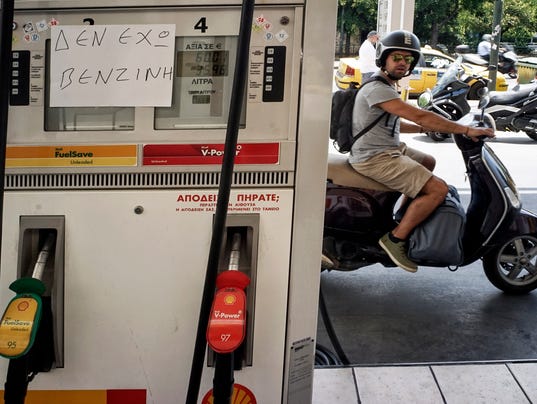
Greece is in an economic depression. Whether or not it agrees to the ruinous terms imposed upon it by its creditors in order to obtain a bailout, or if Greece opts for a much more uncertain route out of the Eurozone, Greece has years of hardship ahead of it.
The government is turning to offshore oil and gas as a potential source of revenues. Greece has almost no oil and gas production to speak of, and has failed in the past to make any major discoveries. But it still holds out hope of large potential reserves located offshore.
Under the previous government, Greece proposed tax cuts for oil and gas exploration in order to attract more investment. It also conducted extensive 2D seismic surveying of offshore tracts in the Ionian and Mediterranean Sea between 2012 and 2014, in an effort to improve data on its reserves.
On Tuesday, the Greek government said that it had received three bids for offshore oil drilling, to the west in the Ionian Sea and south of Crete in the Mediterranean. There were over 20 blocks up for bid accounting for over 200,000 square kilometers. The Greek government had invited Russian and Chinese companies to bid, but so far the Energy Ministry has not revealed which companies submitted the three bids.
To a large degree, Greece’s oil and gas fortunes depend on Energean Oil & Gas, the country’s only domestic oil producer. Energean is trying to boost production at Greece’s only producing field, the Prinos. It just completed a 3D seismic survey of the field, which will help it learn more about what is located beneath. But the field is mature and only produced 1,300 barrels per day in 2014. The company has a multiyear plan to lift that to 10,000 barrels per day, still a paltry sum by global standards.
Energean is also planning an exploration program with its partner Trajan Oil & Gas for its onshore Ioannina block in Western Greece, as well as the KataKolo block, located in Western Peloponnese. The government estimates the block has three to five million barrels of recoverable oil.
Of course, the debt crisis has cast a long shadow over Energean’s operations. The company had hoped to partner with larger international oil companies to develop offshore oil fields. Larger companies could provide the financing that the small Energean needs. But plans for partnerships were essentially put on hold because of the uncertain political and economic environment.
“Without liquidity in the system provided by the banks and a clear message that Greece will remain in the eurozone, without consensus by all political parties that strategic areas such as tourism, shipping or exploitation of natural resources will remain unaffected by political changes, the business climate will remain negative,” Energean’s CEO, Matthaios Rigas, told the FT in a May 2015 interview.
Despite the turmoil over the last few weeks, which included a default on an IMF payment, bank closures, and a potential rupture with the Eurozone, the Greek Energy Ministry ruled out extending the bidding round beyond the July 14 deadline. The deadline had already been pushed back by two months Prime Minister Alexis Tsipras in an effort to attract more interest.
Yet another option the Greek government is considering is a Russian-backed natural gas pipeline. The Turkish Stream project – seen as a rival to the Trans-Adriatic Pipeline that would run from Azerbaijan to Italy – would allow Russia to ship natural gas to Europe without having to worry about Ukraine. Greece’s Energy Minister revealed on July 9 his support for the pipeline, which could send 47 billion cubic meters of natural gas through Greece if it is completed.
However, that project is highly suspect, as many European policymakers support the alternative route from Azerbaijan. Also, Turkey has yet to agree to the project. There is a good chance it will not be constructed.
Still, Greece would also benefit from the Trans-Adriatic Pipeline, but the Energy Minister has expressed his dissatisfaction with the financial terms even though he supports the project in theory.
Even if Greece is successful in attracting more interest and investment from oil and gas companies, it will be several years before any substantial increases in oil production materialize. That offers little solace to a government and people who are looking for short-term economic answers.
6 Comments on "Greece looks to offshore oil and gas"
rockman on Sat, 18th Jul 2015 1:39 pm
Prinos Field: According to this AAPG report the field produces from a “submarine fan”. Think of a river dumping reservoir quality rocks along the coast line of Louisiana. Except instead of being in less than 100′ of water it happens in thousands of feet of water depth. The sands are carried that far out by turbidite flows: think of a river but running along the seafloor thousands of feet deep.
Not a good trend to expect a large number of similar deposits. The Rockman wrote his MS thesis on one such field in the San Joaquin Basin in S. CA. They can be prolific but scarce compared to other trends. And occurring under a salt bed will make them rather difficult to find even with modern 3d seismic:
“The first well, East Thassos 1, was drilled 20 km east of Thassos on a large anticline in 1971. It encountered an oil accumulation but with very low gravity oil.The next two wells were drilled west of the island in 1972-1973 on a fault-bounded anticline combined with a stratigraphic pinch-out. This led to the discovery of the South Kavala gas field. Subsequent testing proved this field to be very small and for the time being not economical. The existence of hydrocarbons in the area encouraged further drilling.
The fourth well, Prinos 1, was drilled close to the top of the Prinos structure at the end of 1973 and was completed in February 1974. This was the discovery well for Prinos field. The Prinos 2 well, completed in April 1974, confirmed the discovery. The structure itself consists of two anticlines separated by a small graben. The caprock is a thick salt section intercalated with elastics. A generalized stratigraphic column. The producing zones are located not within the salt section, as at South Kavala, but immediately below it in a submarine fan of upper Miocene age). There are three reservoir. During 1975-1977, four delineation wells were drilled. The second delineation well (Prinos 4) proved that the northeast high, later named North Prinos, is completely separated from the rest of the structure by a fault, downthrown to the southwest. This reduced the presumed original area of Prinos field by nearly half. Additionally, the North Prinos reservoir also proved to be of limited extent, with a thinner pay zone and with a different oil quality. Another well drilled on this structural high, close to Prinos 4, the Prinos North 1, was nonproductive.
Makati1 on Sat, 18th Jul 2015 9:12 pm
All of the oil/gas dreams we read about are years away, if ever, in a world on the brink of war. I personally doubt we have five years to get our shit in order before it happens. I hope I am wrong and we avoid it by some miracle, but I don’t believe in miracles. I believe in preparation. Do you?
Sign on our door:
The Future
Failure to prepare
is
preparing to fail.
Northwest Resident on Sun, 19th Jul 2015 1:25 am
If Greece had exploitable oil, they would have gone after it when oil was $100-plus per barrel.
Why would Greece be so desperate for oil?
Food and Fuel Imports Drive Structural Imbalances and Debt/Currency Crises
“Portugal, Ireland, Italy, Greece and Spain) also happen to be major importers of energy.
What does this have to do with Greece’s debt crisis?
…the key driver of Greek debt (is) imports that far exceeded exports, not occasionally but structurally, year in and year out.
If a nation does not generate a significant percentage of its own energy and food needs, or export enough goods and services to offset its imports of energy and food…”
…then that nation is screwed, but not nearly as much today as it will be in the near-term future, relatively speaking.
http://www.peakprosperity.com/insider/93399/more-sovereign-defaults-coming
rockman on Sun, 19th Jul 2015 12:00 pm
NR – Greece per se would be going after oil…tge expat companies would. I’ve never looked at any trade structures the Greek might have on the table so I don’t know if they lacked incentive enough for the companies. Consider Mexico: had they changed their attitude toward foreign companies 2 decades ago they might not be suffering the decline they are now.
Or maybe there wasn’t enough potential to attract companies. Then again drilling Greek shallow waters would have been easy for Shell then the Arctic.
BobInget on Sun, 19th Jul 2015 12:51 pm
I’ll bet more modern drilling techniques might improve on fields once thought unprofitable.
Northwest Resident on Sun, 19th Jul 2015 5:05 pm
rockman — So true. I just never heard of Greece having any significant amount of oil before. I can’t imagine that they would have gone all this time without exploiting whatever oil resources they had, or signing to let a major player do it for them, if they had anything that was worth getting. Which is why it just strikes me as odd that they are just now getting around to looking to offshore oil and gas. Have a good look, guys! Hope you find something — you desperately need it!