
Peak Oil is You

Donate Bitcoins ;-) or Paypal :-)


Page added on May 21, 2014

Export Delusions: Why the rush to export natural gas is a fool’s errand

Click the thumbnails to view slideshow. © J Henry Fair, flights provided by LightHawk
On a sweltering day in May last year I sat dumbfounded at a US Senate Energy & Natural Resources Committee meeting. Pat Outtrim, VP of Cheniere Energy, was arguing for fast-tracking approval of Liquified Natural Gas (LNG) exports because it would benefit energy consumers… in Great Britain.
A year later and the drum beat for approving LNG export operations is reaching a crescendo. This time it’s spurred by claims that we must save Europeans from the grip of Russia, who is using its position as the primary natural gas provider in Europe to annex Crimea and assert its power in the region.
In both cases, the rationale is the same: The US has an over-supply of natural gas—thanks to an explosion of hydraulic fracturing (“fracking”) for previously inaccessible shale gas—and it’s our duty as international citizens to make sure that our friends in Europe (not to mention Asia) can benefit from our lower-cost largesse.
Ostensibly in response to the crisis in Ukraine, two bills have been introduced in Congress: Senate Bill 2274, introduced by Mark Udall (D-CO), and House Bill 6, introduced by Cory Gardner (R-CO).
Gardner’s bill is, frankly, a little nuts—calling for the Department of Energy to simply approve “without modification or delay” all LNG export terminal applications that were submitted before March 6, 2014, due diligence be damned.
Udall’s bill is a little more measured but I confess to being even more chagrined by it, considering that Udall’s late brother Randy was one of the few voices in the country who recognized that the so-called “shale revolution” is really just a short-term phenomenon.
(If you can find the time, I highly recommend watching this brilliant and expansive lecture on shale gas by Randy Udall just a few months before his death: “Halliburton is Fishing in the Mancos Sea.”)

Despite plans for massive expansion of LNG export facilities, the U.S. is still a net importer of natural gas. © J Henry Fair, flight provided by SouthWings
LNG exports have become a hot-button issue and enmeshed with the fate of an energy efficiency bill and a vote on approval of the Keystone XL pipeline. It’s pitted Democrats against one another, though interestingly the split is between those from states where drilling is taking place (export proponents) and those from manufacturing states who hope that cheap and abundant natural gas supplies can bolster their economies.
What seems to be entirely missing from the debate are a few realities that should render this debate moot:
Reality #1: The U.S. is still a net importer of natural gas. Yes, you read that right. In 2013, we produced 24.28 trillion cubic feet (tcf) of natural gas, but consumed 26.03 tcf. Now, the gap between production and consumption has been shrinking in the last decade as shale gas drilling went into overdrive, but our storage of natural gas supplies (needed in preparation for the cold winter months) is at alarmingly low levels—more than 40% lower than it was just a year ago. The idea that we have a surplus of natural gas to export is bogus.
Reality #2: By the time these LNG export terminals are completed, the “shale revolution” may have come and gone. As Post Carbon Institute has documented in painstaking detail, shale wells deplete at breakneck speed—on the order of 70% for a typical well in the first year and between 30-50% for entire fields. That means industry must replace nearly half of production each year just to maintain current levels. But there are only so many economically viable drilling locations. Unless drilling rates grow dramatically, it appears that all the major shale gas plays—with the exception of the Marcellus—have already peaked. It’s likely that by the end of the decade, US natural gas production will again be in decline.
Reality #3: The industry is losing its shirt at current natural gas prices—the real motivation behind the LNG export push. The shale gas drilling frenzy led to a steep decline in natural gas prices; this was great for utilities and consumers but has led to a lot of companies writing off assets and even more to rely on debt to keep the drilling treadmill going, since many of these operators are losing money. Exporting natural gas would raise prices domestically, something the industry badly needs in order to earn a profit.
Reality #4: While the benefits are fleeting, the costs will be borne for generations. There is a lot of debate about the climate and health impacts of shale gas drilling, with studies showing conflicting findings (for a great, albeit wonky, resource for peer-reviewed papers on shale gas check out this library put together by PSE Healthy Energy). But a few things are difficult to dispute:
1. Whether or not water contamination has already occurred, well casing failure is an inevitability 100% of the time. It’s just a matter of when.
2. The millions of gallons of fresh water that are used on average for each shale gas well drilled can’t be returned to the hydrological cycle. Whether or not industry gets better at recycling their waste water for use in other frack jobs, we’ll never again be able to drink that water or use it to grow food.
3. The boom and bust phenomenon that comes with the shale gas (and tight oil) drilling frenzy can create huge, negative social and economic impacts—increased crime, inflation, blight, infrastructure costs, and social services that can no longer be maintained by tax revenue once the boom ends. Export advocates are essentially arguing for sending all the benefits of fracking abroad while keeping all the costs here at home.
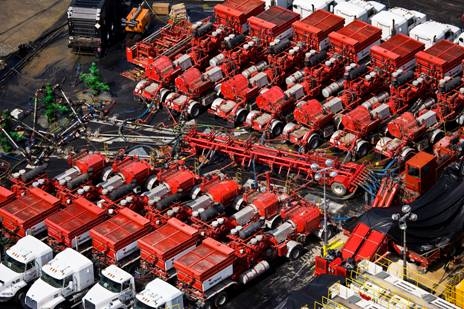
Fracking a single well can require over a thousand trucks. The hope that cheap and abundant natural gas supplies can bolster economies has prompted investment in ancillary equipment used in extractive processes. © J Henry Fair, flight provided by LightHawk
When you step back from the feel-good rhetoric and look more closely at these underlying—and under-reported—realities it’s clear that the rush to approve LNG export terminals is a fool’s errand. And by that I mean an errand on the part of some elected officials to fool us so that the oil & gas industry can ensure its profits.
6 Comments on "Export Delusions: Why the rush to export natural gas is a fool’s errand"
rockman on Wed, 21st May 2014 6:23 pm
An adequate piece but I wonder why he skipped the most important fact: not only is the US a net NG importer the story is about exporting LNG. LNG of which the US is an even greater LNG importer. The last stats I found the US exports 7X as much as it imports.
And from what countries do we import LNG? Most of the same countries the EU imports from…including Norway. Why would EU buyers pay to ship across the Atlantic when it’s available in their own backyard? Only one answer: including the transport cost they old have to get the US LNG at a lower price. And why would a US LNG owner pay to ship LNG to the EU for less than they could sell it to a US consumer? The answer is they won’t.
So how is Cheniere going to sell the NG they signed the 20 contract with that British utility? Especially when they won’t start shipping it for at least 18 months? Easy: the price of the LNG will be priced based upon the Henry Hub price at the time + the cost of compression + the cost of transport + a guarenteed
rockman on Wed, 21st May 2014 6:50 pm
Dang…accidentally hit send.
+ a guaranteed profit margin for Cheniere. IOW they are not going to sell it cheap. Which also brings us to the very common misstatement in this discussion: the US isn’t going to sell LNG to the EU because it doesn’t own any LNG. Corporations (some US and some foreign ones) own the LNG. They will decide who they’ll sell to and at what price. There is no guarantee that any of the LNG export facilities currently under license review by the gov’t will ship any LNG to the EU.
The only way a new LNG plant can be built is when they have long term (typically 20 to 30 years) contracts with a fixed pricing structure. The plant owner also has to acquire long term guaranteed domestic NG contracts that meet their LNG delivery contracts.
If the EU wants to acquire long term LNG deliveries from any US company they need to start signing contracts (with guaranteed purchase ability) now. Otherwise the only LNG they might acquire from a US company will be by paying spot prices. Last winter New England utilities had to pay more than twice the price for spot LNG imports then what Russia was selling NG to European countries.
The EU buying NG from US companies won’t be like placing an order on Amazon when you decided you want some and then have it delivered in two days. LOL.
The LNG biz doesn’t work like that. Never has…never will.
Makati1 on Wed, 21st May 2014 7:28 pm
Reality is a bitch …
rockman on Thu, 22nd May 2014 8:40 am
M – True…and then you die.
J-Gav on Thu, 22nd May 2014 3:11 pm
Yup – spot prices can also be a bitch.
Export boom my royal red …!
But we’ve been over that before on this board.
Useful to point out that LNG is kind of a different critter, Rockman. I used to work (as an English teacher) with a French company here that dealt with such transactions. Those people had serious headaches every day and that was mostly what we talked about (with a little grammar thrown in). Once those facilities are built, if they aren’t bringing it in, it’s trouble. France gets a quarter of its natgas in liquid form, coming to just 3 terminals. For Spain it’s 75%! This will continue to be a newsy subject.
rockman on Thu, 22nd May 2014 3:26 pm
J-Gav: Yep. Really a very different business model then pipeline NG. Deals can radically change in just an hour. I recall last year an LNG tanker was turned around mid Atlantic and sent to a different buyer. Can’t do that with NG flowing down a pipeline. If you didn’t catch my other post: last winter during Feb/Jan a utility in Boston had to pay $23/mcf for spot LNG. Someone with the supplier made a damn good payday.