
Peak Oil is You

Donate Bitcoins ;-) or Paypal :-)


Page added on January 9, 2016

Depletion Of China’s Reserves Creating Concern And A Potential Derivative Nightmare In Oil
With continued uncertainty in global markets, today a legend in the business warned about the depletion of China’s massive reserves and a potential derivative nightmare in the crude oil market.
Here is a portion of today’s note from Art Cashin: How Fast Are China’s Reserves Shifting – China has a huge pool of foreign currency reserves but recent moves to defend the yuan are hemorrhaging them out the door. Here are a couple of bits from a Bloomberg column on the topic:
China’s $3 trillion-plus in foreign currency reserves, the biggest such stockpile in the world, would seem to be a gold-plate insurance policy against the country’s current market chaos, a depreciating currency and torrent of capital leaving the country.
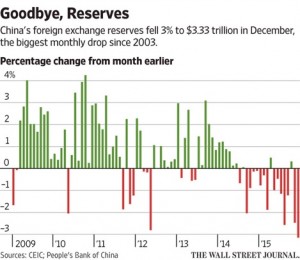
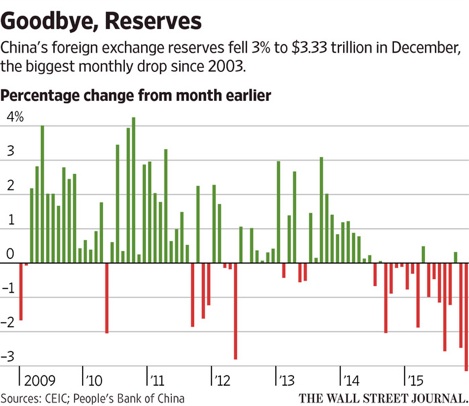
Maybe not, say economists. First off, data point to an alarming burn rate of dollars at the People’s Bank of China. The nation’s stockpile of foreign exchange reserves plunged by $513 billion, or 13.4 percent, in 2015 to $3.33 trillion as the nation’s central bank coped with a weakening yuan and an estimated $843 billion in capital that left China between February and November, the most recent tally available according to data compiled by Bloomberg.
“My greatest worry is the fast depletion of foreign exchange reserves,” said Yu Yongding, a member of China’s monetary policy committee when the currency was revalued in 2005.
True, trillions of dollars under the central bank’s care are thought to be invested in safe liquid securities, including Treasury bonds. The U.S. measure of China’s holdings of Treasuries, the benchmark liquid investment in dollars, stood at $1.25 trillion in October, according to the U.S. Treasury Department, which cautions that the figures may not reflect the true ownership of securities held in a custodial account in a third country.
Then:
The decline in reserves accelerated from August, when China made a surprise devaluation to the yuan and said it would allow the market a greater say in setting the currency’s value. Authorities followed up in December by flagging a loosening of the yuan’s links to the dollar and said its strength would be judged against a basket of currencies.
The yuan’s weakness comes as the $10 trillion-plus economy likely grew by its slowest in 25 years years in 2015 and as the nation’s markets suffer their worst start to the year in two decades. Trading on the CSI 300, down 10 percent this week, was suspended twice this week as heavy selling triggered a circuit breaker.
The drop in the nation’s foreign reserves over 2015 was the first since 1992, ending a 22-year ascent that began under former top leader Deng Xiaoping in an effort to keep a floor under the tumbling yuan. They fell by $108 billion in December alone.
“Where is the line in the sand, and what happens when we get there?,” said Charlene Chu, the former Fitch Ratings Ltd. analyst known for her warnings over China’s debt risks and now a partner of Autonomous Research Asia Ltd. “China’s large hoard of foreign reserves gives the country considerable power and influence globally, and I would think they would want to protect that. If there is such a line in the sand, it is very possible we hit it in 2016.”
To be sure, intervention isn’t the only thing dragging China’s reserves lower. There’s also a valuation impact from fluctuating currencies. Some of the fall may also reflect authorities accounting for its investments. Chu reckons much of the decline up to June 2015 was mostly due to investments in illiquid assets and valuation changes rather than capital outflows.
Some experts think a reserve drop to $2 trillion could set off alarms and badly spook markets.
Overnight And Overseas – Shanghai was up the Dow equivalent of 300 points amid rumors that the government was a big, big buyer of stocks. Separately, and more importantly they marked the yuan higher. European markets opened higher but gave back most gains by midday. Gold is softer and oil is mixed.
Consensus – With China on pause, I suspect crude will be at center stage. A break below $32 could bring on follow-up selling due to some derivative associations. Stay wary, alert, and very, very nimble. Have an absolutely wonderful weekend! You deserve it.
5 Comments on "Depletion Of China’s Reserves Creating Concern And A Potential Derivative Nightmare In Oil"
Davy on Sat, 9th Jan 2016 5:12 pm
The real definition of China’s foreign reserves:
“Kyle Bass: US down 10%-20% by year-end”
http://video.cnbc.com/gallery/?video=3000476898&play=1
“So what we are going to see next is a credit cycle, and in a credit cycle you see some losses, but if China’s banking system loses 10%, you are going to see them lose $3.5 trillion. He then puts this number in the context of China’s “massive” foreign reserves: What’s the magic number in their FX reserve pile today? When you look at banking system assets divided by their foreign exchange reserves, China is 7x, it’s one of the worst in the world. I think people are mypoically focused on a giant number of reserves, of $3 trillion or thereabouts, and no one is really paying attention to the size of the system and what’s about to happen.”
makati1 on Sat, 9th Jan 2016 6:36 pm
Considering that over $1 Trillion of those ‘reserves’ likely to be sold would be USTs, the US should be worried more than China.
And China’s oil purchases are far from over. They have just begun to stockpile. They are building underground storage for twice what they already have stored. And will begin to fill them this year.
So they are trading USTs for gold and oil. Real things. Not a bad ‘mistake’, I think. Only the US dollar is shaking in it’s boots.
makati1 on Sat, 9th Jan 2016 6:41 pm
BTW: That reference:
http://www.ibtimes.com.au/china-builds-more-underground-storage-tanks-strategic-oil-reserves-driven-cost-savings-security
“Meanwhile, China’s thirst for crude will lead to a 8 percent surge in its oil purchase from abroad in 2016. The average purchases will be 7.2 million barrels a day, said a Bloomberg survey.”
Should be an interesting year.
Davy on Sat, 9th Jan 2016 6:51 pm
Markets Are Correcting Hard
http://www.peakprosperity.com/blog/96191/markets-correcting-hard?utm_campaign=weekly_newsletter_213&utm_source=newsletter_2016-01-08&utm_medium=email_newsletter&utm_content=node_title_96191
They are worried that these grotesquely-inflated “”markets”” will begin to implode, gather steam, get further away from their control, and end up causing real damage to one or more major banks (the only entities that central banks actually care about). Or even possibly one or more small countries.
My favored interpretation of these events is that the entire world is now one interlinked set of trading algorithms and capital flows. A large number of these trading algorithms are based on ‘correlation trading’ which means they buy and sell things in related trades. So it might be “buy the Yen, sell gold, and buy the Nikkei.” There are correlated trades like this being executed 24 hours a day, 365 days a year.
The August surprise Yuan devaluation upset of a lot of carefully tuned trades and the rest is history. Markets all over the globe crashed quickly, and at heavy volume.
Davy on Mon, 11th Jan 2016 6:18 pm
Good read on the myth of decouple and the yet to be realized Chinese real estate black hole, increasingly destabilizing capital flows, and mounting demand destruction. Folks, this is just getting started for all of us. Hang on and close your eyes you are going to open them in a new reality.
http://www.zerohedge.com/news/2016-01-11/china-syndrome-coming-global-financial-meltdown