
Peak Oil is You

Donate Bitcoins ;-) or Paypal :-)


Page added on November 8, 2014

Brussels: passing the message about resource depletion
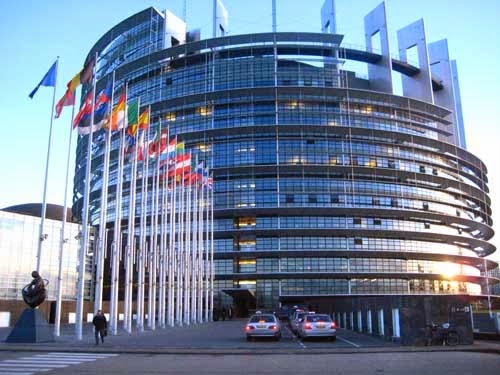
As I walk to the hearing on energy security in Europe, I am struck first of all by the size of the hall. The “Alcide De Gasperi” room in the palace of the European Parliament in Brussels is clearly a place built for impressing people, in addition to its function as a meeting room. One of its most remarkable features is the long row of windows of the interpreters’ rooms. Since there are 24 official languages of the European Union, there have to be at least 50 interpreters working in there. Then, I also notice how the screens for projecting one’s slides are small and located high up, near the ceiling. This is not a place where you are supposed to support your statements with data and graphs. It is a place built for political debate.
As people collect in the hall, I can see that the atmosphere is rather formal, with several members of the European Parliament sitting in the audience. Most people are dressed in suits and the men wear ties. On the podium, there are six invited speakers. And there we go; I immediately sense the mood of the conference: this is not a scientific meeting. None of the speakers seem to be an expert about fossil fuels, intended as markets, production, resources, reserves, and the like. Rather, they seem to be mainly concerned with strategic and political issues. The line that emerges from the presentations and from the reactions of the audience is clear: it is a highly confrontational attitude (to put it mildly) toward Russia, accused to be engaging in an economic war against Western Europe. The gist of what I hear is that the European Union must unite in defense; we must follow the example of the United States and get rid of our silly regulations and of the local resistance against drilling and nuclear plants. Europe can exploit its shale gas and oil resources (and also nuclear energy) and attain energy independence, as the United States did. It is “drill, drill, drill” all over.
This line, in various shades, is the position of four speakers out of six. The bias in favor of fossil fuels is shown also by the fact that the lady charged with defending renewables is given the last time slot of the hearing. The fossil oriented attitude seems to be shared by the majority of the audience. Not that it is not challenged by some of the MEPs in the room. One of them (I know him well, he has been a long time ASPO supporter) stands up and tells to one of the speakers: “it is not true that the United States has attained energy independence. You have to stop getting your data from newspapers!”. He is right, (you can look at the data yourself). But it is an isolated reaction, and the overall debate remains based on the idea that the US has become energy independent or that, at least, it will soon become independent.
When it is my turn to speak, I tell a different story. I try to explain that the ultimate origin of the energy security problems in Europe is due to depletion, and that drilling more is not the solution. I keep the message as simple as possible; tailored for people who are not specialists in oil and gas. I show the price trends, I tell them something about energy return, and I make the point that renewable energy is not subjected to depletion. I sense that my talk is well received: the people in the audience listen to what I say, and they look up at my slides (but those screens are too high and too small, dammit!). I also get several questions and comments – mostly favorable ones. After the hearing is over, several people stop me to discuss further about what I said. As a talk, it was a reasonably successful one.
But, on the whole, I think I had a very modest impact, if any. As I noticed many times, it is extremely difficult to pass to decision makers messages which are perceived as out of the ordinary, as the message on resource depletion is. The problem has many facets and it has to do, mainly, with the way politicians think. According to my experience, politicians – especially high level ones – are very smart people. The problem is that they are swamped with information; just as most of us. So, in the great mass of data arriving, how do you decide what is the truth? If you are a scientist – or you are scientifically trained – you have ways to evaluate the data and filter out the bad ones. But politicians are not scientists, they are not scientifically trained, so they use a different method. They maintain a healthy dose of skepticism about everything they hear; they don’t pay too much attention on data, and they tend to side with the interpretation that they perceive as the most compatible with the general opinion of the group they belong to.
There are reasons for this “groupthink” syndrome that, probably, affects politicians more than most of us. It is because then main tool in the political struggle, today, is the demonization of adversaries. So, a politician is very careful to avoid to be singled out from the crowd of colleagues and subjected to the standard demonizing treatment. For a politician, there is safety in crowds; a traditional strategy well known also by sheep and fish. In practice, you may see a politician as having a built in opinion detector in his head. He/she will sense the position of the majority and try to avoid straying too far away from it. In general, the way for a politician to obtain power is to occupy the center; to be seen as a moderate. That this is the way to success has been known for a long time; even rigorously modeled (in economics, it is known as the “Hotelling’s law“). Scientists are sometimes contrarians, politicians almost never are.
So, I think I can figure out the reaction of most of the MEPs to the hearing on energy security in Brussels. It was something like, “Well, that Italian guy who spoke about resource depletion might have a point about what the real problem is. I couldn’t his slides so well, so high up near the ceiling, but he seemed to have some good data. But, on the other hand, the other speakers saw the problem differently. If most people in the parliament think that Russia is waging an economic war against us and that drilling more is a good idea, then there has to be something in it. For sure, I shouldn’t take the risk of siding with a minority option.”
Cassandra’s legacy by Ugo Bardi
5 Comments on "Brussels: passing the message about resource depletion"
turningpoint on Sat, 8th Nov 2014 1:36 pm
The opinion of the herd may change in time as they begin to realize their position is absurd and is hurting them economically.
Angela Merkel is still following the herd but she has stated in the past that sanctions against Russia are beginning to hurt the European economy. The European commission estimates that economic warfare with Russia will cost the EU a growth rate of 0.2% to 0.3% this year.
To some degree, some Europeans realize they’re shooting themselves in the foot. I don’t know how many European politicians have received the message but I also know, even though Poland is taking a hard line position, Hungary was the first EU country to back out of the whole thing. As a result, we have visa restrictions against 6 Hungarian politicians. I think cracks are forming in European armor.
The more these sanctions hurt Europe, the more pressure there will be to back out of this mess or try to find an off ramp.
GregT on Sat, 8th Nov 2014 1:54 pm
“For a politician, there is safety in crowds; a traditional strategy well known also by sheep and fish.”
🙂
rockman on Sat, 8th Nov 2014 6:02 pm
Greg – Or as put by my favorite French philosopher: To be…not to seem. In this case the EU Commission seems to be addressing their energy problem.
Feemer on Sun, 9th Nov 2014 10:39 am
I love the EU. So it hurts me to say what everyone knows, it is declining. It has no resources left. However, they still have power, influence, and potential. They MUST increase renewables and increase efficiency. for every 1% increase in efficiency (throughout the eu) Russian imports of gas fall over 2%. Screw the carbon reductions, focus just on renewables and efficiency and the carbon emissions will follow. The EU must do this, as well as make more friends in south america (for resource reasons). They should also focus on building the digital economy and become the world leaders in this.
Boat on Sun, 9th Nov 2014 11:16 am
Feemer, eliminating immigration would be a huge step towards sustainability. Along with much tougher regulations pushing business and private sectors towards efficient buildings and equipment. The days of growth for growths sake is still with us. Our politicians are just in the pockets of business.