
Peak Oil is You

Donate Bitcoins ;-) or Paypal :-)


Page added on September 15, 2013

Behind Syria’s Crisis: How Oil & Gas Limits Contributed To The Civil Unrest

The Syrian civil war has been ongoing since 15 March 2011. Though the roots of the conflict are political by nature, Syria’s depleting oil and gas reserves also played a major role in sparking the unrest: When oil exports dropped, the government suddenly found itself unable able to pay for programs that had been placating its citizens to some degree.
In my view, oil and gas resource limits are major contributors to the conflict in Syria. This is happening in several ways:
1. Syria is an oil exporter that is in increasingly perilous financial condition because of depleting oil resources.
When oil production is increasing, it can help an oil exporter in two ways: (a) part of the of the oil supply can be used internally, to grow more food and to support increased industry, and (b) exports of oil can be used to provide revenue for governmental programs such as food subsidies, education, and building highways. Syria’s population grew from 8.8 million in 1980 to 22.8 million in 2012, at least in part because of the wealth available from oil extraction.
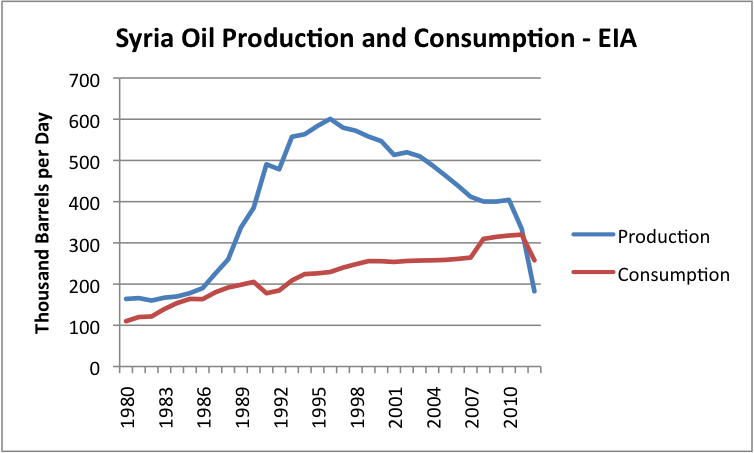
Figure 1. Syria’s oil production and consumption, based on data of the US Energy Information Administration.
Now Syria’s oil production is dropping. The drop between 1996 and 2010 reflects primarily the effect of depletion. The especially steep drop in the last two years reflects the disruption of civil war and international sanctions, in addition to the effect of depletion.
When oil exports drop, the government finds itself suddenly less able to pay for programs that people have been expecting, such as food subsidies and new irrigation programs to support agriculture. If revenue from oil exports is sufficient, desalination of sea water is even a possibility. In Syria, wheat prices doubled between 2010 and 2011, for a combination of reasons, including drought and a cutback in subsidies. When basic commodities become too high priced, citizens tend to become very unhappy with the status quo. Civil war is not unlikely. Thus, oil depletion is likely a significant contributor to the current unrest.
Egypt has many Similarities to Syria
Egypt is another example of an oil exporter whose oil production has dropped because of geological decline. Its chart of oil production and consumption (Figure 2) looks very much like Syria’s (Figure 1).

Figure 2. Egypt’s oil production and consumption, based on BP’s 2013 Statistical Review of World Energy data.
Egypt is actually doing a little better than Syria. One of the things that has helped Egypt is its natural gas production, because it has been another source of export revenue. Unfortunately, Egypt’s natural gas production suddenly flattened starting in 2009, again because of depletion (Figure 3).

Figure 3. Egypt natural gas production and consumption based on BP 2013 Statistical Review of World Energy.
As Egypt started losing oil supplies, it was able to keep its own energy consumption growing (to keep up with growing population) by rapidly cutting back on exported natural gas (even though it had contracts in place to sell some of the this natural gas).Part of this cutback was to its pipeline customers, namely Israel, Lebanon, and Syria. Of course, this left Egypt with less foreign revenue to fund subsidies, education, and many other programs, but Egypt’s own energy consumption (Figure 4) was able to keep growing, helping agriculture and industry to function as normal.

Figure 4. Egypt’s energy consumption by source, based on BP 2013 Statistical Review of World Energy.
Syria, on the other hand, was consuming all of the natural gas it produced. In fact, is was importing a little gas from Egypt, so it had no exports it could cut back on. In fact, Egypt’s cutback worked the wrong way from Syria’s perspective–it lost a small amount of natural gas imports from Egypt.

Figure 5. Syria Natural Gas production and consumption, based on data of the US Energy Information Administration.
As a result, Syria found its energy consumption decreasing (Figure 6), even as population continued to rise.

Figure 6. Syria Energy Consumption by Source, based on EIA data.
At least part of the decline in Syria’s energy consumption occurred because of damage to oil and gas pipelines and to electrical transmission equipment. According to the CIA Fact Book, Syria’s industrial production shrank by 36% in 2012. Thus, geological depletion and the civil war that grew out of inadequate resources both contributed to the drop in energy consumption.
Going forward, this tendency toward civil disorder is likely to get worse, whether or not the US decides to attack. The underlying issue in Figure 1 is depletion. Population remains high. Even if damage to pipelines and transmission lines get fixed, the depletion issue will continue, and the population will need to be fed.
2. Economic sanctions, to the extent they have an affect, can be expected to act similarly to resource depletion and increase the tendency toward civil disorder.
Syria has been operating under economic sanctions from the US since 2004. To the extent that these had an effect, one would expect that they would reduce economic activity, and thus energy consumption. It is hard to see a significant change in energy use patterns in the years immediately after 2004, from the charts provided.
Many other countries have added sanctions since hostilities broke out in 2011. It is difficult to tell how much effect the 2011 sanctions have actually had. It is possible that they contributed to Syria’s drop in energy consumption. It is also possible the civil disorder together with depletion explain the recent drop in oil production and consumption.
Even with sanctions, Syria continues to participate in international trade. According to the EIA, Syria continues to trade with Russia, Iran, Iraq, Malaysia, and Venezuela. Other sources mention China (here and here) as a trading partner with Syria. North Korea is also mentioned as being a trading partner, especially in the area of chemical weapons.
3. Oil pipelines from Iraq through Syria would be helpful if Iraq is to greatly ramp up its oil output in the next few years.
The United States has an interest in getting oil production from Iraq ramped up, in the hope that world oil production can continue to rise. World oil production has been increasingly flat, even taking into account liquid substitutes and new sources, such as biofuel and new US tight oil production.

Figure 7. Growth in world oil supply, with fitted trend lines, based on BP 2013 Statistical Review of World Energy.
One of the limits in ramping up Iraqi oil extraction is the limited amount of infrastructure available for exporting oil from Iraq. If pipelines through Syria could be added, this might alleviate part of the problem in getting oil to international markets.According to the EIA,
One particular project proposes to build two oil pipelines (and one for natural gas) that would send Iraqi crude to the Mediterranean coast in Syria, and from there to international markets. The first of the proposed pipelines would send heavier crudes from northern Iraq and have a capacity of 1.5 million bbl/d. The second pipeline would send lighter grades from southern Iraqi fields, and would follow the same route as the former Haditha-Banias pipeline; the second section is scheduled to have a 1.25 million bbl/d capacity.
4. The possibility of natural gas pipelines through Syria to alleviate potential shortages in Europe and elsewhere is contentious.
Russia currently is a major exporter of natural gas to Europe. It would like to keep natural gas prices as high as possible because of the high cost of its natural gas extraction, and because of the high cost of building new pipelines. Russia does not necessarily welcome new natural gas production from, for example, Qatar or Israel, carried by pipeline through Syria. Such new supply might reduce natural gas prices in Europe, either because of oversupply or because the other natural gas sources have a lower cost of extraction and transport.
If new pipelines are built through Syria, there are several countries that might theoretically ship natural gas through such pipelines, and there is considerable rivalry among these countries. For example, Israel and Iran are rivals as to which country might export natural gas to Europe. Also, as noted above, there is a possibility that natural gas from Iraq could be exported through Syria to the international market, if suitable pipelines were built. There is even theoretically a possibility that natural gas from Turkmenistan could be exported by pipeline through Iran, Iraq and Syria, cutting out Russia (and the profits it receives in buying, transporting and selling this gas).
It should be noted that even though many countries have their sights set on exporting natural gas to Europe and other parts of the world that need natural gas, it is not at all clear that this additional transport of natural gas will work out as planned. We have known for a long time about a large amount of “stranded” natural gas–gas that is theoretically available, but it simply too expensive to extract and ship to locations where it might be purchased. The limits on how much natural gas will be consumed are financial–how much can consumers really afford.
The affordability issue is clear if we think about a family in India, living on $2 a day, deciding whether to burn animal dung or compressed natural gas for cooking. If the price of natural gas is high, the family in India will choose to burn dung. A similar issue arises for a pensioner in the UK, deciding to what temperature to heat his home. It also arises for an electric power plant in Germany, deciding whether to burn natural gas or coal. If the cost of natural gas is too high, demand is likely to shift to cheaper fuels, or to disappear through alternative behavior–for example, wearing long underwear to keep warm in winter, instead of heating homes as warmly as today.
5. Need for America to prove its might, to maintain the US dollar’s reserve currency status.
Without the reserve currency status of the US dollar, America cannot continue to run a big balance of payment deficit importing large quantities of oil. This is important, because the world’s total oil supply is not growing much (Figure 7), regardless of price. If America is forced to consume less, more oil will be available for the rest of the world.
Conclusion
Because of its oil depletion, Syria will remain a problem country, regardless of whether the US decides to intervene militarily. Removing Assad as leader of Syria cannot be expected to solve Syria’s problems. Even if oil deletion were not the major issue, US’s recent experience in Libya suggests that removing a leader does not guarantee future stability. Associated Press reports this week, Libya’s oil exports plunge as problems escalate.
Some may argue that Syria has other gas and oil that it can exploit, and because of this, its depletion problems are only temporary. In particular, the EIA report on Syria notes that there are both shale oil resources in Syria and natural gas resources offshore that Syria might develop. In my view, there are several reasons that this optimism is unwarranted. As a practical matter, even if there were peace and plenty of investment capital, developing these resources would take several years. During this period, other countries would need to donate enough resources to keep the population pacified. Can this really be done, especially if other countries are reaching limits themselves?
Furthermore, it is not at all clear that extraction of oil from shale can really be developed profitably. No one outside North America has yet figured out how to do so. The US has laws and pipeline infrastructure that are different from elsewhere that help make shale development possible at reasonable cost. Available credit and low interest rates are also helpful. The US also has abundant water resources, and population that is not too dense, so that fracking is less of an issue than it would be elsewhere. A recent Wall Street Journal article talks about the difficulty China is having trying to extract hydrocarbons from shale.
There is also the question I mentioned above with respect to the economic feasibility of new natural gas resources. If the cost is too high, the cost may simply be too high for buyers. Furthermore, if buyers find a need to cut back on other expenditures to purchase gas products (or for that matter, high-priced oil products), they are likely to cut back in the purchase of other discretionary items. Layoffs are likely to occur in discretionary sectors, leading to recession and reduced demand through fewer jobs. Thus, one way or another, a reduction in demand is likely to occur.
Egypt and Syria are not the only countries in the area with oil depletion problems. Yemen’s oil chart of oil production and exports (Figure 8) looks very much like that of Syria and Egypt.

Figure 8. Yemen oil production and consumption, based on US Energy Information Administration data.
Saudi Arabia may even be reaching limits on its extraction capability. It recently is reporting refocusing on unconventional resources, something it would not do if conventional oil were performing well. Saudi Arabia is also using a greater number of drilling rigs, reported to be necessary because of the increasing difficulty of extracting oil from mature fields.
If oil depletion is becoming an increasing problem, I am afraid we can expect increasing conflict in the Middle East, regardless of whether the US chooses to intervene in Syria because of increased oil depletion. A shortfall in one country can ripple to the next country, and on to the next country, as exports are reduced, and as civil unrest spreads.
It is easy to blame bad leaders for the problem, or a bad form of government. Much of the problem, however, is simply not having enough oil resources to go around for the size of population the world has today. We can kid ourselves about additional oil and natural gas resources being available, but these very much depend on the ability of buyers to pay higher prices, without excessive recessionary impacts.
By Gail Tverberg
Gail Tverberg is a trained casualty actuary who writes about the impact of the limited supply of oil. She speaks internationally about oil issues, and writes frequently about the issue on her blog, Our Finite World and on The Oil Drum (where she is an editor). Tverberg is also a Fellow of the Casualty Actuarial Society and a Member of the American Academy of Actuaries. She has a Masters Degree in Mathematics from the University of Illinois, Chicago.
14 Comments on "Behind Syria’s Crisis: How Oil & Gas Limits Contributed To The Civil Unrest"
CAM on Sun, 15th Sep 2013 3:53 pm
Depletion! It is relentless and ongoing 24/7. It may be the most important overlooked factor by both sides on the peak oil debate. We may be close (or not) to the point in time when all major conventional oil fields go into decline (depletion). When this does happen (and it will at some point) the overall decline rate may exceed all projections. (Think Ghawar, water flooding, and the flow rates of two immiscible liquids as just one of many factors. And, of course the availability of financial resources committed to finding oil as the price of the resource itself exceeds the ability of the consumer to pay. Then of course there will be hoarding by, well, everyone, individuals, corporations and countries. Well, you could go on and on!!)
CAM on Sun, 15th Sep 2013 4:03 pm
And one more thing that doesn’t seem to draw much attention. Suppose that countries that have not yet reached peak oil, reach it all at once or within a very short time span. The current intense efforts to extract everything possible in as short a time as possible could lead to exactly this result. The following decline rate would be jaw dropping!!
DC on Sun, 15th Sep 2013 4:22 pm
Once again, Gail displays her standard amerikan ignorance of the world beyond her suburban car-centric bubble. Unlike Egypt, where one can clearly see the links between production peaks, over-population, and food shortages\price rises, Syria, had NONE of these issues prior to the US terror campaign.
Not every crisis in the world or even in the ME is a result of oil production levels. While the US backed and funded foreign jihad against the Syrian govt ultimate IS about oil, it was never about Syria’s oil per se. Gail never once mentions the US’s hand and direct role in sending in the extremist mercenaries(the ones that have indeed disrupted the normal operation and flow of that countries oil flow). IoW, they care cause-not ‘depletion’. The depletion is being cause by the so-called ‘rebels’. We see an identical pattern in Libya, and Iraqi production was severely depressed as well, first by sanctions-then by actual invasion, though Iraq has somewhat recovered now, over a decade later, instability is now the norm, not the exception anywhere the brutal US military sets up shop.
This article is basically a mix of will willful ignorance and blindness. I have long felt she was rather severely over-rated in terms of her contributions and junk like this above has done nothing to change my opinion on the matter.
Airwicky on Sun, 15th Sep 2013 4:35 pm
This article says it all for the most part. We’ve probably hit peak oil production or very near it (including all the other liquid fuels). I did find something I wasn’t believing and that was when the article mentions the USA having abundant water supply to frack.
CAM – you said that both sides of the peak oil debate miss out on talking about depletion?? That’s the whole discussion .. it’s just a debate about when! I think the thing most people forget about it the quality and price affordability of the “rest” of the world’s supply
Airwicky on Sun, 15th Sep 2013 4:43 pm
Well and to DC comment – that is mostly true. There are and will probably be increasingly mettling by superpowers including the US as oil depletes. It’s basically a proxy war US vs Russia. Other countries have interest so lets see what happens
bobinget on Sun, 15th Sep 2013 4:58 pm
WE are waiting for more shoes to drop before any rebuilding of Syria and as yet intact Lebanon.
It’s entirely possible, out of all the destruction raped
on Syria in particular, could come ‘new’ environmentally sustainable energy future.
THink about it. If all telephone wires in a city are torn down would any company/government pay millions to replace them?
While it will take many years for us to find out Syria’s
fate, we needn’t wait long to see if Japan can make renewable energy work for it.
Today, Japan closed its last remaining Nuke for ‘maintenance’ with NO date for reopening.
If you recall, yesterday I posed the fact that of major EU countries, Sweden now generates half its electrical
power renewably. (the US about 13%)
The sad fact, Japan cannot continue to import ever higher rates of coal, oil and gas indefinitely. With accounts deficits the largest in developed world,
its currency the yen, continues to fall making imports even more dear. Increase energy imports, currency weakens, What a nightmare.
Japan is on a crash program to develop solar,wind geothermal and so on. The good news, Japan is not yet at war with China over disputed undersea oil and gas reserves off China’s coast.
Japan’s current Right wing PM wants to restart at least 40 odd closed nukes rather then war with China. It will be a public cool to freezing on nuclear power now that utilities bills have risen 30% since Fukushima and set to go higher still.
(Fuku BTW is out of control, see YouTube) Any sane political observer thinks war with China is more likely then restarts.
Japan, before Syria (and Lebanon) IS the biggest ‘Peak Oil’ story of this young century.
bobinget on Sun, 15th Sep 2013 5:25 pm
Airwicky,
US has plentiful water. It’s just that it’s not always located where it’s needed.
With the ongoing effects of climate change, record drought for years on end punctuated by flooding
as never seen in human history. From Canada to Colorado we inhabitants will, out of need, modify our water collection, transportation, use and reuse. I doubt ranchers, farmers, even greenies will object to long distance water lines crisscrossing America.
Solar tech, metallurgy, nano fibers, (for filtering) are advancing, at a rapid pace. Unlike oil, when water changes from liquid to a gas, not simply heat, it always comes back down someplace on earth.
If you are investing, you could do worse then follow water conservation, reclamation and desalination
progress.
And yes, there are several companies busy recycling fracking water to varying degrees of success.
GregT on Sun, 15th Sep 2013 6:40 pm
“From Canada to Colorado we inhabitants will, out of need, modify our water collection, transportation, use and reuse.”
No we will not, we will simply move. Climate refugees by the hundreds of millions, if not billions. Scientists, policy makers, and governments worldwide, are already very aware of this.
Tech is the cause of our problems, not the answer to them. The more we try to manipulate the Earth’s natural systems, the more severe the repercussions will be.
We are not in control of nature, nature is in control of us, as we are about to find out. The hard way.
SteveK on Sun, 15th Sep 2013 7:01 pm
Speaking of water, there’s Gasfrac’s WATERLESS technology http://www.gasfrac.com/in-the-news.html
A cynic might note that bombing major MENA reserve states “back to the stone age” is a way to ensure they don’t grow and consume their oil internally.
bobinget on Sun, 15th Sep 2013 10:19 pm
I know GregT is hoping for the worst so as to punish
us sinners..
A point, GregT.
If we brought (AGW) on ourselves, then in fact, we humans did, to some great degree, ‘control nature’.
Doubly so, post enlightenment. (if a person has prior
knowledge but continues to act in a perverse manner,
ipso facto, that person is indeed ‘controlling nature’.
Due to my advanced age, no doubt more guilty then most.
Dare I point out? Before century’s end there will indeed be billions of climate refugees. IMO, North America is better suited then most geographically and politically for survival.
GregT on Mon, 16th Sep 2013 3:14 am
If we brought on AGW, I would argue that we are not controlling nature. If we were in control, we would be able to change nature as we deem, without consequences. We would be able to reverse the damage that we have already done, and continue to do.
I am hoping that we can get our shit together before we completely fuck up this planet for our children, and our grandchildren. If I were “hoping for the worst so as to punish us sinners”, I would ignore the warnings coming from our scientific community, and I would also ignore the growing evidence that they are correct in their views.
I am not the one that is doing that.
I see an opportunity here to change the course of human history on this planet. For the positive. We are already seeing the consequences of our actions. To ignore them, and continue on doing what we are doing, in my opinion, is immoral.
GregT on Mon, 16th Sep 2013 3:37 am
Oh, and if I might add. Politically, we are already in serious trouble. Our governments are corrupt, and the systems that they support, are also corrupt. I would give North American political systems less than two decades before they collapse into chaos. And no, that is not what I would like to see.
Take a look at any climate change models. If we continue on the path that we are currently on, it is extremely likely that the vast majority of North America will be uninhabitable far before 2100.
I am not a fan of leaving a legacy such as this to my progeny. Your mileage may very.
BillT on Mon, 16th Sep 2013 4:06 am
Syria is oil and gas pipelines and many more things, but the real goal is control of the Middle East and the maintenance of the dollar as the world’s reserve currency.
If you haven’t noticed, the countries taken down recently all threatened the dollars status. ALL of them. Also, they were countries NOT tied to the West’s Central Banking system. Iran is one of the few left. And now China, Russia, India, Japan, Brazil, and many other countries have begun trading in non-dollars. The days of the dollar are short and the Empire knows that when it goes, so does the empire into the 3rd world in a very short period.
And I agree with GregT that the US has few years left as a viable political system. I would add that it also has few years left as a coherent economy and financial system.
Arthur on Mon, 16th Sep 2013 10:59 am
Syria first and foremost is a geopolitical issue. The reason why Syria is under fire is because it is allied to Iran and Russia. If Syria had been a meek ally to the US, like Jordan or Mubarak-Egypt, it would have been left alone. The (petro) dollar is not the issue here, since Syria has no carbon reserves worth mentioning. Pipelines are an issue of secondary nature only, because the (orchestrated) ‘uprising’ started in March 2011, where the contracts of the so-called ‘islamic pipeline’ (Iran-Pars, Iraq, Syria, Lebanon) were signed later in 2011.
The destabilization of the entire ME (Iraq, Syria, Iran) was planned in a Washington thinktank by Richard Perle and co. as early as 1996 as part of the PNAC & Clean Break strategy papers, before 9/11, the latter being an integral part of the entire scheme.
http://en.wikipedia.org/wiki/A_Clean_Break:_A_New_Strategy_for_Securing_the_Realm
There was a temporary setback for the US, when islamist Morsi took over in Egypt, who together with Erdogan (too) enthusiastically supported US efforts in Syria, causing Iran-Russia-China focused Washington to pause for a minute and consider the possibility that the US might make a similar blunder like in Iraq, this time handing over the entire ME to Erdogan and Morsi types, with little affinity for the West. But after the Morsi problem was satisfactorily solved at the cost of 1500 killed protestors (by gun fire, not gas, a subtle difference, somehow mysteriously crucial), Washington could concentrate on Assad again. One thing is certain, the US does NOT want to give Syria to the islamists, but instead splinter it, preferably in thousand pieces. Because the only motive Washington has is weakening SCO, nothing else.
However, meanwhile everybody on this planet with an above roomtemperature IQ looks through the intentions of Washington. The success of Putin is probably rooted in the broad support he got from all BRICS members during his Petersburg summit against an ‘incredibly small attack’ (words of Kerry), as well as the backing off of the British, the most loyal satrap regime the US normally can rely on ever since September 3, 1939. Add to this that the US population started to realize that the Zionist dominated political gang in Washington would bravely fight WW3 until the last American, they started to protest as well. That was too much for Washington. Fortunately for Obama/Kerry, Putin came up with a face saving proposal, that called off US airstrikes indefinitely.
Meanwhile nothing has changed on the ground. The US will increase weapons deliveries via it’s ‘Syrian Support Group’, located in Turkey. And Russia and China know they should double their efforts in getting rid of the dollar.