
Peak Oil is You

Donate Bitcoins ;-) or Paypal :-)


Page added on August 16, 2016

As Saudi Austerity Starts to Bite, a Testing Time for Its Prince
Fahad bin Raja sells cars for a living in Saudi Arabia’s capital. Abdullah Saeed drives them. In the kingdom’s new age of austerity, both men are finding it harder to make ends meet.
Saeed, 63, says his monthly rent of about 2,000 riyals ($560) is covered by social insurance payments, but that leaves the cost of supporting his wife and five of his nine children who live at home. He drives a taxi and his wife sells home-made perfumes. As higher fuel and utility bills eat into his income, he says “it’s getting very hard to earn money in Riyadh.”
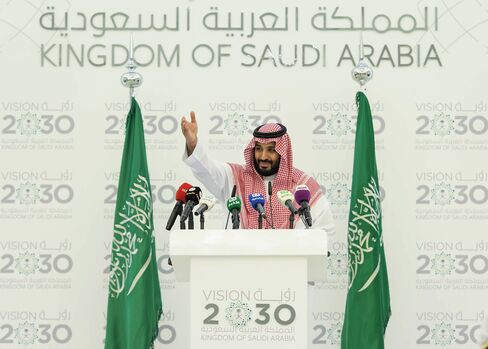
Saudi consumers are getting squeezed by the government’s master-plan to rein in spending and reduce dependence on energy exports after a two-year oil slump. Subsidies for gasoline, electricity and water have been slashed, and there’s more to come. Deputy Crown Prince Mohammed bin Salman, the program’s architect, is promising to curb public-sector wages, and visa fees have been increased, raising the cost of importing home help.
Welfare for Loyalty
That’s a reminder that austerity is a relative term: Saudi handouts remain generous — and gasoline cheap — by global standards; domestic help is still inexpensive, while in most of the Western world it’s a luxury or an anachronism. Still, the changes are a radical shift for a ruling family that gives its citizens no say in public affairs, instead offering welfare in exchange for their loyalty. Any changes to that formula represent a gamble — in this case, by Prince Mohammed.
“The risk is that the reform package will not reduce Saudi dependence on oil income, which it almost certainly won’t,” said Bruce Riedel, a senior fellow at the Brookings Institution who spent 30 years at the Central Intelligence Agency. “Then the kingdom remains vulnerable to sharp drops in the price of oil. That could create instability.”
Consumer spending growth is already weakening as the fiscal retrenchment bites. It’s forecast to slow to between 2 and 3 percent in 2017 and 2018, from 6 to 7 percent during the past decade, according to London-based Capital Economics. Imports from the European Union dropped by about 10 percent in the first quarter. ATM cash withdrawals and point-of-sales transactions also fell, central bank data show.
In a giant used-car lot in the capital’s Ash Shifa neighborhood, Bin Raja and his fellow dealers complain that fewer people are showing up for daily auctions, and prices are sliding. “The economic situation has gotten bad,” he said, citing the Saudi-led war in Yemen as a drag on the kingdom’s economy. Sitting in a 2004 GMC Suburban, lined up alongside hundreds of other models stretching the equivalent of city blocks, he said its sale price has dropped 43 percent in the last six months.
Age of Abundance
The 33-year-old is from a generation more accustomed to abundance than their parents. Adjusted for exchange-rate, annual gross domestic product per person soared from $29,500 in 1990 to $53,624 last year, according to International Monetary Fund data.
The oil windfall changed the face of major cities, with shopping malls springing up and shops offering luxury brands from Hugo Boss to Louis Vuitton. The ranks of the public sector swelled with millions of Saudi nationals, many paid more to do less.
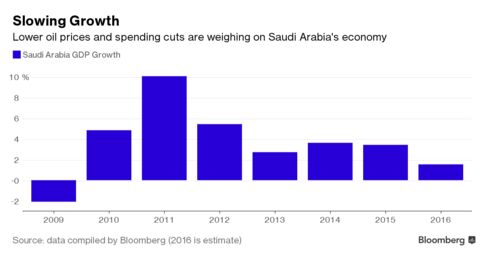
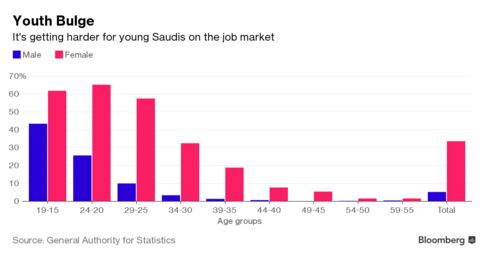
This year, the economy is forecast to grow 1.5 percent, according to data compiled by Bloomberg. Excluding the 2009 global recession, that’s the slowest pace for more than a decade. The IMF estimates medium-term growth would settle around 2.5 percent, hardly enough to lower one of the world’s highest youth unemployment rates.
The impact could have been worse. “The Saudis have avoided a crisis so far because of large reserves,” Riedel said.
The kingdom burned through about $175 billion of the central bank’s foreign assets since they peaked at $737 billion in August 2014 as the government sought to finance a budget deficit that reached 16 percent of economic output.
It was the sheer pace at which reserves were disappearing that made action so urgent, according to Prince Mohammed and his team.
Their National Transformation Program envisages cutting public wages to 40 percent of spending by 2020, from 45 percent today. Other elements include selling shares in state companies — including the crown jewel, oil giant Saudi Aramco — setting up the world’s biggest sovereign wealth fund, and a bonfire of regulations that hold back private business.
The plan, announced with much fanfare over four days in June, was greeted with some skepticism — and not just overseas. Jameel al-Theyabi, editor-in-chief of local newspaper Okaz, dismissed the ministers’ presentations as empty verbiage. A cartoon by Abdullah Jaber in Makkah newspaper showed a Saudi official presenting a citizen with a house then gleefully rescinding the offer.
Trouble Ahead?
Businessmen are also concerned. Over a recent dinner in Riyadh, a group complained privately that it was becoming more difficult to operate after the government started delaying payments to contractors.
If that mood spreads, it could spell trouble for the 31-year-old Prince Mohammed. He heads the Defense Ministry, making him responsible for the bogged-down war with Shiite rebels in Yemen, as well as the Economic and Development Affairs Council. Failure to achieve the plan’s targets, or rapid adjustments that provoke a backlash, could hurt his image among the Saudi public and also within the Al Saud dynasty.
The prince is widely thought to be the power behind his 80-year-old father’s throne, but he’s not the heir to it; that’s his cousin, Interior Minister Mohammed bin Nayef.
Yemen War
“I think that the risks are more intra-family,” said Gregory Gause, a professor of international affairs at Texas A&M University. Prince Mohammed “has had two high-profile portfolios. The Yemen war isn’t going that well. If he does not succeed here, my assumption is that his standing in the family goes down.” That may not matter now but “it could be very important once his father leaves the scene,” Gause said.
Gause cites examples in the Middle East of austerity plans that have backfired. In oil-rich Algeria in the mid-1980s, the International Monetary Fund imposed spending cuts during an energy-price crash. That triggered protests and helped the country’s Islamist opposition party win municipal elections. When they looked like repeating the victory in a national vote, the army stepped in “and we got a decade of violence,” Gause said.
That’s an unlikely scenario in Saudi Arabia, which is richer, more stable, and has the bedrock of a decades-old alliance with the U.S. Still, authorities have signaled they’re alert to the risk of popular resentment. Prince Mohammed said in April that the government wanted to limit the impact of subsidy cuts on poorer citizens. After public complaints about price increases, the water minister was sacked.
Young Saudis
In the end, it may be younger Saudis who’ll determine if Prince Mohammed’s plan stands or falls. Almost 60 percent of the country’s 21 million citizens are under the age of 30.
Successful job-creation would make sacrifices worthwhile. For now, young people are noticing the changes too. “At home we’ve started to feel a bit of a sting in the day-to-day costs,” 20-year-old college student Aisha Saad said in an interview in Riyadh.
Taxi-driver Saeed, who served in the Saudi National Guard for 17 years, says he wouldn’t mind if utility prices go up or down, if he could earn enough to pay them. He remembers a time in Riyadh when life was much easier and less expensive than it is today.
“I care about being able to support myself and my family,” he said.
15 Comments on "As Saudi Austerity Starts to Bite, a Testing Time for Its Prince"
makati1 on Tue, 16th Aug 2016 7:50 pm
Almost back to riding those camels…lol
rockman on Tue, 16th Aug 2016 7:54 pm
“Adjusted for exchange-rate, annual gross domestic product per person soared from $29,500 in 1990 to $53,624 last year”. And add that to the fact I pointed out in another post: for more the 30 years the per capita income of the OPEC nations run at the current level. Combined it makes the use of the term “austerity” in the title completely asinine IMHO.
rockman on Tue, 16th Aug 2016 7:54 pm
“Adjusted for exchange-rate, annual gross domestic product per person soared from $29,500 in 1990 to $53,624 last year”. And add that to the fact I pointed out in another post: for more the 30 years the per capita income of the OPEC nations run at the current level. Combined it makes the use of the term “austerity” in the title completely asinine IMHO.
Sissyfuss on Tue, 16th Aug 2016 8:21 pm
Saeed used the rythm method for years to no avail. Then one day his wife told him”I no sleep with with you now, prefer camel.” After that no more kids were produced which caused Saeed to proclaim”Allah be praised but I surely miss my camel.”
Go Speed Racer on Tue, 16th Aug 2016 11:27 pm
Saudi Arabian austerity:
Instead of gasoline being ten cents a gallon,
Now it is fifteen cents a gallon.
Also instead of watching the public executions
for free, now there is a $3 door charge.
Go Speed Racer on Tue, 16th Aug 2016 11:38 pm
If Saaed can’t make enough money with the
day job driving the taxi, he could sell dynamite
belts on the side, and make them
in his apartment in the evening.
Hello on Wed, 17th Aug 2016 4:57 am
Useless muslim trash. Where are the Germans with their solution (endlösung) when you need them?
Ah yes. I forget. They are in the process of transforming into a muslim trash nation themselves.
shortonoil on Wed, 17th Aug 2016 6:42 am
Oil prices are down an average of 62%. Oil is 85% of Saudi income. Growth has fallen 5%. Me thinks Abdula sat on his abacus.
peakyeast on Wed, 17th Aug 2016 6:43 am
Having 9 children? I find absolutely no sympathy for this fucking cockroach.
For all i care he can sell them as spare parts to rich people if he can take care of them.
Its people like him who is destroying the world and stealing our future.
Cloud9 on Wed, 17th Aug 2016 7:08 am
Venezuela and Alberta show us where this thing ends. At some point an oil based economy becomes no longer viable. We all know what follows is a decline. At some point the economic system fails which will in time be followed by failed states. The diaspora of Muslims from failed states is just beginning. Interesting times for all of us.
Kenz300 on Wed, 17th Aug 2016 7:23 am
Oil producing countries like KSA are one trick ponies…….they need to diversify their economies away from fossil fuels ……….. It is time to end the subsidies for oil and oil products
dooma on Wed, 17th Aug 2016 8:50 am
I remember the good old days when you could go contracting in KSA and fix their aircraft for a minimum of $100,000 USD tax free PA-not bad money for a tradesman.
Now, they are offering less than half that. Nobody I know in the business will touch that sort of contract with a ten foot pole.
And as far as not being able to afford “housemaids” anymore, well I guess they are going to miss out on raping and beating some poor young Filipino girl.
Things are sure changing in the KSA today.
HARM on Wed, 17th Aug 2016 11:59 am
“Saeed, 63, says his monthly rent of about 2,000 riyals ($560) is covered by social insurance payments, but that leaves the cost of supporting his wife and five of his nine children who live at home.”
Only nine children? Heck, he’s already living on welfare. Why not just go for a baker’s dozen?
denial on Wed, 17th Aug 2016 2:28 pm
when will it hit the united states? I was telling a friend that she should not expect her teaching pension in 15 years or very little of it. She thought I was absurd, can anyone link me to some articles on the vulnerability of pensions? At 16.9 trillion in gov debt and 12 trillion in credit card debt how is this country still standing ; I just don’t see how this can go on for another 15 years but then again I am shocked it has gone on for 8.
Rick Bronson on Wed, 17th Aug 2016 7:47 pm
Saudi’s know very well that if US consumes 20 million b/d of oil / day, then the Chinese will consume 90 million b/d of oil /day.
With the production only at 95 million b/d, there will be a shortage and prices will increase.
Until then they are willing to sacrifice some of their comforts.
But the increase in oil prices will also bring in a increase in alternative fuel vehicles.