
Peak Oil is You

Donate Bitcoins ;-) or Paypal :-)


Page added on January 20, 2013

Algeria Hostages Dead
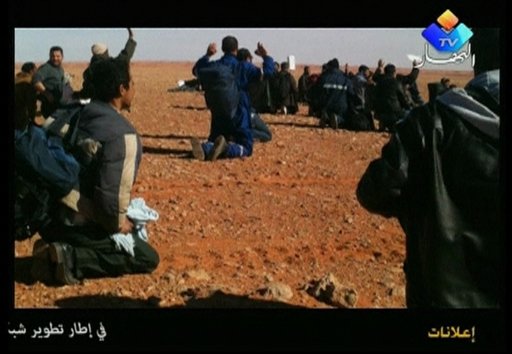
Algerian bomb squads scouring a gas plant where Islamist militants took dozens of foreign workers hostage found “numerous” new bodies on Sunday as they searched for explosive traps left behind by the attackers, a security official said, a day after a bloody raid ended the four-day siege of the remote desert refinery.
The official, who spoke on condition of anonymity because of the sensitivity of the situation, said the bodies were badly disfigured and difficult to identify.
“The bodies could be either Algerian or foreign hostages,” he said.
Algerian special forces stormed the natural gas complex in the Sahara desert on Saturday to end the standoff, and the government said all 32 militants were killed. Earlier Sunday, Algeria’s chief government spokesman said he feared the toll of hostages – which stood at 23 on Saturday – would rise as the special forces teams finished their search.
He said the militants came from six countries and were armed to cause maximum destruction. Sonatrach, the Algerian state oil company running the Ain Amenas site along with BP and Norway’s Statoil, said the entire refinery had been mined.
“They had decided to succeed in the operation as planned, to blow up the gas complex and kill all the hostages,” said Communications Minister Mohamed Said, speaking on a state radio interview.
The American government had warned that there were credible threats of more kidnapping attempts on Westerners.
With few details emerging from the remote site in eastern Algeria, it was unclear whether anyone was rescued in the final operation, but the number of hostages killed Saturday – seven – was how many the militants had said that morning they still had.
British Prime Minister David Cameron said Sunday that three Britons were killed and another three are believed dead, along with a foreigner who was living in Britain. He said that 22 Britons who survived the ordeal are now back in Britain.
“Now, of course, people will ask questions about the Algerian response to these events, but I would just say that the responsibility for these deaths lies squarely with the terrorists who launched a vicious and cowardly attack,” Cameron said.
The siege at Ain Amenas transfixed the world after radical Islamists linked to al-Qaida stormed the complex on Wednesday, which contained hundreds of plant workers from all over the world, then held them hostage surrounded by the Algerian military and its attack helicopters for four tense days that were punctuated with gun battles and dramatic tales of escape.
Algeria’s response to the crisis was typical of its history in confronting terrorists, favoring military action over negotiation, which caused an international outcry from countries worried about their citizens. Algerian military forces twice assaulted the two areas where the hostages were being held with minimal apparent mediation – first on Thursday, then on Saturday.
“To avoid a bloody turn of events in response to the extreme danger of the situation, the army’s special forces launched an intervention with efficiency and professionalism to neutralize the terrorist groups that were first trying to flee with the hostages and then blow up the gas facilities,” Algeria’s Interior Ministry said in a statement about the standoff.
The U.S. State Department issued a travel warning Saturday night for Americans in or traveling to Algeria, citing credible threats of the kidnapping of Western nationals. The department also authorized the departure from Algeria of staff members’ families if they choose to leave.
Immediately after the assault, French President Francois Hollande gave his backing to Algeria’s tough tactics, saying they were “the most adapted response to the crisis.”
“There could be no negotiations” with terrorists, the French media quoted him as saying in the central French city of Tulle.
Hollande said the hostages were “shamefully murdered” by their captors, and he linked the event to France’s military operation against al-Qaida-backed rebels in neighboring Mali. “If there was any need to justify our action against terrorism, we would have here, again, an additional argument,” he said.
In the final assault, the remaining band of militants killed seven hostages before 11 of them were in turn cut down by the special forces, Algeria’s state news agency said. The military launched its Saturday assault to prevent a fire started by the extremists from engulfing the complex and blowing it up, the report added.
A total of 685 Algerian and 107 foreigner workers were freed over the course of the four-day standoff, the Interior Ministry statement said, adding that the group of militants that attacked the remote Saharan natural gas complex consisted of 32 men of various nationalities, including three Algerians and explosives experts.
The military also said it confiscated heavy machine guns, rocket launchers, missiles and grenades attached to suicide belts.
Algeria has fought its own Islamist rebellion since the 1990s, elements of which later declared allegiance to al-Qaida and then set up new groups in the poorly patrolled wastes of the Sahara along the borders of Niger, Mali, Algeria and Libya, where they flourished.
The standoff has put the spotlight on al-Qaida-linked groups that roam these remote areas, threatening vital infrastructure and energy interests. The militants initially said their operation was intended to stop a French attack on Islamist militants in neighboring Mali – though they later said it was two months in the planning, long before the French intervention.
The militants, who came from a Mali-based al-Qaida splinter group run by an Algerian, attacked the plant Wednesday morning. Armed with heavy machine guns and rocket launchers in four-wheel drive vehicles, they fell on a pair of buses taking foreign workers to the airport. The buses’ military escort drove off the attackers in a blaze of gunfire that sent bullets zinging over the heads of crouching workers. A Briton and an Algerian – probably a security guard – were killed.
The militants then turned to the vast gas complex, divided between the workers’ living quarters and the refinery itself, and seized hostages, the Algerian government said. The gas flowing to the site was cut off.
The accounts of hostages who escaped the standoff showed they faced dangers from both the kidnappers and the military. The militants focused on the foreign workers from the outset, largely leaving alone the hundreds of Algerian workers who were briefly held hostage before being released or escaping.
7 Comments on "Algeria Hostages Dead"
Arthur on Sun, 20th Jan 2013 3:36 pm
Arab Spring arrives in Mali and Algeria. An election in Algeria won by islamists was declared null and void by the military, backed by the hypocrytical west. Democracy is in principle good, but one should not overdo it.
Plantagenet on Sun, 20th Jan 2013 3:44 pm
This is blowback from the US-French-British war on Libya. Khadaffy was a nut, but his regime suppressed the Islamists. Now that Khadaffy is gone we see a resurgence of Islamist activity and anti-west terrorist attacks in Benghazi in Libya and now in Algeria.
DC on Sun, 20th Jan 2013 4:50 pm
These guys really hit a nerve didnt they? BP must have ordered the Algerian military to take back the plant and expend anyone moving, hostage or no. BP, the US and so on, are totally fine combating the make-believe ‘Al-Quaida terrorists’ who, not suprisenly, do nothing except plot pointless(and futile) attacks on airliners filled with Obese amerikans on there way to disneyland, or… Wichita or someplace equally unimportant.
Thats the problem with corporate amerikas fake war-of-terror. Its fine when all they need to do is set up fake plots like the underwear bomber, but when someone actually goes off script and hits BP or some other US corporate entity, where it hurts, well, they dont like that one bit. We can see that clearly here. BP and US officials are clearly not well adjusted to the fact that people are actually resisting and choosing meaningful targets to attack. Thats why the attack on the CIA base in Libya(yea they call it an embassy or somesuch), and now this, are causing them so much trouble. There media created created AL-Q is supposed to sit around and plot to blow-up airliners and never succeed of course. No ONE is actually supposed to actually attack US corporate power in any serious way, but now they have, and they went crazy. They went in shooting and didnt care who got in the way. Just as long as there precious gas-plant was retaken and as many attackers killed as possible was all they care about….
Oneaboveall on Mon, 21st Jan 2013 12:08 am
Good point, DC.
I think the wisdom of Heath Ledger’s Joker sums it up:
“Nobody panics when things go ‘according to plan.’ Even if the plan is horrifying! If, tomorrow, I tell the press that, like, a gang banger will get shot, or a truckload of soldiers will be blown up, nobody panics, because it’s all ‘part of the plan.’” They went off plan and everyone has just lost their mind.
csatadi on Mon, 21st Jan 2013 12:53 am
As I see Tuaregs want to be free and independent.
Algeria is worrying because half of its lands are inhabited by Tuaregs, too.
BillT on Mon, 21st Jan 2013 1:25 am
The ‘fun’ in the Middle East is only beginning. What oil? Oh, the stuff that now costs $250, IF you can get it.
Arthur on Mon, 21st Jan 2013 10:12 am
http://news.antiwar.com/2013/01/20/british-pm-northern-africa-war-could-last-decades/
British PM Camoron has announced that the war in Africa could last decades. The fact that Camoron speaks of his ‘iron resolve’ already hints that we are talking about a resource war.lol… as well as an attempt to keep these countries staying meek satellites, NWO material, rather than fundamentalist regimes, hostile to the western global empire in status nascendi.
Meanwhile the west is losing on all fronts, certainly there where she has boots on the ground… and become sitting ducks for the beardmen with an attitude, a gun and an IED. The only thing the West achieves is unleashing the forces of fundamentalism and the removal of the last bulwarks of halfway securalism, like Saddam, Assad and Mubarak.
Good for them and good for those who oppose globalization and wish for a post-Bretton Woods, multipolar world, the one desired by China, Russia, India, muslims and even the founders of the EU.
Concerning resources, it does not matter who rules Mali or Algeria, as any regime will do business in the long term.