
Peak Oil is You
Donate Bitcoins ;-) or Paypal :-)


Page added on April 18, 2016

US 2015 Oil Production and Future Oil Prices

Oil production can be confusing because there are various “pieces” that may or may not be included. In this analysis, I look at oil production of the United States broadly (including crude oil, natural gas plant liquids, and biofuels), because this is the way oil consumption is defined. I also provide some thoughts regarding the direction of future world oil prices.

Figure 1. US Liquid Fuels production by month based on EIA March 2016 Monthly Energy Review Reports.
US oil production clearly flattened out in 2015. If we look at changes relative to the same month, one-year prior, we see that as of December 2014, growth was very high, increasing by 18.0% relative to the prior year.

Figure 2. US Liquids Growth Over 12 Months Prior based on EIA’s March 2016 Monthly Energy Review.
By December 2015, growth over the prior year finally turned slightly negative, with production for the month down 0.2% relative to one year prior. It should be noted that in the above charts, amounts are on an “energy produced” or “British Thermal Units” (Btu) basis. Using this approach, ethanol and natural gas liquids get less credit than they would using a barrels-per-day approach. This reflects the fact that these products are less energy-dense.
Figure 3 shows the trend in month-by-month production.

Figure 3. US total liquids production since January 2013, based on EIA’s March 2016 Monthly Energy Review.
The high month for production was April 2015, and production has been down since then. The production of natural gas liquids and biofuels has tended to continue to rise, partially offsetting the fall in crude oil production. Production amounts for recent months include estimates, and actual amounts may differ from these estimates. As a result, updated EIA data may eventually show a somewhat different pattern.
Taking a longer view of US liquids production, this is what we see for the three categories separately:

Figure 4. US Liquid Fuel Production since 1949, based on EIA’s March 2016 Monthly Energy Review.
Growth in US liquid fuel production slowed in 2015. The increase in liquid fuels production in 2015 amounted to 1.96 quadrillion Btus (“quads”), or about 59% as much as the increase in production in 2014 of 3.34 quads. On a barrels-per-day (bpd) basis, this would equate to roughly a 1.0 million bpd increase in 2015, compared to a 1.68 million bpd increase in 2014.
The data in Figure 4 indicates that with all categories included, 2015 liquids exceeded the 1970 peak by 16%. Considering crude oil alone, 2015 production amounted to 98% of the 1970 peak.
Figure 5 shows an approximate breakdown of crude oil production since 1945 on a bpd basis. The big spike in production is from tight oil, which is another name for oil from shale.
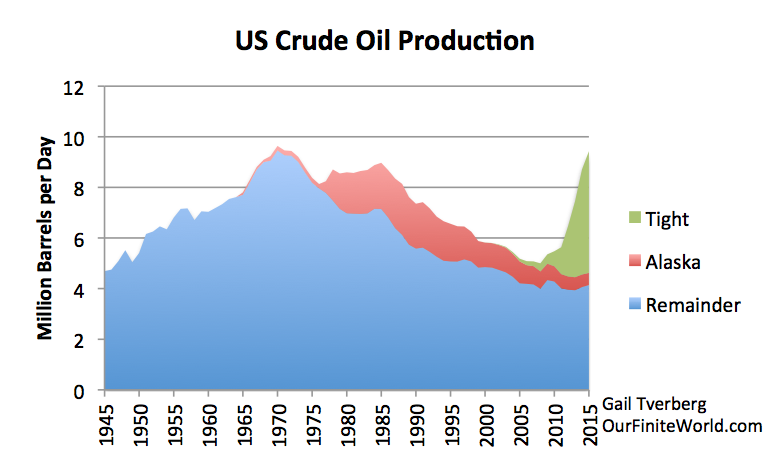
Figure 5. Oil crude oil production separated into tight oil (from shale), oil from Alaska, and all other, based on EIA oil production data by state.
Here again, US crude oil production in 2015 appears to amount to 98% of the 1970 crude oil peak. Thus, on a crude oil basis alone, we have not yet hit the 1970 peak.
Prospects for an Oil Price Rise
Most recent analyses of oil prices have focused on the amount of mismatch between supply and demand, and the need to craft a temporary agreement to reduce oil production. The thing that is missing in this discussion is an analysis of buying power of consumers. Is the problem a temporary problem, or a permanent one?
In order for the demand for oil products to keep rising, the buying power of consumers needs to keep rising. In other words, some combination of wages of consumers and debt levels of consumers needs to keep rising. (Rising debt is helpful because with more debt, it is often possible to buy goods that would not otherwise be affordable.)
We know that in many countries, wages for lower-level workers have stagnated for a number of reasons, including competition with wages in lower-wage countries, computerization, and the use of automation (Figure 6). Thus, we know that low wages for a large share of consumers may be a problem.
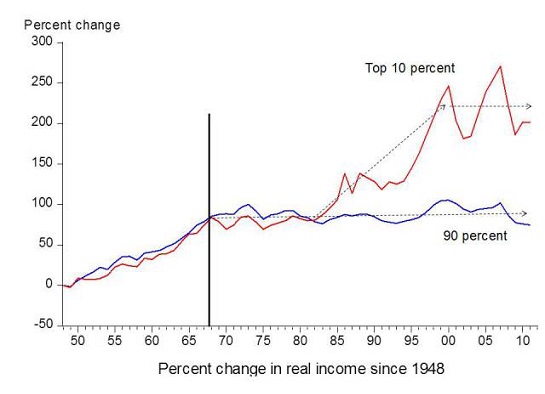
Figure 6. Chart comparing US income gains by the top 10% to income gains by the bottom 90% by economist Emmanuel Saez. Based on an analysis IRS data, published in Forbes.
Figure 7 shows that world debt has been falling since June 30, 2014. This is precisely the time when world oil prices started falling.
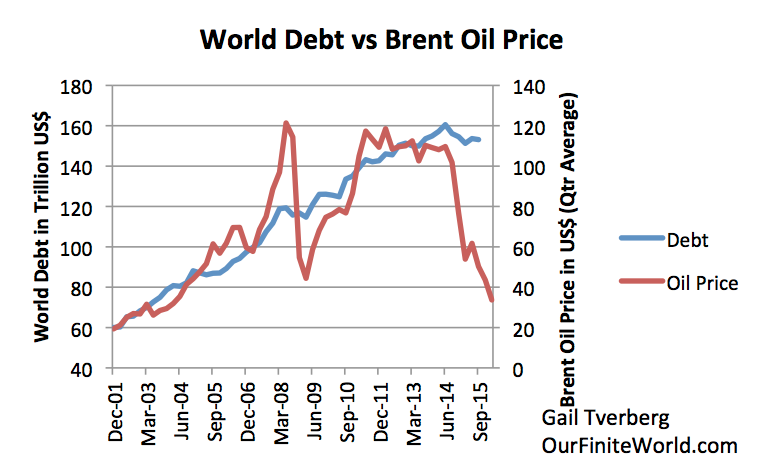
Figure 7. Total non-financial world debt based on Bank for International Settlements data and average Brent oil price for the quarter, based on EIA data.
One reason for the fall in world debt, measured in US dollars, is the fact that the US dollar started rising relative to other currencies about this time. Oil is priced in dollars; if the US dollar rises relative to other currencies, it makes oil less affordable to those whose currencies have lower values. The big rise in the level of the dollar came when the US discontinued quantitative easing in 2014. World debt, as measured in US dollars, began to fall as the US dollar rose.
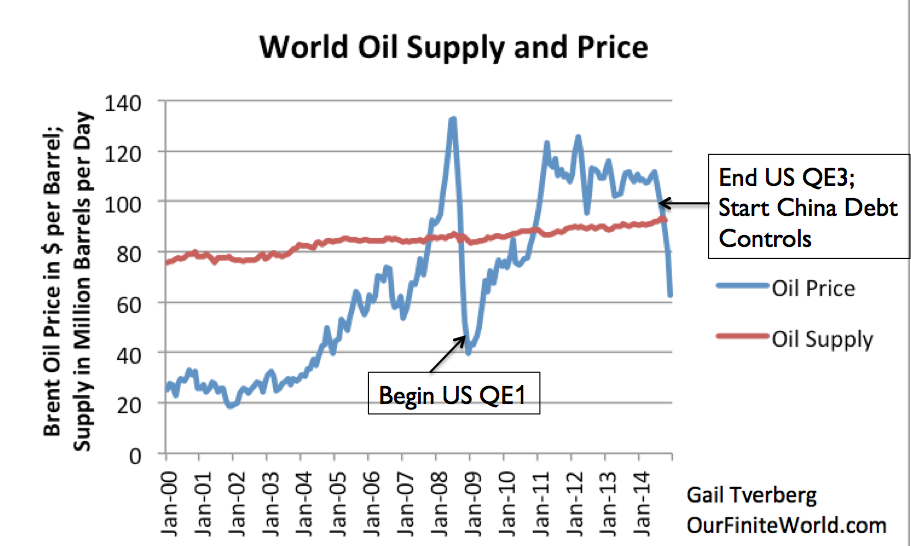
Figure 8. World Oil Supply (production including biofuels, natural gas liquids) and Brent monthly average spot prices, based on EIA data.
As long as the US dollar is high relative to other currencies, oil products remain less affordable, and demand tends to stay low.
Another issue that struck me in looking at world debt data is the way the growth in debt is distributed (Figure 9). Debt growth for households has been much lower than for businesses and governments.

Figure 9. World non-financial debt divided among debt of households, businesses, and governments, based on Bank for International Settlements data.
Since March 31, 2008, non-financial debt of households has been close to flat. In fact, between June 30, 2014 and September 30, 2015, it shrank by 6.3%. In contrast, non-financial debt of businesses and governments have both risen since March 31, 2008. Government debt has shrunk by 5.6% since June 30, 2014–almost as large a percentage drop as for household debt.
The issue that we need to be aware of is that consumers are the foundation of the economy. If their wages are not rising rapidly, and if their buying power (considering both debt and wages) is not rising by very much, they are not going to be buying very many new houses and cars–the big products that require oil consumption. Businesses may think that they can continue to grow without taking the consumer along, but very soon this growth proves to be a myth. Governments cannot grow without rising wages either, because the majority of their tax revenue comes from individuals, rather than corporations.
Today, there is a great deal of faith that oil prices will rise, if someone, somewhere, will reduce oil production. In fact, in order to bring oil demand back up to a level that commands a price over $100 per barrel, we need consumers who can afford to buy a growing quantity of goods made with oil products. To do this, we need to fix three related problems:
- Low wages of many consumers
- World debt that is no longer rising (especially for consumers)
- A high dollar relative to other currencies
These problems are likely to be difficult to fix, so we should expect low oil prices, more or less indefinitely. Lack of oil supply may bring a temporary spike in oil prices, but it cannot fix a permanent problem with consumer spending around the world.
46 Comments on "US 2015 Oil Production and Future Oil Prices"
Plantagenet on Mon, 18th Apr 2016 3:46 pm
Gails belief that law oil prices will go on “indefinitely” doesn’t make any sense and does’t match up well with historical patterns of oil prices.
Oil production typically goes through booms and busts. Once oil production exceeds demand, an oil glut eventually occurs and the price of oil plummets.
Then the cycle repeats.
CHEERS!
dave thompson on Mon, 18th Apr 2016 6:38 pm
Yes of course why did we all not understand and see, it’s a PLANTAGLUT!
Makati1 on Mon, 18th Apr 2016 6:52 pm
Plant, past performance is no longer an indication of future performance. We are in uncharted territory now. Nothing is EVER going to be the same as in the past.
Too many people trying to make a living by living in the past and not preparing for the future. If you cannot think outside the box, you will be trapped in it.
denial on Mon, 18th Apr 2016 8:22 pm
As others have said time and time again….you can’t predict prices!! Saudi Arabia is running dry ; that is why we are seeing their crazy reactions lately. Something is afoul in saudi land, shale oil will play out….so I don’t pretend to predict prices…..what happens if the FED starts to give out helicopter money? OR we have WW3 predictions like Gails are for fools….
Survivalist on Mon, 18th Apr 2016 8:32 pm
The world will have to get by on a lot less oil very soon if prices are gonna stay low. Less oil means less food. Less food means less people. People will soon have a choice between high oil prices or starvation. No more brand new iGadgets every year, no 6 dollar coffee and a muffin. People will have a whole new paradigm to get used to very soon. From what I understand the energy in a barrel of oil is equal to 12 people working full time for a year. If you want to farm your quarter section you can buy oil or hire people. As long as a barrel is cheaper than the annual wages of 12 farm workers it’ll be in demand by agriculture.
makati1 on Mon, 18th Apr 2016 8:40 pm
Survivalist, I agree, mostly. But without ‘economy of scale’ even the farmers will have to do without. soon, if YOU do not grow it, you will not have it. Machine farming is about over. Horses, mules, or oxen are the new tractor.
denial on Mon, 18th Apr 2016 9:00 pm
I don’t mean to bogart this conversation but is it me or does all the news out of Saudi Arabia seem very strange lately
1. Killing of Shia Cleric
2. Announcement to divest out of oil
3. Involvement in Syria
4. Threat to sell U.S assets
the list goes on and on….I think something is going on in Saudi land I just don’t know what yet….my bet is still that they are running out of oil…..faster than we think…
Azurean on Mon, 18th Apr 2016 9:13 pm
Oil can’t get expensive fast enough to blunt Obama’s plan to turn us into the dumping ground of the third world. Hes just gonna turn this country into something akin like the middle east where the dominant majority has to fight off organized minorities encroaching on its territory.
Boat on Mon, 18th Apr 2016 9:15 pm
denial,
They got an educated 30 yr old in charge of the oil, military and economy. This aint the old Saudia.
Question, if they want to sell a 19.5 stake in their oil and the buyer found depleted fields. Wouldn’t that ruin the rest of the sale? Don’t think the Saudi or investors are that dumb.
Boat on Mon, 18th Apr 2016 9:25 pm
Lol Azurean,
We are a nation of immigrants. The top 10 percent own the land. Or was that the top .001 percent.
Survivalist on Mon, 18th Apr 2016 9:59 pm
@denial
Check out this take on the House of Saud
http://youtu.be/hh8isVX3H9w
@Mak
I’m not saying they won’t have to do without it. I’m just saying they’ll want it. There will be demand for oil as long as it’s cheaper than the annual wages of 12 workers. Whether that demand is met or not is a different matter.
Survivalist on Mon, 18th Apr 2016 10:23 pm
@Boat
Saudi Arabia is offering to sell a stake in their refinineries/refining business not a stake in their oil reserves aka their fields. Saudi Arabia will not allow their oil reserves to be scrutinized. To sell their reserves is not an option if they wish to remain unscrutinized. They can easily however sell a stake in their refineries.
Wolfie52 on Tue, 19th Apr 2016 7:35 am
Pretty easy to understand the low growth of consumer debt: slow to NO population growth in western economies (who are much more likely to take on debt than are those in developing countries). Combine that with aging populations who are in general less likely to take on any debt, and there is your explanation. (Ala Occam’s Razor).
Unfortunately in the modern world, it seems many know a lot about a small slice of something, but few can look at the entire picture and see how so many things affect the system.
We need to teach “THE BIG PICTURE VIEW” instead of specialization.
Anonymous on Tue, 19th Apr 2016 7:53 am
denial – Saudi’s actions are more understandable from the perspective of Ghawar production collapsing over the next two years (as suggested by some studies from Swedish ASPO group) than from a country still with over 200 billion barrels of reserve, but without verifiable data who knows?
JuanP on Tue, 19th Apr 2016 8:15 am
Russian oil production costs $9!
http://russia-insider.com/en/russia-breakeven/ri13964
makati1 on Tue, 19th Apr 2016 8:45 am
Wolfie, I agree, although I call it “total systems” or how everything is connected in today’s world. You cannot talk about oil unless you talk about all of the resources needed to recover that oil, refine it and get it to the consumer. Even oil recovery starts in the mines, metal refineries, factories, warehouses, trucking, hundreds of thousands, maybe millions of people involved, etc just to make the machines, drill bits, piping, etc. used in drilling a well.
makati1 on Tue, 19th Apr 2016 8:56 am
Survival, your thinking is seems a bit off. Oil recovery, like most everything else today is a matter what the price is that can make a PROFIT. Oil at $10,000/bbl will not keep a company open or make a profit if they can only sell 100,000 bbls/year. All of the parts that go into the oily system would also increase in cost as the economy of scale would be gone. Incomes of the consumers would not go up to match the new price of oil so the wells would be shut in and the Age of Petroleum would be over. Gone. Never to return.
You cannot go out and drill a few hundred feet and strike an oil gusher like the first wells tapped over a century ago. Now you must go down thousands of feet, maybe miles, at huge expense to be even able to pump the oil out of the ground, also at great expense. There is no easy oil to get.
Why do you argue about oil at any cost when the financial system that makes it all possible is about ready to crash and burn, also never to return? The US is over 250% of GDP in Debt. Europe and Japan is in even deeper debt. Who knows where China or India really are. Those are the oil burners of the world. If/when they go, so goes the oil industry. Wait and see.
shortonoil on Tue, 19th Apr 2016 9:21 am
Because producers are no longer replacing the reserves that they are extracting, and their reserves are the major portion of their total book value, the net worth of the world’s petroleum industry is now falling at about the same rate as its gross sales. The industry is replacing less than 1 in 8 barrels of what it extracts. That constitutes an annual decline in net worth of $1.3 trillion per year.
In 2013 (the last year for which there is data) E&D cost were $20/ barrel to replace 4 Gb of the 32 extracted. At $40 oil producers can no longer afford to replace reserves. With world wide water cut now averaging 47% lifting costs are too high on most wells to allow such luxuries. World petroleum production is now consisting of already developed reserves, and that will continue to be true into the future. The increasing energy required to produce oil, and its products has reduced the value of the energy remaining to be delivered to the economy. The economy can no longer afford a price high enough to cover the full life cycle cost of production, which includes reserve replacement.
Consequently, as existing fields are pumped down, production will fall. By our estimates that decline rate will average about 5.3 mb/d per year over the next 14 years; which is an average decline rate of 5.7% per year. Production over that 14 year period will average about 57 mb/d. This is likely to be punctuated with periods of much higher production declines as the Giants (which supply 50% of world production) come off their plateaus. The impact of this decline on the world’s economy will be significant!
http://www.thehillsgroup.org/
Geopressure on Tue, 19th Apr 2016 9:42 am
The negative thing about water production is the disposal cost associated with processing & getting rid of it. The cost (in both energy & $$$) to lift the saltwater is very low & often free when you can use a vapor recovery unit & run your equipment off of free natural gas.
The term “Lifting Cost” is a bad term… It implies that the cost of actually ‘lifting’ the saltwater is great, when in fact it is not…
—
Shortonoil; Global Production has already fallen more than most people know. Major Product Pipelines are already being shut down in the US & driving season is not even here yet – this is why Obama’s headed to Saudi this week, to beg them to increase their production…
So Production has fallen & will continue to fall, but there is absolutely no way that production will fall by 5.3 Million BOPD per year. That is simply not realistic, not with all the new sources that are being brought online…
penury on Tue, 19th Apr 2016 10:16 am
You have the horse pushing the cart, For a short time take a look at production. versus demand. Is it a glut of production? or a dearth of consumption? Which scenario would result in lower prices because the storage facilities are full? Which would most likely cause
a price increase? Geop says “there is no way production will fall by 5.3 million barrels per day per year.” With the expansion of the war in the ME you could be correct, but even the “Hundred Year War ended”
Tim on Tue, 19th Apr 2016 10:17 am
Easy… Tell them keep their oil we don’t need it.
geopressure on Tue, 19th Apr 2016 11:01 am
penury;
I’m not so sure that there is a glut… Major Product Pipelines are already shutting down in the US… It seems like we are looking at the opposite of an oil glut – though the media is binding it & will continue to do so…
***Correction from my Previous Post***
It appears that Obama is flying to Riyadh because Saudi Arabia is about to switch to Yuan-Only & end the petrodollar altogether… This explains why the FED had two emergency meeting last week… It explains why China just pegged their Yuan to the price of Gold (no longer fiat)… It explains why Obama is flying over there… it explains why all this Saudi-911 Bullshit has sprung up from nowhere in the last week or two to threaten the Saudis with… It explains why the ‘favorite’ Prince has just taken over in place of the Oil Minister… It explains why the Saudis are threatening to dump US Treasuries…
To be clear, It looks like one of the following things is happening::
(1) the Petrodollar is about to end & Obama will loose the power to manipulate oil prices via increasing (or decreasing) the value of the dollar… OR
(2) the Saudis want the US to think that they are about to end the petrodollar so that the US won’t raise interest rates after the April 27th FED Meeting – which they were definitely planning to do…
If I had to pick, I would wager that #1 of the above is taking place… It would be unwise to make a drastic move like Peg the Yuan to gold if the entire plan was not going to be executed…
shortonoil on Tue, 19th Apr 2016 11:15 am
“Russian oil production costs $9!”
http://russia-insider.com/en/russia-breakeven/ri13964
The numbers in that article are EBITDA (earnings before interest, taxes, depreciation, and amortization). It is the metric that banks use when determining loan eligibility. It in no way reflects full life cycle production costs. A good guess from those numbers would be about $38/ barrel.
shortonoil on Tue, 19th Apr 2016 11:41 am
“there is no way production will fall by 5.3 million barrels per day per year.”
Those estimates came from the Etp Model, and are quit in line with other estimates that have been given by Campbell, Leharrere, Robelius, and many, many other recognized evaluations of the post peak decline. Following Hubbert’s curve gives a decline rate of about 2%, but when the Giants begin their descent it is generally agreed that their decline will much, much higher. We think that production will continue to follow the price, as it has for the last 150 years:
http://www.thehillsgroup.org/depletion2_022.htm
The last time the price was at this level was in 2004, and production was 68 mb/d. There is no reason to assume that production will not follow the price down, just like it followed it up.
http://www.thehillsgroup.org/
geopressure on Tue, 19th Apr 2016 11:57 am
When you figure lease operating cost, each field & each well is an individual case…
Where I operate, wells cost between $4,000 & $5,000 per month to operate (or it did when oil prices were high)… In this case, I’m talking about 20, 30, 40 year old wells that are marginal, not a new well…
If a well makes 40 BOPD, that’s about $4.20/BBL
If a well makes 20 BOPD, that’s about $8.40/BBL
If a well makes 10 BOPD, that’s about $16.80/BBL
If a well makes 5 BOPD, that’s about $33.60/BBL
As you can see, the less oil your well makes, the higher the production cost (aka ‘lifting cost, aka lease operating cost) is…
This is why marginal stripper wells that only make a BBL or 2 per day are the first wells to be shut in when the price starts falling – of course, their months operating cost are not that high either…
geopressure on Tue, 19th Apr 2016 12:04 pm
Shortonoil, if crude oil production were to fall by 5.3 Million BOPD over the course of the next year, the price of oil would be $250/BBL – or whatever price was required to depress demand by 5.3 Million BOPD (which would be a high price, a record high price)…
Right now Global Demand is growing at HIGH rates all across the globe… 5.3 NMillion BOPD is not even kinda realistic…
Sorry, I know that it seems like I have singled you out to argue with of late, but that is not my intent… I enjoy discussing this stuff with you…
Davy on Tue, 19th Apr 2016 1:04 pm
Oil does not live in an alternative reality divorced of economic realities. If we see an oil spike to $250 it would be an extreme event characterized by abnormal economic conditions of both supply and demand IOW this would be an economic crisis situation. The economy in NO way can function with oil price at that level. I am not saying it couldn’t happen I am saying it won’t happen for long.
shortonoil on Tue, 19th Apr 2016 2:16 pm
“Shortonoil, if crude oil production were to fall by 5.3 Million BOPD over the course of the next year, the price of oil would be $250/BBL”
Now who exactly is going to buy $250 oil, the market couldn’t support $100 oil; if fell 70%. A barrel of oil doesn’t supply $250 worth of energy to the economy. At $250 the cost of a BTU to the end consumer is 3.54 times as much as the cost of the same energy coming from electricity. $250 oil gives $8.30 gas. If you are planning on selling $250 oil you apparently know some really, really stupid people.
penury on Tue, 19th Apr 2016 2:17 pm
Davy, I am not certain that the economy (world) can function with oil at 40 dollars a barrel. Look at BDI look at transportation index for U.S. Europe is basket case, producing nations appear to be having budget problems, emerging markets are in serious difficulty due to the increasing strength of the U.S. dollar. Corporations in the U.S. are filing bankruptcy claims at a rate higher than 2008. Happy Days.
shortonoil on Tue, 19th Apr 2016 2:20 pm
If oil goes to $250 go long on long……….long extension cords!
Davy on Tue, 19th Apr 2016 2:35 pm
Right Pen, although Wall Street lives in a different dimension so a temporary spike is possible as all the cockroaches scatter.
observerbrb on Tue, 19th Apr 2016 2:47 pm
Can the world economy function with oil at 40 dollars a barrel?
I would say that NO:
http://www.bbc.com/news/world-africa-35990319
http://www.reuters.com/article/angola-imf-idUSL5N1793L1
http://www.ft.com/intl/cms/s/0/8f563f76-0608-11e6-a70d-4e39ac32c284.html#axzz46I9n75Nx
http://www.reuters.com/article/us-global-oil-idUSKCN0XG01U
http://www.reuters.com/article/us-nigeria-oil-delta-idUSKCN0XE10C
I believe that the oil price slump is starting to affect the capacity of these countries to maintain the oil infrastructure and its management. What could happen to the West if two/three/four Oil exporting countries collapse at the same time?
peakyeast on Tue, 19th Apr 2016 3:16 pm
Oil is only one of the problems. As we have emptied the ocean, burned all the forests, killed all the wild animals. –
Then suddenly we will have to provid all those resources ourselves suddenly.
This will require an enormeous effort and be very costly in energy and other resources.
The system will not survive having chopped up everything else while still having the same amount of mouths to feed, clothe, house and so forth.
GregT on Tue, 19th Apr 2016 5:23 pm
“Can the world economy function with oil at 40 dollars a barrel?”
The real question should be:
Is the global economy functioning as well with oil at $40/bbl as it did in the past?
The answer would be NO. Oil at $40/bbl is still too expensive for economic recovery from the global financial crisis. Historical oil prices during periods of non-recession were in the $20/bbl range.
While we may be in a price slump from a year and a half ago, oil is still twice what it has been historically during periods of strong economic growth. While lower oil prices may be good for net oil
importers, countries cannot consume their way out of recession. That would require productivity.
makati1 on Tue, 19th Apr 2016 5:56 pm
Peaky, as you said in so many words, the energy slaves are dying due to a junk diet of debt. All big oil corporations/nations are debt obese and have various stages of Central Bank diabetes. The doses of ‘helicopter money’ being injected into economies have prolonged the misery, but are also beginning to fail. We will soon see the collapse/death of the whole system and total chaos that has not been seen in human history. Exciting times to be alive, isn’t it?
marmico on Tue, 19th Apr 2016 6:01 pm
oil is still twice what it has been historically during periods of strong economic growth.
The price of oil is an input to the price of oil products. People and firms buy oil products, refineries buy oil.
Economic growth has waxed and waned over the last 70 years, more waxing than waning. The oil product that people buy is gasoline. Gasoline is cheap relative to wages, disposable income or any other metric that you conveniently fail to mention. It’s just as cheap as it was prior to the 1973 OPEC supply shock.
https://research.stlouisfed.org/fred2/graph/?g=4dSf
Tverberg is an idiot. Tick tock.
geopressure on Tue, 19th Apr 2016 7:05 pm
makati1;
I don’t know if you noticed it or not (you were likely busy preaching about the sky falling), but the DJIA just climbed above 18,000 & is approaching All-Time-Record-Highs…
—
In your defense, the sky really & truly may fall if the Petrodollar ceases to exist… That is where the large portion of the U.S.’s power has originated from… If anyone wants to buy oil, they must first buy dollars, then they can buy oil…
makati1 on Tue, 19th Apr 2016 7:30 pm
geo, and you don’t seem to see the stupendous bubble that is the Stock Market Casino today. ALL of you little players are being suckered in to drain your last dollar. Go for it, but don’t say you weren’t warned.
BTW: Did you notice that you can buy oil now WITHOUT going through the dollar? You need to catch up with the world. Also, the market casino is dropping…
Survivalist on Tue, 19th Apr 2016 8:17 pm
I’ve got a quarter section of land. I need to plow it this week. I can hire a couple 100 people to do it by hand or I can burn a barrel of oil. What’s so hard to get?
makati1 on Tue, 19th Apr 2016 8:41 pm
Better find a way to use that land without oil. That day is coming fast. I suggest permaculture. Start now because you cannot have a working permaculture system in a few months or years.
geopressure on Tue, 19th Apr 2016 9:47 pm
Yes, you CAN buy oil now without using the dollar, but no one does so… If the Dollar is straight up dumped, that will forever change the world…
It will have such a negative impact on the US that the Western Media is not even reporting on it…
makati1; I don’t own any stocks… at least not in publicly traded companies… I trade options… right now I’m playing mainly calls on several small-cap gold miners (though I am not a big gold proponent)… & as always looking for opportunities…
makati1 on Tue, 19th Apr 2016 10:21 pm
geo, you know for a fact that “no one is doing so”? How do you know what anyone else does? I think you ought to check into how Iran sold oil while it was being censored by the Empire. And, you are sure that Russia is not selling oil for rubles to China? Why would they publish such facts?
You seem to be too involved with the oily BAU that you are blind to the direction we are headed and what is currently happening outside the oily world.
makati1 on Tue, 19th Apr 2016 10:24 pm
geo, you are one of those “Capitalist Pigs” then? Someone who doesn’t want to work for a living? The first in line to go when the SHTF? So be it.
I’m smart enough to never have played in the market casino. I worked for my living as everyone should. Sweat, tired muscles and a feeling of accomplishing something. Making a contribution of real things to the world, not being a leech on those who do.
makati1 on Tue, 19th Apr 2016 10:28 pm
Geo, you trust the “Western Media”? One of the 6% who do. Says something about your intelligence, doesn’t it?
http://www.shtfplan.com/headline-news/nobody-believes-the-media-anymore-trust-has-eroded-to-just-6-percent-of-americans_04192016
geopressure on Tue, 19th Apr 2016 10:49 pm
Yep, I believe every word that the media says…
—
You’re right, there are some limited transaction going on currently in currencies other than the dollar… mostly between India & Iran… Most everything else is carried out in dollars though except for a few trades aimed at generating headlines…
The BRIKS Nations have been working to create a financial system that will allow transactions to bypass New York so that the US Government does not have jurisdiction over all international transactions in the world…
makati1 on Tue, 19th Apr 2016 11:41 pm
You DO see the direction we are headed. But those black swans that are blocking out the sun are getting tired. Who knows what tomorrow will bring? Better be prepared as best you can for a radical downgrade in lifestyle. It’s easier to step down the ladder at your own pace than to have it pulled out from under you.