
Peak Oil is You

Donate Bitcoins ;-) or Paypal :-)


Page added on November 6, 2011

Time to Worry: World Oil Production Finishes Six Years of No Growth
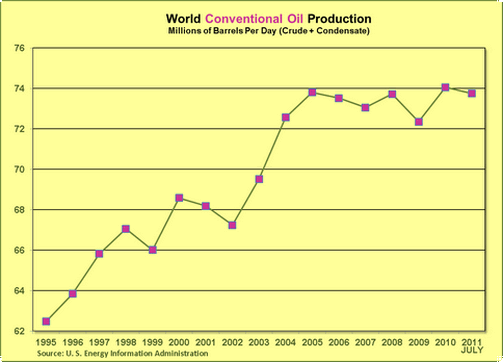
As oil prices rose ever higher in the last decade, the optimists kept predicting rising production capacity and plummeting prices. Looks like they got it wrong.
We are entering what may be the longest stretch of no growth in world oil production since the early 1980s. But the reasons for that lack of growth differ in ways that ought to make us all uncomfortable.
Starting in 1980, production slumped because for the first time in history people needed less oil. After the huge oil price increases in the 1970s, cars suddenly got smaller. People became more careful about combining trips to save gas. A lot of people switched their home heating to natural gas which was considerably cheaper than heating oil. And, in the United States the Congress severely restricted the use of oil for new electric power generating plants. Those using oil began to switch to cheaper natural gas and coal. The whole globe went on an energy efficiency binge.
Beyond this, the world went through two recessions, one in 1980 and the second in 1981-82 which turned out to be the worst since World War II (until the current one). That curbed oil demand as economic activity sank. All the while, large oil discoveries in Alaska and the North Sea and furious drilling elsewhere produced a glut of capacity that sent prices from a high near $40 a barrel in early 1981 to about $16 a barrel six years later. As it turned out, all of these factors combined to keep world oil production below its 1980 peak until 1988.
Fast forward to 2005 when conventional oil supplies stopped growing and then fluctuated between 73 million and 74 million barrels per day on an annual basis through 2010. (Production averaged 73.8 million barrels per day this year from January through July, the last month for which data is available.) The chain of events following the 2005 peak are both different and worrisome. Following the cessation in growth of conventional oil supplies, the world economy continued to grow until the end of 2007 when it slipped into recession. Prices peaked in July 2008 at around $147 a barrel.
But then they plunged to around $35 a barrel in December 2008 as the world sank into an economic slump worse than anything since The Great Depression. With it oil demand and production slumped as well. Then the price did something that few people expected. It bounced back even as overall global economic recovery remained sluggish. Rapid recovery in the Far East, however, created robust demand for oil even as North American and European countries remained locked into an unusually tepid rebound. As a result, last spring prices for Brent crude vaulted above $125.
Six years from the ostensible topping out of conventional petroleum production, prices remain considerably higher. Oil prices finished 2005 around $50 a barrel. As of this writing, they are around $90 for Nymex crude and around $110 for Brent crude. This, of course, is exactly the opposite of the trend which occurred in the six years following the 1980 peak. Today, the often predicted rise in conventional supplies has failed to materialize, flummoxing the optimists so much that they simply ignore the data and talk of wonders yet to come.
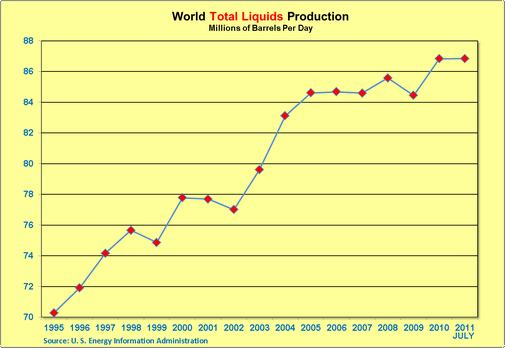 Astute observers will say that this is not the whole picture. After all, high prices for a resource also stimulate substitutes for that resource. And, true enough, the substitutes for oil are starting to arrive. But the big question is: Will they arrive soon enough and at a scale that is large enough to make up for the current stagnation in the rate of oil production and the eventual and certain decline in that rate? So far the answer is no.
What the U.S. Energy Information Administration, which is the statistical arm of the U.S. Department of Energy, used to call “total oil production” has now morphed into so-called “total liquids production.” It’s a tacit admission that conventional oil supplies cannot meet all our needs. But even total liquids production–which includes ethanol, biodiesel and natural gas liquids–has moved up only a paltry 2.6 percent during the entire period from the end of 2005 to today. Hence, the continuing high prices for liquid fuels.
Now, it’s not as if high prices haven’t sent people looking for more oil and working on more substitutes. The problem is that all of this activity is facing a considerable headwind. It’s called depletion. And, as they say in the oil patch, depletion never sleeps. It’s going on in every operating well in every country around the clock, 365 days a year. Estimates suggest that the decline in current production capacity might be around 4 percent per year. That means that 4 percent of the current production capacity for oil must be replaced each year just to break even. And, of course, to grow supplies, new production capacity must exceed this amount. But it hasn’t, and oil substitutes haven’t really grown by any significant amount in the last six years either.
The media loves to announce new seemingly large discoveries of oil as if they are the solution to what is really an unfolding liquid fuels crisis. They point to the Tupi field off Brazil which is purported to have 8 billion barrels of oil in it. And, they point to discoveries in the deepwater Gulf of Mexico thought to contain between 3 and 15 billion barrels. And, they point to the 4 billion barrels in the Bakken Shale in North Dakota. It all sounds like a lot. When I ask audiences how long a billion barrels of oil will last the world at current rates of consumption, I often get replies that range anywhere from three months to 5 years. The correct answer is 12 days. Just multiply these multi-billion-barrel discoveries by 12, and you’ll realize right away that they are not going to overcome the constraints we are experiencing in oil supplies.
Something else has to give, and that something is probably going to be consumption. Either consumption will decline as the result of a new slump in the economy–a slump partly caused by high oil prices–or it will decline because high prices will encourage people to be more frugal in their energy use. Many of the poorest in the world will no doubt have to do without.
There is a third way. We could now begin a crash program to reduce our consumption of oil through new efficiency standards, higher energy taxes, expansion of convenient mass transit, and new energy-wise personal habits. All this would hurry the transition away from an energy source that will only become more problematic over time.
The optimists would have you ignore the oil production and price data of the last six years. It’s as if they are channeling the late comedian Richard Pryor known for his trademark phrase: “Who you gonna believe? Me or your lying eyes?” After six years of flat oil production in the face of record prices, it’s time to start believing your lying eyes.
9 Comments on "Time to Worry: World Oil Production Finishes Six Years of No Growth"
Kenz300 on Sun, 6th Nov 2011 10:03 pm
The banks did not take proper risk reduction into account and caused a financial crisis. Our energy companies and consumers are not taking risk reduction into account and the toll it will take on the economy if we have an oil price hike or major supply disruption. This might be because as supplies get tighter the oil companies raise prices and make more money. They have no incentive to diversify the risk.
Consumers have the incentive but little control. We need alternatives to the oil companies to reduce risks to the consumers, business and the economy. Capitalism only works when there is competition. We need alternatives and competition to oil for transportation fuel. Bring on the electric, flex-fuel, hybrid, CNG, LNG and hydrogen fueled vehicles. Let’s diversify our sources and types of energy and diversify our risk.
DC on Sun, 6th Nov 2011 11:31 pm
Why would lack of growth, in anything be a cause for worry? We have a surplus of growth as it is. Too many cars, too many roads, people, Too much noise. Time for the end of growth. That may the indust-growth complex have fits, but that system is doomed. If it takes a lack of growth to choke that chiken, then so be it. Lack of increase in fossil-fuels does not worry me at all, its the complete lack of viable alternatives however, that does. People can live w/o oil, or a lot less of it, they cant live w/o an alterantive though.
Harquebus on Mon, 7th Nov 2011 12:32 am
It’s too late. Might as well sit back and enjoy the show.
BillT on Mon, 7th Nov 2011 3:01 am
‘Alternatives’ is all you hear from the deniers. There are no alternatives to oil. Yes, there are a few alternatives to heating, a few alternatives to electric, but nothing that will put a 787 in the air for 9,000 miles or move huge cargo ships across the Pacific.
Bio-fuels, hydrogen, etc, ALL depend on oil. Oil mines the minerals to make the machines that mine the minerals. When those machines wear out, solar PV is not going to mine more minerals, refine them into steel and then shape and assemble and deliver them back to the mines. Never gonna happen. And no, coal is not that plentiful anymore either and what is left is low quality/energy. We are about back to the days of wood for fuel.
We have waited too long to make the adjustment easily. Now, we will make it the hard way.
James on Mon, 7th Nov 2011 4:47 am
We should also start growing more trees for fuel and lumber. We will need to revert back to using wood for heating homes, and lumber to build simplistic, practical homes that are smaller than conventional homes we have today.
sunweb on Mon, 7th Nov 2011 10:32 am
The alternatives are all based in fossil fuels. Without the fossil fuel inputs in mining, processing, transportation, manufacturing and installation, there would be no “alternatives”. Because of the fossil fuel inputs and associated environmental degradation, these devices are not renewable, sustainable, green or smart. Many will not truly pay for themselves in energy output compared to necessary energy input. We are simply playing games using up valuable gifts from past lives, the earth and time.
Energy in the Real World with pictures of proof.
http://sunweber.blogspot.com/2011/01/energy-in-real-world.html
DC on Mon, 7th Nov 2011 10:59 am
By alternatives, one should clarify. Hydrogen Hoaxsters, Bio-fools, Hybrids, even electric(if by electric we mean simply substiting one gas-powered personal trash-bin, with an electric one), then no, none of those are alternatives. Those things are all status-quo extenders, all expensive, complex, and even more energy intensive in many cases than the gas-garbage bins they are supposed to supplant. Corporate power has eliminated all alternatives to itself. big-ag, Big suburbs, big schools, big transport. big-medicine. When it all runs low on fuel, not only will no alernative to any of it exist, it will be nearly impossible to salvage much out of the wreckage of the old.
That said, the only way to force people to change, is for them to realize they cant have more of what theyve been enjoying for the last century. Perhaps this is the start of that.
Ferris on Tue, 8th Nov 2011 10:43 pm
What is sadly being missed by most in this crisis is the fact the global food systems are almost entirely reliant on oil, we are entering a situation where 7 billion people have over shot farmland so dependant on fossil fuels that it just wont be possible to grow anything until the fertility is returned to the land, and that can take years. As a permaculturlist, I’ve seen some extreme forms of land degredation taking decades to repair, so you might say we’re living on Easter island prepairing to lop the last of trees, and I expect we will probably share their fate.
NIMIGJE on Thu, 10th Nov 2011 7:24 pm
The truth is clear. Oil demand in increase during low oil prices, will be destroyed to the levels affordable by oil supply, which is on steady decline,probably 4% Year or more.
This of course, will effect everything, by increasing the food prices and other goods.
The problem of oil demand supply is vital, it is non reversible. The supply will decrease. The new discoveries can not keep in peace the oil price. With certainty the oil prices will be even higher than IEA or other are forecasting time after time.
The problem we all have, is that the renewable energies need energy to implement, and the energy required is oil. Is there any solution on these circumstances? Yes the solution is to increase the prices of oil, leave the oil companies make big profit and have possibility to invest more, to decrease somehow the decline rates on oil production. By destroying the oil demand, I say the low income peoples will not use their cars. My believe is that by increasing the oil price by 50 cents a liter, over the actual price the demand will decrease 2-3%, and this will give the possibility to use the oil on public transportation, on new renewable industries.
I personally, can not accept the solution on increasing even more of crude oil prices, and pump prices. However, peoples do not need only observers, critics or simple news that will shock everybody. Peoples need solutions, action to solve the problems.