



EIA begins monthly survey-based reporting of U.S. crude oil production
With the release of today’s Petroleum Supply Monthly, EIA is incorporating the first survey-based reporting of monthly U.S. crude oil production statistics. Today’s Petroleum Supply Monthly includes estimates for June 2015 crude oil production using new survey data for 13 states and the federal Gulf of Mexico, and revises figures previously reported for January through May 2015.
From the EIA’s Monthly Crude Oil and Natural Gas Production webpage.
Beginning with the June 2015 data, EIA is providing estimates for crude oil production (including lease condensate) based on data from the EIA-914 survey. Survey-based monthly production estimates starting with January 2015 are provided for Arkansas, California, Colorado, Kansas, Louisiana, Montana, New Mexico, North Dakota, Ohio, Pennsylvania, Texas, Utah, Wyoming, and the Federal Gulf of Mexico. For two states covered by the EIA-914—Oklahoma and West Virginia—and all remaining oil-producing states and areas not individually covered by the EIA-914, production estimates are based on the previous methodology (using lagged state data). When EIA completes its validation of Oklahoma and West Virginia data, estimates for these states will also be based on EIA-914 data. For all states and areas, production data prior to 2015 are estimates published in the Petroleum Supply Monthly. Later in 2015, EIA will report monthly crude oil production by API gravity category for the individually-surveyed EIA-914 states.
This is great news for those of us who have been complaining for years about the EIA’s poor and misleading data collection methods.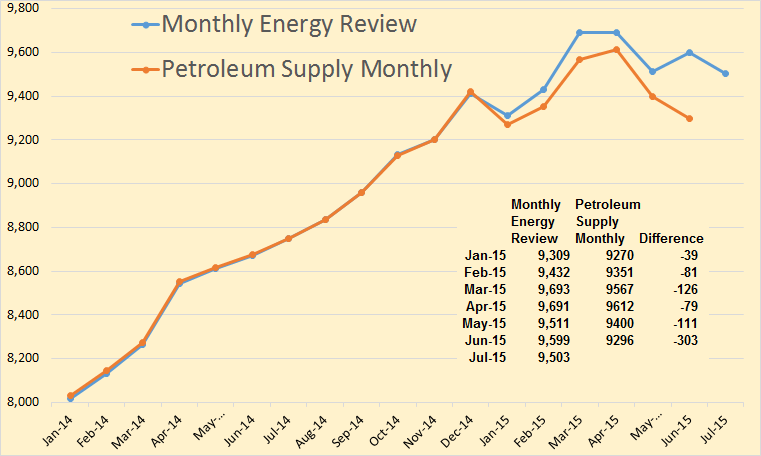
June C+C production, according to the Monthly Energy Review, was almost 9.6 million barrels per day. But the Petroleum Supply Monthly cuts that by 303,000 bpd. And they have production dropping by 316,000 barrels per day in the last two months, May and June.
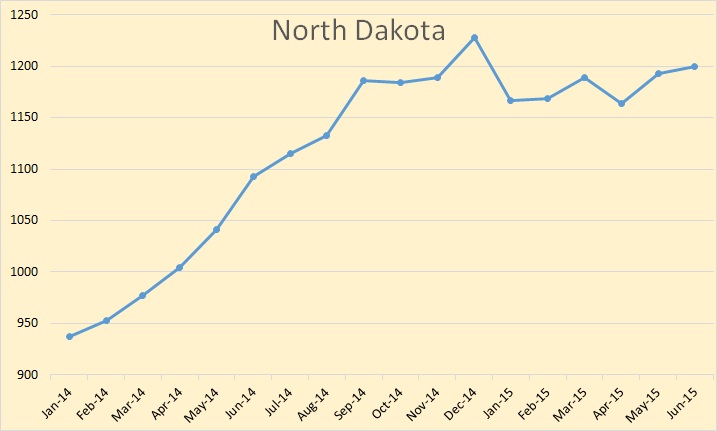
The Petroleum Supply Monthly reports the exact same data for North Dakota as the NDIC reports in their data release.
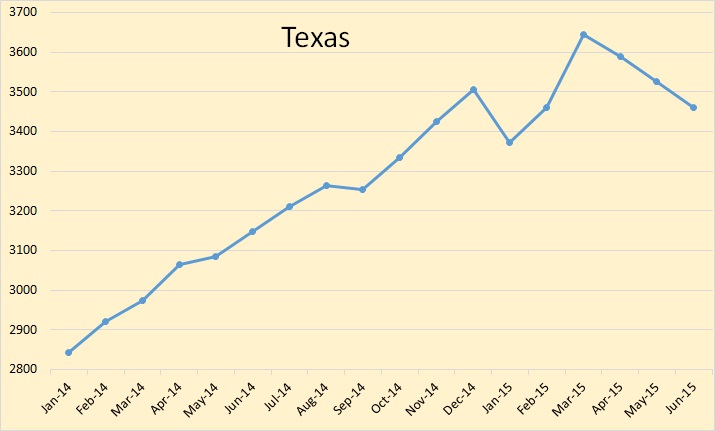
Texas peaked in March at 3,644,000 barrels per day but has since dropped by 184,000 bpd to 3,460,000 bpf.
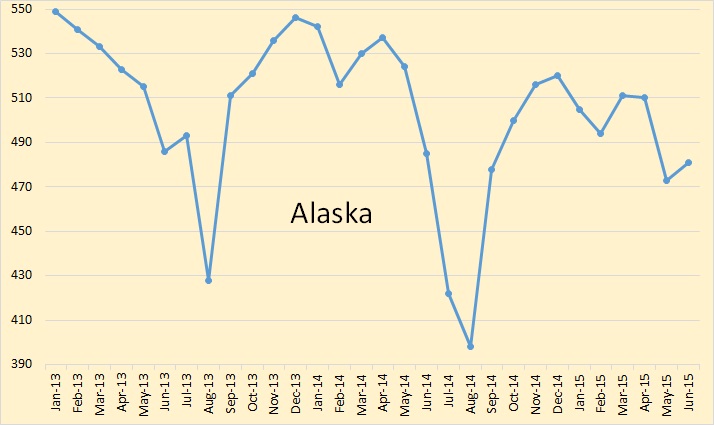
The oil price decline has had little effect on Alaska production. They just continue their sure but steady decline.
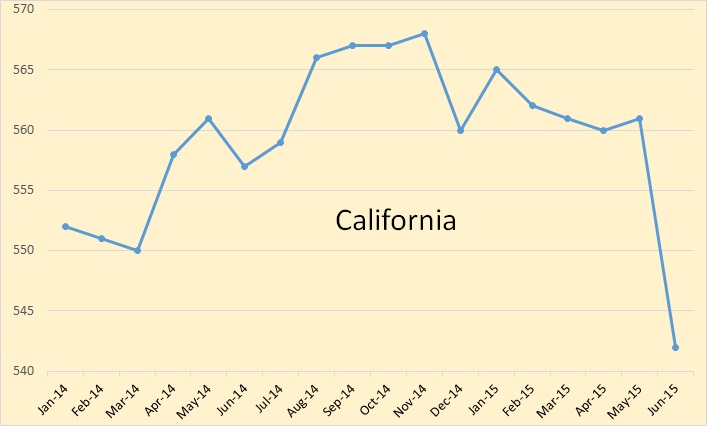
California dropped by 19,000 bpd in June.
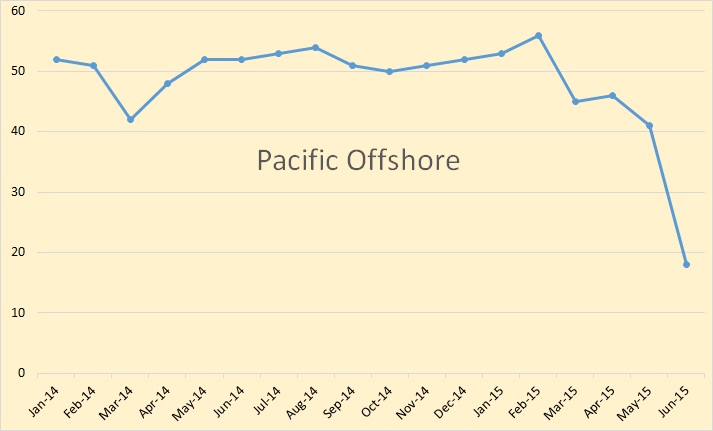
Pacific Offshore is down to 18,000 barrels per day.
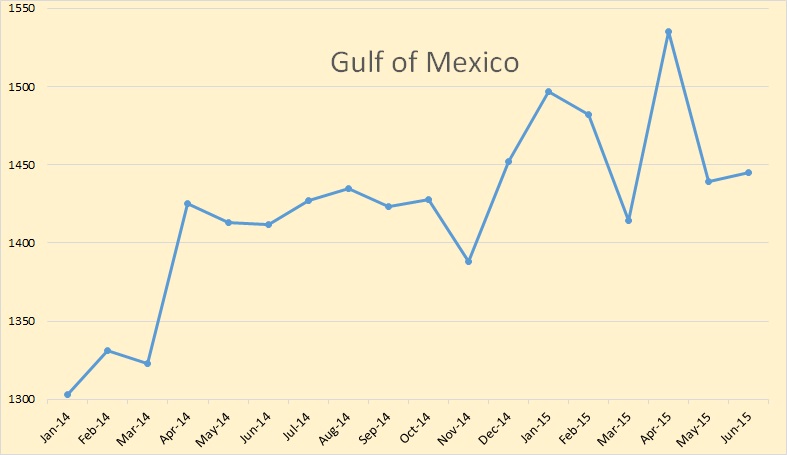
The Gulf of Mexico is trending slightly upward.
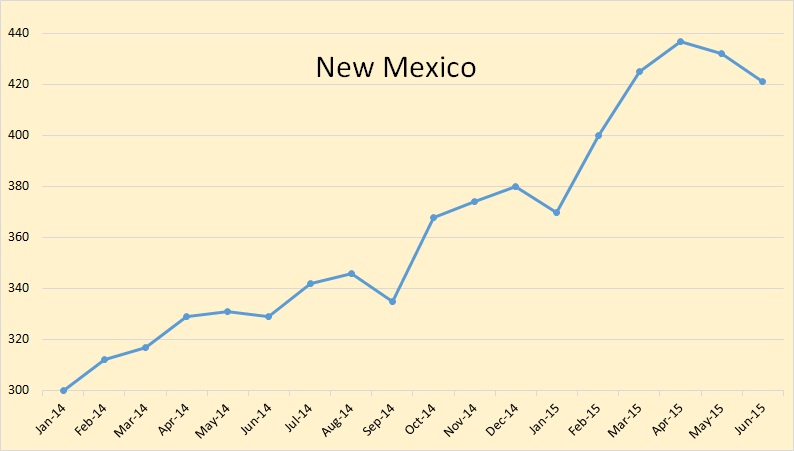
New Mexico, who’s production come partially from the Permian, was bucking the trend through April but has since dropped 16,000 barrels per day to 421,000 bpd.
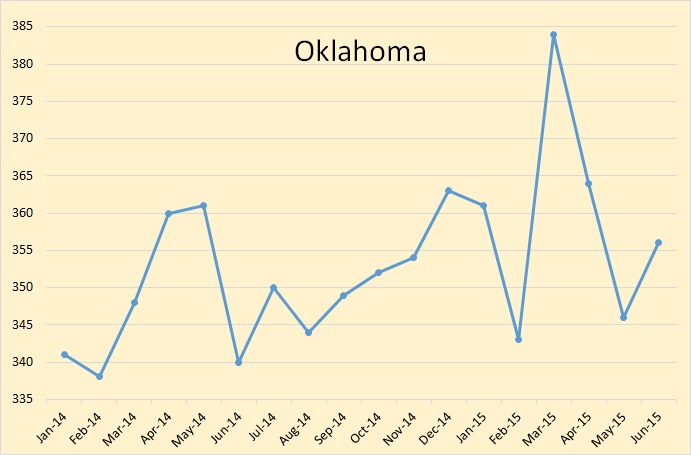
Oklahoma is not yet part of the new survey method but this estimate is likely very close. They seem to be holding their own despite the price collapse.
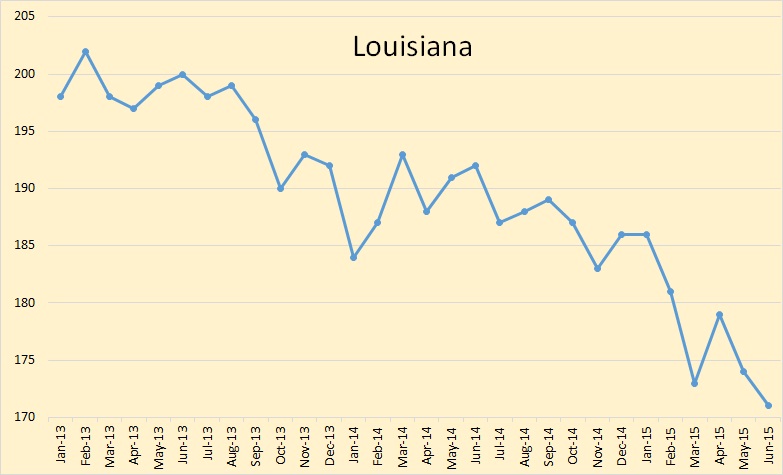
Louisiana continues its natural decline.
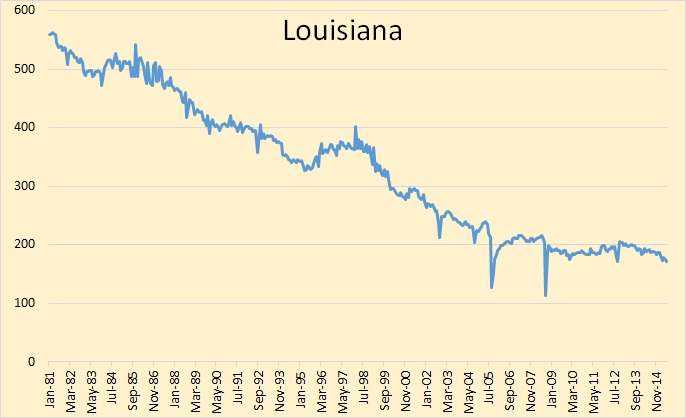
Louisiana once produced 560,000 barrels per day but what happened to Louisiana eventually happens to all producing states and nations.
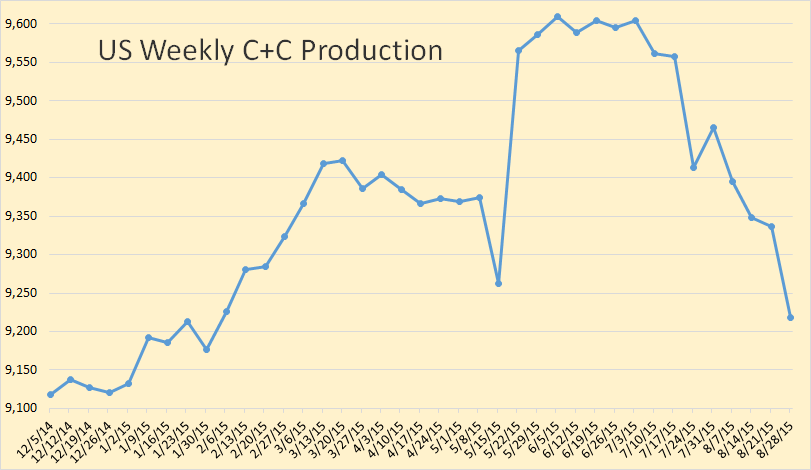
US production was down 119,000 bpd last week. However only 19,000 of that was the lower 48. Alaska was down 100,000 bpd. That was likely due to their usual summer maintenance. The EIA says US C+C production for week ending 8/28/15 was 9,218,000 barrels per day. That is approximately one million barrels per day less than either Saudi Arabia or Russia is producing.
Iraqi Oil Output Declining as of 2018 in Morgan Stanley’s View
Iraq’s crude production will start to decline in 2018 because of a slowdown in investment due to lower oil prices and a costly war on Islamist militants, according to Morgan Stanley.
OPEC’s second-largest crude producer will pump 4.18 million barrels a day in 2017, with output then falling to 4.132 million in 2018 and to 4.127 million by 2020, Haythem Rashed, a Morgan Stanley analyst in London, said in a Sept. 2 report. The bank had previously forecast rising output every year to 4.6 million barrels by 2020.
Iraq’s production has climbed 1 million barrels a day by July from a year earlier, becoming the strongest contributor to global supply, Morgan Stanley said. The removal of export constraints in the south, increased pipeline capacity in the semi-autonomous Kurdish region and the separation of heavy and light crude streams all contributed to growth, according to the report.
“With these infrastructure and crude marketing tailwinds now largely played out, we see limited prospects for further production growth,” Rashed said in the report.
Iraq was one of great hopes for cornucopian crowd. Leonardo Maugeri has Iraq at 7.6 million barrels per day in 2020. They are at 4 mbd today and I don’t expect them to ever reach 5 mbd.
BobInget on Fri, 4th Sep 2015 11:12 am
Wa happened to the GOM?
Is it possible its ‘fished’ out?
Alaskan production couldn’t support local consumption if Alaska had more then 176 people.
California’s production looks downright dangerous if anyone happened to be walking under that chart.
Looks like we are stuck with North Dakota.
I sure hope Gay Marriage doesn’t screw that up like it has everything else.
BobInget on Fri, 4th Sep 2015 11:25 am
US consumption is near its highest in years.
Venezuela, sells oil elsewhere.
The MidEast, North Africa, afire.
Greatest refugee disaster since WW/2.
Libya: Posted on 25 August 2015. Tags: Es Sider, force majeure, oil production, Ras Lanuf …
South Iraq escapes fighting, exports go up.
The real burning question, on this holiday weekend:
Will West Texas close over $47. ?
Really, who cares about consumption or production, there’s a glut, haven’t you heard?
BC on Fri, 4th Sep 2015 12:08 pm
We’re setting up for US oil production of 5-6Mbd (and an associated decline in consumption) in the years to come coincident with another global deflationary recession.
That will help reduce the “glut”. 🙂
joe on Fri, 4th Sep 2015 1:12 pm
Does it matter how bean counters count beans?
Sub 50dlr oil, and rising FED rates will put us right back in OPEC’s pocket, then guess what. They wont be repeating past mistakes. The hypocrite regimes in Riyadh and Tehran will fix the oil markets, then blow each other and the West to hell. Tight oil is about 1:2 eroei. So at 50dlrs cost to produce, you have to break even and repay investors. Debt is the answer, so you gotta now include an extra 5c on the dollar minimum just to break even if the FED raises rates during next year. That could be dividends to investors out the window. Were not even a whole year into this new OPEC policy and nobody is really sure about the future of tight oil.
That in itself tells its own tale.
Oil from the sea in Alaska? Feels like an act of desperation.
North Sea oil lasted about 40 years, its clearly in a decline phase. Alaskan oil maybe has about the same, Artic Ocean oil will be about same, if growth projections are accurate, probably less since all growth projections seem to underestimate not overestimate in the long run. Poor Syrians, they will get to the West just in time for their kids to see it fall and go into permanent decline.
Davy on Fri, 4th Sep 2015 1:18 pm
BC, there is no reason a glut will not remain in a deflating world. If demand is falling faster than supply an overhang will remain. Once the decay of the global economy gathers steam all kinds of irrational, dysfunctional, and odd ball occurrences are going to pop up. Most of us have been habituated to a supply and demand market for resources in an economy of growth all our lives. This may be over with new rules of the game.
This new game will have to be adapted to in different ways than we are accustomed to. It will be those who are flexible in thinking and abilities who will succeed. Those who hang on to the old way of thinking will be swept aside. Reality has no opponents. It always wins.
penury on Fri, 4th Sep 2015 4:17 pm
I think that many people have commented over the last six months that the supply glut is really a consumer shortage. oil can go to 20 dollars a barrel (not really) theoretically and people still could not buy it. the truth of the matter is PEOPLE HAVE NO F***ING MONEY.
Makati1 on Fri, 4th Sep 2015 6:17 pm
penury, you are right. Who cares what the cost of oil is if your pockets are empty of coins to buy it? And that is the current state of affairs in much of the Western world. The red blood is flowing over their kitchen floors, just as it is over that of the Stock Market casino and the Federal Government. Only the middle class sees it and feels the strain. The poor have lived with it all their lives. The rich don’t notice, unless their stocks go down.
In the present world, America is trying to destroy the middle class as it is a hindrance to their plans for world domination. There can only be Lords and serfs in the new world they dream of. They are fast succeeding in their goal.
As for a ‘new’ way to count beans, nothing is really new. The lies will continue. The masses cannot handle reality. They have never been exposed to it. Especially in America.
onlooker on Fri, 4th Sep 2015 6:29 pm
“In the present world, America is trying to destroy the middle class as it is a hindrance to their plans for world domination.”
That is why have no allegiance to my “country” the notion of the US if it ever existed is long dead. Instead what we have is people fighting over things like abortion and right to carry an assault weapon ho hum we are the Crazy Planet.
Boat on Fri, 4th Sep 2015 6:54 pm
penury.
Then why is consumption for gasoline and diesel going up all over the world. Do you guys know how to read charts?
Truth Has A Liberal Bias on Fri, 4th Sep 2015 9:10 pm
Ron has the best peak oil site on the net. His forecast will prove to be spot on. That is unless there’s a few Ghawars hiding behind the cushions in the couch, but I doubt there is. Even a global boom in LTO production won’t make up for the decline in conventional production.
Boat on Fri, 4th Sep 2015 9:42 pm
Truth,
You say that as Russian oil production is higher, Iran higher, Iraq higher. World production higher with less tight oil, less oil sand, less deep sea production. Can you explain that?
GregT on Fri, 4th Sep 2015 11:39 pm
“Then why is consumption for gasoline and diesel going up all over the world. Do you guys know how to read charts?”
Do you understand exponential growth Boat? Do you understand how money works?
Honestly Boat, do you ever stop to wonder why you are in constant disagreement with so many people here? Or do you believe that you are much smarter than everyone else?
OFT on Mon, 7th Sep 2015 10:27 am
Boat,
Russian oil production is still benefiting from several years of implementing improved secondary recovery techniques and from more liberal taxation frameworks (particularly for heavier oils). The result is more production from existing old fields as these changes work their way through the system. Total production is likely to have peaked over the summer and will probably stabilise, or start to decline, given the current financial constraints.
Iran can add production that has been mothballed and also rapidly benefit from external expertise, subject to sanctions being lifted. Expect its production to increase if sanctions ease.
Iraq has genuinely large untapped new, or poorly produced existing resources. It is one of the few countries with massive, untapped, onshore resources, close to existing markets and distribution networks. In both cases these can add significant volumes to the Iraqi total, subject to a semblance of stability and a co-operative mindset by all parties, including the ruling party. Expect its production capacity to increase if either stability or co-operation improve.
Boat on Mon, 7th Sep 2015 11:25 am
GregT,
Honestly Boat, do you ever stop to wonder why you are in constant disagreement with so many people here? Or do you believe that you are much smarter than everyone else?
We have not reached peak oil globally. The economies will continue to grow oil use. Everything indicates this but the doomer narrative. If we had not had geopolitical problems in the middle east we may have never had the six years of high prices. Which BTW did not slow global net consumption over that period of high price. And possibly the fracking revelation would have never taken place.
Please show me the global charts that show I am wrong. I have posted plenty that support my opinion.
Boat on Mon, 7th Sep 2015 11:36 am
OFT,
I think that is exactly correct. I have been trying to make another point. I would like your opinion. As conventional oil from around the world increases it is keeping up with growing demand. At the same time, tar sands, fracking, and offshore oil is on the decline. To me this does not show a lack of oil Just oil from other areas cheaper to produce.
Claims of demand destruction may effect growth of consumption but overall growth and consumption still are rising.
GregT on Mon, 7th Sep 2015 12:40 pm
The effect of the global financial crisis on OECD potential output
Patrice Ollivaud, David Turner
27 Mar 2015
Potential output losses from the global financial crisis are estimated by comparing recent OECD published projections with a counter-factual assuming a continuation of pre-crisis productivity trends and a trend employment rate which is sensitive to demographic trends. Among the 19 OECD countries which experienced a banking crisis over the period 2007-11 the median loss in potential output in 2014 is estimated to be about 5½ per cent, compared with a loss in aggregate potential output across all OECD countries of about 3½ per cent.
http://www.oecd-ilibrary.org/economics/the-effect-of-the-global-financial-crisis-on-oecd-potential-output_eco_studies-2014-5js64l2bv0zv
GregT on Mon, 7th Sep 2015 1:03 pm
The Inclusive Growth and Development Report 2015
Since the onset of the financial crisis, the question of how to unlock new sources of productive employment and translate economic growth into broad-based progress in living standards has preoccupied political and business leaders in developed and developing countries alike. These challenges have been among the foremost concerns of the World Economic Forum Global Risks Report surveys. While a widespread international consensus now exists on the need for more socially-inclusive models of growth and development, little in the way of concrete policy guidance has emerged.
http://www3.weforum.org/docs/WEF_Forum_IncGrwth.pdf
GregT on Mon, 7th Sep 2015 1:10 pm
Stalling Economic Growth in Emerging Europe and Central Asia
WASHINGTON, April 17, 2015 – In the Emerging Europe and Central Asia (ECA) region, lower oil prices and the economic slowdown in Russia are weighing heavily on many economies in Eurasia, while countries in the Eurozone are benefiting from lower oil prices and a modest economic recovery. Overall, economic growth in ECA will be almost non-existent in 2015, down from 1.8 percent last year, the World Bank said during the 2015 World Bank/IMF Spring Meetings.
http://www.worldbank.org/en/news/press-release/2015/04/17/stalling-economic-growth-in-emerging-europe-and-central-asia
GregT on Mon, 7th Sep 2015 1:22 pm
Former BP geologist: peak oil is here and it will ‘break economies’
A former British Petroleum (BP) geologist has warned that the age of cheap oil is long gone, bringing with it the danger of “continuous recession” and increased risk of conflict and hunger.
At a lecture on ‘Geohazards’ earlier this month as part of the postgraduate Natural Hazards for Insurers course at University College London (UCL), Dr. Richard G. Miller, who worked for BP from 1985 before retiring in 2008, said that official data from the International Energy Agency (IEA), US Energy Information Administration (EIA), International Monetary Fund (IMF), among other sources, showed that conventional oil had most likely peaked around 2008.
http://www.theguardian.com/environment/earth-insight/2013/dec/23/british-petroleum-geologist-peak-oil-break-economy-recession