
Peak Oil is You

Donate Bitcoins ;-) or Paypal :-)


Page added on February 14, 2014

The economics of shale oil
 Frackin’ the Bakken
DENNIS LITHGOW is an oil man, but sees himself as a manufacturer. His factory is a vast expanse of brushland in west Texas. His assembly line is hundreds of brightly painted oil pumps spaced out like a city grid, interspersed with identical clusters of tanks for storage and separation. Through the windscreen of his truck he points out two massive drilling rigs on the horizon and a third about to be erected. Less than 90 days after they punch through the earth, oil will start to flow.
What if they’re dry? “We don’t drill dry holes here,” says Mr Lithgow, an executive for Pioneer Natural Resources, a Texan oil firm. In the conventional oil business, the riskiest thing is finding the stuff. The “tight oil” business, by contrast, is about deposits people have known about for decades but previously could not extract economically.
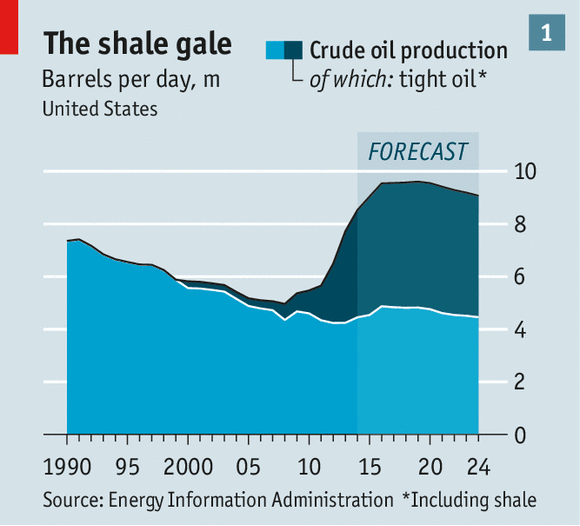
Pioneer’s ranch sits at the centre of the Permian Basin, a prehistoric sea that, along with Eagle Ford in south Texas and North Dakota’s Bakken, are the biggest sources of tight oil, a broad category for the dense rocks, such as shale, that usually sit beneath the reservoirs that contain conventional oil. Since 2008 tight-oil production in America has soared from 600,000 to 3.5m barrels per day (see chart 1). Thanks to tight oil and natural gas from shale, fossil fuels are contributing ever more to economic growth: 0.3 points last year alone, according to J.P. Morgan, and 0.1 to 0.2 a year to the end of 2020, according to the Peterson Institute, a think-tank. Upscale furniture stores and luxury-car dealerships have sprung up in Midland since the boom began. Mr Lithgow has truck drivers who earn $80,000 a year. Local oil-service firms have been known to hire fast-food workers on the spot. In all, the unconventional-energy boom will create up to 1.7m new jobs by 2020, predicts McKinsey, a consultancy.
And that is only part of the story. Another benefit of tight oil is that it is much more responsive to world prices. Some economists think this could turn America into a swing producer, helping to moderate the booms and busts of the global market.
Pioneer is rapidly boosting production. But Scott Sheffield, the company’s boss, worries that in a few years he will run out of customers; America has prohibited the export of crude oil since the 1970s. At $100 a barrel, the price of West Texas Intermediate (the most popular benchmark for American oil) is comfortably above the break-even cost of tight oil. But the prospect of a glut has futures pricing it at $20 less in 2018. “There will be a lot less oil-drilling when you take $20 out of everybody’s margin,” says Mr Sheffield.
Until the early 1970s, America was the world’s largest oil producer and the Texas Railroad Commission stabilised world prices by dictating how much the state’s producers could pump. When Arab states slapped an oil embargo on Israel’s Western allies after the six-day war in 1967, Texas cushioned the blow by allowing a massive production boost.
But rising consumption and declining production eroded the state’s spare capacity, and in March 1972 Texas called for flat-out production. “This is a damn historic occasion and a sad occasion,” the Texas Railroad Commission’s chairman declared. When Arab producers imposed another embargo the next year, prices rocketed. America had lost the role of world price arbiter to OPEC, a cartel dominated by despotic regimes. American politicians tried desperately to curb consumption (for example, by lowering speed limits) and to conserve supplies (by banning crude-oil exports in 1975).
American production declined steadily from a peak of 9.6m barrels a day in 1970 to under 5m in 2008. About then, independent producers began adapting the new technologies of hydraulic fracturing (“fracking”) and horizontal drilling, first used to tap shale gas, to oil. Total American production has since risen to 7.4m barrels a day, and the Energy Information Administration, a federal monitor, reckons it will return to its 1970 record by 2019. The International Energy Agency is more bullish; it reckons that by 2020 America will have displaced Saudi Arabia as the world’s biggest producer, pumping 11.6m barrels a day.
Besides directly creating new jobs and income, the fossil-fuels boom could help growth by reducing America’s vulnerability to oil-price swings, in two ways. First, as production rises and imports shrink, more of the cash that leaves consumers’ pockets when the oil price rises will return to American rather than foreign producers. David Woo of Bank of America/Merrill Lynch notes that America’s petroleum deficit has narrowed to 1.7% of GDP while Europe’s has widened to nearly 4%, which seems to have made both the dollar and the economy less sensitive to oil prices.

The second channel lies in the economics of shale. Oil flows relatively easily through the porous rocks that make up a conventional reservoir, so a conventional well can tap a large area. As a result, the volume of oil pumped each day declines slowly, on average at 6% per year. By contrast, oil flows much more sluggishly through impermeable tight rock. A well will tap a much smaller area and production declines quite rapidly, typically by 30% a year for the first few years (see chart 2). Maintaining a field’s production levels means constant drilling. The International Energy Agency reckons maintaining production at 1m barrels per day in the Bakken requires 2,500 new wells a year; a large conventional field in southern Iraq needs just 60.
This all means that when oil prices rise, producers can quickly drill more holes and ramp up supply. When prices fall, they simply stop drilling, and production soon declines. In early 2009, after prices collapsed with the global financial crisis, Pioneer shut down all its drilling in the Permian Basin. Within six months, output in the affected areas dropped by 13%.
Bob McNally of Rapidan Group, an industry consultant, predicts that America could be “force-marched” back to the stabilising role it played in the 1960s, this time responding to the market’s invisible hand rather than government diktat. Will that work in practice? It may already have done so. Since 2008, the Peterson Institute notes, turmoil in Sudan, sanctions on Iran and declining North Sea output have taken a lot of oil off the market. Without America, which accounted for half of the growth in global output over that period, Persian Gulf producers might not have been able to make up for the loss. Prices could have risen sharply, hurting consumers everywhere. Yet they did not.
Oil firms try not to over-react to short-term price fluctuations, of course. Capital, equipment and labour all cost money, so they try to ramp up production only in response to what they think will be long-term shifts in the oil price.
 Frackin’ the Bakken
The ban on crude-oil exports hurts producers and makes it harder for America to become a swing supplier. Light, sweet (ie, low-sulphur) West Texas Intermediate already trades at a discount of $8 to Brent, its global peer. That is due mostly to transport and storage bottlenecks in America, but increasingly the export ban makes a difference. In recent decades American refiners have reconfigured themselves to handle the heavier, sour oil imported from Mexico, Venezuela and Canada’s tar sands, leaving them with less capacity for refining tight oil, which is light and sweet.
The oil price at which shale producers break even ranges from $60 in the Bakken to $80 in Eagle Ford, reckons Michael Cohen of Barclays, a bank. If exports yielded an extra $1 to $1.30 a barrel, he estimates that might raise total output by as much as 200,000 barrels per day.
If the ban were lifted, crude-oil exports could start more or less straight away. The necessary pipes and tankers are mostly there already. But the political debate is only in its infancy. By law the president can allow exports he considers in the national interest. Barack Obama has yet to express a view on the ban. Legislators from non-oil-producing states are wary. “For me the litmus test is how middle-class families will be affected,” says Ron Wyden, the Democratic chairman of the Senate energy and natural resources committee.

The main beneficiaries of the ban are the refiners. They buy light, sweet American crude for less than the global price, turn it into petrol and then sell that at the global price. Exports of refined petroleum products are not banned, and have, unsurprisingly, soared.
Defenders of the ban (including, naturally, some refiners) claim that if America exported more oil, Saudi Arabia would reduce its own output. Prices to American consumers would not fall, they say, and might even rise. Historical evidence says otherwise, however. When Congress allowed Alaska to export crude oil in 1995, its west-coast customers did not pay any more for petrol, diesel or jet fuel.
Oil producers would obviously benefit from lifting the ban. So might other Americans, in less obvious ways. A global oil market that fully included America would be more stable, more diversified and less dependent on OPEC or Russia. The geopolitical dividends could be hefty. As Pioneer’s Mr Sheffield notes, “It’s hard to believe we’re asking the Japanese to stop taking Iranian crude, but we won’t ship them any crude ourselves.”
Correction: We said above that higher export prices could raise output by as much as 200,000 barrels per year. We meant per day. Sorry. This has been corrected.
11 Comments on "The economics of shale oil"
Davy, Hermann, MO on Fri, 14th Feb 2014 7:09 pm
I seemed to remember an article from the Economist “Drowning in oil” If I remember correctly oil was going to $5 then it climbed to $145 in a few years. Now that is a hell of a spread!
Nony on Fri, 14th Feb 2014 7:45 pm
Digging this story big time. It conceptualizes a lot of points I have been making. Important things like the fast on/off nature of shale drilling. The positive flip side of the negative “high decline”. BTW, my back of the envelope was $10/bbl price impact from US tight, but that is based on a less inelastic (more elastic) demand response than most. Have been seeing stories that it has been more like a $20/bbl impact on world price. And if you are a doomer, you probably believe in very inelastic demand…
rockman on Fri, 14th Feb 2014 8:12 pm
Just a couple of picky points regarding the curves showing decline curves. First, the conventional curve is not very representative of many large conventional fields. Often, especially in a water drive reservoir, production can hold flat for many years. Second, “tite-oil well” is made up term that has no meaning in the oil patch. There are “tite” reservoirs which produce slowly because they have low permeability. And in reality such reservoirs have some of the lowest decline rates. I’ve seen “tite” reservoirs produce X bopd with no decline for 6+ years. And there are fractured reservoirs which are what most are talking about when they reference “tite-oil wells”. These are the reservoirs with extremely low permeability in the rock matrix but have very permeable fracture systems which produce those very high initial flow rates followed by very high decline rates. The chart tries to give an expression of the differences but does so very sloppily IMHO.
As far as the oil export question: what’s the difference between exporting 2 million bopd of US (which is currently prohibited) and exporting the refined products (which is not prohibited) made from 2 million bopd of US oil? The only significant difference I see is which refineries are making the profit selling the products and which country has to deal with the pollution from the refinery process. Right now the Sierra Club is suing the huge Exxon refinery in Baytown, Texas, over emissions. If that oil were exported instead there would be that much less pollution from that plant. Last I looked virtually no consumer in the US uses oil…they only buy refined products. So the domestic market for refined products will be the same whether the oil or its products are exported.
And does everyone know how the export of 50,000 bbls/day of Eagle Ford production to Canada doesn’t violate the oil export ban? Because we aren’t exporting “oil”. The production is run through a slight upgrading system and thus we aren’t exporting “oil” but a refinery “product”. And why ship that production past Gulf Coast refineries and send it half way around the continent to Canada? Because those Canadian refineries can produce a higher value product from those liquids then a Gulf Coast refinery. A much higher value even taking into account the shipping cost. Folks will have a difficult time understanding these dynamics and economics if they continue to think that every bbl of oil is the same as every other bbl.
MSN fanboy on Fri, 14th Feb 2014 11:40 pm
What a pity for you Doomers (apart from rock, appears to be impartial)
Looks like price will rise and more production will be added to fill the gap. 🙂
Even if the article is a formal fallacy.
Davey on Fri, 14th Feb 2014 11:46 pm
Msn have you ever studied basic economics or read a profit and loss statement. Sometimes it don’t add up.
rollin on Sat, 15th Feb 2014 2:31 am
Actually, finished product exports are far less than oil imports, so they are essentially refining imports and then exporting product.
The first graph mistakenly gives the impression that fracked wells give the same initial output as conventional wells. Rock is very right about the conventional well curve being wrong.
The point of the article is for the oil industry to whine about not being able to export crude taken from US soil. There are reasons for that, one being that that is US property they are removing. But for oil companies, the American market is not good enough.
I think if the government is stupid enough to allow export of crude, they should tack a $10 per barrel charge on oil all around, to be distributed to the American people.
Northwest Resident on Sat, 15th Feb 2014 2:32 am
MSN — What happens is the price of energy rises, businesses have to lay employees off or pay less to compensate for the extra expense if they want to remain competitive, people overall pay much more for energy and have less available to purchase other products, until finally people can’t afford the high energy price anymore so they greatly reduce their spending on energy, due to decreased demand the price of energy goes down, rinse lather and repeat. But it gets to a point where the price of energy can’t go down much more because of the extraction costs, and that’s when your market economy really starts to fall apart.
rockman on Sat, 15th Feb 2014 4:00 am
Just a couple of more points. “finished product exports are far less than oil imports”. Yes…for now. Market dynamics will control the future. But as long as the US economy remains RELATIVELY strong we’ll be able to compete well for those products. OTOH shouldn’t that also be true or crude oil? If the US can outcompete foreign product buyers than why not expect the same or domestic crude? Why a different concern?
Also let’s think about it for a moment. If one thinks it’s a bad idea to export domestic oil production does that hold for just US production? Or does that philosophy hold for all exporters…like the ones we import oil from? Does good for goose is good for the gander ring a bell? LOL.
Davy, Hermann, MO on Sat, 15th Feb 2014 12:01 pm
@rock, yea agreed! The US despite all the bashing is not going away economically, politically, and militarily. It will decline relatively within the context of a global multicultural world but no more. If it collapses so does the global system
Rock is right about oil and the markets. When you have a global market like oil there is no need to overdo the national strategy. Especially with the complexities of the product, refining, and transport. It is best to allow comparative advantage to work. I will say, we need to watch market distortions that will bite us in the ass later. When you drop sources because you think you have plenty at home you might wake up one day scrambling to get sources if your exuberance was not grounded in reality.
rockman on Sat, 15th Feb 2014 3:06 pm
Davy – And what may drive home the inconsistency of a “don’t export our oil” attitude is if México, our second largest oil import source, decides in the future to follow the US lead and ban their oil exports. Probably won’t go down exactly like that but in a round about way. Like letting China access what the US has always taken for granted. Also some folks don’t realize we net as much benefit from Mexican imports as the numbers might indict. We export refined products back to them worth about 25% of the value of their oil exports.
And what will US attitudes be one day when Canada starts restricting it’s oil exports to the US in order to meet their own domestic demand? Or even worse: they start sending large volumes of “our” oil to China et al? LOL.
ted on Sat, 15th Feb 2014 3:35 pm
Interesting point Rock, haven’t we lost a lot of contracts with S.A because China has stepped in and bought them? The problem I see when U.S tite fields stop producing and we have to go back to the open market to buy oil. Oh well by then China will be in a full blown civil war and we will be in our depression…because people here will have realized we have no economy.