



Guest Post by SRSrocco
This post does not necessarily reflect the views of Dennis Coyne or Ron Patterson.
The carnage continues in the U.S. major oil industry as they sink further and further in the RED. The top three U.S. oil companies, whose profits were once the envy of the energy sector, are now forced to borrow money to pay dividends or capital expenditures. The financial situation at ExxonMobil, Chevron and ConocoPhillips has become so dreadful, their total long-term debt surged 25% in just the past year.
Unfortunately, the majority of financial analysts at CNBC, Bloomberg or Fox Business have no clue just how bad the situation will become for the United States as its energy sector continues to disintegrate. While the Federal Government could step in and bail out BIG OIL with printed money, they cannot print barrels of oil.
Watch closely as the Thermodynamic Oil Collapse will start to pick up speed over the next five years.
According to the most recently released financial reports, the top three U.S. oil companies combined net income was the worst ever. The results can be seen in the chart below:
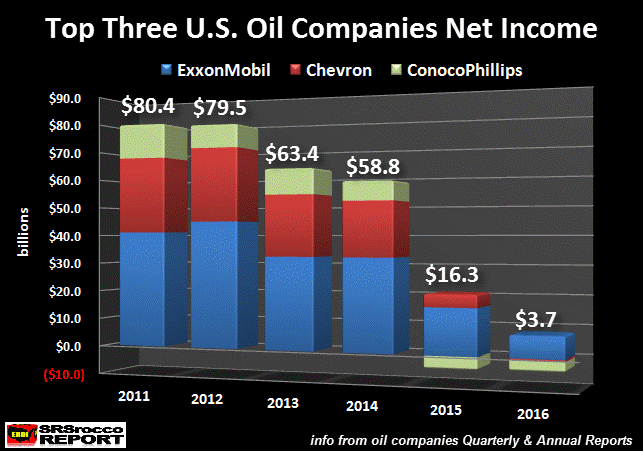
In 2011, ExxonMobil, Chevron and Conocophillips enjoyed a combined $80.4 billion in net income profits. ExxonMobil recorded the highest net income of the group by posting a $41.1 billion gain, followed by Chevron at $26.9 billion, while ConocoPhillips came in third at $12.4 billion.
However, the rapidly falling oil price, since the latter part of 2014, totally gutted the profits at these top oil producers. In just five short years, ExxonMobil’s net income declined to $7.8 billion, Chevron reported its first $460 million loss while ConocoPhillips shaved another $3.6 billion off its bottom line in 2016. Thus, the combined net income of these three oil companies in 2016 totaled $3.7 billion versus $80.4 billion in 2011.
Even though these three oil companies posted a combined net income profit of $3.7 billion last year, their financial situation is much worse when we dig a little deeper. We must remember, net income does not include capital expenditures (CAPEX) or dividend payouts. If we look at these oil companies Free Cash Flow, they have been losing money for the past two years:
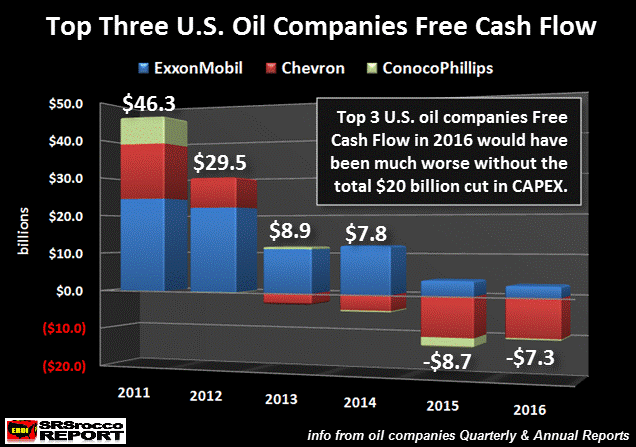
Their combined free cash flow fell from a healthy $46.3 billion in 2011 to a negative $8.7 billion in 2015 and a negative $7.3 billion in 2016. Now, their free cash flow would have been much worse in 2016 if theses companies didn’t reduce their CAPEX spending by nearly a whopping $20 billion. I don’t have a chart to show their capital expenditures, but here are some of the annual figures:
Top 3 U.S. Oil Companies Total CAPEX Spending:
2013 = $87.2 billion
2014 = $85.4 billion
2015 = $66.0 billion
2016 = $46.6 billion
The combined CAPEX spending from these three oil companies fell 29% in 2016 versus 2015 and 46% since 2013. Basically, ExxonMobil, Chevron and ConocoPhillips have cut their combined CAPEX spending in half in the past three years. This is bad news for either building or at least maintaining oil production in the future.
NOTE: Free Cash Flow is calculated by subtracting CAPEX spending from the company’s operating cash or profits.
Even though these companies slashed nearly $20 billion in CAPEX spending in 2016, they still suffered a negative free cash flow of $7.3 billion. However, this does not include dividend payouts to their shareholders. Not only did these companies pay a total of $46.6 billion in CAPEX in 2016, they also forked out an additional $21.4 billion in shareholder dividends. Dividend payouts do not come out of thin air.. they must come from cash from operations.
If we include dividend payouts, this would be the net result on these companies Free Cash Flow:
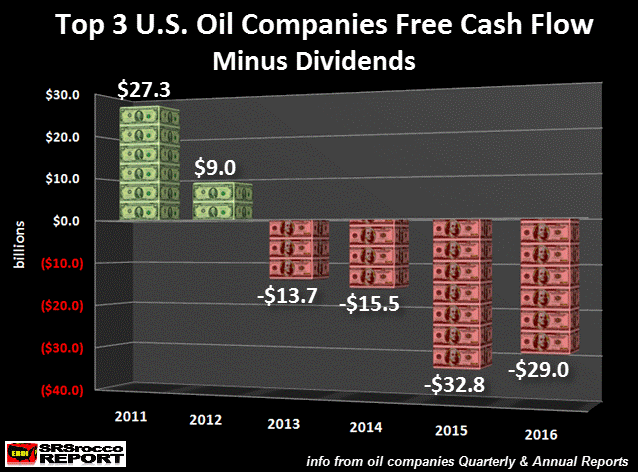
Here we can see that the large dividend payouts by these three oil companies impacted their bottom line much worse than the figures shown in the Free Cash Flow chart above. Thus, the free cash flow minus dividend payouts provides us evidence that these oil companies have been seriously in the RED since 2013, not just the past two years displayed in the Free Cash Flow chart.
As we can see, the group’s free cash flow minus dividends was a negative $32.8 billion in 2015 and a negative $29 billion last year. Of course, these three companies may have sold some financial investments or assets to reduce these negative values, but a company can’t stay in business for long by selling assets that it would need to use to produce oil in the future.
So, what has falling free cash flow and dividends done to ExxonMobil, Chevron and ConocoPhillips long-term debt? You guessed it… it skyrocketed:
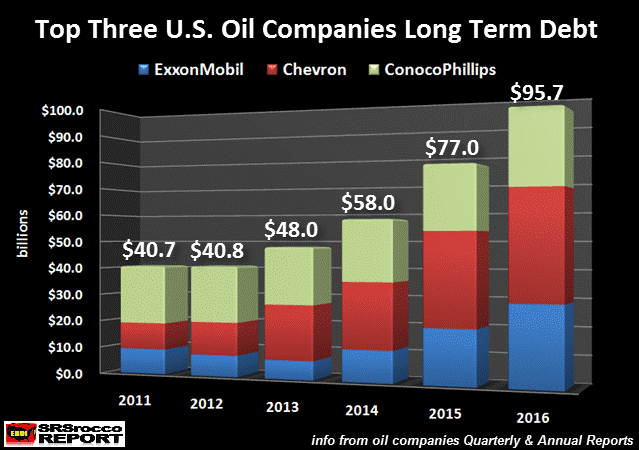
When these three companies still enjoyed positive free cash flow in 2011 and 2012, after paying CAPEX and dividends, their long-term debt did not increase. However, as their operating profits really started to decline, the debt on their balance sheets increased significantly. As we can see, the combined long-term debt in these three companies balance sheets ballooned from $40.8 billion in 2012 to $95.7 billion in 2016.
Basically, these three companies combined long-term debt has doubled in just the past three years. This is bad news as the situation in the energy markets continues to disintegrate. Zerohedge published this article, Goldman Stunned By Collapse In Gasoline Demand: “This Would Require A US Recession” which stated the following:
So yes, both gasoline stocks and supply remains at extremely high levels, but what set off alarm bells is not supply, but demand: the EIA last week reported that the 4-week average of gasoline supplied – or implied gasoline demand – in the United States was 8.2 million barrels per day, the lowest since February 2012. And, as Reuters adds, U.S. refiners are now facing the prospects of weakening gasoline demand for the first time in five years.
Unfortunately, the massive amount of debt overhanging the U.S. economy has put a lot of leverage on the public’s ability to continue purchasing consumer goods and services. While the market has become clever at selling cars for example, by first offering lower interest rates and extended loan payouts, it is now resorting to leasing vehicles at ultra low monthly payment plans… just to get rid of them. Leasing automobiles at monthly rates that are uneconomic for the auto industry in the long run, only allows the GREATEST FINANCIAL PONZI SCHEME to continue a little longer.
When we start to add up all the data, the U.S. economy is getting ready to hit a BRICK WALL. Furthermore, the situation at the top three U.S. oil companies will only get worse going forward. As ExxonMobil, Chevron and ConocoPhillips continue to bleed to death, watch for U.S. oil production to fall precipitously in the future.
Yes, it is true that U.S. oil production has increased over the past several months due to the DRILLING RIG HAMSTERS doing their thing by taking good investment money and producing more crappy low quality oil. However, this isn’t something to cheer about. Rather, I call this…. turning GOLD into LEAD.
Some readers send me information of the growing drilling rig count and oil production in the Permian field in Texas. Yes, that is where the activity has moved to. Why? Well, it is one of the last fields that can produce oil similar to the Bakken and Eagle Ford.
That being said, I would refrain from believing that this bump up in U.S. oil production will SAVE THE DAY. Why? Because it is being done on the back of a massively indebted energy sector which has been able to continue drilling by using rigs that have seen their rental rates cut in half, or more, due to the implosion of the drilling rig industry in 2015 and 2016.
The evidence provided in this article showing the continued financial disintegration at these top three oil companies suggests that the U.S. energy sector is in serious trouble. We must remember, the top oil companies are supposed to be the most profitable. However, if we take a look at what is taking place in the top shale oil and gas producers, the situation is even more dire. I have republished this chart from a previous article showing that the shale oil and gas industry hasn’t really made a profit since 2009:
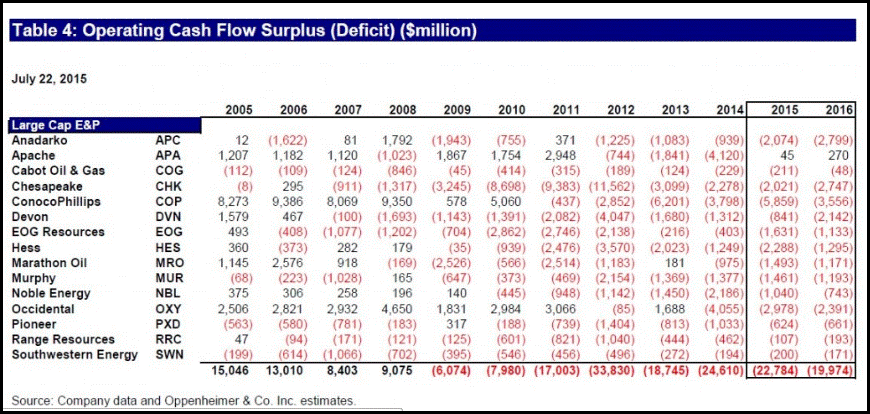
While some of the companies made free cash flow profits in various years, as an industry, these oil and gas producers have been in the RED since the U.S. Shale Energy Industry really took off in 2009. So, the notion that rising oil production from increased drilling rig activity is going to change the SEA OF RED taking place in the entire U.S. energy sector, suggests individuals or the market has gone completely insane.
As I have stated before, Americans continue to suffer from an increasing amount of BRAIN DAMAGE. Now, I am not just talking about the typical JOE BAG of DONUTS, as they at least have an excuse due to the propaganda put out by the Mainstream media. However, I am really surprised that “supposedly” intelligent individuals continue to either believe in U.S. energy independence or the more silly “Abiotic oil” theory that the Earth has a CREAMY NOUGAT CENTER of oil… that will refill all the oil fields in the world. (James Howard Kunstler gets the credit for that wonderful term).
While I realize the “Abiotic Oil Theory” is complete HOGWASH, many individuals still believe it is true. This theory has been propagated by a few Russian scientists and engineers, but I can assure you the bulk of the Russian oil industry is not drilling down to ultra deep depths to get their oil. I will be publishing an article shortly as a rebuttal to a recent newsletter post titled, How I came to Realize I was Wrong About Peak Oil – F. William Engdahl. Unfortunately, Mr. Engdahl has failed to look at the real evidence, instead has fallen HOOK, LINE and SINKER by faulty information and lousy conspiracy theories.
The number of individuals who fail to believe in PEAK OIL will diminish greatly as the Thermodynamic Oil Collapse picks up speed over the next five years. During this time, it would be prudent to own physical precious metals rather than highly inflated debt-based paper assets or real estate.
Midnight Oil on Fri, 10th Feb 2017 8:11 am
Trump will fix that…make America A#1 and the leader of fossil fuel exporter!
Unfettered Growth Capitalism is just what the Doctor ordered…
Cloud9 on Fri, 10th Feb 2017 8:25 am
Wrote this to the President this morning: Mr. President, I suspect that you are well aware, that the marvels of the last two hundred years were built on the extraction of cheap fossil fuels. For those two hundred years, we have pushed an exponential extraction of those fuels. The cheap and easy is now being replaced by the more difficult and expensive. We have reached or are about to reach a point of decline in fuel production. Those that are far wiser than I am, who have studied the thermodynamics of oil production, predict that the cost of extraction will destroy the oil market by as early as 2023. This means that the level of economic activity we currently enjoy is destined to contract violently in the next decade. This contraction will pull us back into the 19th century. Rail and water travel will be the most viable heavy transportation systems. Please, focus on rebuilding our rail roads.
Antius on Fri, 10th Feb 2017 9:07 am
We live on a ball of rock 8000 miles wide folks. We use stored energy that we dig out of the ground to process minerals that we also dig out of the ground into consumable stuff.
Now the energy supply is declining (we have eaten the best bits) and minerals are depleting (we have already eaten the best bits of those too), so we need even more energy to produce the same amount of consumable stuff. But we have less energy to do it with, not more.
So we are going to get poorer and poorer, until eventually the few survivors will go back to using stone for tools and burning biomass to keep warm.
It’s time to move out folks. Leaving this planet will be the most difficult thing human beings have ever accomplished. But I don’t see that there can be any decent future for anyone unless we manage to do it.
penury on Fri, 10th Feb 2017 10:07 am
And yet the rig count continues to rise. So the question remains, which point is correct?
Cloggie on Fri, 10th Feb 2017 10:12 am
It’s time to move out folks. Leaving this planet will be the most difficult thing human beings have ever accomplished. But I don’t see that there can be any decent future for anyone unless we manage to do it.
Where to?!
Jef on Fri, 10th Feb 2017 10:15 am
Penury – They are losing money on every barrel but they make up for it on volume.
Sissyfuss on Fri, 10th Feb 2017 10:40 am
OK Rock, spin this into something positive before my nightmares return. Make these graphs go away!
rr on Fri, 10th Feb 2017 12:14 pm
Permian bubble: http://www.bloomberg.com/news/articles/2017-02-10/at-60-000-an-acre-permian-may-be-too-ritzy-as-oil-prices-rise
twocats on Fri, 10th Feb 2017 12:47 pm
penury – “And yet the rig count continues to rise”….despite… “permian bubble” and an increasingly unprofitable industry.
its an important debate about how long the oil industry can survive/raise production if/while/when remaining unprofitable.
and if the oil industry is sinking below profitability, how many other industries are also below profitability. And how much will demand rise without solid “organic” economic growth present.
Money printing has done the trick more or less so far, and will continue for those close to the spigot. there is a shit-ton of capital out-and-about… shit-tons.
“the (oil) market can remain irrational for longer than [the vast majority of the human population] can remain solvent” [paraphrase of keyes]
I also don’t see demand backing down, pressuring oil producers to continue losing more and more money at a faster and faster rate.
Hard to say what will give in first.
Kenz300 on Fri, 10th Feb 2017 12:58 pm
Fossil fuel use is in decline.
Wind and solar are the future. No monthly cost for “fuel”
Anonymous on Fri, 10th Feb 2017 2:25 pm
Cloggo asks “Where to?!”
The answers should be obvious cloggo. Well all move to HOLLAND. According to (you), the dutch live in a post-scarcity, green eco-topia the likes of which exist only in your own mind. Good to know all us industrial refugees have a place to go. Wind powered trains, bio-fools made from unicorn shit, billions of EVs, 3d printers cranking out windmills and solar panels, sun-power freeways. Tulips too cheap to meter, and best of all, climate change doesn’t exist in cloggos Hollandia(all a commie hoax ya know).
We can keep trashing the planet now that we have to place to go. Everyone can crash at Cloggsters place.
rockman on Fri, 10th Feb 2017 2:50 pm
Sissy – OK, here you go. “…are now forced to borrow money to pay dividends or capital expenditures.” Pubcos have always borrowed capex…nothing new there. Second, Big Oil is spending many tens of $BILLIONS buying proved producing oil reserves at a price much lower then it has cost them to develop the same reserves by drilling for more then 10 years. In fact we are probably seeing the largest fossil fuel wealth transfer in the history of the oil patch. Paying $12 to $18 per producing bbl these acquisitions are PRODUCING NICE PROFITS TODAY at $50/bbl. And for every $ the price increases those profits increase. At $60+/bbl in the future…$BILLIONS IN PROFITS.
And profits from previously producing wells pushing them into the “red”? Complete bullshit. Wells that generate net income (revenue – production cost) are generating a profit. No company looses money producing a well. Which doesn’t mean the original investment in all the wells turned a profit. But those are “sunk costs” and have no bearing on the profitability of continuing to produce them. Additionally many of the wells producing at lower oil prices the last two years had already recovered 100% of their original investment and were thus in the black before the price crash and remain so today. The damage being done to companies today is being inflicted by huge debt loads they took on during the drilling boom.
Now debt to assets ratios…like ExxonMobil:
It is the leverage ratio indicating the relative proportion of shareholders’ equity and debt used to finance a company’s assets. A low debt to equity ratio indicates lower risk, because debt holders have less claims on the company’s assets.
And XOM’s current d/e = 0.27. IOW derbtors have claim to only 1/4 of XOM’s value…the rest belongs to the shareholders. And currently better then the d/e of the sector (0.32) and the industry as a whole (O.42). You want to see trouble: Anadarko: 1.25 d/e. Or go back to the late 90’s when oil fell below $20/bbl and the XOM d/e exceeded 1.0. And what was the XOM d/e during the height of the boom in June 2010 when we had record high oil prices: 0.15 As mentioned pubcos borrow much of their operational capex even in good times. In fact will tend to borrower at even higher levels to take advantage of higher oil prices as quickly as possible. Even more the case as a result of historically low borrowing costs as we had during the boom: borrowing 8% money to make 12% on your investment is SWEET MEAT. LOL.
Which is exactly what we saw during the boom time as shorty often points out…big time borrowing. The real pain comes when lower oil prices hit before wells recover their costs and loans are paid down. And it is the current divestaure of assets by those companies that ExxonMobil et al are picking up that are not only currently generating profitable returns but potentially OBSCENE PROFITS if we get a price surge in the future.
And we in the oil patch just loves OBSCENE PROFITS. LOL. Folks crying over the fate of poor little XOM…give me a f*cking break.
Many people who think they understand how a company like ExxonMobil conducts business actually don’t have a f*cking clue. LOL. Here’s some insight from a year ago many know nothing about:
“Few phenomena in the stock market are more predictable than oil major Exxon Mobil Corp’s massive share buyback program. Until now. The company, which has spent about $210 billion over the last decade buying back its own stock, is bowing to the reality that crude’s sharp downturn is hurting its bottom line. It surprised investors on Tuesday by dramatically ratcheting back share repurchases, and for the first time in 15 years, Exxon Mobil will only buy back shares to offset dilution as opposed to return cash to shareholders.
Exxon reported its smallest quarterly profit in more than a decade and said it will cut 2016 spending by one-quarter and suspend share repurchases. It is an unusual move as Exxon has spent more on share buybacks than any other company in the past 10 years, according to S&P Dow Jones Indices figures, and it’s not even close. It far surpasses second-place Microsoft Corp, which has bought back $125 billion in that time.
“Exxon was the poster child for that and they haven’t done so much of that lately,” said Howard Silverblatt, senior index analyst at S&P Dow Jones. In 2015, the company bought back $4 billion in shares, which was the smallest amount it spent since 2000. Back then, Exxon spent $1.86 billion on repurchases, but it was a net issuer of shares in the first two quarters of that year.
For the first quarter of 2016, the company could still be a net purchaser of shares, because stock grants to employees through benefit plans and options programs means it will need to buy back stock to offset dilution, the company said Tuesday. The move comes as its shares fall within 15 percent of a five-year low – when it would be more advantageous to repurchase its stock.
Large companies have been criticized for excessive spending on buybacks to reduce share counts, which help boost earnings per share, rather than investing in capital expenditures or research. Exxon has long been known for cash distribution. It is one of the S&P’s so-called “dividend aristocrats,” referring to companies that have increased their dividends every year for 25 consecutive years. For this past year, it spent more than $15 billion on dividends and buybacks. The company’s buyback program peaked in 2008, when it repurchased nearly $35 billion in shares – a year when the stock price averaged $81.36 a share.
Ghung on Fri, 10th Feb 2017 2:50 pm
“U.S. refiners are now facing the prospects of weakening gasoline demand for the first time in five years.”
Demographics and the declining labor participation rate are taking a big cut out of our collective ability to consume at previous levels. My household fossil fuel consumption, already moderate, has declined to about a third of what it was, pre-2009. I’m sure we aren’t alone. While some here may point out that current consumption levels seem “robust”, falling prices and the ‘oil glut’ haven’t spurred demand to anywhere near what these companies need to keep their parties going. Just another segment of our economy that has resorted to robbing Peter to pay Paul.
This current political cycle serves only to distract the masses from what truly ails us. The contraction of our hyper-complex global society is well underway, just as foretold. Meanwhile, our local job market has improved somewhat and consumers are getting more comfortable with higher personal debt levels. Won’t/can’t last.
Hunker down folks.
Anonymous on Fri, 10th Feb 2017 3:23 pm
Thats right rockyman. The uS oil cartel operators on the basis of taxpayer subsidies. Of course they can afford to ‘lose’ money in some of its routine operations, because as you well know, the uS oil-state backstops privately owned oil corps, with public cash. When the state covers pretty much all oil coprs externalities, and then some, how can they ever really ‘lose’, money right?
This is what rockerman means when he misleadingly refers to uS oil corps as ‘pubcos’. He means publicly subsidized and backstopped, but the profits are privately owned. The idea he’s trying to convey is that uS oil is a collectively owned, consensus driven public entity that is, in theory, answerable to the ‘public’, that supposedly ‘owns’ big oil.
The reality of course, is rather different. But can both agree is really does not matter how ‘profitable’ the uS oil cartel is, since uS oils symbiotic relation to the formal uS ‘government’, is as good an example of pure communism as it gets. If ‘profitably’ continues to be a serious problem, then expect the ‘public’ (lol), uS oil corps will quietly ramp up their exploration efforts.
No not that kind of exploration, not to find new oil fields, but to explore new ways to extract new forms of public subsidies both overt and covert.
vegeholic on Fri, 10th Feb 2017 3:57 pm
As Steve remarks in the post it is inevitable that governments will step in and bail out the failing oil companies. They can print money but they cannot print oil. This strategy of propping up the unpropable will transfer our remaining wealth into useless drilling activity. It will keep things going for a short while until the last believer recognizes the futility.
bug on Fri, 10th Feb 2017 4:08 pm
Vegaholic, I feel you are correct, “until the last believer recognizes the futility” and then the fan will be so of shit it will not spin,
SRSrocco on Fri, 10th Feb 2017 5:41 pm
Rockman…. I see you have weighed in and provided some comments in response to the article. From your experience in the industry and your stature here, I see your word carries a lot of weight. Glad to read your response.
That being said, the article was providing data showing an ongoing trend change in the U.S. major oil industry. While it is true that net income is not the same as free cash flow, free cash flow is a good metric to show the health of a company on an ongoing basis.
That being said, even though I don’t have the experience or background in the Oil & Gas Industry, I receive emails and speak on the phone with some well connected, highly experienced, high up the chain individuals from the Oil & Gas industry. Most are recently retired, so they don’t mind sharing what is going on.
For example, one who retried some years ago, stated that ExxonMobil realized the GAME WAS UP, which is why they decided to spend $260 billion on share buy backs since 1997. The majority took place since 2005. Matter-a-fact, since 2005, ExxonMobil spent $220 billion on share repurchases versus $245 billion on CAPEX-Capital Expenditures.
You would think ExxonMobil, being an oil and gas producer, would take that cash flow and invest more of it into future projects. However, as you stated, they decided to take about half of their profits and buy back shares.
Moreover, ExxonMobil only spent $9-$12 billion a year on CAPEX between 1997-2002 to produce an average of 2.5 mbd of liquid production. However, CAPEX expenditures tripled to #34 billion in 2012 as total production declined to 2.4 mbd. In 2015, CAPEX spending fell to $26.5 billion as total production continued to decline to 2.34 mbd.
So, the trend at ExxonMobil does not look good at all… and they are the best on the block in the United States.
Lastly, for all that CAPEX that ExxonMobil spent on new projects or future reserves, it isn’t a PRETTY PICTURE. Going by the data on ExxonMobil’s Annual Reports, we have the following on their “Net Proved Developed and Undeveloped Reserves:
2004 Oil Reserves = 12.5 billion barrels
2004 Gas Reserves = 60.3 Tcf
2015 Oil Reserves = 14.7 billion barrels
2015 Gas Reserves = 60.2 Tcf
While ExxonMobil has increased its liquid petroleum reserves to 14.7 billion barrels, most of it is that crappy oil sand garbage.
Unfortunately, ExxonMobil warned late last year that it might have to eliminate 20% of its future oil and gas prospects. I would imagine the crappy oil sands would be first to go.
So, ExxonMobil and the rest of the U.S. oil and gas industry is heading for BIG TROUBLE. I wouldn’t spend too much time looking at debt to equity ratios when we start witnessing large scale WRITE OFFS and etc.
You can read more about my article focusing on ExxonMobil here: https://srsroccoreport.com/end-of-the-u-s-major-oil-industry-era-big-trouble-at-exxonmobil/
steve
shortonoil on Fri, 10th Feb 2017 5:50 pm
“the (oil) market can remain irrational for longer than [the vast majority of the human population] can remain solvent” [paraphrase of keyes]”
That is really a little tacky, but true?
But, its the cannibalization process! First we will burn up our reserves (like we are doing) then we will burn up everything else. It is sort of a foregone conclusion when you have built a civilization that can not run without oil, and most of what remains isn’t worth taking out of the ground. Oil has been a one way street from day one, we have always known it, but we went speeding down it anyway. It doesn’t say much for the driver, does it?
TrainDriver on Fri, 10th Feb 2017 5:57 pm
Antius says
“It’s time to move out folks. Leaving this planet will be the most difficult thing human beings have ever accomplished. But I don’t see that there can be any decent future for anyone unless we manage to do it.”
The Golgafrinchams http://hitchhikers.wikia.com/wiki/Golgafrincham came up with a better solution (at first) …
Golgafrincham was a planet, once home to the Great Circling Poets of Arium. The descendants of these poets made up tales of impending doom about the planet. The tales varied; some said it was going to crash into the sun, or the moon was going to crash into the planet. Others said the planet was to be invaded by twelve-foot piranha bees and still others said it was in danger of being eaten by an enormous mutant star-goat.
These tales of impending doom allowed the Golgafrinchans to rid themselves of an entire useless third of their population. The story was that they would build three Ark ships. Into the A ship would go all the leaders, scientists and other high achievers. The C ship would contain all the people who made things and did things, and the B ark would hold everyone else, such as hairdressers and telephone sanitisers. They sent the B ship off first, but of course the other two-thirds of the population stayed on the planet and lived full, rich and happy lives until they were all wiped out by a virulent disease contracted from a dirty telephone.
Apneaman on Fri, 10th Feb 2017 6:21 pm
“…governments will step in and bail out the failing oil companies. They can print money but they cannot print oil. This strategy of propping up the unpropable will transfer our remaining wealth into useless drilling activity.”
Don’t forget that they will also burn up an ever growing portion of the remaining glucose fighting over what’s left of the glucose.
They’s hungry little yeast boys they is.
Midnight Oil on Fri, 10th Feb 2017 6:24 pm
NO choice to keep the black goo or rocks burning…I foresee some unmentionable actions done in regard to keep the wheels turning that will make Adolf H look like a Boy Scout.
Humans have a nack to justify just about any savage page in History. Neutron Bomb will clear out a lot of populated regions.
Apneaman on Fri, 10th Feb 2017 6:34 pm
Just another day in Cancer wonderland.
Blue Ridge pipeline spill affecting flow of oil nationally
Hazmat crews clean up Blue Ridge oil spill
“It’s unclear how much crude oil was spilled, but about 4,000 barrels of oil (168,000 gallons) have been recovered according to Texas Railroad Commission spokespersons.”
http://www.kxii.com/content/news/BREAKING-Ruptured-pipeline-near-Blue-Ridge-spews-oil–412209343.html
Dakota Access Pipeline Approved a Week After Co-Owner’s Pipeline Spilled 600,000 Gallons of Oil in Texas
“On January 30, 600,000 gallons (14,285 barrels) of oil spewed out of Enbridge’s Seaway Pipeline in Blue Ridge, Texas, the second spill since the pipeline opened for business in mid-2016.
Seaway is half owned by Enbridge and serves as the final leg of a pipeline system DeSmog has called the “Keystone XL Clone,” which carries mostly tar sands extracted from Alberta, Canada, across the U.S. at a rate of 400,000 barrels per day down to the Gulf of Mexico. Enbridge is an equity co-owner of the Dakota Access pipeline, which received its final permit needed from the U.S. Army Corps of Engineers on February 7 to construct the pipeline across the Missouri River and construction has resumed.”
““Just Spewing”
Brittany Clayton, who works at a nearby gas station in Blue Ridge, which is 50 miles from Dallas, Texas, was close to the scene of the spill when it occurred.
“You could just smell this oil smell. A customer walks in and says ‘nobody smoke.’ You could see it just spewing,” Clayton told KDFW-TV, the local Fox News affiliate in the area. “It was just super huge. It was like a big cloud. The fire marshal said, ‘This is like a danger zone. You guys have to evacuate immediately.’ I was totally freaked out. I kept texting the boss man.”
https://www.desmogblog.com/2017/02/09/dakota-access-pipeline-approved-enbridge-spill-texas
Apneaman on Fri, 10th Feb 2017 6:43 pm
Team Cancer is pulling out all the stops in industrial civilizations bottom of the ninth. They had to dredge the very bottom of the swamp for pinch hitters, but what the fuck eh? Why not when you’re down by 25 runs and there’s two out.
Trump Names Industry Lobbyist and Climate Science Denier Mike Catanzaro as Top White House Energy Aide
https://www.desmogblog.com/2017/02/08/trump-mike-catanzaro-energy-aide-lobbyist-climate-denier
I wonder if Cheeto’s cancer crew has got in touch with Satan to fill the Surgeon General’s position?
“Mr Beelzebub, do we have an offer for you”
All the suffering you can dream up and full dental & vision coverage.
shortonoil on Fri, 10th Feb 2017 7:18 pm
“NO choice to keep the black goo or rocks burning…I foresee some unmentionable actions done in regard to keep the wheels turning that will make Adolf H look like a Boy Scout. ”
The first big scare will come from the refineries when they start to shorten production runs. There are growing inventory problems, keeping inventory is a big cost and a big effort. The refinery industry is at a disadvantage because what goes into a refinery has a self life of at least 50 years, what comes out about 2. There is a backup limit to finished product inventories. We are in to our third year.
rockman on Fri, 10th Feb 2017 8:03 pm
U.S. refiners are now facing the prospects of weakening gasoline demand for the first time in five years.” According to the EIA net gasoline production declined significantly from 2005 to 2015. Since 2015 production has been steady.
https://www.eia.gov/dnav/pet/hist/LeafHandler.ashx?n=PET&s=MGFRX_NUS_1&f=M
And according to the same EIA: “U.S. Product Supplied of Finished Motor Gasoline” peaked in 2007 and has since slowly declined thru 2016.
https://www.eia.gov/dnav/pet/hist/LeafHandler.ashx?n=pet&s=mgfupus2&f=a
And according to the same EIA US gasoline exports held fairly constant from the 90’s to mid 2010. Since then it hasd increased about 5X.
https://www.eia.gov/dnav/pet/hist/LeafHandler.ashx?n=pet&s=mgfexus1&f=m
And according to the same EIA US imports of gasoline peaked in 2006 and then declined about 70% in 2014 and has since slowly increased about 10%.
https://www.eia.gov/dnav/pet/hist/LeafHandler.ashx?n=pet&s=wgtimus2&f=4
And according to the same EIA: “How much gasoline does the United States consume? In 2015, about 3.34 billion barrels of gasoline were consumed in the United States. This was about 1.5% less than the record high of about 9.29 million barrels per day consumed in 2007.
https://www.eia.gov/tools/faqs/faq.cfm?id=23&t=10
There you go…that should make the US gasoline dynamic perfectly clear.
Midnight Oil on Fri, 10th Feb 2017 8:27 pm
I got an idea!! Why not do a reply like accuse Mexico of slant drilling into our oil fields and stealing OUR oil!!! Demand an outrageous payment that the Mexican Government has no choice but to refuse and escalate hostilities to the point of armed conflict!!
In that manner we can blow up and burn excess inventories, solve the immigration issue and annex Mexico as a Commonwealth of the United States…like Puerto Rico. No need to for messy half way around the world BS.
Yep, there are hectres of shale gas reserves in Mexico…just what Cheeto ordered.
Too bad it didn’t work for Saddam Hussein back in the 1990 invasion of Kuwait.
But bills have to be paid and sometimes one has to do, what needs to be done.
rockman on Fri, 10th Feb 2017 9:34 pm
SRS – As I’ve explained many times before the oil knew “THE GAME WAS UP” when I first went to work for Mobil Oil in 1975. I’ll repeat the same story I told here and at The Oil Drum more then 10 years. My first mentor explained PO and how the end game was clearly visible. Of course we didn’t use the term “peak oil” then and still don’t today. It was simply the “reserve replacement problem”. Of course there would be periods of net gains even if we could point to them specifically like the Deep Water GOM and Brazil or the Canadian oil sands and US shales. But we knew demand would still grow. Maybe in spurts but would increase as the population increased. And oil prices would rise and fall as the boom/bust cycle repeated itself.
Of course most in the oil patch didn’t give a sh*t about the long term dynamics…including the Rockman. It has always been about surviving/prospering from year to year. In 1990 no one in the oil patch gave a second’s thought to how much oil would be produced in 2017 or what the price might be. They only thinking that long term would be the very upper top management of Big Oil. And even they tended to be strongly focused on the Q to Q time frame.
I’m sure many of you “civilians” think the oil patch is surprised where we are today. Especially Big Oil like XOM. ExxonMobil realized decades ago it would never be able (in the long term) to replace its depleting reserves base by drilling. It had only two vehicles to preserve shareholder value: production acquisition (especially during busts as we are experiencing now) and stock buybacks:
“You would think ExxonMobil, being an oil and gas producer, would take that cash flow and invest more of it into future projects.” They are: by A, buying reserves of other companies and B, buying their own stock. Think about that for a moment. Some years ago XOM acquired XTO for a hefty price. But what they actually acquired was XTO stock. By owning the stock the can add XTO reserves to it’s books. Which, in a manner, is no different then buying XTO’s stock: XOM now owns the assets of the former owners (those former XOM shareholders…just like the XTO shareholders).
Of course let’s not forget where “Mobil” came from in its name:
“In 1998, Exxon and Mobil signed a US$73.7 billion merger agreement forming a new company called Exxon Mobil Corp. (ExxonMobil), the largest oil company and the third largest company in the world. This was the largest corporate merger at that time. At the time of the merge, Exxon was the world’s largest energy company while Mobil was the second largest oil and gas company in the United States. Formally, Mobil was bought by Exxon. Mobil’s shareholders received 1.32 Exxon’s share for each Mobil’s share. As a result, the former Mobil’s shareholders receives about 30% in the merged company while the stake of former Exxon’s shareholders was about 70%.”?
IOW Exxon did not pay $1 for Mobil Oil. It just handed thousands of sheets of paper that only cost several $thousands to print.
This would be a good time for some experienced stock market analyst to jump in with a detailed discussion or the repurchase and dilution dynamics of public companies. But the Rockman will continue wading thru unfamiliar waters:
About Shares Outstanding – “The volume of stock shares issued by the company and in the hands of the public. This number entails how much is being traded in the open market. A decreasing shares outstanding over time may be the result of company buybacks. Companies frequently make stock buybacks and retire those buybacks as treasury stock. Shares outstanding represents a company’s market value spread across the amount of shares outstanding. The amount of shares outstanding is frequently used in ratios such as Earnings Per Share.”
Now check out the chart:
https://ycharts.com/companies/XOM/shares_outstanding
In just the last 5 years the number of outstanding XOM shares have decreased by. 550 MILLION shares. At the current market price they would be worth $46 BILLION. Remember Exxon acquired the second largest US oil and gas company by swaping stock (IOW pieces of paper) that had a face value of $74 BILLION. But understand when Exxon acquired Mobil in 1998 the stock was worth $31/share. Today its worth $84/share. Contemplate that for a moment: XOM “treasury stock” is currently selling for almost 3X as much as it was when it used its stock to acquire the second largest US publicly owned oil company.
At this point all I can do if offer one analyst’s view…if you’re digging the stock angle. From the Rockman’s point of view this post got very boring many words ago. LOL. But the bottom line: the future of ExxonMobil is a lot more complicated the just the price of oil:
We can see the company spends extraordinarily heavily on buybacks. The last five years have seen an average of $17 billion annually spent on buybacks. That’s a staggering amount of money, but as we saw above, the spending is resulting in a very nice reduction of shares. We can also see that buybacks have drifted downward in magnitude since the XTO acquisition but are still quite substantial, with last year’s number coming in at more than $13 billion.
So, what does all of this mean? We know that XOM has spent a total of $85.4 billion in the last five years repurchasing its own shares and that it has managed to reduce the float by a total of 526 million shares. Those shares, if repurchased today, would be worth about $45 billion, just above half of what XOM paid to retire them. But it isn’t as bad as it may seem; XOM issued a lot of shares in connection with the XTO acquisition. XOM issued something like $30 billion worth of stock to pay for XTO, which – aside from the debt assumption component – was an all-stock deal. That’s why we saw the company’s share count jump in 2010 despite heavy spending on buybacks that year.
Apart from that, XOM also spent heavily on stock in the last couple of years that was more expensive than what it could be purchased for now. This has resulted in a loss of value, but given that the XTO deal was such a huge piece of this puzzle, the loss of value due to the company’s share price declining of late has been very minor.
One note of caution on XOM is that the company is in the middle of a severe free cash flow crunch due to the rout in energy prices during the past year. I wrote about the company’s declining FCF and how it could affect the dividend, but the same goes for the buyback. Lower FCF means lower capital returns, all else being equal. This played out in February when the company slashed its buyback for the first quarter. In addition to trimming the buyback to only $1 billion in the first quarter, the company said it would need to evaluate subsequent quarters throughout the year. This isn’t necessarily bad news as it means the company is willing to be nimble, but it isn’t a rosy forecast either. XOM shares are cheaper now than they were, but the pool of buyback money is somewhat rapidly shrinking – at least for now. This could crimp the potential for the company to buy back cheap shares in the coming months.
Overall, XOM has actually done a nice job with its buyback program. The company is spending heavily, but the results speak for themselves. Were it not for the company’s stock issuance in connection with XTO, we’d be looking at a much lower share count and a much better return on its money. Still, by my count, the buyback program – despite the fairly recent drop in the share price – has still proven to be mostly accretive for shareholders. I’d imagine management is licking its chops to buy shares at current prices and boost the effectiveness of the program so that the next time the company wants to make a transformational deal like XTO, it can more easily afford to do so.
shortonoil on Sun, 12th Feb 2017 10:57 am
Regardless of the claims by the industry it is falling into an increasingly distressed state. That is no more obvious than in the refining portion of the industry. They have witnessed the yield on a barrel of crude fall by 10% in just the last six years. Their raw material cost will soon overwhelm them. The full commentary on this subject can be found here:
http://peakoil.com/forums/post1348279.html#p1348279