
Peak Oil is You

Donate Bitcoins ;-) or Paypal :-)


Page added on August 3, 2014

The Amazing Story of America’s Coming Energy Independence
Dependence on foreign oil has long been an economic and political concern for the U.S., but over the past decade, the country has quickly reduced that reliance as domestic drilling exploded and consumers began using less fuel.
By late next year, the U.S. will begin exporting a significant amount of natural gas, something it has imported until recently. By 2016, the country should be a net exporter of natural gas.
The major energy problem has always been oil, where Saudi Arabia, Iraq, Venezuela, Columbia, and Russia are some of our biggest suppliers.
So, just how close is the U.S. from being independent of the rest of the world’s oil? Energy independence may not be as far away as it seems.
Where has our dependence on foreign oil gone?
U.S. net imports of crude oil and petroleum products have dropped a whopping 58% from late in 2005, when net imports peaked at 13.59 million barrels per day. What’s incredible is that the pace of decline hasn’t slowed in recent years, but instead picked up steam slightly, as you can see below.
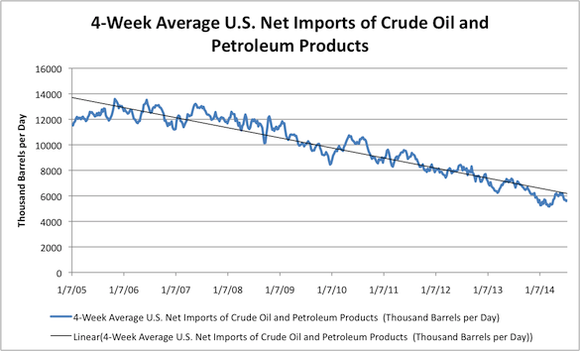
Source: U.S. Energy Information Administration.
What’s surprising is that it’s not just an increase in oil drilling that’s caused the decline in imports. Declining demand has played a big role as well.
The boom in energy production
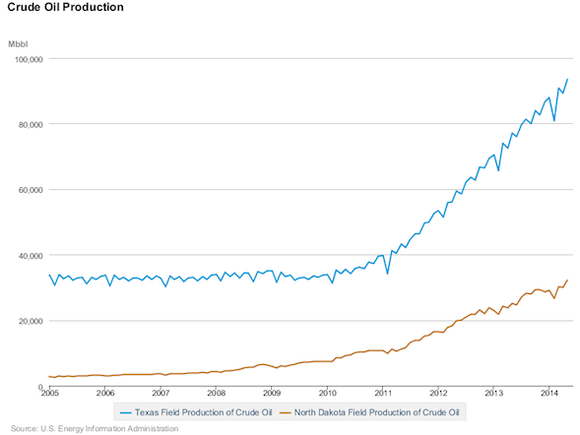
It’s well known that new drilling techniques in shale deep beneath the earth’s surface have been responsible for most of the increased oil production in the U.S., but just how fast production has increased is incredible.
Below is a chart of the crude oil production in Texas and North Dakota, two states that accounted for 48.5% of the oil production in the U.S. in May, according to the U.S. Energy Information Administration.
Source: U.S. Energy Information Administration.
You can see that the trends are showing no signs of slowing, either. Oil and gas companies are focusing their efforts on oil-rich fields right now, and production should continue to grow, especially in Texas and North Dakota where the Eagle Ford, Barnett, and Bakken plays continue to show increasing potential.
Declining consumption helps the cause
While increased oil production is great, it doesn’t mean a lot to imports if consumption is rising as well. The good news is that consumption is falling, and that’s helped reduce imports even further.
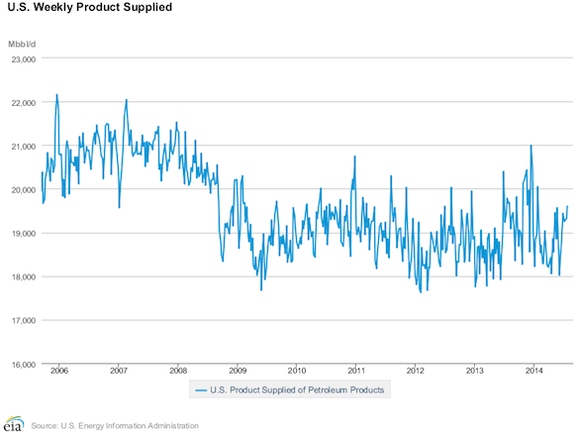
Source: U.S. Energy Information Administration.
There are a few things driving the reduction in oil consumption. First, people are simply driving less as a result of urbanization and the simple desire to save money. But when they are driving, they’re driving more efficient cars.
SUVs that were very popular during the 2000s have seen sales decline in favor of hybrids and even electric vehicles. New CAFE standards were put in place in 2012 that will require automakers to reach a fleet fuel efficiency of 54.5 miles per gallon by 2025, and the technology to make that happen is already being put into vehicles.
These factors will at least keep a cap on consumption growth long term, if not reduce consumption overall. That’s key if the U.S. is ever going to be truly energy independent.
When will the U.S. be energy independent?
Within the next few years, the U.S. will be a major natural gas exporter, so the big concern for energy independence is oil.
If the current rate of net import decline continues, the U.S. will be energy independent around 2020 and could even become a net exporter by then. That’s an amazing turnaround from importing a net 12.5 million barrels of oil per day in 2005.
37 Comments on "The Amazing Story of America’s Coming Energy Independence"
strummer on Sun, 3rd Aug 2014 5:47 am
“people are simply driving less as a result of urbanization and the simple desire to save money”
When you put it this way, it seems that the people in Africa are starving as a result of the simple desire to save money too.
peakyeast on Sun, 3rd Aug 2014 6:58 am
“What’s surprising is that it’s not just an increase in oil drilling that’s caused the decline in imports. Declining demand has played a big role as well.”
If that is a surprise during the second great depression then the author must be an idiot.
dissident on Sun, 3rd Aug 2014 7:47 am
The graph supposedly showing the Texas production is an obvious fake. I don’t know why someone would fake such figures but there you have it. It is a simple function with an exactly linear ramp after mid 2011 with some high frequency noise overlaid. Look at the North Dakota graph, it shows longer timescale variations, which is to be expected.
eugene on Sun, 3rd Aug 2014 7:52 am
Just another hyper optimistic, poorly researched article written by someone paid to do so.
Boat on Sun, 3rd Aug 2014 8:23 am
The artical and doomers don’t mention the improved tech of auto mpg. Bring on more cash for clunckers.
Davy on Sun, 3rd Aug 2014 8:25 am
These Wall Street lobbied MSM fools are creating a monkey trap that can only end bad with mal-investment and unrealistic confidence.
rockman on Sun, 3rd Aug 2014 8:38 am
“It’s well known that new drilling techniques in shale deep beneath the earth’s surface have been responsible for most of the increased oil production in the U.S”. And again following the philosophy that if you repeat a lie often enough more folks will believe. The tech used today isn’t very different then it was 20 years ago. What is new is oil prices increasing from $35/bbl to over $95/bbl.
Boat on Sun, 3rd Aug 2014 8:51 am
The tech is much different and getting much more efficient. 16 wells per pad draining fields more effectively and quicker for starters. Drilling and fracking is getting more and more like a Nascar team driving down the costs of production. But Rock i get your point, still just a hole in the ground. After the US civil war they used artillery shells to frack, at the time it was revolutionary.
shortonoil on Sun, 3rd Aug 2014 9:05 am
Remember the hype that surrounded the ethanol fiasco? We are supposed to now all be crushing around in alcohol power vehicles. That didn’t work! Someone forgot to mention that the EROI of ethanol is about 1:1. That someone was the lobby pushing for government subsidies to back ethanol.
We are now being hyped by another professional, well funded PR campaign. They are again forgetting to mention that the ERoEI of shale is to low to power the economy. Of the very best of the shale, the Bakken, only 70% its produced hydrocarbons can be converted into transportation fuels. In the rich gas condensate fields of the Eagle Ford it is 7%.
“American energy independence, the new Saudi Arabia, the miracle of shale, and etc.” is just another attempt by the same bunch of PR specialist to put a very distinctive color of lip stick on a very ugly pig. The same trick of using a lot of barrels that are worth anything, is being pulled again. “Fool me once shame on you; fool me twice shame on me.”
http://www.thehillsgroup.org/
Boat on Sun, 3rd Aug 2014 9:12 am
Tell me short, How much Nat gas from these same wells is used to process oil in refineries, combined with CHP tec that has turned the US into a huge petroleum net exporter. There are more sides to the fracking story than doomers let on.
Boat on Sun, 3rd Aug 2014 9:14 am
Then let’s talk about the fracking which will explode in mexico in the next 20 years. The bridge of fracking to alternatives looks real to me.
Kenz300 on Sun, 3rd Aug 2014 9:22 am
Bring on the electric, flex-fuel, hybrid, biofuel, CNG, LNG and hydrogen fueled vehicles. End the oil monopoly on transportation fuels. Competition is good and needed.
Cities are becoming more people centered and less auto centered.
People are walking more, riding a bicycle more and taking mass transit more.
Politicians need to expand safe walking and bicycle paths that connect schools, work, homes and businesses. Cities need to be designed to be more walkable and bike able.
Businesses, apartments and schools need to provide greater opportunities to lock and store bicycles safely.
Cities need to bring back trolleys to the center of the city. Trolleys once were an important part of the urban transportation system. They are more efficient people movers than an automobile.
The price of oil keeps rising. That will continue to drive changes in behavior.
Davy on Sun, 3rd Aug 2014 9:42 am
Boat, short makes an important point that if it is even partially true spells trouble for your aurgument of copious supplies from Mexico. We know the us shale plays are a retirement party.
ghung on Sun, 3rd Aug 2014 9:49 am
Boat: “…CHP tec that has turned the US into a huge petroleum net exporter.”
Gosh… When did that happen? Either I missed the memo or you pulled that one straight out of your ass. Care to share your sources and figures? The EIA reports total “U.S. Net Imports of Crude Oil and Petroleum Products” at 6.2 million barrels per day in 2013. Either they are lying or you are,, or maybe I missed something.
Beery on Sun, 3rd Aug 2014 9:53 am
The writer of this article has a brilliant future in stand up comedy.
steve on Sun, 3rd Aug 2014 9:56 am
Stories like the one above make me so mad because they are just to placate the masses….we still need a Saudi sized oil patch every 4 years just to keep up with declining wells and growth…unless the plan is to crash the whole system. and with a deep…deep depression ..and that may very well be the case…
Boat on Sun, 3rd Aug 2014 9:58 am
Davy, not supplies from Mexico. From 1999 to 2013 our exports to MEX doubled and projected to double again by 2018. Nat gas is cheap and plenty of it. All of North America trades in it’s own market with prices around $4.50 while most of the rest of the world pays much more. Mexico will continue to enjoy robust growth as a result. Cheap energy raises all boats in North America.
JuanP on Sun, 3rd Aug 2014 10:13 am
Boat, wellcome! Hang around in this forum for a few months if you think the USA is a net petroleum exporter, you have a lot to learn. The USA imports millions of barrels of petroleum every day of the year and has been doing so for decades. We are also a net gas importer, IIRC.
You should be more reserved and less confrontational in your comments until you’ve learned more about the subject. There are many people here you could learn from.
Boat on Sun, 3rd Aug 2014 10:29 am
Juan you need to reread my comments. I made no such claims. petroleum products is much different than oil. and we are a net exporter of refined products. I made no claims of the US being a net nat gas exporter. Although it is projected to do so in 2016, we will see. I consider myself well read on the topic of energy and talk numbers from the eia. If I read anti american slander and one sided opinions, I just consider it my obligation to educate the other side of the equation. Let’s look at the full picture.
JuanP on Sun, 3rd Aug 2014 10:36 am
I agree with the author that there is an amazing story of a coming global and American energy independence to tell, just not this story. The story would revolve around increasing oil prices and production costs everywhere, declining global oil production, and the ELM. And it is an amazing story to tell, all right, could even be a book.
Boat on Sun, 3rd Aug 2014 10:40 am
Juan, even US DOE projections as far out as 2050 show nothing but oil imports.
Boat on Sun, 3rd Aug 2014 10:44 am
My mistake, in my earlier comment I ment to say the US is a net refined petroleum product exporter. Not a oil exporter.
paulo1 on Sun, 3rd Aug 2014 10:59 am
I skipped the article after the headline and went straight to the comments. I thought, “this should be good”. Well done, folks.
Paulo
Dave Thompson on Sun, 3rd Aug 2014 11:30 am
The amazing story of America’s coming energy independence. As in fairy tale story.
ghung on Sun, 3rd Aug 2014 11:30 am
Boat: “Mexico will continue to enjoy robust growth as a result. Cheap energy raises all boats in North America.”
There you go again, Boat. According to numerous sources, “robust” may be overstating Mexico’s current growth rate. Quoting ‘tradingeconomics dot com’:
“The Gross Domestic Product (GDP) in Mexico expanded 0.30 percent in the first quarter of 2014 over the previous quarter. GDP Growth Rate in Mexico averaged 0.63 Percent from 1993 until 2014, reaching an all time high of 2.90 Percent in the first quarter of 1996 and a record low of -6.60 Percent in the first quarter of 2009. GDP Growth Rate in Mexico is reported by the Instituto Nacional de Estadística y Geografía (INEGI).”
Per the World Bank, Mexico’s “Economic growth in 2013 fell to 1.1 percent…”
Perhaps your definition of “robust growth” differs from mine, but it sounds like more hype to me. I’ll concede that cheap natural gas may be helping Mexico avoid contraction for now; little more.
I can do this all day long.
JuanP on Sun, 3rd Aug 2014 11:35 am
Kenz, you left out compressed air cars. If you haven’t heard about them, do some research. They are really cool for short distances and light duty vehicles.
I love bicycles, electric trolleys and trains, too. In the condo where I live there is a bike locker room that costs $10 per bicycle per month to use. In my previous condo, no arrangement for bikes or scooters at all. Up the elevator to your unit.
bobinget on Sun, 3rd Aug 2014 11:35 am
Kazakhstan is a huge NG exporter. Maybe someday the US can emulate.
Boat on Sun, 3rd Aug 2014 12:17 pm
http://www.tradingeconomics.com/mexico/gdp
yes we certainly differ on the idea of robust growth. Add to their growth the coming fracking boom and robust may turn to dramatic growth as compared to their bleak past. They also have a ridge of mountains running through the backbone of their country that has some of the best wind in the world. I suspect the nat gas and oil revenue will provide capital for this energy starved country.
shortonoil on Sun, 3rd Aug 2014 1:49 pm
“yes we certainly differ on the idea of robust growth. Add to their growth the coming fracking boom and robust may turn to dramatic growth as compared to their bleak past.”
The shale boom grew in the US for three reasons:
1) The US had most of the needed infrastructure already in place.
2)The US shale industry had access to huge amounts of cheap money (complements FED).
3) The US shale industry had a captive market for its LTO production with the Canadian bitumen producers.
Mexico doesn’t have any of those benefits. If the Chinese are shunning shale production (and just about everyone else) why would anyone think that Mexico could do it?
http://www.thehillsgroup.org/
Boat on Sun, 3rd Aug 2014 2:30 pm
Eagle Ford and Houston. Mexico uses alot of fuel oil and to generate electricity. Impoted nat gas from the US and their own fracking potential is much cheaper.
Pianomanatee on Sun, 3rd Aug 2014 4:51 pm
Me too, Paulo1. I knew the comments to this cornucopian article woild be good. I was not disappointed.
rockman on Sun, 3rd Aug 2014 5:48 pm
Boat – “The tech is much different and getting much more efficient.” I was using the same horizontal drilling and frac’ng tech 20 years ago as they are using today. We’re drilling 5,000’+ laterals in our shales and Maersk was drilling 30,000’+ laterals years ago in the Persian Gulf. And more then 30 years ago I did a frac more then 10X the volume of a typical current frac stage. I could have been doing exactly what’s being done today in the EFS ten years ago…if I had oil prices 300% higher then as they do now. Heck, much of the frac equipment being used today is over 20 years old.
Better efficiency? Perhaps depending on how one defines it. But you’re leaving out the fact that current shale well are costing 2X to 4X what they were when the boom started. Somewhat more productive wells now but drilling laterals several times longer and doing 20+ frac stages instead of just several. In reality the frac’ng costs have been exceeding the drilling cost of many of the wells for some time.
But don’t take what I say wrong: despite the views of others the shale plays as a whole are still viable IMHO…as long as oil prices stay high. But that doesn’t change the fact that there are a finite number of locations left to drill even at the higher prices. And no improvement in efficiency is going to change the high declines rates of fractured reservoirs. Not one of the currently completed shale wells will be producing anywhere close to a significant amount of oil in just 4 to 5 years. That’s a already proven by earlier wells. The oil patch will keep poking shale wells as long as prices stay high. They have no choice: it’s drill or die. The same is true for the Rockman.
Boat on Sun, 3rd Aug 2014 6:41 pm
A newer tech is to is to have over 200 fracks in the same amount of line in groups of three vrs maybe 20. Shorter and wider fracks is the idea with many more of them. They claim much better results of extracking oil in a given area.
Makati1 on Sun, 3rd Aug 2014 9:01 pm
The more outrageous the story, the closer to the cliff…
Northwest Resident on Sun, 3rd Aug 2014 9:34 pm
Fracking is a big-time money loser, or as the writer of the article linked below states, where money goes to die. It is a temporary bridge to our oil-deprived future. When it goes bust, as it will soon enough, we’ll officially be in the next stage of our fast ride down the backside of peak oil.
“The financial hype around fracking, the limitless, nearly free liquidity provided by the Fed since late 2008, and investors so desperate for yield that they’re willing to incur just about any risks in their vain battle to come out ahead have had Wall Street frothing at the mouth. The sweeps of creative destruction have broken down. Instead, the boundless stream of money has been searching for a place to go, and it went to an economic activity – fracking – where money goes to die. What’s left is debt, and wells, especially gas wells, that will never produce enough to pay off the debt that was incurred to drill them.
These binges can go on for a long time, for far longer than a sane person in normal times would think possible. But with revenues barely growing, cash flows from operations stagnant, and debt levels that are soaring, at some point, something has to give.”
Wolf Richter: How Fracking Is Blowing Up Balance Sheets of Oil and Gas Companies
nakedcapitalism dot com/2014/07/fracking-blowing-up-balance-sheets-old-companies.html
baptised on Mon, 4th Aug 2014 12:00 am
Was this article written before or after Thurs.& Fri. huge stock market losses?
MKohnen on Mon, 4th Aug 2014 2:46 am
Boat,
What are you arguing for? First off, you act as if you need to convince the world that oil will last forever! In case you haven’t noticed, most of the uninformed world already believes that! But to convince informed people is a different story. Consider the people here more like scientists, and scientists believe in tests for every theory. The simplest and most honest test for whether oil production is becoming easier or harder is the price trend. If you are right, the price will come down, and should start doing so fairly soon. If you are right, the FED can stop QE immediately since the drop in energy prices will spur the economy and prevent rampant inflation (I realize that I am not using the word “inflation” in the economist’s monetary sense.)
If you’re wrong, energy prices will go up, the economy will continue to struggle, and rather than cease QE, the FED will rejig it so it looks different, and probably even ramp it up.
Time will tell. But if the US government thought you are going to be right, they’d be acting a lot calmer than they are right now!