
Peak Oil is You

Donate Bitcoins ;-) or Paypal :-)


Page added on April 21, 2013

Tech Talk – The BP view of the future

So I suspect I should apologize. Here I am talking about the future projections for energy production that have been made by companies such as ExxonMobil and Shell, as though they were still the key and only players in the world. Yet, in reality, Saudi Aramco (12.5 mbdoe); Gazprom (9.7 mbdoe) and National Iranian Oil (6.4 mbdoe); appear in the list before ExxonMobil arrives (at 5.3 mbdoe), and then there is PetroChina (at 4.4 mbdoe) before BP arrives (at 4.1 mbdoe) and it is only then that we find Shell, which lies 7th at 3.9 mbdoe.
So the projections of the ExxonMobil’s of the world are of somewhat lesser value than they might, at one time, have been. (For those curious the list continues with Pemex (at 3.6 mbdoe); Chevron (at 3.5 mbdoe) and Kuwait Petroleum Co (3.2 mbdoe). This not only rounds out the top ten, it also closes out the list of those producing more than 3 mbdoe. (Abu Dhabi comes next at 2.9 mbdoe).
Yet, with those caveats, and recognizing that Saudi Arabia now produces only slightly less than ExxonMobil, Shell and BP combined, let me review the BP forecast, having already completed that for ExxonMobil and Shell. And while the latter two looked sufficiently far into the future as to obfuscate a little their shorter-term projections, BP is still focusing on the relatively short-term that runs to 2030.
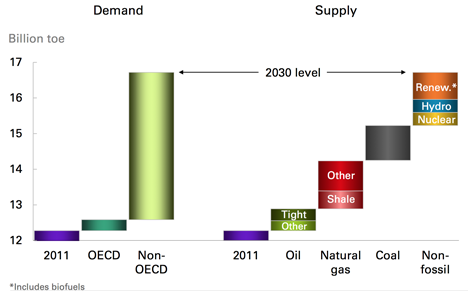
Within that time frame BP expects overall energy demand to grow by 36%, though, as with the ExxonMobil projection, BP expects that a “tremendous increase” in energy efficiency will continue to develop, thereby slowing the need for future resources. They point out that, without this improvement in efficiency, global energy supply will need to double by 2030 in order to sustain economic growth.
This is particularly true for the United States, which BP sees approaching self-sufficiency in Energy, while it is the continued growth in demand from countries such as China and India and the Asian Pacific countries that provide most of additional need. Comparing their view from 2 years ago with the present there does not appear to be much change in the overall forecast. (Note that after the first two figures all the remainder come from the 2030 BP Energy Outlook).


There is a small increase in the overall demand from non-OECD countries in the more recent projection, but not a great difference. But this increase in demand reduces from a growth averaging 2.1% in the 2010-2020 time frame, to a growth of 1.3% in the following decade.
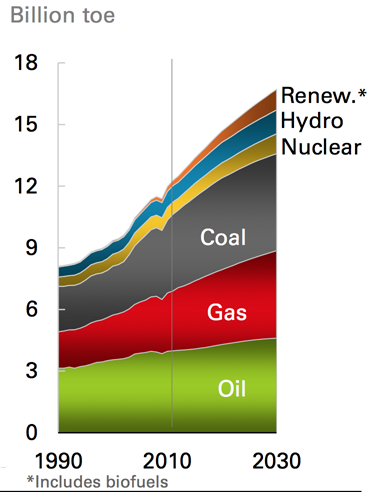
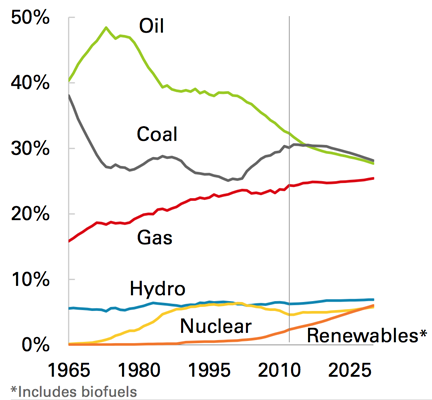
Within the period to 2030 BP anticipates that all major energy sources will continue to see an increase in overall energy production.
The fastest growing fuels are renewables (including biofuels) with growth averaging 7.6% p.a. 2011-30. Nuclear (2.6% p.a.) and hydro (2.0% p.a.) both grow faster than total energy. Among fossil fuels, gas grows the fastest (2.0% p.a.), followed by coal (1.2% p.a.), and oil (0.8% p.a.).
In terms of natural gas and oil supply questions are more urgent, and BP provide the following answer.

BP make the following prediction:
The US will likely surpass Russia and Saudi Arabia in 2013 as the largest liquids producer in the world (crude and biofuels) due to tight oil and biofuels growth, but also due to expected OPEC production cuts. Russia will likely pass Saudi Arabia for the second slot in 2013 and hold that until 2023. Saudi Arabia regains the top oil producer slot by 2027.
Other than tight oil, BP anticipates some increase in biofuel production, and from the oil sands, with significant increase in Iraqi production, and some gain from the remaining OPEC countries (one suspects Venezuela is included here) and from NGL production.
The largest increments of non-OPEC supply will come from the US (4.5 Mb/d), Canada (2.9 Mb/d), and Brazil (2.7 Mb/d), which offset declines in mature provinces such as Mexico and the North Sea. The largest increments of new OPEC supply will come from NGLs (2.5 Mb/d) and crude oil in Iraq (2.8 Mb/d).
In this regard BP believes that currently OPEC has a spare capacity of around 6 mbd, but will continue to cut production to sustain prices over the decade.
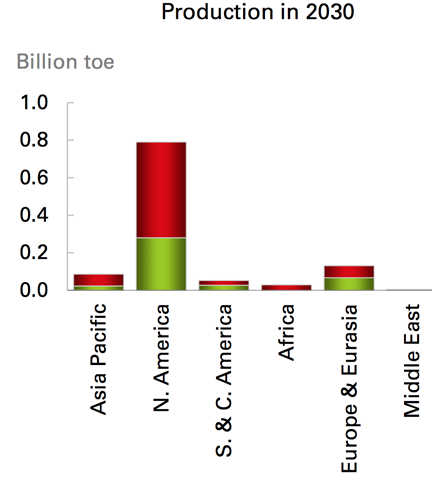
BP see roughly a 7% p.a. increase in shale gas production with most coming from the United States, Mexico and Canada. This will bring total natural gas production to 459 bcf/day by 2030. Of this North America will see a growth in production of 5.3% pa and by 2030 will be exporting roughly 8 bcf/d. In other countries the biggest growth will be in more conventional natural gas production, coming from the Middle East (31 bcf/d), Africa (15 bcf/d) and Russia (11 bcf/d).
This increase in supply, and the greater use of LNG tankers is likely to keep natural gas prices relatively stable.
5 Comments on "Tech Talk – The BP view of the future"
J-Gav on Sun, 21st Apr 2013 9:14 pm
Oh gee, what happens when the natgas boom busts in the US (1 to 4 years)… and what happens to all those very expensive LNG tankers who no longer have much to haul around? And what happens to the very expensive conversion facilities contructed to deal with that? And what happens to anybody who listens to what BP has to say about the future of anything?
BillT on Mon, 22nd Apr 2013 12:46 am
“No, no, look this way. Ignore those facts. Here is the ‘true BP story’ about energy. Ignore those neigh-Sayers. Growth is coming, really, and we can supply that if … well, if we find another Saudi Arabia and another North Sea, and another Alaska, and … Wait! Don’t go away! Listen to us! Wait…”
J-Gav, you got it correct. There is a lot of misery in those investor/gambler’s future.
BillT on Mon, 22nd Apr 2013 1:20 am
BTW: Anyone who believes that ‘progress’ is the only future we have should take time to read these two articles by one of my favorite bloggers.
http://thearchdruidreport.blogspot.com/2013/04/an-aside-to-my-readers.html
http://thearchdruidreport.blogspot.com/2013/04/the-religion-of-progress.html
A new blog is published every Wednesday.
Others on Mon, 22nd Apr 2013 3:57 am
All those numbers are given in mbdoe which means million barrels / day oil equivalent and not just Oil.
So they are including natural gas as well.
If you take Oil alone, then the number will be much lesser.
Kenz300 on Mon, 22nd Apr 2013 3:49 pm
Who Killed $2.18 Gasoline? | Renewable Energy News Article
http://www.renewableenergyworld.com/rea/news/article/2013/04/who-killed-2-18-gasoline