
Peak Oil is You
Donate Bitcoins ;-) or Paypal :-)


Page added on July 28, 2013

Tech Talk – Of Egyptian Bread and Oil
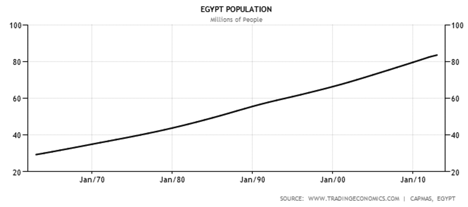
The turmoil in the Middle East shows little sign of ending in the near future, and the potential lack of enough cheap fuel for the population is a warning that the levels of unrest may continue and even get worse. There is, however, some hope for enough local supply in the near term to help with some of the indigenous problems. Consider, for example, Egypt, which has the largest population of the countries in its immediate vicinity, a population that has grown 200% in the last 50 years.
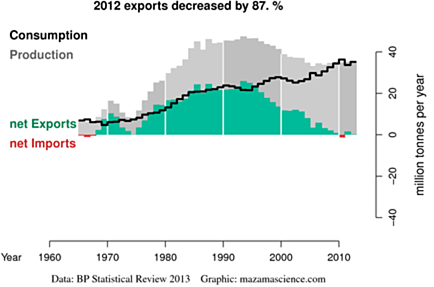
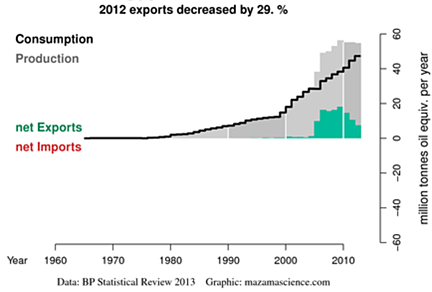
This may help with the short–term problem, which has too many political entanglements to allow any solid predictions for longer term help from outside the country, but there are potential sources of increasing domestic supplies from both the Western Desert and the Nile Delta itself.
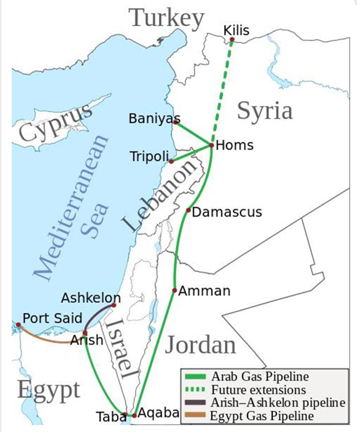
Egypt has been supplying natural gas to Jordan, Syria, Lebanon and Israel through the Arab Gas Pipeline, with flow starting in Arish, and the leg to Ashkelon being underwater.
The possible presence of oil-bearing strata at a lower depth in the Levant Basin has led Noble to plan an offshore well to go down 31,200 ft to a potential field holding perhaps as much as 1.8 billion barrels of oil. However, Noble estimates the chance of success at 25%.
The recent success in finding these resources within the Levant Basin suggests that the potential for other discoveries in future years, with significant possible impacts on the local economies.

In the longer term, as the Israeli fields come on line, it might be possible to change the direction of flow of the Arish-Ashkelon pipeline to carry Israeli gas into Egypt. There are thus potential technical solutions to getting fuel to Egypt to meet their growing need.
However,this does not address the underlying problem of how Egypt is going to be able to pay for that fuel (not to mention the bread). Even with a potential glut in global natural gas prices, without a stable economy Egypt is not going to be able to pay its import bill. This was evident towards the end of the Morsi government, when a lack of cash, or hard credit made it more difficult for the country to assure itself of enough imported oil to meet demand. The continued turmoil will keep away the tourists that could provide the economy with enough funds, while the lack of international recognition of the current regime is currently keeping the IMF from providing any help.
A couple of hundred years ago, deriding the people’s need for bread reputedly led one ruling family to the guillotine. In the time since the people have also come to expect that they can also get fuel. Until both demands are satisfied it may be more likely than not that rule in Egypt will remain unstable, with the presence and influence of the competing mobs making rational decisions less achievable and the situation worse. (And they are also blowing up pipelines in Iraq.)
8 Comments on "Tech Talk – Of Egyptian Bread and Oil"
GregT on Mon, 29th Jul 2013 5:51 am
We don’t live in the 1600s anymore. Modern agricultural practices require oil.
Not enough oil, not enough food.
Arthur on Mon, 29th Jul 2013 9:28 am
Moderator: please delete previous post now under moderation.
———————-
http://cleantechnica.com/2013/07/28/what-0-36w-solar-means/
Research: 2017 –> 36 cent/Watt
That would result in an electricity price FIVE times less than paid on the major European wholesale market, EEX, the European Energy Exchange.
Solar is going to whipe out fossil. The only critical factor is timing. If we wait too long we throw our societies into chaos where nothing can get organised any longer.
‘Development aid’ in the future could consist of shipping turn key solar panel factories from Europe to Egypt, where an unlimited supply of ultra cheap labor exists. Egypt has an endless solar energy potential.
Excess energy could be used as an export product, possibly converted into H2 + CO2 –> CH4 (methane)
…leading to a carbon-neutral combustion cycle. Many (European) countries have nation wide methane grids plus 1-2 year storage facilities.
See wikipedia “Sabatier reaction”
BillT on Mon, 29th Jul 2013 12:23 pm
Dream on Arthur. ^_^
In the near future, Western Europe, what is left of it, will be under Russian domination. the South Pacific will be under China, and the US will be a 3rd world nation. What is left of it, that is. Or so it seems as I look at today’s world and the direction it is heading. After all, they need to get rid of about 6 billion of us ‘eaters’ soon or…
GregT on Mon, 29th Jul 2013 4:32 pm
Arthur,
“If we wait too long we throw our societies into chaos where nothing can get organised any longer.”
If you haven’t noticed, Egypt is already in Chaos. They need food now. Solar generated electricity is not going to feed the masses, in Egypt, or anywhere else.
Arthur on Mon, 29th Jul 2013 5:32 pm
“If you haven’t noticed, Egypt is already in Chaos.”
That’s for political reasons, not because these people are starving.
GregT on Tue, 30th Jul 2013 12:19 am
http://www.wfp.org/countries/egypt/overview
http://documents.wfp.org/stellent/groups/public/documents/ena/wfp257519.pdf
“The country has, in addition, suffered from the effects of a number of major international shocks since 2006; the avian influenza epidemic followed by the food, fuel and financial crisis. By 2011, 25.2 percent of the population were unable to meet their basic needs.”
moli on Tue, 30th Jul 2013 1:13 am
the economic contraction will be managed very carefully by the oil cartel governments over the next few decades. so obviously there will be many red herrings , increased surveillance, and tons of media bs
GregT on Tue, 30th Jul 2013 4:22 am
The economic contraction will not last for several decades. If we are fortunate it will last for another ten years. Most likely less.
The truth of the matter is, economics are the least of our concerns. The economy has no bearing what-so-ever on natural survival. The environment trumps human greed, and in the end, it is greed that will destroy any hope that we as humans have at survival, and it will happen much sooner than most would like to believe.
We can live without an economy, but we will die without a healthy natural environment.