
Peak Oil is You

Donate Bitcoins ;-) or Paypal :-)


Page added on December 16, 2012

Tech Talk – Iran and the new EIA and OPEC Reports

With the possibility that demand for Iranian oil may fall below 1 million barrels a day (mbd) as sanctions continue to bite, Iran has announced that it wants OPEC to cut back production to the agreed quotas, rather than the overall additional 1 mbd that is actually being produced, and sold. Such a move would, of course, make it more difficult for those customers who have found a way of replacing Iranian oil, and perhaps incline them more towards disregarding the embargo.
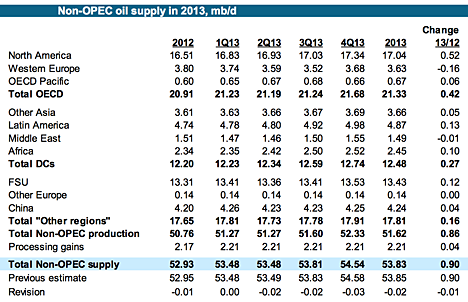
OPEC has just released their December Monthly Oil Market Report (MOMR) in which they anticipate that earlier projections for 2013 oil demand growth will still be valid, at 0.8 mbd. (Though they note that December 2012 growth y-o-y was at 1.0 mbd as the US economy continued to improve). They expect that all of this increase will be met by non-OPEC increases in supply, and that demand for OPEC oil may even drop 0.4 mbd. Part of that projection continues to rely on increased US crude production, and the EIA TWIP of December 5th had the latest chart showing that projected growth, based on the newly released Annual Energy Outlook 2013.
Coming back to the MOMR their projections do not include the recent news that Venezuelan President Chavez has had to have a fourth operation for cancer, and has named a successor, although the operation was apparently successful. This may complicate the decisions on how much to allocate among the OPEC partners, especially since all continue to need higher priced oil.
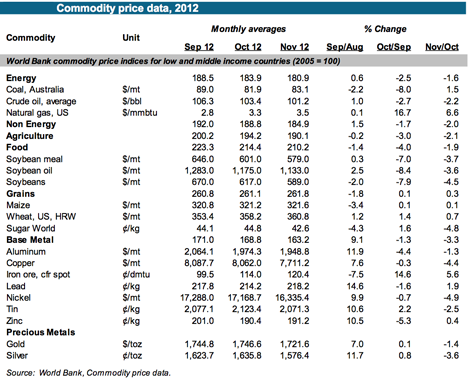
OPEC also give the price of various commodities in their report, and before going on to discuss country production, those prices are informative. At present, with the decline in overall global demand, metal prices in particular seem to be continuing to slide.
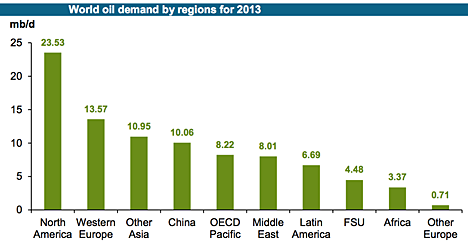
Looking at where this oil might come from, the main increase is still anticipated to come from North America.
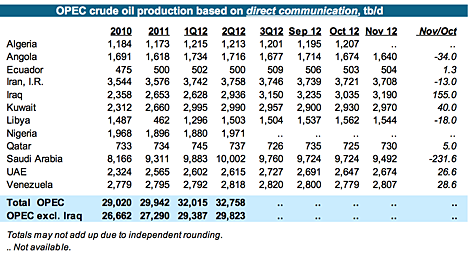
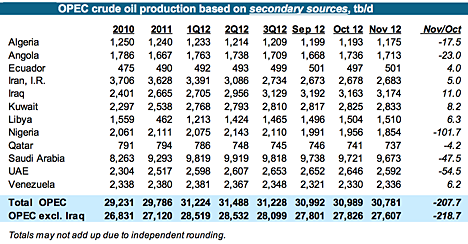
Which brings us back to OPEC production levels. (Note that this is for crude oil and does not include the roughly 6 mbd in NGL that are currently being produced).
Firstly, this is what the various governments are reporting that they are producing:
The meeting was largely distracted by debate over who should be the new Secretary General, with this being “kicked down the road” for a decision at the end of May.
On the other hand, while Malaysia had promised to halt imports of oil from Iran last March, the IEA is reporting that they increased crude purchases from Iran in November. Whether this is oil ultimately destined for that country, or whether this is a convenient transshipment point from Iranian tankers bringing in crude, which is then transferred to other carriers and a second purchaser is not clear, although a Chinese oil trader appears to be involved.
A move to make US natural gas available to NATO allies has begun in the Senate, with the intent that perhaps this could wean countries like Turkey from their use of Iranian and Russian natural gas. Whether this will ever amount to much is not clear, since Senator Lugar, the initial author, was defeated in the primary to the last election and thus leaves the Senate at the end of the term.
One Comment on "Tech Talk – Iran and the new EIA and OPEC Reports"
BillT on Sun, 16th Dec 2012 1:02 pm
Lots of ‘pipeline’ dreams here. That black bulge in the top graph is like counting the chicks before the eggs are even laid..lol.