
Peak Oil is You

Donate Bitcoins ;-) or Paypal :-)


Page added on November 18, 2012

Tech Talk – Global oil supply and Iranian Production
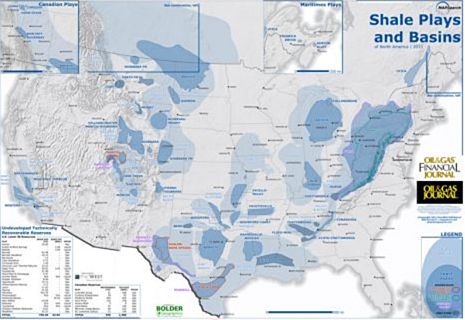
One of the headlines this week has come from the IEA Report that suggests that the United States will be the top global oil producer in five years. Yet back in DeSoto Parish in Louisiana where the Haynesville Shale discovery in 2008 started the bonanza, revenues are now falling and school board budgets are being tightened as the end of the glory days are now beginning to appear.
Just this week Aubrey McClendon has said that Chesapeake’s prospects for oil in Ohio, where Chesapeake had high hopes for the Utica Shale, are now dim. It is easy to look at one of the large maps that the Oil and Gas Journal include in their print editions, showing all the shale deposits in the United States, and to be carried away (as the IEA apparently are) with the vast acreage that is shaded on the map. Unfortunately, as we are seeing, reality tells another story. The size of the resources have been measured in the past, and with the best plays being given preference, the recognition of decline rates, and unprofitable wells have not yet been given the prominence in the popular press that they will ultimately draw.


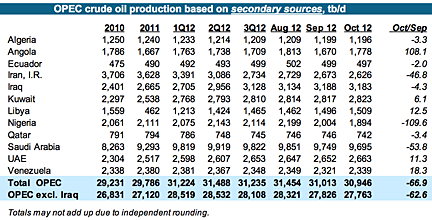
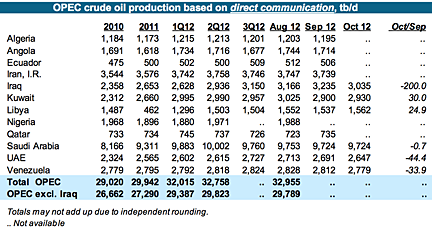
When the “as reported directly” table is compared, Iran is shown to be still producing at around 3.7 mbd.
Concurrently Turkmenistan has stopped exporting natural gas to Iran. Normally Iran would increase imports, over the winter months to around 1 billion cu.ft/day (bcf/d), although this import is partly for geographic reasons, and Iran has, in the past, exported about 80% of the equivalent volume to Turkey. Iran has, apparently, suggested that Turkmenistan increase the delivery to 1.4 bcf/d, but since Turkmenistan can now get a good price for its gas from China, there is more of a debate this year over price, without agreement at the moment. Iran also swops around 35 mcf/d of natural gas with Armenia, in return for electric power.
As a way to try and work around the current sanctions, Iran has been changing to a scenario where it can move more of its oil using its own tankers. The country had been storing millions of barrels in part of this fleet, but that volume is being sold so that the vessels can, instead, haul oil. And there is the possibility that the insurance on these vessels has been “fiddled” to get around the burden imposed by sanctions.
Internally the sanctions are having considerable effect.
Although the government maintains that the official inflation rate is 25 percent, . . . with some analysts claiming that actual figures are double the government rate. In addition, unemployment has soared, with estimates stating that between 500,000 and 800,000 Iranians have lost their jobs. . . . . .”Business is drying up, industry is collapsing. There’s zero investment,” said an Iranian businessman in September. . . . .the government has attempted to shield the lower classes by offering them cash handouts and subsidizing certain imported staple goods, making them relatively affordable for poorer segments of the population. But even these efforts have had a limited effect, as the price of goods such as Barbari bread went from 1,000 rials to 5,000 rials last week.
There are even suggestions that the economy could “essentially explode” by next spring. On the other hand there are ways of getting around sanctions, and these may allow the crisis to continue to simmer for some time.
All of would suggest that exports of Iranian oil will not be easily available for some time, although, with a new regime in China their commitment to maintaining current levels of trade is now not clear. China will open two new refineries one for 240 kbd in Quanzhou that is scheduled to start next June, and one for 300 kbd that is to be located in Zhanjiang, with oil for the latter anticipated to come from Kuwait. Nevertheless it may be that China, which is currently taking about half the Iranian exports might find it possible to accommodate more.
One Comment on "Tech Talk – Global oil supply and Iranian Production"
actioncjackson on Sun, 18th Nov 2012 4:07 pm
“The United States will overtake Saudi Arabia as the world’s leading oil producer by about 2017 and will become a net oil exporter by 2030, the International Energy Agency said Monday.” – NY Times link from article
Lmfao