
Peak Oil is You

Donate Bitcoins ;-) or Paypal :-)


Page added on June 17, 2012

Tech Talk – Current oil production and the future of Ghawar
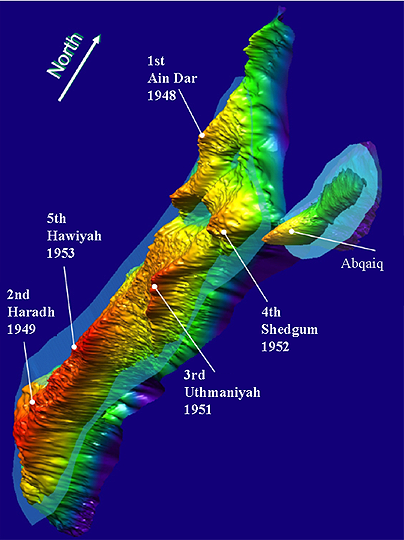
There is a growing impression being given in the discussion of oil and natural gas supplies, that the world is moving into a period where there will soon be such a plentiful sufficiency of crude that the US may consider exporting some of its production. (h/t Leanan). But if one looks behind the headlines, and particularly at the current status of the largest oilfield contributing toward this rosy picture, the Ghawar field in Saudi Arabia, that optimism becomes more evidently built on a very transient set of data that, as this series of posts seeks to show, will not be sustainable for any significant period into the future.
The three major oil producers (i.e. those producing more than 5 mbd each) are currently seeing surges in production as the world moves to an overall production of 90 mbd. The OPEC June Monthly Oil Market Report (MOMR) notes that this has brought Russia to 10.33 mbd in May, some 100 kbd over the same period in 2011; and Saudi Arabia is reported to have averaged 9.917 mbd in May, up 40 kbd over April. The United States is running at 6.236 Mbd of crude (from the EIA TWIP), while importing 9.117 mbd. The MOMR reports US oil supply at 9.66 mbd on average, but counts more than just crude in this value. The gain over the past year is around 600 kbd. It is interesting to note, in regard to OPEC production the continued difference between the volumes that OPEC reports from direct contact with the suppliers, and that when the numbers are obtained from “secondary sources.”
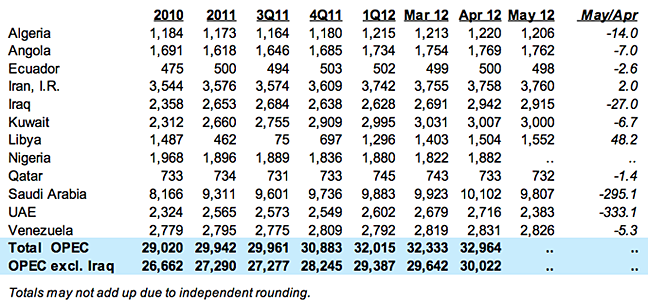
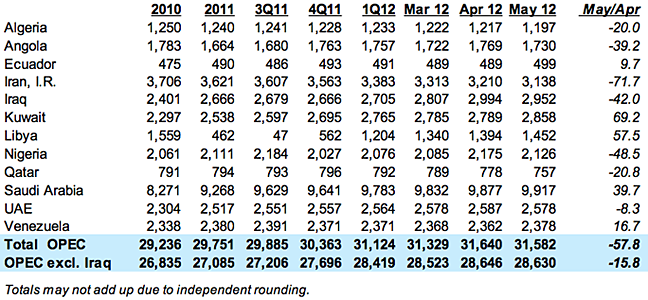

I have, however, in previous posts, given my reasons for anticipating that the surge in both Russian production and that in the United States are at near peak, and will soon decline. Saudi Arabia’s fall will be less dramatic and a little later, but the combination does not bode well for the international supply in the next presidential term.
The big question with Saudi Arabian production has been, to date, more focused on the production from Ghawar, which at 5 mbd has been the rock on which the overall production builds. But that rock is continuously eroding under the long production periods that its different regions have seen.
The final major new effort to bring new production on line in the overall field was the effort at Haradh, down in the South tip of the field.
JoulesBurn has written comprehensively on this region, beginning with the first well that came into production. In 1979, as the late Matt Simmons pointed out in “Twilight in the Desert”, the three northern segments of Ghawar, Ain Dar, Shedgum and North Uthmaniyah were producing 4.2 mbd of the 5.3 mbd total Ghawar output, with South Uthmaniyah producing another 400 kbd. By 2006 North Uthmaniyah was running at a 46% water cut.
Joules has taken the historic record for that region of the field and made a short movie presentation included in a post that shows how Uthmaniyah was developed over the years.
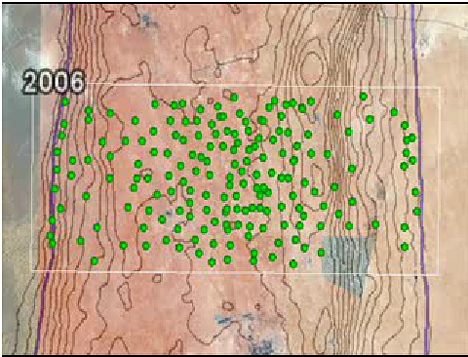
The further development of the lowest segment of Ghawar, down at Haradh, was one of the major projects that Aramco listed as contributing to their ability to produce up to 12.5 mbd. The latest development built on earlier development and because the use of horizontal wells had transitioned into maximum reservoir contact (MRC) designs by the time of Haradh III reduced the anticipated number of wells from 280 verticals to 32 MRC wells.
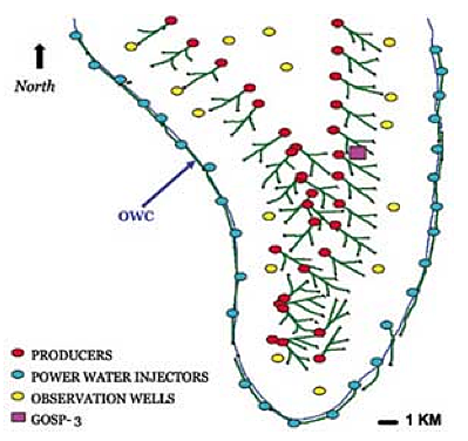
It is relevant to note that Joules updated his view of the region in 2010 when he noted that, after looking at the satellite images of the region, he was able to show that instead of the production coming from the original 32 wells, there were actually some 52 production wells connected up, which – as he noted – raise a few questions as to the actual performance of the wells over the original projections.
Aramco have reported, however (pdf) using Real-Time Reserve Management, that it had by the summer of 2009, been more successful than anticipated.
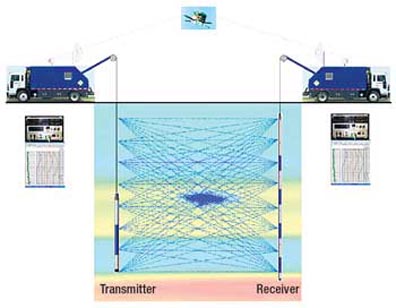
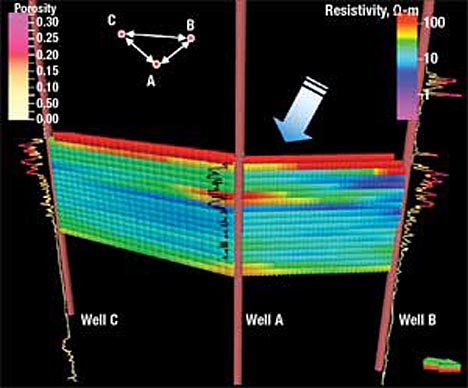
Some of the additional wells drilled were to allow cross-hole tomography (pdf) to monitor the location of the oil:water front which, as production evolved, did not follow the anticipated path. This was particularly important to establish given the 1 km spacing between wells and the more complex geology relative to that further north in Ghawar.
3 Comments on "Tech Talk – Current oil production and the future of Ghawar"
BillT on Sun, 17th Jun 2012 11:59 am
Pretty pictures signifying nothing new. We all know that Saudi oil fields are dying. And that their exports will dwindle and end this decade.
Plantagenet on Sun, 17th Jun 2012 4:32 pm
Excellent technical discussion of Ghawar and its history of production. We all know that Saudi oil fields are finite, and their production will peak this decade.
BillT on Sun, 17th Jun 2012 11:18 pm
Planet, as far as the Us is concerned, when they stop exporting, they are done.