
Peak Oil is You

Donate Bitcoins ;-) or Paypal :-)


Page added on September 16, 2012

Tech Talk – China’s Coal Industry

In this run-up to the election, the American Energy future seems to have faded into the quiet background. Gone are the concerns of past years, as both parties seem to have bought into the idea that the nation is well on track toward a much reduced need to import oil. Wood Mackenzie is forecasting that tight oil production will rise from 1.5 mbd this year to 4.1 mbd in 2020, with the Bakken producing 1.3 mbd, the Eagle Ford 1.3 mbd, the Permian plays (Bone Spring, Avalon, Wolfcamp and Cline) will produce 440 kbd, and the Niobrara should be good for 90 kbd. With the decline in production from the impact of Isaac in the Gulf not yet over, it is not yet clear whether the plateau in US production that was starting to form will continue, or whether the gains in production that these projections require will continue.
But there are some signs that these projections are, shall we say, a little ambitious. Well costs are now running in the $9 – $11.2 million range and, to sustain production, in these formations where wells have a high annual decline rate, increasing numbers must be drilled each year to offset that decline, and the poorer quality of newer wells. But declining rig counts and other concerns are for the future, and if no one coughs too loudly we can pretend that everything remains fine until we get past November.
China does not have that luxury, since the country, having set its people on an upwardly mobile quality of life path, must continue to provide the power that such a ladder requires. As I noted last time, the potential gains from the increased use of natural gas have been noted. Actions have already been taken to make sure that future supplies will meet anticipated needs and work has begun to tap the gas shales of the country.
But despite those efforts, the underlying strength of the Chinese power industry comes from coal.
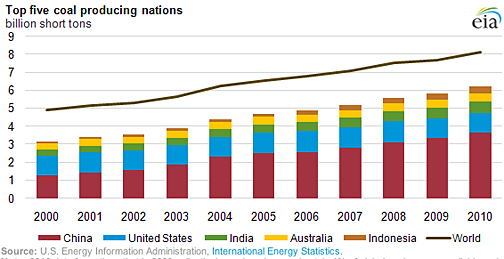
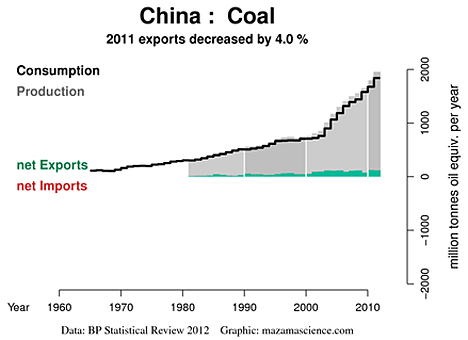
In 2007 Chinese coal production contained more energy than total Middle Eastern oil production. The rapid growth of coal demand after 2001 created supply strains and bottlenecks that raise questions about sustainability.
In 2010, China produced almost half of the world’s coal tonnage.
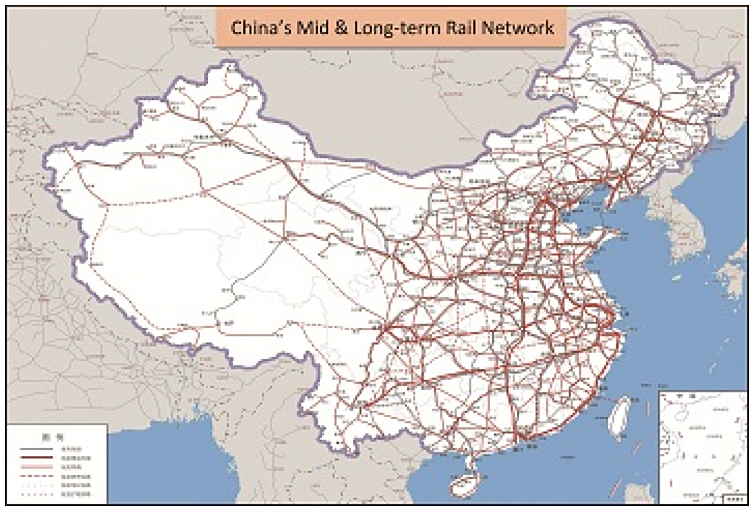
New developments of technology in the West are much harder to come by these days. Research and innovation in coal mining in particular has fallen on hard times in both Europe and the United States (to the point of almost disappearance) and thus as China moves toward automation of its mining, particularly in thin seam conditions they are less able to draw on external sources, and must develop more of their own.
Life is a little different in other ways also, and Western companies can now get into the country and collaborate on development. Peabody, for example, is now developing coal mines in China. It has also been working with the government of Mongolia and will help develop mines in the Tavan Tolgoi region. This may be the only growth region for the company at a time when the current Administration in the United States, not to mention those in Europe, seem bent on closing the industry down as fast as they practically can. Given the amount of power that will be required to sustain current qualities of life, and the disappointing, and expensive costs of recent alternatives, the question as to how long this long-term unrealistic view will prevail is a matter of conjecture. China seems to retain a more realistic view of what is going to be needed, and planning accordingly.
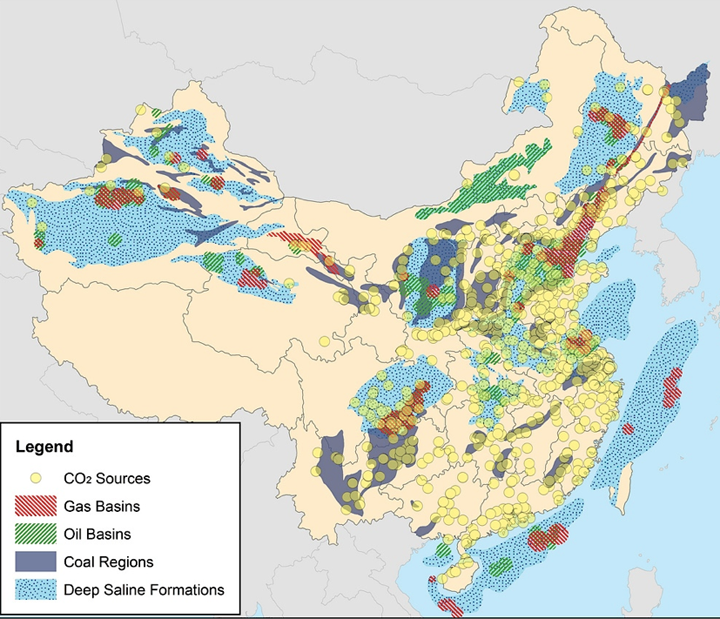
There have been some thoughts given to the possibility of sequestration of all the carbon dioxide that will be generated from the various power plants that use this coal. However the power plants are not necessarily close to places where it might be easy to sequester the gas.
In addition, Rembrandt has recently taken note of the developing Chinese coal to chemicals industry. As conventional oil becomes less available as a feed stock, so the growth of this effort will likely justify the development.
Although China has in the short term (perhaps the next ten to fifteen years) enough coal to sustain internal growth in demand, it is nevertheless also moving pro-actively to ensure that it will have adequate supplies in the out years. Much has been made in the past of their activities in Australia, but, as I have noted, several times in the past the Chinese are becoming well established in Botswana, inter alia, in a country with almost no coal industry yet, but up to 200 billion tons of what are not even counted as reserves yet, because of lack of demand. This may be a lesson for the rest of us.
2 Comments on "Tech Talk – China’s Coal Industry"
BillT on Sun, 16th Sep 2012 11:56 pm
China is buying up resources all over the world with your Walmart dollars. Keep in mind that they have about a trillion plus of them to dispose of before they all become Charmin. The Chinese see what American’s prefer not to, that the demise of the dollar and the “American Dream’ is nearing.
Kenz300 on Mon, 17th Sep 2012 1:57 pm
The Chinese develop long term plans. Seems like the rest of the world is planning quarter to quarter. Most businesses are too concerned with quarterly profits and short term goals to see the long term picture. China slowed its population growth to a manageable level. That was a necessary first step. Now they are developing the industries of the future. They are making huge investments in Wind and Solar and want to be the supplier to the world. They are also hoping to leap frog auto technology by investing in electric and hybrid autos and new battery technology.