
Peak Oil is You

Donate Bitcoins ;-) or Paypal :-)


Page added on July 1, 2012

Tech Talk – a new Energy Report from Harvard makes unsupportable assumptions
The OGPSS posts of the last few months have been following a path of looking in a relatively realistic manner at crude oil production with emphasis on that coming from the United States, Russia and Saudi Arabia – the current focus of the weekly pieces. An earlier piece, looked at a Citigroup report of considerable optimism, and the post explained why, in reality, it is impractical to anticipate much increase in US production this decade. Since then, after reviewing the production from Russia, several posts have shown why their current lead in daily crude oil production is likely to be soon over, and that Russian production will then decline, as the oil companies are not bringing new fields on line as fast as the old ones are running out. Saudi Arabia, as the current section of posts are in the process of explaining, is unlikely to increase production much beyond 10 mbd, since Ghawar, the major field on which its current production level is built, is reaching the end of its major contribution, though it will continue to produce at a lower rate into the future. The bottom line, at least to date, is that there is no evidence from the top 3 producers that their production will be even close, in total, to current levels by the end of the decade.
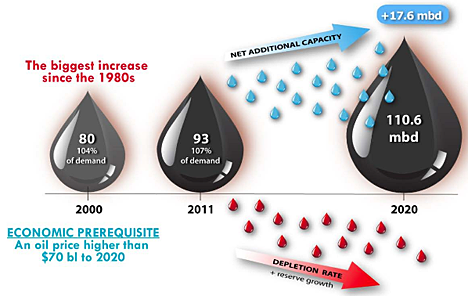
So, (h/t Leanan) there now comes an Energy Study from Harvard which boldly states that this is rubbish, and that by 2020 global production will be at 110.6 mbd and these concerns that most of us have at The Oil Drum (inter alia) are chimeras of the imagination.
That too is shown as a plot:
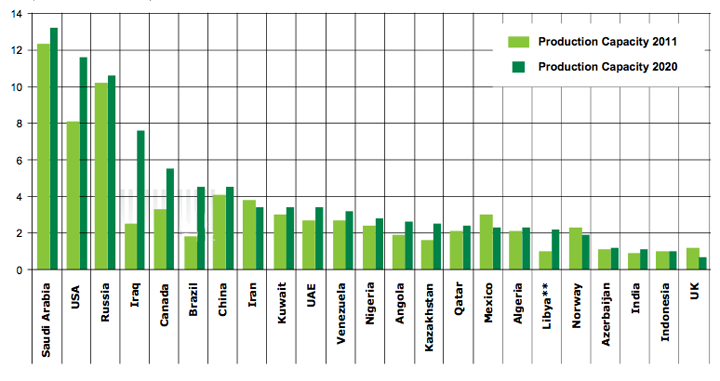
It is interesting, however, to note the report’s view on field declines in production:
Throughout recent history, there is empirical evidence of depletion overestimation. From 2000 on, for example, crude oil depletion rates gauged by most forecasters have ranged between 6 and 10 percent: yet even the lower end of this range would involve the almost complete loss of the world’s “old” production in 10 years (2000 crude production capacity = about 70 mbd). By converse, crude oil production capacity in 2010 was more than 80 mbd. To make up for that figure, a new production of 80 mbd or so would have come on-stream over that decade. This is clearly untrue: in 2010, 70 percent of crude oil production came from oilfields that have been producing oil for decades. As shown in Section 4, my analysis indicates that only four of the current big oil suppliers (big oil supplier = more than 1 mbd of production capacity) will face a net reduction of their production capacity by 2020: they are Norway, the United Kingdom, Mexico, and Iran. Apart from these countries, I did not find evidence of a global depletion rate of crude production higher than 2-3 percent when correctly adjusted for reserve growth.
Sigh! I explained last time that with the change in well orientation from vertical to horizontal, that there was a change in the apparent decline rates. This is because when the wells run horizontally at the top of the reservoir that they are no longer reduced in productive length each year, as vertical wells are, as the driving water flood slowly fills the reservoir below the oil as it is displaced. This does not mean that though the apparent decline rate from the well has fallen that it will, in the ultimate, produce more oil.
The amount of oil in the region tapped by the well is finite, and when it is gone it is gone, whether from a vertical well that shows that gradual decline with time, or from the horizontal well that holds the production level until the water hits the well and it stops. I am not sure that the author of the report understands this.
The point concerning support logistics is critical in a number of instances. The political difficulties in increasing production from the oil sands in Alberta, through constraints on pipeline construction either South or West, are at least as likely to restrict future growth of that deposit as any technical challenge.
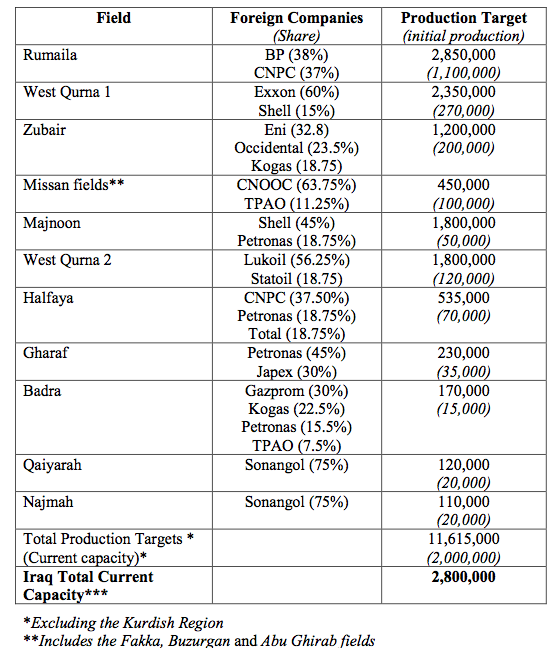
The four countries that the report sees contributing most to future oil supplies are (in the ranked order) Iraq; the United States; Canada and Brazil. For Iraq he sees production possibly coming from the following fields, within the next eight years.

As for US production, this is tied to increasing production from all the oil shales in the country, which will see spurts in growth similar to that seen in the Bakken and Eagle Ford.
I estimate that additional unrestricted production from shale/tight oil might reach 6.6 mbd by 2020, or an additional adjusted production of 4.1 mbd after considering risk factors (by comparison, U.S. shale/tight oil production was about 800,000 bd in December 2011). To these figures, I added an unrestricted additional production of 1 mbd from sources other than shale oil that I reduced by 40 percent considering risks, thus obtaining a 0.6 mbd in terms of additional adjusted production by 2020. In particular, I am more confident than others on the prospects of a faster-than-expected recovery of offshore drilling in the Gulf of Mexico after the Deepwater Horizon disaster in 2010.
As I noted in my review of the Citicorp report this optimism flies in the face of the views of the DMR in North Dakota – who ought to know, since they have the data. The report further seems a little confused on how horizontal wells work in these reservoirs. As Aramco has noted, one cannot keep drilling longer and longer holes and expect the well production to double with that increase in length. Because of the need to maintain differential pressures between the reservoir and the well, there are optimal lengths for any given formation. And, as I have also noted, the report flies in the face of the data on field production from the deeper wells of the Gulf of Mexico.
It seems pertinent to close with the report’s list of assumptions on which the gain in oil production from the Bakken is based:
*A price of oil (WTI) equal to or greater than $ 70 per barrel through 2020
*A constant 200 drilling rigs per week;
*An estimated ultimate recovery rate of 10 percent per individual producing well (which in most cases has already been exceeded) and for the overall formation;
*An OOP calculated on the basis of less than half the mean figure of Price’s 1999 assessment (413 billion barrels of OOP, 100 billion of proven reserves, including Three Forks).
Consequently, I expect 300 billion barrels of OOP and 45 billion of proven oil reserves, including Three Forks;
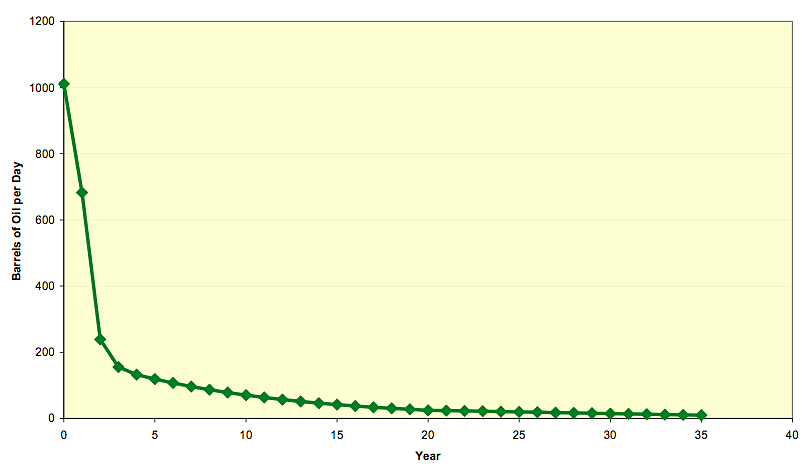
*A combined average depletion rate for each producing well of 15 percent over the first five years, followed by a 7 percent depletion rate;
*A level of porosity and permeability of the Bakken/Three Forks formation derived from those experienced so far by oil companies engaged in the area.
Based on these assumptions, my simulation yields an additional unrestricted oil production from the Bakken and Three Forks plays of around 2.5 mbd by 2020, leading to a total unrestricted production of more than 3 mbd by 2020.
Enough, already! There are too many unrealistic assumptions to make this worth spending more time on. To illustrate but one of the critical points – this is the graph that I have shown in earlier posts of the decline rate of a typical well in the Bakken. You can clearly see that the decline rate is much steeper than 15% in the first five years.
7 Comments on "Tech Talk – a new Energy Report from Harvard makes unsupportable assumptions"
BillT on Sun, 1st Jul 2012 2:26 pm
Harvard…where all rich inbreeds go to meet other rich inbreeds to keep inbreeding. It is an institution long past it’s expiration date. I guess they think that if it comes from Harvard, it is not to be questioned. But, really, 110 mbd by 2020? Maybe 70 mbd net, if we are lucky.I always thought that the rich could afford the better grades of cocaine.
dissident on Sun, 1st Jul 2012 3:25 pm
I don’t know why supposedly high quality reports that come out of academia and are like the postings of a teenage troll on the internet even tolerated. This blog post at the TOD totally destroys the Harvard “report”.
But I will nitpick and say that TOD has been predicting the collapse of Russian oil production for years. Nobody knows the URR for Russia and it is not plausible that its reserves are less than those of Kuwait.
DMyers on Sun, 1st Jul 2012 5:19 pm
The Harvard study should be titled: “Applying Modern Energy Accounting Techniques To Increase Oil Production”
Obviously, one of these new accounting techniques is simply to ignore the factor of depletion. Depletion must be deeply discounted as we focus on the short-term.
I’ll admit, that does go a long way toward changing the outcome in a favorable way. And maybe these Harvard guys really do know something we don’t.
I’ve got depletion coming out the arse. I’d love to do away with it altogether, but a sixty to seventy percent reduction would really help. Harvard Brothers, how does one get away with this?
Arthur on Sun, 1st Jul 2012 8:00 pm
Harvard got inspired by the Wallstreet folks to master the art of cooking the books.
BillT on Mon, 2nd Jul 2012 12:36 am
Arthur, maybe the Wall Street boys learned how to cook the books at Harvard?
DMyers on Mon, 2nd Jul 2012 2:59 am
Arthur, I think BillT has made a good point. I know you’re over there in …uhh, Holland? Germany? Laprascoponía? Foreign countries confuse me. I’m one of those guys you hear about who can’t find Japan on a map of America.
What Bill is saying is, the Harvards run America. Okay, throw a little Princeton and Yale in there, but mainly Harvard. Take that to the bank. And with that important piece of knowledge, I grant you American citizenship, if you don’t already have it. I’m just a low level bureaucrat, but I think I can make it stick, if you want to come over and get a drivers license.
Arthur on Tue, 3rd Jul 2012 8:00 pm
DMyers… from Holland, you know the country where boys like to put a finger in a dyke. Do not worry about your inability to find it. It is too small to be found.