
Peak Oil is You

Donate Bitcoins ;-) or Paypal :-)


Page added on April 9, 2013

Should the last few years have updated your idea of peak oil?

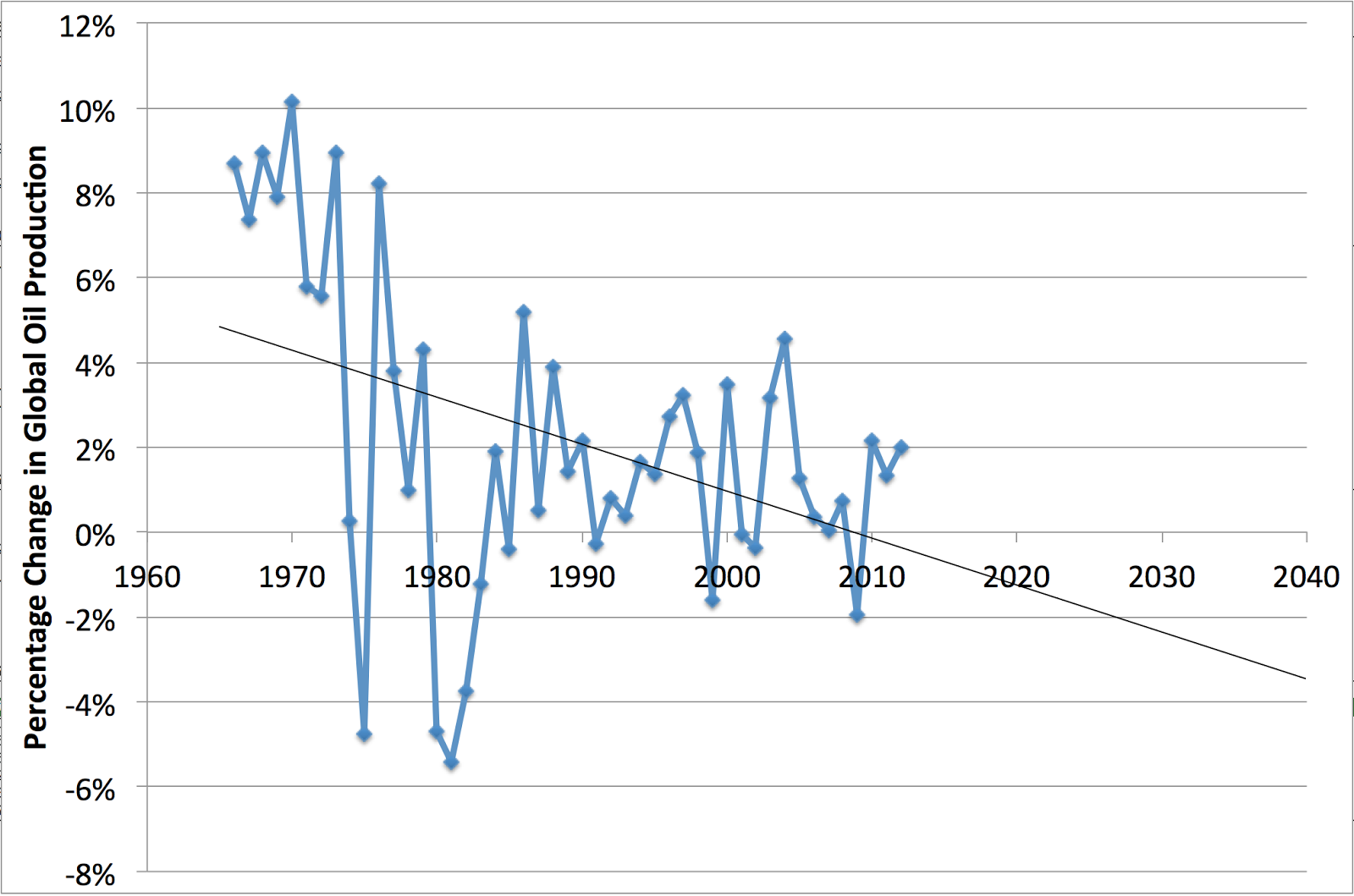
Nate Hagens draws my attention to this recent interview with Dennis Meadows, lead author of the famous Limits to Growth series of books. Meadows is very pessimistic. I was particularly interested in his views on oil production and peak oil, in which he states positively that peak oil is in the past (which is very arguable at best, given that oil production is still making new monthly highs), and also that
Oil production will be reduced approximately by half in the next 20 years, even with the exploitation of oil sands or shale oil.
For oil production to halve over the next twenty years, it would have to decline on average by 3.5%/yr throughout that time (possibly some years by more, some years by less). Above I have posted the average annual change in oil production 1965-2012 (with data from BP except for 2012 from EIA). I have also added a linear trend line out to 2040. Obviously, this is a rather rough time series and the linear fit is not particularly strong and the extrapolation not particularly stable. But it’s not clear that anything else will work much better – global oil production is a very complex process that we understand poorly. In that situation, we are probably best sticking to very simple models and acknowledging their severe limitations. At any rate, the straight line implies that peak oil (in the sense of “average growth is zero”) was in about 2009. The straight line also implies that we would not reach average growth being -3.5% until almost 2040.
So Professor Meadows is asserting unequivocally that this line is going to make an abrupt turn downwards in the next decade or two. Possible, but it’s a strong claim that requires strong evidence, and the interview certainly doesn’t lay out the basis for his views, or his certainty in them.
To give some idea of the issues with ignoring “oil sands or shale oil”, let’s stop the tape in 2007 before the US tight oil revolution came on stream (and before the great recession also, to avoid being too biassed by that). That would give this graph:
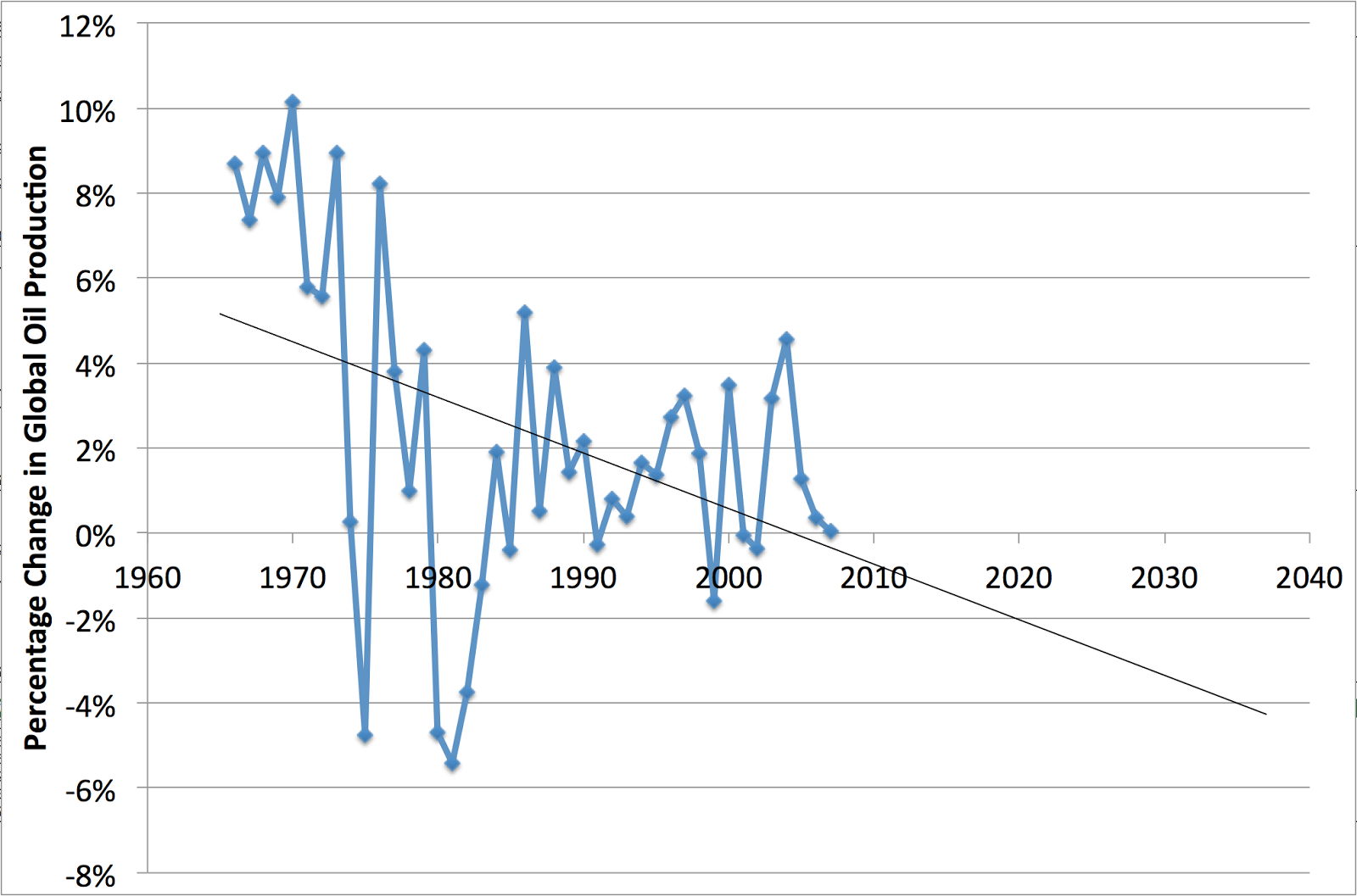
You can see that on that basis, peak oil was projected to be in 2004. So five years of additional data have moved the peak later by five years. That should give anyone with an open mind very strong pause indeed about asserting that they have a very clear idea of when peak oil is any more. And the date at which oil production would be -3.5% has gone from about 2030 to the late 2030s. Five years’ data have moved that estimate more than five years.
I think Professor Meadows is expressing an inappropriate level of certainty in an inappropriately negative scenario, given the available data. I think all that we can say with any confidence at this point is that it seems in the last decade to have become much more difficult to raise oil production by large percentages than it used to be, even in the presence of sustained high oil prices. Presumably this reflects a move closer to peak oil – I think it’s reasonable to suggest that we are on a bumpy plateau around the oil peak. But not more than that.
13 Comments on "Should the last few years have updated your idea of peak oil?"
Concerned on Tue, 9th Apr 2013 7:26 pm
Oil production now includes gas to liquids and ethanol and refinery gains and who knows what else.
The shale gas revolution is seeing $100 bbl oil in the midst of a global recession .
No my friends PEAK OIL IS HERE!
shortonoil on Tue, 9th Apr 2013 7:49 pm
“Oil production will be reduced approximately by half in the next 20 years,”
Seventeen years!
The Hill’s Group
J-Gav on Tue, 9th Apr 2013 8:23 pm
Peak oil, by what used to be the definition of oil, happened in about 2005-2006. Stuart Staniford, the author of this article, says we don’t know when peak oil will occur and then goes on to concede we’re on the famous ‘bumpy plateau’! Those who haven’t yet got that far need to do a little homework. Professor Meadows looks spot-on to me and I don’t see why he needs to be qualified as ‘pessimistic’ rather than realistic. Not quite sure, on the other hand, how Stuart Staniford should be qualified. Almost looks like some guy running a hedge-fund …
shortonoil on Tue, 9th Apr 2013 9:44 pm
“I think Professor Meadows is expressing an inappropriate level of certainty in an inappropriately negative scenario, given the available data.”
Professor Meadows is not using an inappropriate level of certainty. There are models which can be employed for evaluating the depletion state of the world’s reserve which are much more accurate than the traditional Buckley-Leverett model that is used for individual field determinations.
The Buckley-Leverett model has been amazingly successful as applied to the evaluation of a field. When extended to 48,000 fields, the accumulative error overwhelms the final determination. I don’t know how the professor came to his conclusions, but we have found that Exergy Analysis can produce results that far surpass traditional approaches.
The Hill’s Group
econ101 on Tue, 9th Apr 2013 10:37 pm
Oil always was a conglomerate of anything from flammable paraffin waxes to light crudes almost ready for the tank. Lamenting the fact that oil aint what it used to be is a recognition of our energy bounty.
We dont have $100 oil because of shale. We have $90 oil right now. We got $120 oil because of peak oil politics.
Oil at these supplies and prices is very affordable. Its the hope of sensible Americans everywhere that we return to a policy supportive of our energy industry to assure our supplies stays affordable and plentiful.
To do that we need to increase supplies and break the monopoly peak oil politics handed to OPEC. Shale technologies are a great benefit and might even do it alone but renewed development on those areas currently off limits but rich in oil/gas should begin.
Mark Ziegler on Tue, 9th Apr 2013 10:39 pm
Any oil not imported during this shale boom (Fracking) might be given up forever due to foreign consumption.
rollin on Tue, 9th Apr 2013 10:40 pm
Yes there is an overall downtrend globally, however as an analyst myself,the linear fit does not seem appropriate for this data set. Production falls steeply until the mid 1980’s then runs with a slight downward trend. So unless there is other evidence to promote a steep downward conclusion, I do not see these conclusions as anywhere near accurate. The range is narrow enough lately to show an overall descent of 3 percent or more within a decade.
What is significant to much of the world is that there has been a descent in petroleum export volumes. This should force immediate action for the importers.
Plantagenet on Tue, 9th Apr 2013 10:49 pm
Econ is misrepresenting the facts again. We do indeed have $100+ oil right now—-Brent is priced at $104.66 today.
GregT on Wed, 10th Apr 2013 1:04 am
Econ/ SOS,
If it wasn’t for OPEC, and US military might over other people’s oil all over this planet, the US would have crashed when it peaked, in 1970.
Here’s an idea, live on your own oil, and stop murdering everyone else for theirs. Come back in a year, if you are still alive, and tell us how affordable YOUR life is.
DC on Wed, 10th Apr 2013 1:27 am
Well said Greg. I too would love to see amerika(and SoS specifically) get by on 1/3 of what it now does. And they can stop calling Canadian and Mexican Imports ‘amerikan’ while they are at it. I would like to see how the Us gets by on the 5 million bpd they actually produce, instead of the 18-19 million they steal from Canada, Mexico, the Middle East etc.
BillT on Wed, 10th Apr 2013 1:59 am
Keep in mind that a degree, even a PhD, does NOT confer intelligence or wisdom. It often promotes arrogance and an ‘I know what is good for you’ attitude.
A lot of ‘doctors’ claimed that smoking did NOT contribute to cancer long after the world knew better. Money can buy anyone. Always see who signs the author’s paycheck for the spin. In this case, I suspect he works for the Petro industry in some form. Misinformation?
Jerry McManus on Wed, 10th Apr 2013 3:19 am
Anyone with even a rudimentary knowledge of Dennis Meadows’ work will know that he has spent the last several decades exploring the behavior of complex systems, especially the interplay of population, pollution, food, industrial capital, and non-renewable resources.
The world models he helped create and update with new data over the last 40 years have withstood the test of time remarkably well, much better than the linear extrapolations and razor thin focus on oil alone that Staniford seems to have strapped on like blinders.
Anyone with a rudimentary knowledge of stocks, flows, and feedbacks in the aforementioned complex and dynamic systems will also know that such systems can produce highly non-linear behavior, especially in the presence of positive feedback loops.
There is nothing in Stanifords myopic and willfully ignorant analysis to disprove that behavior, whereas the comprehensive work of Dennis Meadows has been substantially validated by several decades of additional data.
You decide.
BillT on Wed, 10th Apr 2013 2:50 pm
Jerry, money turns the tides of the past. Anyone can be bought and someone with a good record just costs more. I don’t believe someone just because they had a past record of being honest. If I read articles from a hundred sources and his is off at some illogical tangent, I discard it as bogus or at least suspicious. I might consider his argument, but remain unchanged in my thinking until the other 99 join his way of thinking. I do adjust with new info, but it has to pass my BS filters first.