
Peak Oil is You

Donate Bitcoins ;-) or Paypal :-)


Page added on November 1, 2011

Saudi oil production cut looms
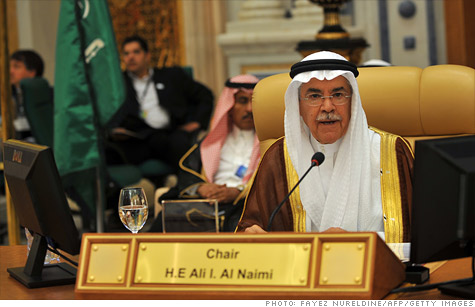
Saudi Arabia, one of the world's largest oil producers, may soon cut oil production.

The move, which some analysts believe may have already begun, comes in response to additional supplies coming online from elsewhere.

 The country, which had ramped up production earlier this year in response to the Libyan crisis, has been eyeing the resumption of Libyan oil exports as well as gradually rising oil exports from Iraq.
Those rising exports, as well as the sluggish global economy, have caused crude prices to fall over the last few months, and Saudi Arabia's own budgetary constraints at home require the kingdom to support the price of crude at close to $100 a barrel.

Brent crude -- which the price of most oil is now pegged to as a result of an oversupply in the U.S. benchmark WTI -- has been trading in the $105 to $110 range for the last month. That's down from over $125 a barrel in April.

U.S. drivers have gotten a bit of a reprieve as a result. Gas prices have fallen from around $4 a gallon this spring to under $3.50 currently.

But for the Saudis, who promised $130 billion in housing subsidies and other social spending this past spring to help ward off Arab Spring protests at home, this is a dangerous trend.

Libya oil eyed by Western companies

"We believe Saudi Arabia now requires oil at $92 a barrel to break even fiscally, up from $60 a barrel in 2008, on higher post-Arab Spring spending," Deutsche Bank oil analyst Paul Sankey wore in a research note earlier this month. The Saudis "will cut production to defend $92."

Sankey thinks that the production cut already began in September.

Saudi Arabia was producing about 9 million barrels of oil a day before hostilities broke out in Libya, according to the U.S. Energy Information Administration.

When the Libyan civil war shut down nearly all of that country's 1.6 million barrel-a-day production, the Saudis increased output to nearly 10 million barrels a day.

But now Libya's oil is beginning to come back online. It's thought the country is producing between 300,000 and 500,000 barrels a day. That might rise to a million barrels a day by the middle of 2012.

Iraq has also been steadily increasing its production, if slowly. That country, which holds enormous oil reserves, has seen production grow by about 300,000 barrels a day in the last year, according to EIA. It's now producing about 2.6 million barrels a day.

Iraq's production is expected to continue rising steadily for years to come as international oil companies like Exxon Mobil (XOM, Fortune 500), BP (BP) and Shell (RDSA) revamp the country's oil fields, which suffered from decades of war and embargos.

On the demand side, the world's thirst for oil has been tempered byongoing sluggishness in the U.S. and European economies. Even China's economy slowed in the most recent quarter.

Plus, the debt crisis in Europe has only gotten worse since this past spring, when analysts were predicting a rebound to the global economy in the second half of 2011 and the Saudis pondered a production increase.


"The combination of these factors will compel Saudi Arabia to pull back some or all of the production increase it made in the summer of 2011 by the first quarter of 2012," Greg Priddy, a global energy analyst at the Eurasia group, a political risk consultancy, wrote in a recent research note.

Priddy said there could even be a broader cut from OPEC announced when the cartel meets December 14, although coordinated action from OPEC isn't necessary for the Saudis to decrease production on their own.

That production cut may be staved off if oil prices rebound, as they have in recent days as talk of a solution to the European debt problems propel a number of commodities higher.

But given the propensity for false starts on the debt issue, and the volatility of commodity markets in general, the long term trend still points toward a cut.
2 Comments on "Saudi oil production cut looms"
Kenz300 on Tue, 1st Nov 2011 9:58 pm
The era of cheap oil is over. Every country that imports oil needs to develop a plan for greater energy self sufficiency. The Saudi’s are not immune from the Arab Spring and although they are currently talking about voluntary reductions in supply, involuntary reductions remain a possibility in the future. The risks to the world economy are too high to put more and more eggs in the OPEC oil supply basket. It is time to diversify our energy sources and types. Financial institutions seem to have not learned about risk reduction. Our economies need risk reduction with respect to energy supplies. Will we diversify before we are forced to by higher prices and reduced supplies?
Btritt on Wed, 2nd Nov 2011 4:00 am
And the beat goes on…
So, where do we cut? I suggest a $1 tax on gas…and then add $1 per year until it is up to European prices. Then add 25 cents per gallon per year to heating fuel. Then bring home our foreign troops and shut down 400 bases. Think of the demand that will fall. And the reshuffling of priories in the US. After all…6,700,000,000 people get along with the 75% of the world’s oil we DO NOT use. So can we.