
Peak Oil is You

Donate Bitcoins ;-) or Paypal :-)


Page added on February 23, 2016

Saudi Arabia’s oil minister says no oil production cuts coming
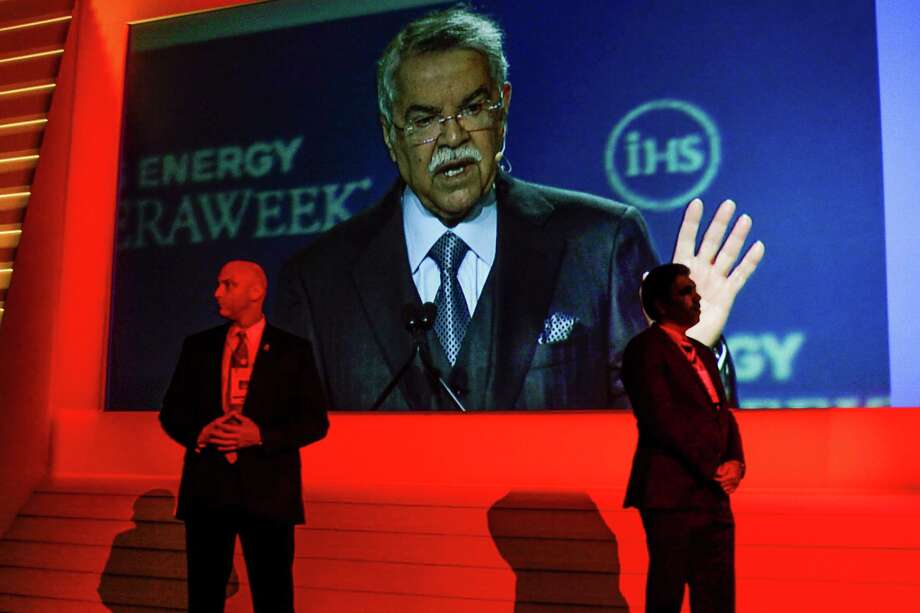
Saudi Arabia’s chief oil strategist dashed any hope the world’s biggest oil-exporting nations will cut their output to prop a depressed oil industry, saying it’s better for the market to wipe out high-cost oil producers who can’t compete.
In his first encounter with the U.S. energy industry since oil prices collapsed in late 2014, Saudi oil minister Ali al-Naimi left no room for speculation: The oil market will recover the hard way, leaving shale drillers in Houston and across the U.S. to wither under financial pressure to correct the global oversupply of crude that has suppressed prices.
For struggling U.S. oil and gas companies, the blunt declaration struck deep as many of the largest domestic producers rely heavily on shale and deep-water oil production, which is several times more expensive than pumping crude from the heart of the Mideast.
“It sounds harsh, and unfortunately it is, but it is a more efficient way to rebalance markets,” Al-Naimi said. “Cutting low-cost production to subsidize higher-cost supplies only delays an inevitable reckoning.”
Without production cuts by Saudi Arabia and other nations, analysts don’t see a way for prices to rise quickly because of a dramatic oversupply of crude amid weaker global demand. More domestic oil producers are struggling to say solvent, many shedding thousands of jobs in Houston and other major markets.
“The next six to 12 months is going to be a decimation … bodies all over the place,” Mark Papa, former chief executive of Houston oil company EOG Resources said at the CERAWeek conference, a gathering of thousands of world energy leaders.
Beyond Houston, the oil minister’s remarks reverberated across the markets, causing domestic crude prices to plunge 4.5 percent on Tuesday and Wall Street worries that the industry will be a drag on the global economy.
Meanwhile, energy executives, stung by the minister’s tough words, say they are preparing for the worst. Ryan Lance, chief executive of No. 3 U.S. oil producer ConocoPhillips, said his company is girding itself for a turbulent year. Over the past year, the company has cut 3,200 jobs, slashed billions in spending and reduced its shareholder dividend 81 percent.
“We at ConocoPhillips are planning on the worst case,” Lance said.
David Lawler, who has led BP’s U.S. shale operations since 2014, said in an interview that the British oil giant’s shale-focused unit has cut jobs and asked for more favorable terms from equipment providers.
“We’re trying to take out as much cost as we can,” Lawler said. “There’s a significant amount of debt in the industry from the last cycle.”
One reason the executives expect further pressure on U.S. drillers is because, so far, domestic production has held up. Output has slipped less than 5 percent even though companies have sidelined more than 1,000 rigs. Shale oil production, in particular, has become more resilient as companies cut costs and get more efficient.
“Every dollar spent in the second half of 2015 generated about two times in terms of barrels of oil what it did at the end of 2014,” said Raoul LeBlanc, an IHS analyst who studies North American oil production.
The U.S. oil industry has been able to cut its 33 percent annual decline rate to 24 percent this year and could go as low as 15 percent in 2017, LeBlanc said. If crude prices had held at $43 a barrel, U.S. production could have held steady this year. “All that is really needed is cash,” he said. “The X’s are on the map. There’s plenty of rigs. If we get $45, $50 oil, that will get things going.”
The International Energy Agency says the world’s oil supply should realign with global demand in early 2017 after U.S. oil production falls by 800,000 barrels a day. The IEA also projects global demand will hold steady at 1.2 million barrels a day over the next few years.
But at the conference, officials from China National Petroleum Corp. suggested reason to worry about the world’s long-term appetite for crude oil. Yilin Wang, chairman of the state-controlled CNPC, said the world’s second-biggest consumer of oil has “entered a new normal” of slow growth.
It’s possible China’s oil demand will peak in 2030 as alternative fuels replace oil products used in increasingly efficient cars and China’s manufacturing gives way to the service sector, which should make up more than half of China’s economy by 2020, said Qian Xingkun, vice president at the CNPC Economics and Technology Research Institute.
Mohammed al-Qahtani, senior vice president of upstream for Saudi Aramco, said the oil industry faces a time of uncertainty, but that long-term demand for oil is growing, noting that 300 million Chinese citizens will move into the middle class. “This pattern will be repeated across the developing world,” he said.
The fight for the world’s oil demand has appeared cut-throat between rival producers in the past year and a half, but al-Naimi declared the world’s biggest oil exporter is not at war with the U.S. shale industry. At the same time, he noted, there is no reason to attempt to curtail production given that similar agreements in the past have been marred by disputes.
“There is no sense in wasting our time seeking production cuts; they will not happen,” al-Naimi said. “Inefficient, uneconomic producers will have to get out.”
17 Comments on "Saudi Arabia’s oil minister says no oil production cuts coming"
Truth Has A Liberal Bias on Tue, 23rd Feb 2016 11:31 pm
Saudi crude production has been down 6 of the last 7 months. What they produced in January 2016 is close to what they produced in Juky 2013.
This is all smoke and mirrors. They’ll be consuming an extra million barrels a day of crude pretty soon as they enter peak consumption season.
paulo1 on Wed, 24th Feb 2016 4:50 am
regarding: If crude prices had held at $43 a barrel, U.S. production could have held steady this year. “All that is really needed is cash,” he said. “The X’s are on the map. There’s plenty of rigs. If we get $45, $50 oil, that will get things going.”
All that is really needed is cash. Duh. That has to be the dumbest statement I have read in a long while. That applies to everyone and everything, except for the 1%ers I suppose.
Anonymous on Wed, 24th Feb 2016 7:19 am
His entire speech could be reduced to,
“The americans economic war against Russia and Iran is still in effect, and we don’t care who we have to throw under the bus to win it”.
All his talk about high cost and inefficient producers is just so much oily smoke and mirrors. Him and his fellow ISIS\CIA lov’n saudi autocrats have been told to keep prices down, by Tel Aviv and washingtun. These ‘sauds’ cant afford to keep prices low anymore than anyone else, but, the zionists want to bring Russia and Iran to their knees economically, and they are quite willing to damage or wreck their own economies to do it. The 1% never pay the cost of their wars-that’s what everyone else is for….
Davy on Wed, 24th Feb 2016 7:33 am
“Can Things Get Any Worse for Russia? You’re About to Find Out”
http://www.bloomberg.com/news/articles/2016-02-24/putin-s-oil-despair-drives-lucky-few-investors-toward-the-exits
“Thanks to the plunge in oil prices, says Dmitri Barinov, “all bets are off” when it comes to investing in Russia.”
“Russia may exhaust its $120 billion in rainy-day funds within a year or two, says one former government adviser”
“Fundamentally, Russia is a “commodity play,” says Gary Greenberg, who helps oversee about $1.8 billion as head of emerging-markets equities at London-based fund manager Hermes Investment Management. Since Russia’s main exports—raw materials—are dependent directly and indirectly on China’s lackluster growth, the outlook for Russia “is moderate at best,” he says.”
“For Browder, like many investors with long experience in Russia, it all comes down to Putin, who’s expected to win reelection to another six-year term in 2018, despite Russia’s economic travails. “No matter how cheap anything might seem,” Browder says, “it doesn’t matter if you’re on a negative trajectory.” He says the economy still has depths to plumb. “It hasn’t hit bottom, because Putin is still in power.”
JuanP on Wed, 24th Feb 2016 7:49 am
Can things get any worse for the USA? I don’t think I need to provide any links to help people find the answer. Every person in the world with one working synapsis knows that things are getting worse in the USA, they have been getting worse for decades, and will continue to get worse for the foreseeable future. The USA is a collapsing evil empire.
Americans should look no further than their own delusional American one percenter pricks to assign responsibility. America is being destroyed by pricks like Davy and his family.
shortonoil on Wed, 24th Feb 2016 8:16 am
Several days ago “OPEC’S EL-BADRI SAYS 70% OIL SUPPLY OVERHANG IN U.S.” That is 3.5 mb/d; which means he sees the total oversupply as 5 mb/d. About a year ago we stated that production would have to decline by 4.5 mb/d to bring the price back to this graph:
http://www.thehillsgroup.org/depletion2_022.htm
“The producers of these high-cost barrels must find a way to lower their costs, borrow cash or liquidate,” Al-Naimi said Tuesday…”
Because the oversupply now in existence is the result of the entropic decay of the Petroleum Production System the overhang is not a constant. It is growing as time progresses. Next year it will be greater than it is this year. Next year will require more cuts than this year, and more the year after that. OPEC’s ultimatum not to cut is not a decision; it is only alternative available to them. The industry is now pushing on a string; OPEC appears to know that!
http://www.thehillsgroup.org/
rockman on Wed, 24th Feb 2016 8:27 am
The funniest statement is that US companies can’t compete with the KSA. On the production side of the fence (and not the drilling side) US companies have no problem producing the EXISTING WELLS at the current oil price. And neither does Russia or the KSA.
So let’s focus on new drilling ventures to develop NEW RESERVES. So yes: US rig count developing NEW RESERVES is way down. And the KSA? Difficult to say for sure since they don’t share details. OTOH when was the last time we saw them announce a NEWLY DISCOVERED FIELD? Last I heard they had planned to drill a ver exoensive Deep Water well in the Red Sea. Haven’t heard of any results yet. I wonder if low prices have killed those plans.
Bottom line: I don’t recall any announce of NEW KSA RESERVES developed when oil prices were high unlike the numbers we saw for the US and Canada. So who exactly can’t compete with who? LOL. And yes: US shale producers have lost a sh*t load of revenue due to low prices…and the KSA has lost 3X as much.
So yeah: a lot of shale producers will go bankrupt. But that’s still better the another “Arab Spring” this time in the KSA if the new low revenue isn’t enough to keep the natives docile.
Apneaman on Wed, 24th Feb 2016 8:50 am
Revenue cannot be lost – only gained. One cannot lose something they never had.
Lost revenue = money you never had, but you wished you did.
Lost pussy = women who wouldn’t fuck you, but you wished they did.
rev·e·nue
ˈrevəˌn(y)o͞o/Submit
noun
income, especially when of a company or organization and of a substantial nature.
synonyms: income, takings, receipts, proceeds, earnings, sales; profit(s)
“this month’s revenue is up 5 percent from last month”
a state’s annual income from which public expenses are met.
items or amounts constituting a state’s income.
shortonoil on Wed, 24th Feb 2016 9:00 am
“All his talk about high cost and inefficient producers is just so much oily smoke and mirrors. Him and his fellow ISIS\CIA lov’n saudi autocrats have been told to keep prices down, by Tel Aviv and washingtun.”
Did you make yourself a new tin foil hat?
geopressure on Wed, 24th Feb 2016 10:38 am
KSA wants higher oil prices… Therefore they do not announce new discoveries as it would only serve to hurt their cause…
The US Government wants lower oil prices… Therefore companies under their sphere of influence routinely announce their discoveries (especially when publicly traded entities are involved)…
—
The US Government also uses new discoveries as a political tool. Example: the large ENI Gas Discovery in Eqypt… Was this discovery real? or was it designed to get Egypt’s support to help overthrow the Syrian Government? Time will tell…
Nony on Wed, 24th Feb 2016 11:50 am
US shale is probably the marginal cost barrel long-term:
*medium cost (~mid-50s breakeven to keep production stable, obviously shrinking at much less than that, and expanding at much more than that. Say something like a 45-65 band.
*Relatively fast on/off. Not immediate, but compared to deepwater, much faster on. New projects can be halted in months (rigs laid down) and then base production itself has fast decline (over 50% in a year for a new well).
*Scaleable: Many different, small wells, with small producers. We are not talking about monster projects like Kashagan or Manifa that either work or don’t.
*Relatively stable political situation. Not perfect for producers, for sure, but still better than where there are dangers of expropriation or violence.
*Sizeable: ~ 50 billion barrels of produceable resource. 10/10/20/10 for Bakken/EF/Permian/rest. That’s 30 years of production at a rate of 5 MM bpd.
—————
FWIW, I do think SA is sitting on much MORE cheap oil than people estimate. I based this on:
1. Crude burning. This shows that inside the Kingdom, the true value of crude is low. As otherwise they would sell it for export and purchase RFO. Instead they are restricting output. They could probably do 15 or 20 MM bpd (rather than 10) if they really got buys.
2. The area has not been as well explored or developed as the US onshore has. Where there is some, there is more. And they have found lots of big deposits in Arabia. With more exploration, they will find more.
3. The USGS estimated ~90 billion barrels of undiscovered conventional oil in SA (on top of the ~270 billion of stated reserves). [At 10 million barrels per day, that will last them ~100 years.]
P.s. Oh…and we usually end up finding more oil after we start running out! Look at how the world reserves of the 1970s have been replaced despite the 40 years of intervening production. R/P is at 50 years and growing.
Nony on Wed, 24th Feb 2016 12:02 pm
Oh…and on LTO, there’s still the potential for improvements in the technology or development of different resources. They don’t have to be revolutionary developments technically (like discovering lasers or transistors) to have an impact on production volumes or upfront cost. Also, they don’t have to be all new basins, but learning more about the ones we are already in.
It’s very instructive to look at shale gas. That was a development which has had MORE time to become mature and finished than LTO. Yet we still have had sizable improvements even in the last year. We’ve gone from peakers in 2010 saying $6 was not sustainable and would need $8…to long term prices sub-3 as far as the eye can see.
How many gas wells you drilling in the Gulf, Rock? Is demand bad? Or are you getting your ass kicked by shale?
Even in terms of basins, it’s interesting to look at how the Deep Utica has come in late for gas. On the oil side, the Permian took a while to get clicking (I remember Mark Papa being skeptical–saying only the EF and Bakken were significant LTO plays). And now the Permian is considered the best oil play for fracked hz wells (and if you call it tight, shale, conventional or what is wordsmanship…bottom line is that we know more in 2015 than we did in 2011 and even about a pretty mature area.) Similarly, some OK strata have been known for decades, yet we are only know realizing how appealing they are for completion with fracked horizontals.
geopressure on Wed, 24th Feb 2016 12:20 pm
Excellent point made up-thread that Saudi’s domestic consumption is on the verge of growing by 1 Million BOPD as they start cranking up their Air Conditioners…
marmico on Wed, 24th Feb 2016 1:33 pm
Excellent point made up-thread that Saudi’s domestic consumption is on the verge of growing by 1 Million BOPD as they start cranking up their Air Conditioners…
Another fuctard who is oblivious to seasonality.
http://peakoilbarrel.com/wp-content/uploads/2016/02/560669-1.png
marmico on Wed, 24th Feb 2016 1:39 pm
Nony. There is some counterintuitive econometric evidence that prices pull upstream capex costs.
http://www.voxeu.org/article/oil-prices-and-costs-upstream-industry
Nony on Wed, 24th Feb 2016 5:22 pm
I admit to just skimming the article. Wasn’t seeing a quick relevant takeaway. Not sure how this article is different than anything I’m saying. Yes, the Saudis are sitting on cheaper barrels. No denying that. So marginal barrel becomes shale.
I think the article makes the point that with higher activity, rig costs are higher (and visa versa) which is not a surprise. And doesn’t change the idea of a marginal project setting the price (rising costs of rigs with volume is just one more factor of the cost curve).
Anyhow, what we do know is that at 100 (plus a strip headed to 80) production was growing at 1.5 MM bpd/year. At 30 (plus a strip headed to 50), we are dropping. And…last summer when we had the little rally to 60 plus a strip to 70, the rig count started going up from low 600s.
Yeah, there are some moving factors (rig contract stickiness, price drops, even hard exits from the market of rigs), but those are second order.
PracticalMaina on Thu, 25th Feb 2016 1:31 pm
Marmico, AC and desalination are only somewhat seasonal. I see only a 1/5 increase in the high of 09 vs the low of this year. High temps increase violent crimes, so when your chopping off your citizens heads by the dozen, you want to give the rest of them some powerful ac, even in non peak cooling times. And you need ice in there water, some indoor skiing, some water parks, green lawns and maybe even some farms so people can forget for a second that they are on top of the catalyst that will ultimately make their homeland virtually unlivable.