
Peak Oil is You

Donate Bitcoins ;-) or Paypal :-)


Page added on April 13, 2011

Saudi Arabia did not make up for Libyan Oil


The OPEC MOMR came out late yesterday, but it adds to the picture from the IEA report mentioned yesterday morning. In particular, I can now present revised graphs for total liquid fuel production. Here’s the last three year view (not zero scaled):

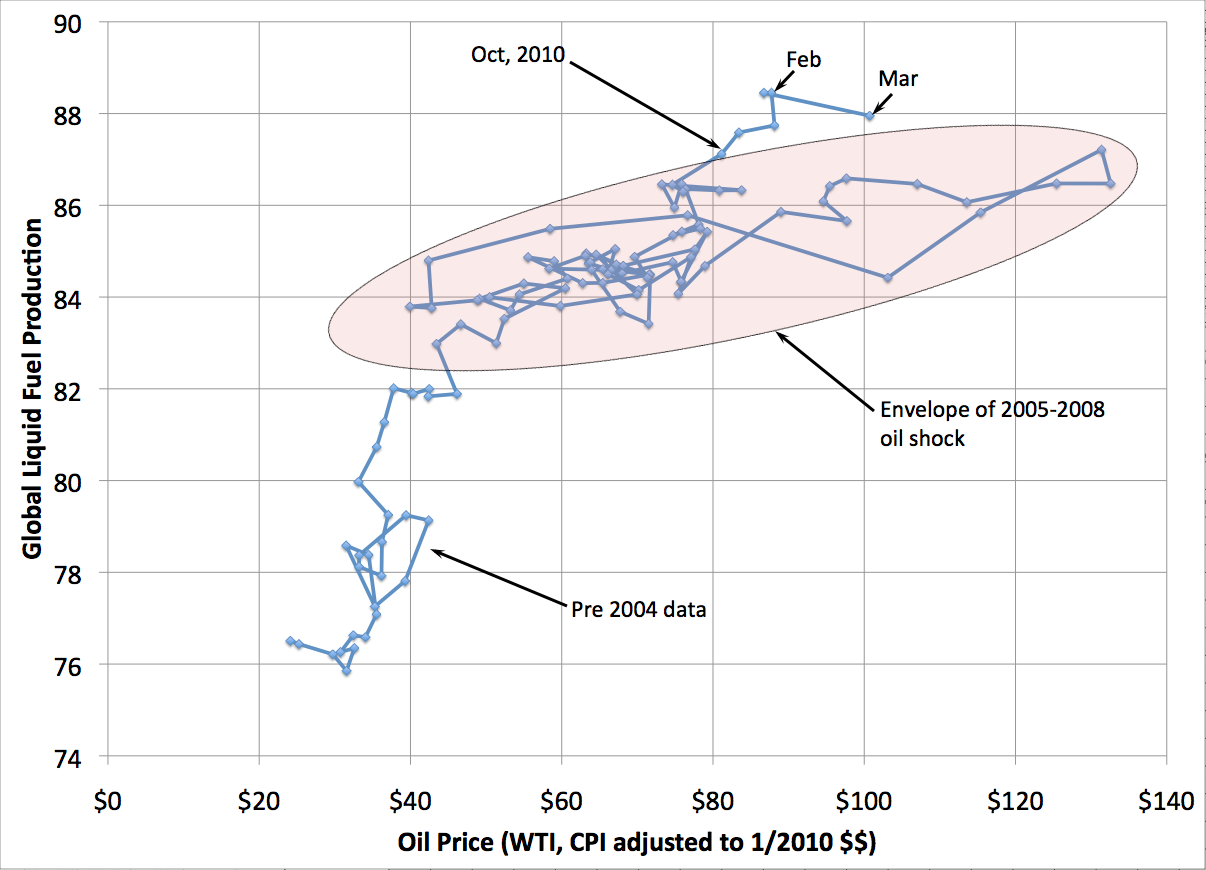
Note that the rise that’s been going in since last fall has now been abruptly interrupted by the Libyan situation, and total oil production has fallen by about 0.5mbd. This is about 0.6% of global production, but given that the world economy has been growing rapidly and needing about another 0.5mbd/month, the shortfall over what would have happened in a counterfactual world with no Middle Eastern unrest is more like 1.2% of global production.
In terms of the price production picture, this has put us much more into territory akin to the 2005-2008 oil shock:
We can put situation almost entirely down to two things: the fact that Libyan production has plummeted, and that Saudi Arabia has made no significant move to compensate. In fact, Saudi Arabia slowed down production increases that it had been making in prior months. First, here’s all the Libyan data currently available:

So the world has abruptly lost something like 1.3mbd of oil production between mid February and March. Now there were a lot of news reports in the business press at the time this was first happening that Saudi Arabia was going to make up the difference. For example, according to Reuters at the time:
Saudi Arabia has increased its oil production to more than 9 million barrels per day (bpd) to compensate for disruption to Libyan output, an industry source familiar with the kingdom’s production told Reuters on Friday.
“We have started producing over 9 million barrels per day (bpd). We have a lot of production capacity,” the source said, but said he could not say when the change had taken place.
Oil prices spiked to a 2-1/2 year peak of nearly $120 a barrel on Thursday, stoked by concern the wave of revolutionary unrest gripping world No.12 oil exporter Libya could spread to big oil producing countries in the Middle East.
A report out of Washington by industry publication Energy Intelligence late on Thursday said Saudi Arabia had made the change quietly to try to avoid stoking regional tensions.
“The Saudi move has not been announced publicly, most likely because of the political sensitivities in the region and the internal dynamics of OPEC,” Energy Intelligence wrote.
Now that the stats are out, we can see that this was total bull. Will that fact be all over the business press? My bet is you’ll have to read some obscure blog called Early Warning to find out what really happened. First off, here’s all the Saudi production data I have (not zero scaled to better show changes):
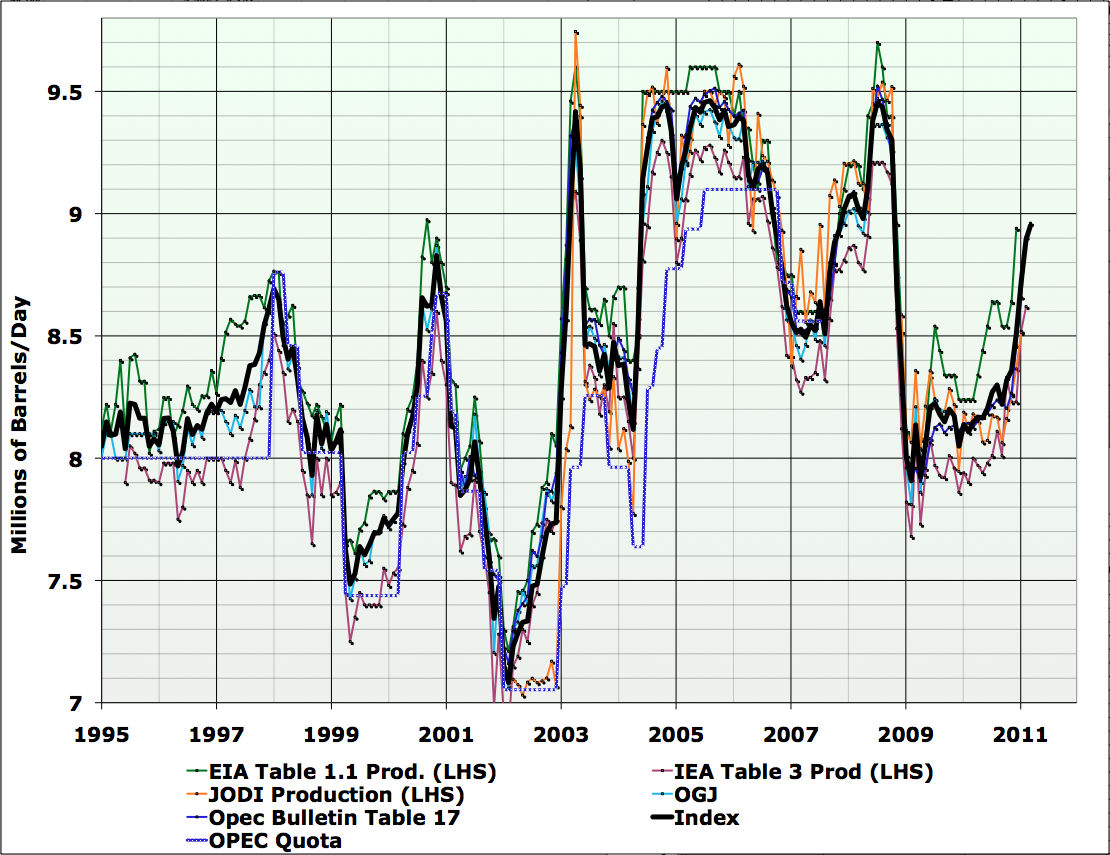
Indeed Saudi production has increased to around 9mbd, but the timing makes it clear this has nothing to do with Libya. For better comparison, I have put both the Libyan and Saudi averages on the same graph (only since 2005), with the scales adjusted to allow easy comparison. In particular, note that the size of the units on both scales is the same, so similar vertical moves in both curves mean the same amount of oil, but the Saudi scale (left hand scale) has been shifted to put the Saudi curve next to the Libyan one (right scale):

I have circled the March data in each case. You can see what was going on. The Saudis were slowly increasing their production from last fall through February, presumably in response to growing global demand and rising prices. But then, in March, when Libyan production went into freefall, they put on the brakes and did almost nothing to make up for the shortage.
The burning question is: why? Back in 2006, when their production started to gradually decline from 9.5mbd even as global oil prices were in the worst spike since the 1970s, I was an advocate of the view that the decline was largely involuntary: they’d never produced more than 9.5mbd, they’d underinvested for decades, and some of their big fields were getting very tired (particular northern Ghawar and Abqaiq) and they were starting a big rash of new projects and ramping up their rig counts at the same time.
I see current events differently. The reduction in late 2008 was clearly voluntary to support prices in the face of the great recession. There’s no new projects announced, and the rig count hasn’t taken off. So my take is that the failure to increase production to compensate for Libya is deliberate. We can only speculate, but my guess is that, having watched how the west has helped to ease Mubarak and Ben-Ali out of power and is intervening in Libya to the same end, the Saudi regime is in no mood to care about our desire for more oil. Instead, they are very much in the mood to build as large a war chest as possible with which to appease their own population, strengthen their defense measures, etc.
So, instead of Saudi production increasing to compensate for Libya, total world production decreased, and oil prices went up sharply to enforce the necessary conservation on the world’s oil consumers.
For drug addicts, there are consequences to pissing off the neighborhood drug dealer.
One Comment on "Saudi Arabia did not make up for Libyan Oil"
Joey Meatball on Thu, 14th Apr 2011 2:01 am
Didn’t I read on peak oil news website just last week that though Saudi oil production may indeed be rising slightly the amount available for export is decreasing quite markedly due to internal needs of their own economy and people? Important factor no?
JM