
Peak Oil is You

Donate Bitcoins ;-) or Paypal :-)


Page added on December 5, 2013

Pipeline On Wheels: Trains Are Winning Big Off US Oil
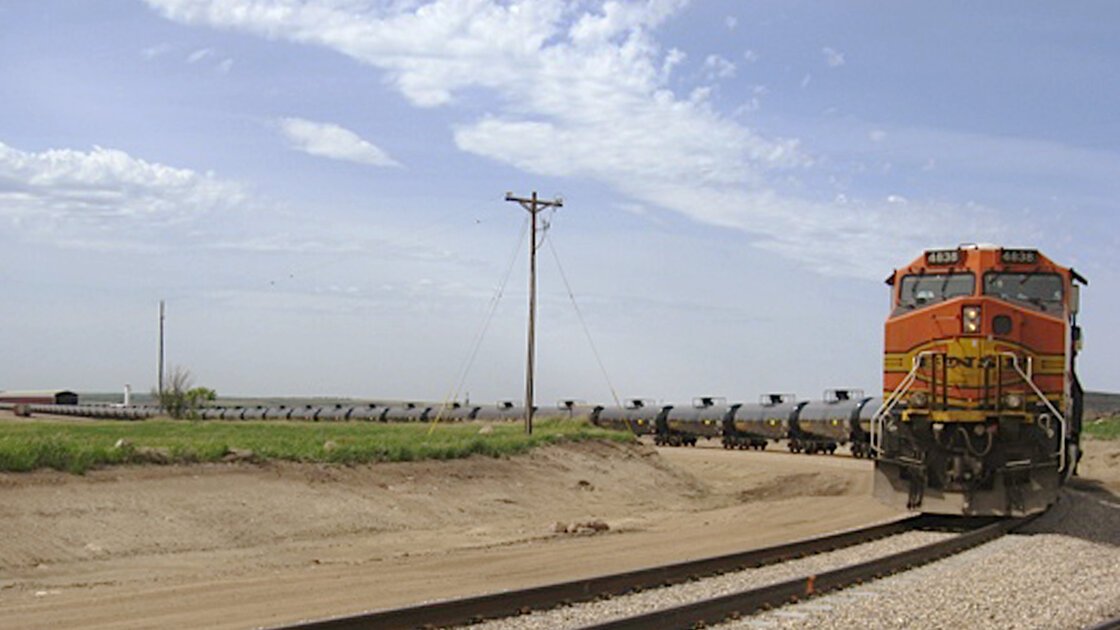
A train leaves the Rangeland Energy company’s crude oil loading terminal near Epping, N.D. So far this year, 60 percent of all oil produced in North Dakota left the state by rail. One economist says there aren’t enough oil tankers to fill the demand.
AP
The oil boom in the United States is creating another boom — for the railroad industry.
So far this year, in North Dakota alone, 140 million barrels of oil have left on trains. Shipments of crude oil by rail are up almost 50 percent over last year — and this upward trend is expected to continue.
A visit to the world-famous Tehachapi Loop, part of a winding mountain pass in Southern California, demonstrates the scale and reach of the oil boom in the middle of the country. As a train full of oil tanker cars rumbles past, it’s hard not to think of it as a pipeline on wheels.
And the railroads? They love it.
“Over the course of the last almost four years, you’ve seen just a rapid development, which attests to the demand for the oil,” says John Miller, a vice president for BNSF Railway.
Railroads are in a good position, he says, with tracks by all the major oil fields. Their main competition is pipelines — and those take a long time to build. Just think about the stalled Keystone XL.
Right now, in many places, existing pipelines don’t have enough capacity to move all of the oil to major markets.
“A pipeline, typically speaking, requires commitments and time to put those together, and time to get permitting, and time to lay the pipe, and time to put it all together — and that could take years,” Miller says.
The industry doesn’t want to wait that long. So far this year, 60 percent of all oil produced in North Dakota left the state by rail.
“It’s amazing when you look at it that way,” says transportation consultant Chuck Clowdis of the Colorado-based firm IHS. “That’s a lot of trains. That’s a lot of tanks moving down a lot of track.”
Clowdis says there’s an overwhelming need to move all this oil to market, and the railroads have so far proved that they’re the most efficient.
At least, they are when they can find enough rail cars to do the job. There’s a backlog of orders in the thousands. “Just finding the tankers right now is the biggest challenge,” Clowdis says.
But the growth doesn’t come without resistance.
On the West Coast, there’s a big push to build new oil rail terminals and retrofit refineries to handle trains. In Bakersfield, Calif., for example, trains could connect with existing pipelines that feed Los Angeles to the south and the Bay Area to the north.
But it’s also a good place to illustrate challenges that crude oil by rail faces. At the nearby Tehachapi Loop mountain pass, freight trains wind and grind around corner after corner as they descend almost 4,000 feet to the valley floor.
That loop was an engineering marvel when it was opened in 1876. But today, even after improvements over the years, it still has bottlenecks and pinch points along the route. That worries some people who live in the valley, including environmentalist Tom Frantz.
“Any kind of derailment with a few sparks somewhere, and you can have a major disaster up there,” he says.
Frantz is concerned about the what-ifs on that pass, especially after in Canada last summer killed more than 40 people. Then, in November, a crude oil train and caught fire.
Frantz says these are reasons to slow down.
“Are they going to start pushing this crude coming in before they get everything as safe as it needs to be?” he says. “Are they going to wait for a big accident before they change how they do things on that rail line?”
But the slowdown Frantz wants isn’t too likely on the West Coast, or across the rest of the country.
The railroads are quick to point out that hazardous material spills and other accidents are way down in the past 30 years. According to the Association of American Railroads, hazmat train accident rates have declined by 90 percent since 1980.
And with states like North Dakota predicted to set another record this year for oil production, rail lines are shooting for new records of their own.
8 Comments on "Pipeline On Wheels: Trains Are Winning Big Off US Oil"
James on Thu, 5th Dec 2013 12:46 am
Well I hope the management of the railroads use the profits as start up money to rebuild the whole rail system so they will be ready when people start using them again.
AWB on Thu, 5th Dec 2013 12:50 am
The tight oil plays in the U.S. (Bakken, Eagle Ford, etc.) face rapid depletion issues, and, as such, why spend all the time and money to build out pipeline infrastructure when your typical “field” is only going to be delivering commercially for a few years. Rail is cheaper and faster to put in place. The Canadian tar sands are a different issue altogether — there’s ~150 bboe in that play and they’re going to be producing for the next 20 years. If the planet doesn’t melt.
Kenz300 on Thu, 5th Dec 2013 1:02 am
Next I hope we improve the commuter rail system in this country……..
DC on Thu, 5th Dec 2013 1:05 am
The 47 people who were killed instantly by the Harper Regimes amerikan partners and there bitumen goop didnt ‘win’ much did they?
http://en.wikipedia.org/wiki/Lac-M%C3%A9gantic_derailment
sparky on Thu, 5th Dec 2013 1:56 am
.
Didn’t warren Buffet made a big play on railroads a few years back ?
pipelines need a long term feeder supply too ,
if production is not long term , building a pipeline is not a good investment .
also filling 1000 miles of pipe require a lot of oil , this is a quite costly exercice , the crude is eventually recovered but the filling is seen as a cost
energy investor on Thu, 5th Dec 2013 4:15 am
Yes Sparky, he bought BNSF and now rakes in the profits 🙂
Bob Inget on Thu, 5th Dec 2013 1:26 pm
Warren Buffet spotted resistance to pipelines long before anti XL groups were organized.
Most energy investors, with single track minds, did not.
While most crude being hauled is domestic, increasingly more Canadian, light and heavy is
Quickly making Keystone XL question moot.
As for safety, tankers now being produced have double walled, often heated to permit shipping
Heavy oil W/O added chemicals.
James A. Hellams on Fri, 6th Dec 2013 1:47 am
It is good, that the railroads are expanding!
The expansion of the railroad systems will be THE PRIME protecter of the country when the oil is finally gone.
All the trackage of the railroads can be electrified (with electricity being generated from every source of energy known to mankind); and can run trains TOTALLY independent of any dependency on oil for energy!