
Peak Oil is You

Donate Bitcoins ;-) or Paypal :-)


Page added on July 26, 2018

Peak Shale Oil?
The largest shale oil producer in the Permian spent $264 million more than they made from operations drilling 63 new wells in the Permian and only added a net 9,000 barrels per day of oil equivalent. Now, how economical is that???
~~~~~~~~~~~~~~~~~~~~~~~~~~~~~~~~~~~~~~~~~~~~~~~~~~~~~~
While the U.S. reached a new record of 11 million barrels of oil production per day last week, the top five shale oil fields also suffered the highest monthly decline rate ever. This is bad news for the U.S. shale industry as it must produce more and more oil each month, to keep oil production from falling.
According to the newest EIA Drilling Productivity Report, the top five U.S. Shale Oil fields monthly oil decline rate is set to surpass a half million barrels per day in August. Thus, the companies will have to produce at last 500,000 barrels of new oil next month just to keep production flat.
Here are the individual shale oil field charts from the EIA’s July Drilling Productivity Report:

The figures that are shown above the UP arrow denote the forecasted new production added next month while the figures above the DOWN arrow provide the monthly legacy decline rate. For example, the chart on the bottom right-hand side is for the Permian Region. The EIA forecasts that the Permian will add 296,000 barrels per day (bpd) of new shale oil production in August, while the existing wells in the field will decline by 223,000 bpd.
If we add up these top five shale oil fields monthly decline rate for August will be 503,000 bpd. Thus, the shale oil companies must produce at least 503,000 bpd of new oil supply next month just to keep production from falling. And, we must remember, this decline rate will continue to increase as shale oil production rises.
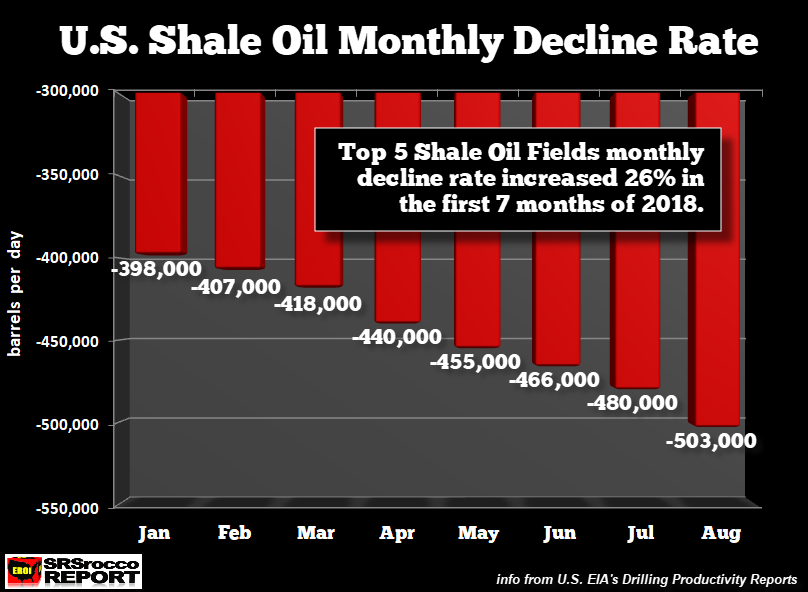
We can see this in the following chart below. Again, according to the EIA’s figures, the top five U.S. shale oil fields monthly legacy decline rate increased from 398,000 bpd in January to 503,000 bpd for August:

In just the first seven months of 2018, the total monthly decline rate from these top shale fields increased by 26%. These massive decline rates are the very reason the shale oil and gas companies are struggling to make money. A perfect example of this is PXD, Pioneer Resources. Pioneer is the largest shale oil producer in the Permian. According to Pioneer’s Q1 2018 Report:
Producing 260 thousand barrels oil equivalent per day (MBOEPD) in the Permian Basin, an increase of 9 MBOEPD, or 3%, compared to the fourth quarter of 2017; first quarter Permian Basin production was at the top end of Pioneer’s production guidance range of 252 MBOEPD to 260 MBOEPD; as previously announced, freezing temperatures in early January resulted in production losses of approximately 6 MBOEPD; Permian Basin oil production increased to 170 thousand barrels of oil per day (MBOPD); 63 horizontal wells were placed on production.
Pioneer spent $818 million on capital expenditures (CapEx) for additions to oil and gas properties (drilling and completion costs) during Q1 2018, brought on 63 horizontal wells in the Permian, and only added 9,000 barrels per day of oil equivalent over the previous quarter. So, how much Free Cash Flow did Pioneer make with oil prices at the highest level in almost four years?? Well, you’re not going to believe me… so here is Pioneer’s Cash Flow Statement below:

Pioneer reported $554 million in cash from operations and spent $818 million drilling and completing oil wells in the Permian and a few other locations. Thus, Pioneer’s Free Cash Flow was a negative $264 million. However, Pioneer spent an additional $51 million for additions to other assets and other property and equipment shown right below the RED highlighted line for a total of $869 million in total CapEx spending. Total net free cash flow for Pioneer is -$315 million if we include the additional $51 million.
Therefore, the largest shale oil producer in the Permian spent $264 million more than they made from operations drilling 63 new wells in the Permian and only added a net 9,000 barrels per day of oil equivalent. Now, how economical is that???
How long can this insanity go on??
If we look at the Free Cash Flow for some of the top shale energy companies in Q1 2018, here is the result:

Of the ten shale companies in the chart above (in order: Continental, EOG, Whiting, Concho, Marathon, Oasis, Occidental, Hess, Apache & Pioneer), only three enjoyed positive free cash flow, while seven suffered negative free cash flow losses. The net result of the group was a negative $455 million in free cash flow.
Even with higher oil prices, the U.S. shale energy companies are still struggling to make money.
So, the question remains. What happens to these shale oil companies when the oil price falls back towards $30 when the stock market drops by 50+% over the next few years?? And how is the U.S. Shale Energy Industry going to pay back the $250+ billion in debt??
58 Comments on "Peak Shale Oil?"
Davy on Fri, 27th Jul 2018 8:00 am
asperger, do you think doing stupid twice makes it less stupid or possibly makes you look twice as stupid?
print baby print on Fri, 27th Jul 2018 8:20 am
Thank you Davy and nony I have no words for you I dont want to get involved in your shity tardi game on this board lijao mijao hao fao
twocats on Fri, 27th Jul 2018 9:01 am
as long as bankruptcy laws allow old debt burdens to be flushed away like diarrhea, while maintaining production to pay down secured debt, while also allowing fresh recapitalization then I’m not sure how this game can end. if investment companies HY bonds are getting their interest back which allows cash for operations, then all these pensions, mutual funds, and ETFs can show the gains even if the principal will never be paid back.
So many mutual funds and ETFs are now “funds of funds” or partially consisting of “collateralized” and other exotic instruments that there is absolutely no way to predict what will happen in a large sell-off event in terms of the value of these vehicles. one can guess that they will not trade at all and will be virtually worthless even if the underlying company has profits, value and positive EPS. How many people own “shares” in companies any more? Even more – how many people have taken physical control of those shares?
Boney Joe on Fri, 27th Jul 2018 9:09 am
DavyDonaldTurd (DDT):
Your frequent outbursts demonstrate, among a long litany of emotional and intelectual deficiencies, you are disgustingly presumptuous and superficial.
No surprise you reside by your lonesome in a shack in the meth capital of the world. Makes you feel like big man on campus. Sad and pathetic.
How often did the teachers have to call you out for special attention?
Davy on Fri, 27th Jul 2018 9:24 am
Bony Juan, quit the games your word and grammar signiture is clearly evident with your sock puppet. It is the games of our resident trolls that gum the board up and prevent this forum from truely being relevant.
Sissyfuss on Fri, 27th Jul 2018 9:33 am
Thus article could included as a chapter in the book. ” The Race for What’s Left.” Eventually resource depletion will go exponential.
print baby print on Fri, 27th Jul 2018 10:15 am
excellent comment twocats , but I think they cannot flash the debts forever I think ?
Cloggie on Fri, 27th Jul 2018 11:36 am
What is so bad about two zeroes extra per century?