
Peak Oil is You

Donate Bitcoins ;-) or Paypal :-)


Page added on March 22, 2011

Peak Oil Theory Misses 2010’s New Peak

Like the TV show Twin Peaks in the 1990s, “Peak Oil” theory also has a cult following. A day doesn’t go by that we do not hear about peak oil, and a lot of time is devoted to these types of conspiracy theories without solid analysis. The message becomes the foundation for erratic thinking, and ultimately erroneous investments. What is sad is that the theory as presented is given validity, and only amounts to — in a best-case scenario — intellectual fraud.
The oil peak crowd comes in all shapes and colors, and the late Dr. M. King Hubbert’s work is the foundation for such predictions. The website theoildrum.com, with a wide following according to web statistics, is listed as a source according to hubbertpeak.com, the source of the graph below. But before we move on, and to give a taste of what is being written and the nonsense analysis being fed to the masses — and I usually don’t do this — here’s one of the latest excerpts from a theoildrum.com post only two weeks ago, when trying to rationalize a decrease in U.S. imports:
It seems to me that oil imports really depend on what the US can afford for imports — how high the price is, how much oil for export is on the world market (which helps determine the price), and whether the U.S. is in recession because of high oil prices. Oil imports were increasing up until 2005; now they are decreasing. This decrease in oil imports reflects the fact that oil in the world export market peaked in 2005, as much as anything else. High oil prices (and layoffs indirectly related to high oil prices) have made it difficult for people to afford goods and services that require oil in their production (vacation trips, new homes, new cars, many other types of goods). As a result, U.S. demand for oil products has dropped to the point where our imports have dropped each year since 2005.
But back to our topic. Please note that the forecast as early as 2012 – less than two years away — reflects a production drop of about 8% from the overall peak in 2008, with the peak value shown as 81.73 million barrels, with the EIA, among others, listed as a source.
[Click to enlarge]
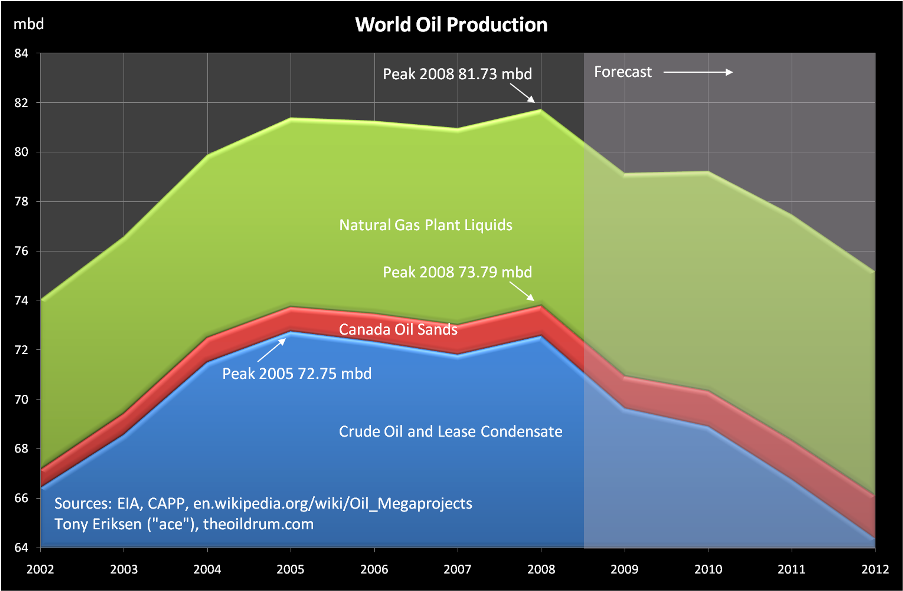
To the average person, and taking into consideration that honesty prevails in our social fabric, the pretty graph above can easily be viewed as the truth, and the need to question the facts behind the picture is not very apparent.
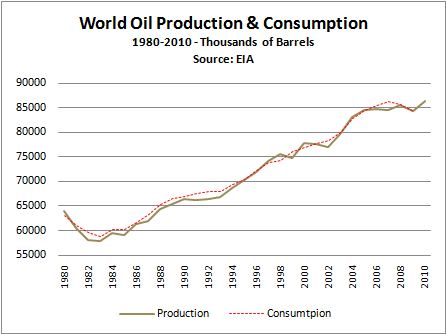
But for starters, world oil production in 2008 was 85,494,789, barrels according to the Energy Information Administration. Although consumption is not available for December 2010 yet, leaving that year incomplete, world production figures are now online, and we have an official new peak in 2010 at 86.344 million barrels, as shown by the graph below. I included the consumption up to 2009 to show the correlation between production and consumption over the last 30 years.
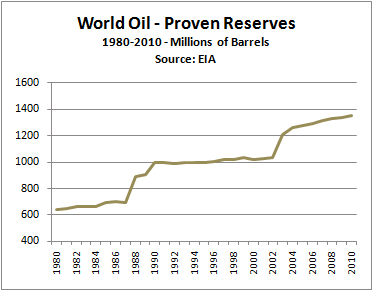
And if some may claim that the data supplied by the EIA is bogus, then one cannot rely on the agency’s projections either. In addition, and despite questionable methods by the oil industry on how the calculations are performed — and I am in no position to override the data — the EIA reported another peak in Proven Reserves.
Where does the “Peak Oil” theory come from? Dr. Hubbert in 1956 predicted that oil production in the U.S. would peak in the 1960s or 1970s, and his prediction proved correct in 1970. Then, in 1974, he once again predicted that global, not U.S., peak oil would hit in 1995. Without dismissing his accomplishments as a geoscientist, one can see where his one-track mind was as far as “peaks” were concerned. The dismissal of a variety of factors, such as technological advancement, contributed to the incorrect forecast.
But in view of recent data, the message has not changed, and the revelation of Wikileaks’ cable regarding Saudi Arabia’s reserves received a lot of attention. The Guardian published “WikiLeaks cables: Saudi Arabia cannot pump enough oil to keep a lid on prices,” with a link to the cable, of which an excerpt follows.
1. (C) SUMMARY: On November 20, 2007, CG and Econoff met with Dr. Sadad al-Husseini, former Executive Vice President for Exploration and Production at Saudi Aramco. Al-Husseini, who maintains close ties to Aramco executives, believes that the Saudi oil company has oversold its ability to increase production and will be unable to reach the stated goal of 12.5 million b/d of sustainable capacity by 2009. While stating that he does not subscribe to the theory of “peak oil,” the former Aramco board member does believe that a global output plateau will be reached in the next 5 to 10 years and will last some 15 years, until world oil production begins to decline. Additionally, al-Husseini expressed the view that the recent surge in oil prices reflects the underlying reality that global demand has met supply, and is not due to artificial market distortions. END SUMMARY.
But not everything in the cable was convenient, and while I sincerely believe that Dr. al-Husseini provided his honest opinion, the Guardian’s article included the reaction of Jeremy Leggett, convenor of the U.K. Industry Taskforce on Peak Oil and Energy Security. He stated that, “We are asleep at the wheel here: Choosing to ignore a threat to the global economy that is quite as bad as the credit crunch, quite possibly worse.”
I understand that oil production will hit a peak sometime in the future, simply because the substance cannot be replenished at the global consumption rate, but Dr. al-Husseini’s opinion is that a production plateau will be reached over the “next 5 to 10 years and will last some 15 years until world oil production begins to decline.” By my calculations, that would put the beginning of the production decline somewhere between 2027 and 2032, using the cable’s 2007 date, and barring any technological developments that may occur between now and then.
But to scream that the end of oil as we know it is very near is synonymous to me calling for an impending global lettuce shortage after my garden was attacked by rabbits. Thus, there is no substitution for the calm and collected informed analysis of the data, and the realization that global economics cannot be forecasted with a simple straight line. Otherwise, why bother with an education, when all we need to teach the new generations is how to obtain the latest data and to draw a 10 degree slope projecting into the future – up or down?
Then, to add some fuel to the fire — no pun intended — Exxon Mobil’s (XOM) CEO Rex Tillerson stated that “the transition away from oil-derived fuels is probably 100 years away,” as reported by Bloomberg in 2009. I’m certain that Mr. Tillerson didn’t mean it and Exxon’s investment in alternative energy sources is living proof of the company’s realization that a shift in energy resources is under way — and shale is only one of them, as I outlined in a previous post.
But the production side of the equation must be balanced with consumption. Despite China’s higher demand, which will be put to the test as economic activity decreases and the forecasted growth rate has already been reduced as I wrote in a previous post about China, consumption in the U.S. and Japan has been declining for the last five years, and only recently has an increase in U.S. demand started to form.
However, considering current economic conditions, a change in trend cannot be baked in just yet; the macro outlying factors still point to a very slow economic expansion or even a contraction. As an example, today’s Existing Homes Sales drop of 9.6%, while home prices declined 5.2% from one year ago, does not add to a very bright outlook. Furthermore, the regional breakdown included in the NAR’s press release showed the decline was uniform across the country.
In short, investing in energy must be done by taking into consideration the various economic factors, and a combination of demographics coupled with the theory of an impending resource depletion is hardly a justification to assume that the price of oil will catapult into the stratosphere without consequence, and that one will benefit financially while being insulated from the projected fallout. I will advance that if peak oil theory is the foundation for any investment in energy, the wheel of fortune will deliver the “bankruptcy” slot before the “jackpot.”
7 Comments on "Peak Oil Theory Misses 2010’s New Peak"
Rick on Tue, 22nd Mar 2011 7:34 am
Stupid propaganda article. Peak oil is a theory – bullshit. These types of articles are always written by trader types* / denial sites, like this one, Seeking Alpha.
* You know them, they drive SUV’s, are fat, and have a cell phone attached to their fat head. And they are brain dead. They’re part of the ME culture. The ME culture will soon go the way of the Dodo.
DMyers on Tue, 22nd Mar 2011 10:24 am
First, the author made a point of the crazy mixed up thinking of Peak Oil adherents by quoting from a piece on theoildrum.com about falling oil imports in the U.S.. It suggests that the oildrum article’s analysis of the causes of this demand fall demonstrate a failure of reason. Then, without ever addressing the specific points of the excerpt, the author ends up with the very same conclusion made clearly in the excerpt, stating that demand in the U.S. has fallen every year since 2005, except the article reformulates this as “the last five years.” Fall in demand equals fall in imports. The author affirmed rather than refuted the excerpt.
The author simply misunderstands Peak Oil, a simple concept, which nonetheless implies a complicated culmination. Just to name a few complications, I begin with liquid fuels.
I have no expertise on this subject, but I have come to believe that oil supply or production numbers include liquid fuels other than conventional oil. The graph in the article tends to support this conclusion. That would tend to complicate production numbers. I think the original Hubbert theory applies only to oil, not to oil aggregated with other liquids. These other liquids would follow their own independent curves of depletion, which would infect the analysis.
Another factor that is grossly distorting a straight up Peak Oil analysis is the use of secondary and tertiary methods of oil extraction. From what I can gather, these methods of extraction are in wide use now. The resorting to extraordinary measures like these is prima facie proof of Peak Oil, and the inclusion of such oil in the production numbers clearly obstructs a view of the true situation.
A final related issue is the resort to sources such as tar sands. How does this relate to a Hubbert phenomenology? This isn’t conventional oil. It never starts out easy. Can this source be included in an honest analysis of the oil situation? To me, this is more of a low quality source, related to a corollary of Hubbert. That corollary is: Energy returned on energy invested will decline for oil following real peak. More simply, we will resort to lower quality sources, which will yield progressively less net energy. That’s what tars sands are, low yield oil. If these are to be treated as a feasible future energy source and are to be thrown into supply data, then please be honest about how these oils really mix, i.e., they don’t.
If there is a fraud here, then it is in the inclusion of all liquid hydrocarbons in, and the treatment of tar sands and their ilk as conventional oil in the numbers, a fraud more pernicious than any common sense observation made within the ranks of Peak Oil believers.
DC on Tue, 22nd Mar 2011 7:32 pm
This guy even mentions that economy may in fact be contracting. If he understood anything at all about PO, he would know that the as the EROEI of fossil fuels continues its decline, a by-product of this fact will that the economy will also contract. It simply cant do anything else. Less net energy means less “growth”. Of course, well see this contraction or stagnation reported as being a result of “high energy” prices. Thus the talking heads can continue to talk about PO in terms of a purely economic problem, while ignoreing the physical reality of PO(what they are doing now IOW)
Chris in NL on Tue, 22nd Mar 2011 8:32 pm
According to the graphs above, we have 1400 million barrels of proven reserves in the world, and a daily consumption rate of 85 million barrels – that gives us less than 17 days.
Am I missing something here?
Matt Simmonds on Tue, 22nd Mar 2011 11:43 pm
Oh great ! I feel soo much better now I’m going to celebrate by buying myself a Hummer for my weekend drives and a Suburban for my daily commute.
This article is complete nonsense. Peak Oil is Peak CONVENTIONAL OIL both sweet and sour and light and heavy. But it does not include TAR or NATGAS LIQUIDS. Not that it’s going to make much of a difference anyway…
Don S on Wed, 23rd Mar 2011 1:03 am
After dismissing peak oil theory, he then goes on to admit that he understands “that oil production will hit a peak sometime in the future…” Does that put him in the “not crazy–but stupid” category?
Rick M on Thu, 24th Mar 2011 10:49 am
Chris,
You are missing something, but it’s hardly your fault.
General consensus is that the world has already consumed over a trillion barrels of oil, with at least that much left (though the latter ought not to be viewed as a NET energy certainty, since it will take a good deal of energy to find, extract and refine the next trillion).
And you are correct, 85 mbpd times 17 days = 1400 mb. But the last graph should be in billions, not millions of barrels… 1.4 trillion barrels would be in the commonly accepted ball-park.
So now we are looking at 17,000 days… about 50 years. So not next month, but surely a concern for our kids. Surely also a concern for us all, once people become aware and clue in to the implications. That awareness will occur much, much sooner than “running out,” as will the difficulties which arise from that awareness.