
Peak Oil is You

Donate Bitcoins ;-) or Paypal :-)


Page added on December 5, 2015

Operating in a World of $50 Oil

While hopes for a reversal in oil prices may have faded just after mid-August when U.S. crude oil futures slipped to a six-and-a half year low, the battered petroleum industry continues to plod along in its search for ways to steer through these difficult times.
Last month, some industry players met in Singapore for the 14th Annual Marine Money Singapore Ship Finance Forum, where there was a discussion on dealing with the impact of oil at $50 a barrel. Rigzone takes a look at the key issues under scrutiny at the forum, including the future direction of oil prices, the impact on the offshore support vessels market and oil consumption in China – the primary driver for global demand growth in recent years.
To recap, global oil prices have lost around half of its value from a year ago due mainly to a supply glut, a development exacerbated by the decision of the Organization of Petroleum Exporting Countries (OPEC) in November 2014 not to reduce production so as to protect their market share. The prolonged supply glut weighed on global oil prices, culminating in U.S. crude futures falling to $40.46 a barrel Aug. 19 – the lowest since March 2009.
Mixed Views on Oil Prices
Panelists at the Singapore forum held different opinions on the future direction of global oil prices. They singled out various factors for the current malaise in the oil markets, including weak demand caused by low global economic growth and the surge in U.S. shale production. But the panelists agreed that the industry downtrend stemmed mainly from OPEC’s stance on keeping unchanged the cartel’s oil production level.
“If you look at what’s happening today, it’s a plan, it’s a strategy, it’s a plot and you can call it what you want. OPEC has a strategy here. It’s just not the force of market pressure. This is a strategy to drive the price of oil down, drive out the producers/competitors that have more expensive recovery, like the Russians, North Sea and U.S. shale production. So that’s what I think the difference is and it’s working,” Kenny Rogers, head of Chemical Transport Logistics at Aurora Tankers/IMC Industrial Group, said.
Panelists were uncertain when global oil prices would recover given the unpredictable nature of the markets.
“At the very peak in 2008, Goldman Sachs [Group, Inc.] said oil would go to $200 [a barrel] and of course it crashed to $37. Only last week they say it will go to $20. I don’t really know. It’s anybody’s guess I believe,” Geir Sjurseth, Managing Director and Head of Offshore Finance at Germany’s DVB Bank SE, said.
He was referring to the last major financial crisis, when global benchmark Brent oil futures peaked at around $145 a barrel in July 2008. At the moment, industry players are unsure whether the oil prices have bottomed.
“No one has ever suggested an alphabet to describe this crisis. The last time [the 2007-2008 crisis] it was all about a V-shaped recovery, a W-shaped recovery or a U-shaped recovery. But there’s no alphabet to describe what we are going through right now,” Fazel A. Fazelbhoy, CEO of Dubai-based Synergy Offshore FZ LLE, a consulting firm focused on the offshore energy and marine sector.
Lower Non-OPEC Supply Key to Market Recovery
With OPEC sticking to its current production quotas, prospects for a recovery in global oil prices will hinge on a reduction in supplies from major non-OPEC producers like those in Russia and the North Sea as well as U.S. shale producers.
“In the short term, it’s going be a cut in supply which is required to help stabilize the oil price. Recent reports … have been proclaiming that OPEC won the oil price war as the non-OPEC producers have started to cut supplies, notably U.S. shale production, most of which makes a sizeable loss while the oil price is languishing in the $40-50 a barrel price range,” Simon Spells, a Singapore-based senior associate at international law firm Berwin Leighton Paisner LLP, told forum participants.
“OPEC itself was likely to respond by cutting back its own production, having achieved the objective of protecting its market share. And this in turn will allow supplies to fall further … which in the short to medium term will assist in leading to an increase and stability in the oil price,” Spells added.
These sentiments were reflected in the “Short-Term Energy and Winter Fuels Outlook” released by the U.S. Energy Information Administration (EIA) Oct. 6. In it, the EIA forecast non-OPEC production, which expanded 2.3 million barrels of oil per day (MMbopd) in 2014, would grow by 1.3 MMbopd in 2015 – with the increase attributed to investments made when oil prices were higher. It estimated output would remain flat in 2016.
“Non-OPEC growth dries up to almost nothing; the Saudi strategy is working … It is has never been about a couple of months or a couple of quarters, but a couple of years, and that is how it is playing out,” according to Michael Wittner, a New York-based analyst at Societe Generale, as quoted by Reuters Oct. 6.
In fact, a panelist commented that the current low oil prices could be a precursor to another rally in the market in the not too distant future.
“I don’t understand how no one has talked in the last three to six months what the decline rate of existing oil production [which could be] anywhere between 8 and 20 percent,” Fazelbhoy said, noting that capital spending has been cut by petroleum companies worldwide amid the industry downturn.
“If no new oil is being discovered and we have an absolute limit of new oil coming from 2014 through 2017, someone is going to wake up one day and say hey we need more oil. The reaction is going to be: you have lost over $100,000, capability has been decimated in the oil industry, in the oil services sector, including oil companies,” he explained.
“You have no infrastructure in place, no major oil fields discovered during this period … You have a declined rate of up to 20 percent and more in some cases, oil inventory goes down, then what? You are going to have this haywire Goldman Sachs prediction probably come true … The point is no one knows. I think $200 is perfectly logical [under such circumstances].”
Offshore Sector Faces Headwinds
The offshore sector, including the offshore support vessel (OSV) segment, serving the oil and gas industry is facing continued headwinds as its revenues are still under pressure from sharp cutbacks in capital spending by petroleum firms, causing delays and cancellations of several exploration and production (E&P) projects.
“$50 oil has decimated the offshore industry altogether. E&P has been growing at a rate of 12 to 14 percent per annum from 2008 onwards and it crashed down to 2 percent growth in 2014. Growth will fall 15 to 20 percent … in 2015 and by up to 25 percent in 2016,” Fazelbhoy said.
Meantime, he revealed that OSV utilization rates fell from 90 to 60 percent while day rates have fallen by around 30 to 60 percent. More downside pressure is expected for OSVs as 400 new vessels are poised to join the global fleet, a number that excludes the estimated 200 newbuilds in China.
While OSV utilization in the Middle East stays high at over 90 percent, largely a result of the OPEC-led strategy to keep oil production up, it has not shielded regional vessel operators from feeling the effects of a worldwide decline in day rates. Vessel day rates for OSV players dipped by more than 30 percent, according to the Synergy Offshore CEO.
Agreeing with the observation, Berwin Leighton Paisner’s Simon Spells noted that the offshore sector is now “coming to a stage where there is going to be some distress in that market and some restructuring required.”
He explained that banks are concerned about the financing arrangements with vessel owners, especially if the existing charter contracts are not being renewed, or renewed as expected, as these are often built into the requirements for existing financing facilities.
Chinese Concerns Eases, Slightly
Economists who spoke at the forum said they expected the economy in China to avoid a “hard landing”, easing concerns of a sharp curtailment in oil consumption in Asia’s largest, and the world’s number two economy after the United States, data from the International Monetary Fund indicated.
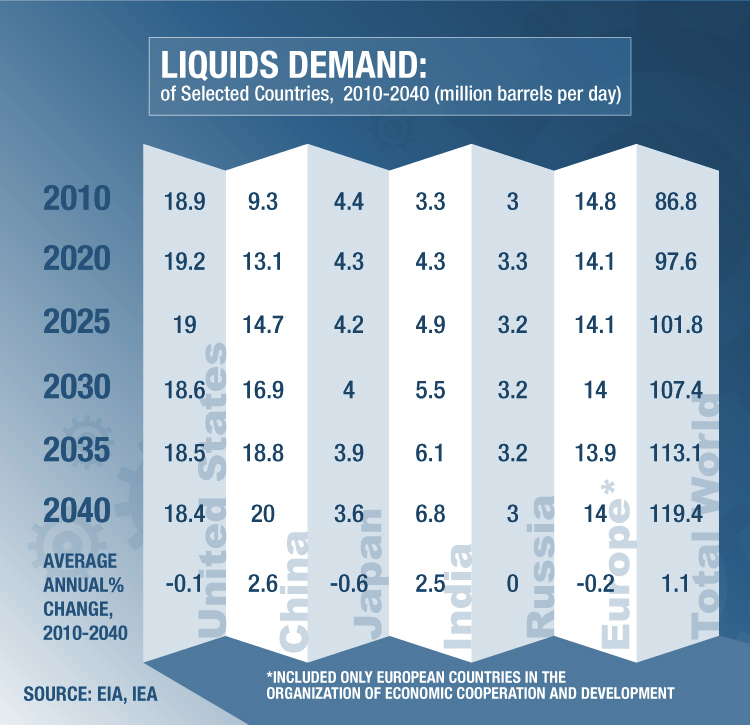
China’s currency devaluation in August and a sharp decline in its equity markets dented confidence in its economy, which – the EIA noted in its May report – accounted for about 43 percent of global oil demand growth in 2014 and an estimated 25 percent for 2015.
“The Chinese authorities have the tools necessary to keep the slowdown in economic growth gradual,” ABN AMBRO’s Head of Macro and Financial Markets Research Nick Kounis told the forum, adding that China’s economy is expected to grow by 7 percent in 2015 and 6.5 percent in 2016, compared to 7.3 percent in 2014.
Another economist held similar views on the Chinese economy, highlighting the country’s importance despite the slowdown.
“China’s economy is slowing but not crashing,” according to Edward Lee Wee Kok, head of ASEAN Economic Research at Standard Chartered Bank. He added that “despite the concerns … about China in the near term … it’s hard to look away from this economy.”
21 Comments on "Operating in a World of $50 Oil"
makati1 on Sat, 5th Dec 2015 7:15 pm
Rigporn and more charts of an impossible future…lol.
Harquebus on Sat, 5th Dec 2015 7:43 pm
Debt default will increase exponentially. A hard landing is unavoidable.
twocats on Sat, 5th Dec 2015 11:43 pm
China has it’s own PPT (they already own 10% or so of equities) so they can certainly run that baby for a while. I sensed real panic in the article and to be honest this is the one and only way we will have a fully realized peak oil within the next 5 years: a deliberate cut in production which leads to a shortfall that is never met once production catches down to consumption. The best thing to hope for is a low oil price for another 8 to 20 months but with production staying strong and demand being tepid. This will give depletion enough time to undercut the baseline production of the planet and make peak oil inevitable. I call it peak oil by “air pocket”.
twocats on Sat, 5th Dec 2015 11:45 pm
I should have said – deliberate cut in exploration and development (which is roughly the same as cutting production, but a different concept).
twocats on Sat, 5th Dec 2015 11:47 pm
Every day that oil prices stay low and production stays high is a great day and there’s only one metric left to watch at this point – production versus consumption. It was the same in 2007 – it wasn’t peak oil but consumption had caught up to production (some believe we were even consuming beyond production for several months, but ??). This caused massive economic shivers. If it happens again we could see some currencies collapse.
Davy on Sun, 6th Dec 2015 12:22 am
Two Cats great summary. I too hope for low oil prices for another 8-20 months. Any time I can get for more prep work is worth its weight in gold. I suspect a real blood bath when supply goes to a shortage at the end of this 8-20 months. I also agree it is the panic because of the disequilibrium of supply and demand that is driving peak oil. I really like your “air pocket” analogy. I like to call it a bumpy plateau of decent. I feel we are past the bumpy plateau. Anything that is not acceptable growth per the requirements of an acceptable operating level of growth is currently very dangerous. This is especially true when we consider time frame. Time is of the essence. Growth that is below par cannot last in this global world. There are too many problems. Population and consumption pressures are too great for subpar growth for very long. I totally agree with your statement “This caused massive economic shivers. If it happens again we could see some currencies collapse.”
ennui2 on Sun, 6th Dec 2015 2:56 am
“Two Cats great summary.”
Hardly. It totally avoided talking about liar loans and CDOs which caused the credit crisis.
marmico on Sun, 6th Dec 2015 4:22 am
In 1965 Twocats earned $2.63 per hour, leaded gasoline cost $0.31 per gallon and the average fuel efficiency (AFE) of the new model year car was ~14 miles per gallon (mpg). Twocats could travel ~120 miles per hour of work.
Fifty years later in 2015 Twocats III earned $21.00 per hour, unleaded gasoline cost $2.50 per gallon and the new model year car was ~33 mpg. Twocats III could travel 275 miles per hour of work.
120–>275 equals 130% greater mobility in 2015 relative to 1965 for twocats compared to his granpappy.
makati1 on Sun, 6th Dec 2015 6:31 am
Marm, you assume that he makes that much today when actually, he probably makes less and takes home a lot less.
A new car in 1965 cost less then 5 months income at $2.63. Today that $21 income would need 9-10 months to buy the same car.
And, BTW: few cars today get anywhere near 33 mpg under the best conditions. Sticker price is another lie that the gullible believe.
But, nice try…
makati1 on Sun, 6th Dec 2015 6:32 am
Ooops! meant sticker mpg…
marmico on Sun, 6th Dec 2015 6:51 am
Davy Green Acres, you are a knife wielding innumerate word salad prattling flag waiving goat sodomizing fuctard.
Kindly fuck off.
marmico on Sun, 6th Dec 2015 6:55 am
Do the arithmetic, makati. Otherwise, you join the bloviating, blathering blowhard crowd.
Davy on Sun, 6th Dec 2015 6:56 am
Enu, I was referencing Two Cat’s comments on PO. Were we talking about credit crisis? CDO’s and liar loans were a symptom not a cause of the 08 near collapse. What we had was a US housing bubble that was magnified by financial instruments of dubious nature. These were traded globally. This bubble was further destabilized by excessive speculation. Oil was bid up to extremely high levels as were other commodities. This bubble burst and we had a near Minsky moment of financial paralysis. This was a huge bubble.
What we have today is more bubbles and this is why what we see today is so unnerving. We replaced one big bubble for many others and added more debt to fuel a bigger fire. The Chinese market bubble is bursting and the commodity super cycle bubble is over. How long before the rest of the world’s equity and bond markets implode? How long until currencies collapse under destabilization? Add to the above TwoCats comments on peak oil and its consequences. We no longer have tools to fight the next round of economic decay. Let us hope this is gradual and the degree is not to severe.
http://www.investopedia.com/terms/m/minskymoment.asp
Davy on Sun, 6th Dec 2015 6:59 am
Mami, what did I say or do to you this fine morning. Why are you so touchy? Is your perfect world of delusional markets and cornucopian fantasy smelling of decay? Maybe it just felt good. Good morning to you too.
marmico on Sun, 6th Dec 2015 7:56 am
Well, makati, I did some arithmetic research.
In 1965, the average new car cost $3,000. (I lied. The earliest data is 1967 @ $3,100)
$3,100 divided by $2.65 per hour equals 1,170 hours of work to buy a new car.
In 2015, the average car cost $27,000.
$27,000 divided by $21 per hour equals 1,300 hours of work to buy a new car.
So it costs 10% more per hours worked to buy a superior car in 2015 and drive 130% further relative to a 1965 car.
Davy on Sun, 6th Dec 2015 8:16 am
“Venezuela Seen Handing Congress to Opposition in Sunday Vote”
http://www.bloomberg.com/news/articles/2015-12-06/venezuelans-to-vote-in-polls-seen-handing-congress-to-opposition
“The country is in an explosive situation,” opposition leader Henrique Capriles said in an interview. “The only reason it hasn’t exploded is because of Sunday’s election. People are waiting.”
“A blowout at the ballot box could produce the kind of recall referendum that failed to unseat Chavez in 2004. Still, most analysts caution against expectations of sweeping change. More likely, they say, political gridlock and a painful process of trying to extract concessions from the president is on the way.”
makati1 on Sun, 6th Dec 2015 8:46 am
Marm, I happened to buy a NEW Chevy Impala Super Sport Convertible with a 396 CU.In. engine, 4 barrel carb, automatic trans, AM/FM radio, etc. The sticker price out of the show room was a bit LESS than $2,500. I made $5/hr that year for a total income of about $10,000 gross. IF you could buy the same today, it would be much closer to $45,000+. Do the math.
rockman on Sun, 6th Dec 2015 9:12 am
Just a small fact about the last time we had an oil price collapse in late 2008. The average oil price for 2009 was $58/bbl….significantly less the 2008 yearly average. So with 2009 prices being so much lower how much more cheaper oil did the consumers buy compared to 2008? They didn’t: less $58/bbl oil was purchased then the higher priced 2008 oil was purchased.
It takes time for economies to turn around as a result of lower energy costs. But this time the dynamics appear different: oil sales have increased with the drop in oil prices. But prices did fall a good bit further this time.
Pete Bauer on Sun, 6th Dec 2015 7:33 pm
““Non-OPEC growth dries up to almost nothing; the Saudi strategy is working …”
But the Saudi Water resources are depleting because of using more water for Oil Production and its grain production is coming to a grinding halt. So the Saudis now have to spend more money on food imports.
http://www.bloomberg.com/news/articles/2015-11-04/saudi-wells-running-dry-of-water-spell-end-of-desert-wheat?cmpid=taboola.science.rt-rtcom
rockman on Mon, 7th Dec 2015 6:15 am
“…the Saudi strategy is working.” And that would be the strategy of losing $180 BILLION PER YEAR in oil revenue? Monies that could have bought a lot of grain.
BTW very little to no fresh water is used to produce oil/NG.
Davy on Mon, 7th Dec 2015 6:38 am
I was going to point that out too Rock. All I ever read has been the Saudis were using brackish or salt water in production.