
Peak Oil is You

Donate Bitcoins ;-) or Paypal :-)


Page added on March 12, 2014

OPEC Update and my argument that OPEC is producing flat out
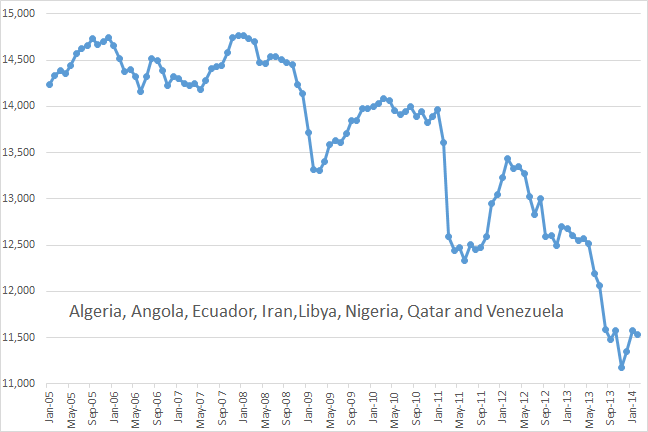
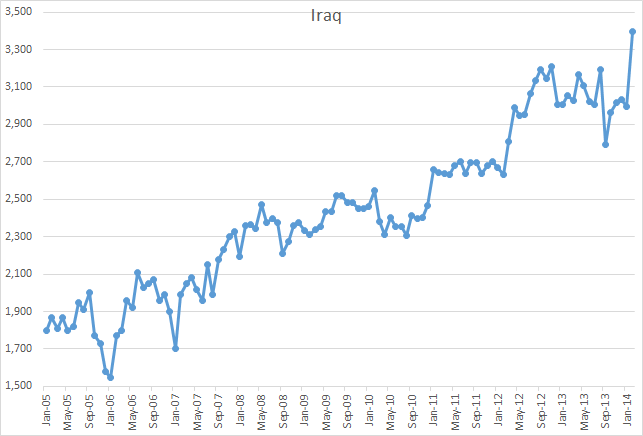
The OPEC Monthly Oil Market Report is just out with OPEC crude only production numbers for February 2014. OPEC Crude production was up 258.6 kb/d in February on the strength of a big jump from Iraq. Iraqi crude oil production was up 400 kb/d to 3,397 kb/d. OPEC crude only production, less Iraq, was down 141.4 kb/d.
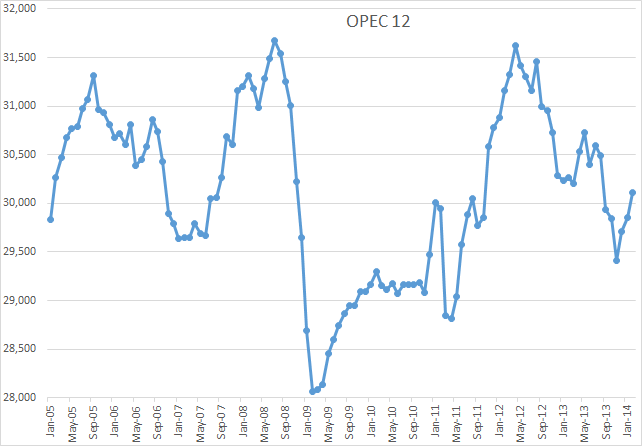
Iraq was the only big gainer this month.
Saudi Arabia was down 102 kb/d but that was after January production had been revised up by 99 kb/d.
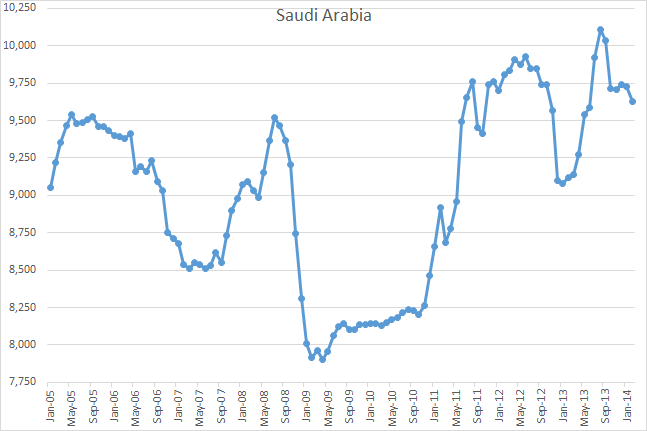
Saudi admitted, early that their old giant fields were in steep decline. Ravensworth.org published the following quote about eight years ago however their web site has since been taken down:
One challenge for the Saudis in achieving this objective is that their existing fields sustain 5 percent-12 percent annual “decline rates,” (according to Aramco Senior Vice President Abdullah Saif, as reported in Petroleum Intelligence Weekly and the International Oil Daily) meaning that the country needs around 500,000-1 million bbl/d in new capacity each year just to compensate.
That quote by Abdullah Saif was widely circulated. and in 2007 International Business Publications published this on page 144:
One challenge for Saudi in achieving their strategic vision to add production capacity is that their existing fields sustain, on average, 6 to 8 percent annual “decline rates” (as reported by Platts Oilgram) in their existing fields, meaning that the country needs around 700,000 bbl/d in additional capacity each year just to compensate for natural decline.
However in 2006 Saudi Arabia’s Center for Strategic and International Studies claims they have gotten this decline rate down to almost 2%.
Without “maintain potential” drilling to make up for production, Saudi oil fields would have a natural decline rate of a hypothetical 8%. As Saudi Aramco has an extensive drilling program with a budget running in the billions of dollars, this decline is mitigated to a number close to 2%.
The drilling program they are talking about is those horizontal wells placed at the very top of the reservoir. Now imagine, that with all those brand new horizontal wells sucking the oil right off the top of the reservoir, they still had a decline rate of over 2%! Of course that was in 2006. It is likely that the water has already hit many of those horizontal wells and their decline rate is now well over 2%. More likely it is a lot higher than that.
But they have brought on Khurais and Manifa since then with a combined production capacity of 2 mb/d. That has enabled them to keep their production levels up… for now. Saudi may, just may, be able to produce half a million barrels per day more than they are right now but I doubt it.
Okay then is OPEC producing flat out? There is absolutely no doubt that, with the possible exception of Saudi Arabia, they are. Eight OPEC nations have serious declining production since 2005. Even to suggest that these eight nations are not producing flat out is to deny reality. To believe that they would deliberately cut production while four countries, Iraq, Saudi Arabia, Kuwait and UAE, are increasing production is delusional.
What about the other four? Iraq makes no bones that they are producing every barrel possible and hope to produce more. And I have discussed Saudi Arabia but what about Kuwait and UAE?
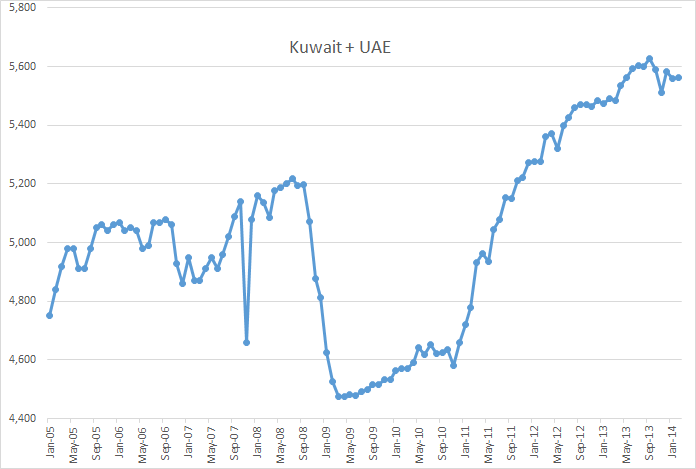
Kuwait and the UAE were later than Saudi Arabia in getting their infill drilling program going. They both started their infill drilling program around 2007, delayed it during the drastic OPEC cuts from late 208 until early 2011, but have since gone full steam with that program. They reached their peak about a year ago. I expect them to hold at this level for two or three years before they start a not too slow decline.
Yes, it is my sincear opinion that OPEC is now producing every barrel they possibly can. OPEC production may increase slightly as Iran dlowly increases their production as sanctions are lifted. And there is even a slight chance that peace may break out in Libya and their production increases, but not likely.
My point is there is OPEC has no spare capacity. If anyone seriously doubts my opinion on this subject then please post your reasons, and name the countries you believe are not producing flat out, in the comments section below.
Updated charts of all 12 OPEC countries can be found here: OPEC Charts
Energy & Capital is a web site that pushes energy stock. They are usually bullish, very bullish on shale oil and usually deny peak oil. That is why it was so surprising to get their latest edition in my email box. However this is just one writer for Energy & Capital. I am sure most others have a different opinion.
Over the past few months, I’ve been sharing my concerns about shale oil.
Namely, that it’s more comparable to a Ponzi scheme than any sort of boom.
I’ve articulated the reasons for my thesis, including fast decline rates, the amount of new rigs and wells needed, and a cost of production that’s been higher than the price of sale for some time now.
And further down he says:
Predictions are tough, especially with a still-struggling economy. If I had to say, prices at least need to rise to the marginal cost of production at $115ish. Trouble with that is anything over $110 for a sustained time causes recession, which of course would send prices lower making projects unviable once more.
It’s classic peak oil. It never went away, we’ve just been able to paper over it with free money for the past half decade.
Seems like the majors realize the gig is up. They’re selling unconventional assets in a big way, wanting to mitigate risk and capex by getting back to conventional. Still, conventional peaked in 2005 and that strategy seems like a last-ditch effort.
10 Comments on "OPEC Update and my argument that OPEC is producing flat out"
J-Gav on Wed, 12th Mar 2014 11:04 pm
Hmmm, if this dude’s right, last ditch could be a bitch.
MSN fanboy on Wed, 12th Mar 2014 11:21 pm
Lets hope they keep this up 🙂 the further down the rabbit hole we go the more chaos is the result 🙂
chaos=Happy 🙂
We should print dollars and lack up the price to 200 dollars a barrel. Why not.
Increase population too, (makes it more likely we crash)
Stilgar Wilcox on Thu, 13th Mar 2014 12:03 am
“It’s classic peak oil. It never went away, we’ve just been able to paper over it with free money for the past half decade.”
Ron Patterson, aka Darwinian from his days at The Oil Drum has done a great job of keeping his website at Peak Oil Barrel on topic and with great graphs. “It’s classic peak oil” speaks volumes about our predicament, because there’s no getting away from it even if for a time we print money.
All the infill drilling by the Saudi’s, Kuwait and UAE is a reflection of the human drive to keep things going just as they have for decades before, but leading to a really bad hangover once the fall from grace ensues.
Davy, Hermann, MO on Thu, 13th Mar 2014 12:12 am
The overall effect of this peak described in this article is really contingent on what the economy does. If we see a slow down or serious correction this year we will see demand drop off. This will especially be true if China has a hard landing which is increasingly looking like the case. China is the big oil demand driver at the moment. A financial correction should allow the rough undulating plateau between supply and demand to continue. The one problem with a financial correction could be lower prices which will choke off production but that may not happen immediately. What this article is saying to me is growth is over from a bellow ground point of view. I feel “real” growth is over already from an above ground economic viewpoint because of the pressures of debt and unfunded liabilities. My question is how long until the system snaps from this double dose of instability. Both the oil issue and the finance issue together mean there is no hope of a recovery. When this becomes common knowledge how long until confidence is lost and the global economic system starts to seize up?
jeep on Thu, 13th Mar 2014 1:28 am
The chart shows very strong evidence of the cartel acting in 2008-9 and possibly as recently as 2012 (see SA graph). Kudos to Ron for putting this together. Very helpful.
I want that cartel cracked and reduced to gibbering cheating and pumping all out. Rockman, drill, drill. (I know you want prices high, but the nice thing about US oil is it is so fragmented that it really does not play well in a cartel. Just look at it as SA creating overhang…so go scoop up that market they are leaving for you.)
Boat on Thu, 13th Mar 2014 2:18 am
Isn’t there more supply in Libya, Iraq,Nigeria? Isn’t there decades of hydrolic fracking around the globe waiting for the tec to get to them? Meanwhile renewables will continue to make advancements. Bugs will be printed for food etc. Dont give up on the humans yet.
GregT on Thu, 13th Mar 2014 2:26 am
There is at least 5 times as many recoverable ‘reserves’ as we need to fry our planet.
If we burn them all, the Earth will reboot, without us.
Northwest Resident on Thu, 13th Mar 2014 5:14 am
“A financial correction should allow the rough undulating plateau between supply and demand to continue.”
Davy, that depends probably on how big of a financial correction it is, I’m sure you agree. Maybe a ten or twenty percent drop and then a long steady plateau with everybody licking their wounds but otherwise carrying on “normally”. Or maybe a larger, perhaps much larger drop, which could lead to widespread panic. And if that happens, who knows where it will lead. The problem with a ten or twenty percent drop these days is, with fraud and hidden debt so rampant in the global financial system, and with so many hot points burning in the world, combined with the well known but officially unrecognized fact that we are scraping the bottom of the oil barrel, a drop of even ten or twenty percent might be enough to set off widespread panic. Do you agree?
Davy, Hermann, MO on Thu, 13th Mar 2014 9:54 am
N/R, “YEA” you and I are in agreement on a likely major contraction of more than 20%. This would change those dynamics mentioned to panic and systematic collapse with a reboot to a much lower standard of living. Then you throw in the many man made problems (waste/nuks) and natural problems (climate/water/food) and it is hard to be optimistic. So my quote: “A financial correction should allow the rough undulating plateau between supply and demand to continue.” Is purely a “if this ship of confidence holds”!! In addition the above is also a short term of 5 to 10 years or less statement. I have no optimism for more than 10 years out…”zero”!!! Panic in this day and age could result in systematic collapse in a short period of time without the ability to reboot the system. This process will destroy a significant amount of infrastructure and knowledge. These risks have never been higher than they are at this moment. This is all because of our global complexity and population overshoot.
shortonoil on Thu, 13th Mar 2014 12:35 pm
Re-post from yesterday “Saudi Arabia Threatens to Blockade Qatar”
Over at Darwinian’s site: http://peakoilbarrel.com/ they are discussing whether or not OPEC has peaked. Jeffery J. Brown posted some numbers from his ECI model (ratio of production to consumption). If you use his model Saudi Arabia is declining at about 4.6% per year; if you take into account their internal consumption. They are requiring more of their own production to power SA.
This coincides quite closely with the ETP model. The ETP model predicts that as time progresses it takes more energy to produce energy; that is, SA must consume more of its own oil to produce its oil (oil = energy). This shows up as declining oil available for export. The ECI model of Jeffery J. Brown’s is a better indicator of world petroleum depletion than a straight numerical count of produced barrels. It implicitly takes into consideration the increasing energy needed to produce energy.
The ETP model indicates that on a quality adjusted bases world production declined by 1% in 2013. On an energy bases it declined by 2.5%. Unless that was compensated for from other sources that translates to a loss of about $350 billion in world economic activity, and about $1 trillion for the US (we use more oil per capita). Interesting, $1 trillion is about equal to the FED’s QE program.
http://www.thehillsgroup.org/