
Peak Oil is You
Donate Bitcoins ;-) or Paypal :-)


Page added on February 2, 2011

Oil Shock Potential of OPEC Nations
While we are all having our minds focussed anew on the wisdom of deriving economically critical commodities from unpleasant autocratic regimes, it seems a good moment to review the potential impact on oil prices of revolutions in each of the various OPEC countries. This is a rather uncertain exercise for at least these reasons:
- It is not certain how much oil production in any given country would be affected by a revolution.
- It is not certain how long any disruption would last.
- It is not certain how much other countries (particularly Saudi Arabia) would be willing and able to make up the difference.
- To the extent Saudi and other spare capacity was used up in response, it is not certain how markets would price that.
- It is not certain how oil prices would respond to actual reductions in supply that were much larger than recent excursions.
Still, we can probably get some general idea of the order of magnitude of the potential effects. In this post, I make the following assumptions:
- I assume that oil production for the country in question is a total loss for long enough to fully affect prices (this might not be true in a more “velvet” revolution, so is basically intended to size the worst case).
- I consider two cases: one in which no additional spare capacity is effectively available, and one in which an additional 2mbd is put on the market (except in the case of a Saudi revolution). It’s realistic that the Saudi’s would make at least some oil available, but I put in the no response case to give some idea of the upper limit of what the market might do in pricing in the fact that there would then be no remaining spare capacity.
- I assume that the price elasticity of oil is -0.05. This is based on this analysis I did of the global price/supply relationship during the last oil shock, and also this study of gasoline demand during 2001-2006 in the US. Although this may be a reasonable assumption for the smaller oil producers, it’s likely in the face of a really big oil shock that oil elasticity might turn out to be somewhat higher (and thus prices somewhat lower).
- I assume that the pre-shock price of oil is $100/barrel (roughly where it is currently), and then based on each countries current production (BP, 2009 figures), figure what the shocked price would be (also in $/barrel).
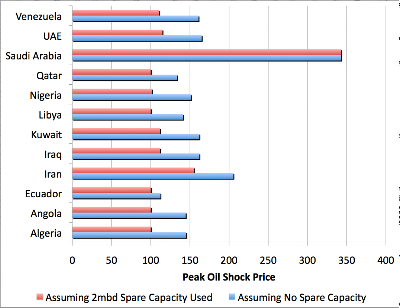
These can probably be described as “worst reasonable case” assumptions. At any rate, under those assumptions, I get the following graph:

As you can see, serious revolutions in most OPEC countries would probably only cause a few tens of dollars rise in oil prices. The big exceptions are Iran, which would likely push oil over $150, and Saudi Arabia, which would send it into the stratosphere.
My assumption is that Iranian protesters will be exhausted for some time by the failure of the protests of 2009 to revoke the fraudulent presidential election. Therefore, Saudi Arabia is the case of most interest.
2 Comments on "Oil Shock Potential of OPEC Nations"
cusano on Wed, 2nd Feb 2011 8:00 am
The entire situation is like walking on rice paper. Something is going to give and the world will change, perhaps suddenly. Political instability or a regime change, terrorism, a natural disaster. Without our constant ‘fix’ of oil, we can’t function as a society as we know it. I just don’t understand why people can’t see this.
Kenz300 on Wed, 2nd Feb 2011 10:29 am
Every country that imports oil needs to develop an energy policy of greater self sufficiency.
We all need to move to safe, clean, alternative energy. Wind, solar, wave energy, geothermal and second generation biofuels are a cheaper alternative than
a disaster in the middle east could cause to the economy.
Economic security and national security will depend on a policy to transition to alternative energy sources rather than relying too heavily on foreign sources of energy.
The lack of jobs and opportunity for a large part of the population combined with a lack of resources like food, water, and energy can become a unstable mixture. Add to that an ever growing population and the problem grows worse each day.
To transfer a nations wealth to other countries for oil is foolish when we can invest that money in alternative energy at home and provide jobs and security for our own populations.
Lets produce local goods, services and energy with local labor.
Tunisia, Egypt…. what other countries have the same problems?
1. High unemployment
2. Lack of resources – food, water, energy
3. declining middle class…
4. wealth concentrated in the top 2%
5. an ever expanding population
6. corruption and greed in business leaders
What country will be next?