
Peak Oil is You

Donate Bitcoins ;-) or Paypal :-)


Page added on September 15, 2015

Oil Production Is Likely To Fall Much Faster Than The IEA Predicts
Summary
According to the IEA, oil production is due to fall by 0.5 million barrels per day next year in non-OPEC nations.
While this is bullish for long-oriented investors, I believe it’s a big undershoot compared to what is likely to happen.
With oil production in the U.S. alone having already taken a beating and with the rig count falling further, oil output is likely to fall faster than the IEA thinks.
Some of this drop will probably come from countries outside the U.S., but the biggest drop, by far, will probably come from unconventional producers at home.
In a recent piece published on CNBC, it was highlighted that according to IEA (International Energy Agency), non-OPEC oil production is slated to fall by around 0.5 million barrels per day in 2016. Over the course of a year, this would imply 182.5 million fewer barrels of oil being produced, which is nearly as high as the estimated 240 million barrel excess the world has at the moment. For investors who are in the United States Oil ETF (NYSEARCA:USO) or energy companies like Linn Energy (NASDAQ:LINE)/LinnCo (NASDAQ:LNCO), BreitBurn Energy Partners (NASDAQ:BBEP), or Approach Resources (NASDAQ:AREX), this is bound to be positive news, but with all due respect, I think the IEA is far off base right now.
Oil production is already falling
According to the IEA, most of this decline will come from the U.S. (mostly Texas) as well as Russia and the North Sea. Of this falloff in production, about 80% is expected to come from the U.S. alone as the high production costs of unconventional drilling becomes uneconomical and rigs are stacked. In fact, because of the big drop in oil prices already, which have seen WTI crude fall from over $100 per barrel last year to a low of $37.75 just a couple weeks ago, the number of rigs in the U.S. are, at the moment, at their lowest point since 2003. Of course, the composition over this timeframe has changed by quite a bit, so if you look solely at oil rigs, we are at the lowest point (excluding a few months earlier this year) since 2010.
(click to enlarge)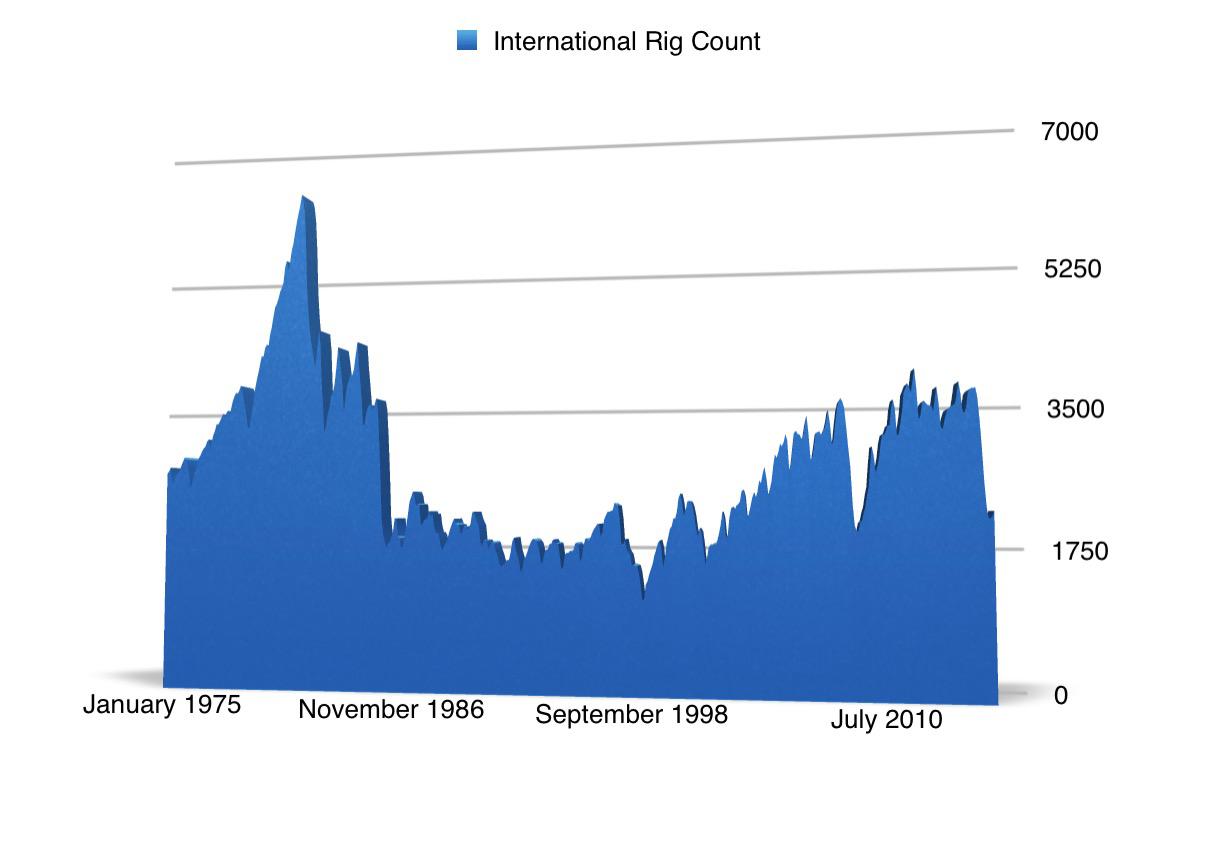
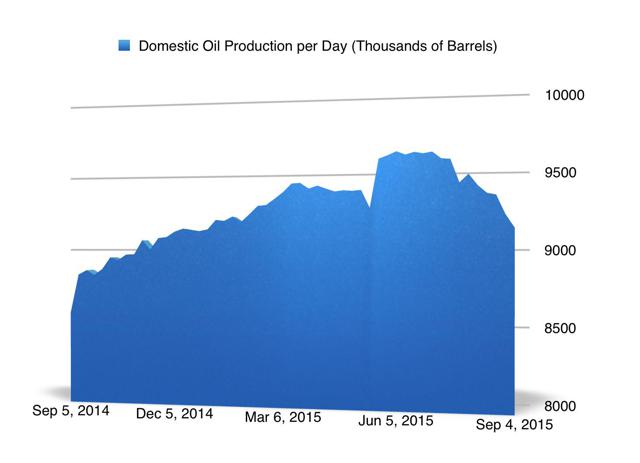
Although rigs have become more efficient over time, the 59% drop in oil rig count we’ve experienced over the past year (with the number in operation falling from 1,592 to 652) has already started impacting output. Using the EIA’s (Energy Information Administration’s) Weekly Status Report, production right now is down to around 9.135 million barrels per day (63.95 million per week). This is still higher than the 8.590 million barrels per day (60.13 million per week) being produced a year ago, but is well below the 9.610 million barrels per day (67.27 million per week) that we peaked at earlier this year.
(click to enlarge)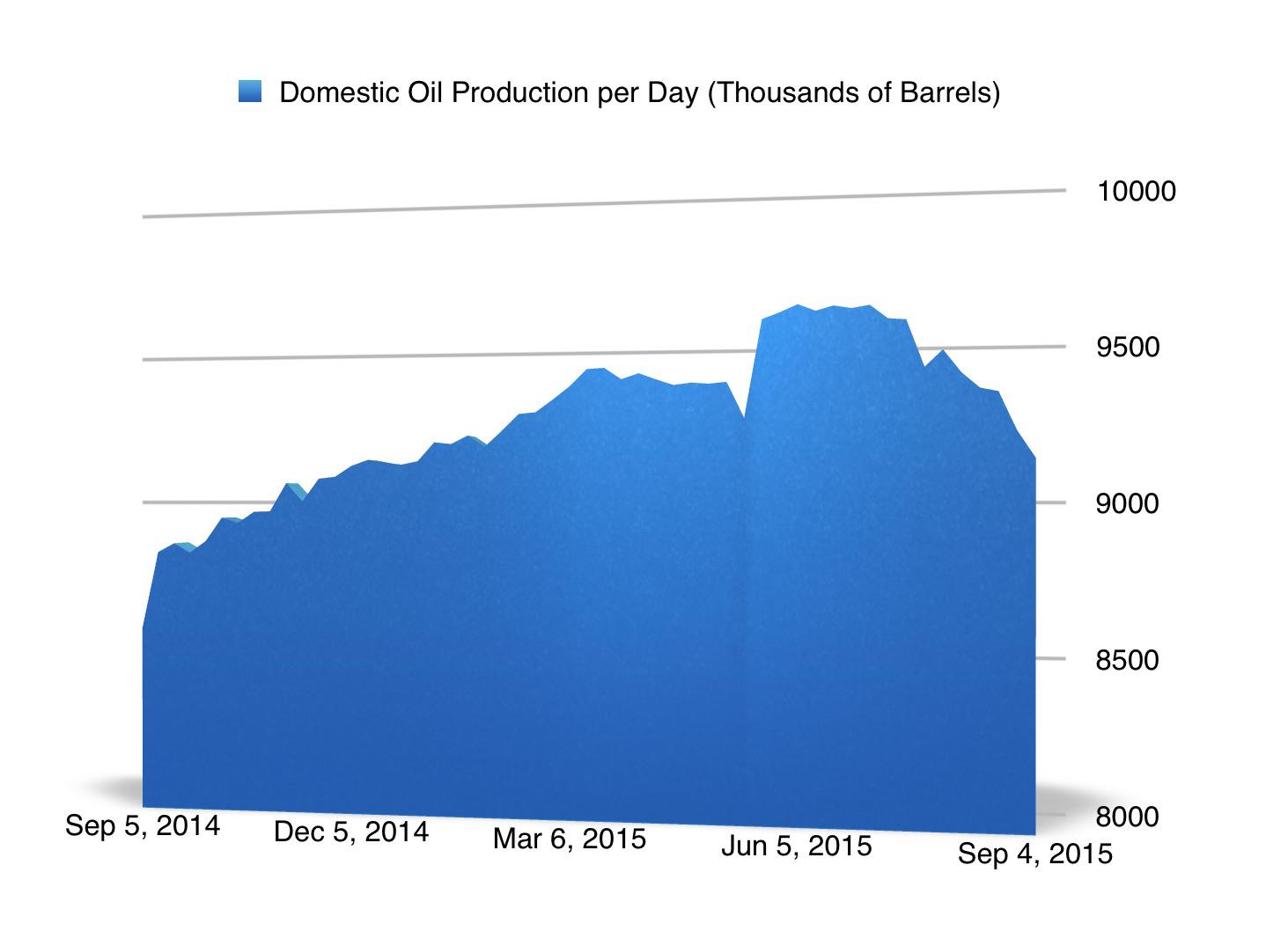
To put things in perspective, the U.S. has already seen a 475 thousand barrel per day decline in just a few short months, thanks to falling rig count and the high depletion rates of unconventional wells. During eight of the past nine weeks, we’ve seen a continued slide in production numbers, with the average weekly falloff totaling more than 52 thousand barrels per day. My own view on this is that, as the depletion rates take a larger and larger toll on existing wells, this number could accelerate, but even if the trend remains unchanged, we could see a more than 884 thousand barrel per day drop between now and the end of this year alone.
A similar tale elsewhere?
With falling rig counts in the U.S. and high depletion rates, it’s no surprise to see oil production dropping. The story, however, is likely to repeat itself in other countries as well, but due to differences in depletion rates, is unlikely to be as severe in most places as it is in the U.S. One place in particular to look at is Canada. This time last year, the country had 405 rigs in operation, 222 of which were drilling for oil. Today, that number totals a more modest 185, with only 70 dedicated to oil production activities.
(click to enlarge)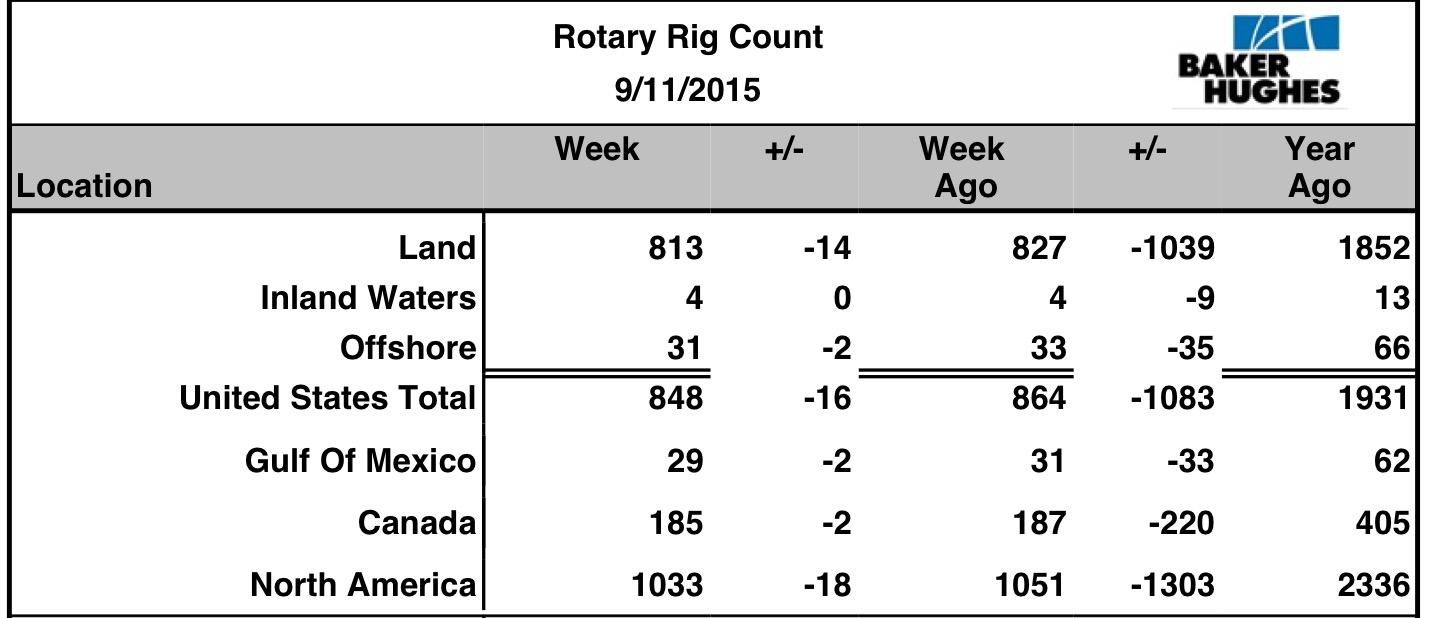
Outside of the U.S. and Canada, rig count has dropped as well. After seeing five straight years of year-over-year growth, the international rig count (excluding these two countries) has finally taken a beating, falling from 1,339 in August of last year to 1,137 today. Every region profiled by Baker Hughes (NYSE:BHI) has shown a drop over this timeframe, with Latin America being hit the hardest. During this period, the region watched its total rig count drop from 410 to 319. Unfortunately, this data is not broken up between oil rigs and natural gas rigs, but it’s probably safe to assume that, just like the U.S. and Canada, both types have contributed to the downturn.
(click to enlarge)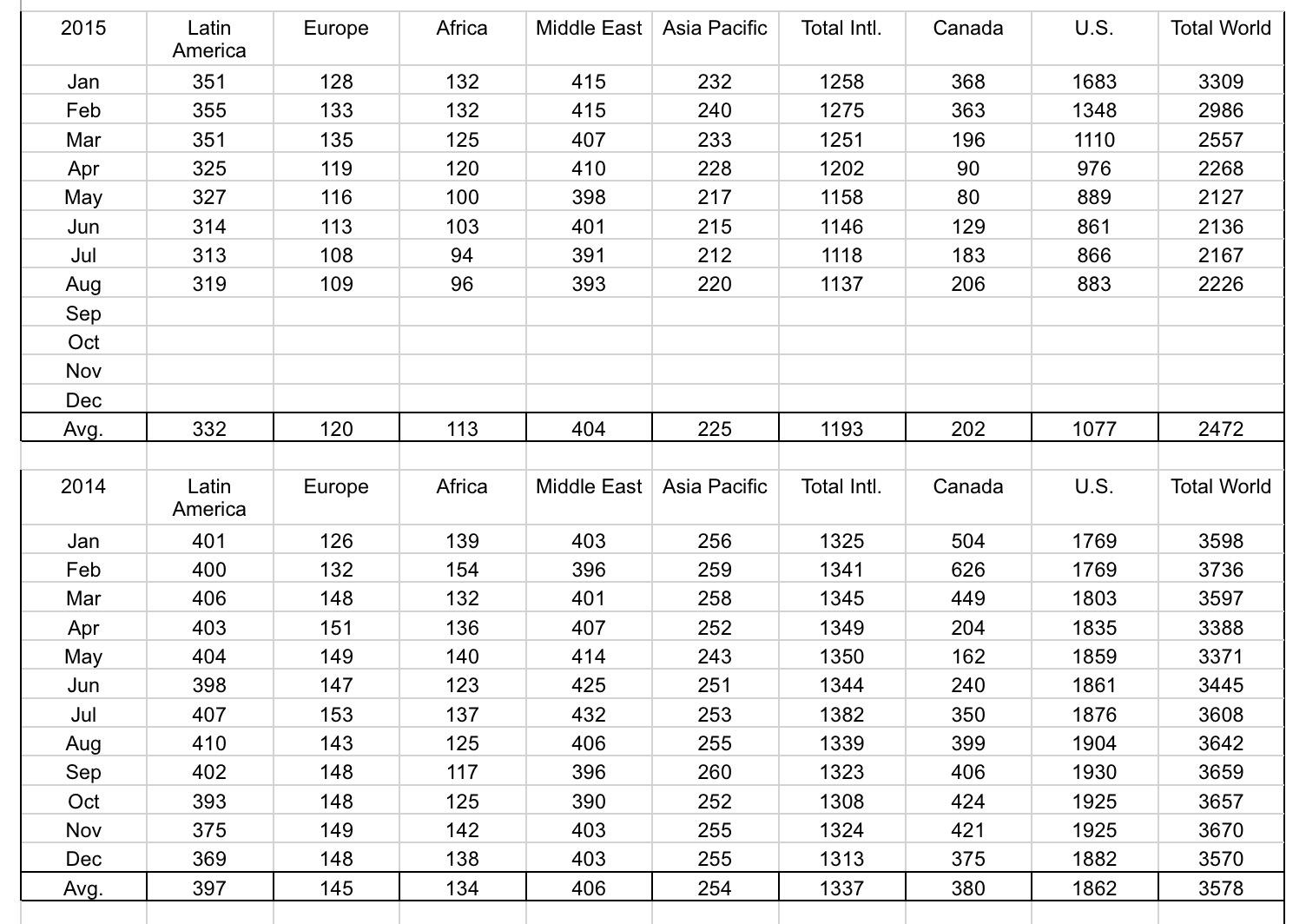
No reliable and consistently-available data could be found regarding the North Sea’s oil rig count, but what I did discover in my research is that investment in the region is expected to drop quite significantly. Despite the fact that oil production from the area is expected to be 65 thousand barrels per day higher this year than it was last year, the IEA thinks that production should start falling there next year and one source I found said that investment in the region should fall by more than half over the next three years given current prices because of the fact that the area represents one of the highest-cost producing regions on the planet.
Takeaway
Moving forward, there is no telling what will happen regarding oil but I am pretty optimistic. Yes, there is fear that China’s economy could harm demand (this is a very real threat that should be monitored) and Iran’s oil production coming back online is also likely to prove somewhat problematic. However, I suspect that many non-OPEC nations will see a meaningful drop in production over the next year that should more than offset the increase in output from Iran, with the U.S. leading the way. Assuming the world does not see any economic downturn in the months to come, this drop in U.S. production, which I believe will be much bigger than the IEA is predicting, should prove bullish in the long run.
18 Comments on "Oil Production Is Likely To Fall Much Faster Than The IEA Predicts"
James Tipper on Tue, 15th Sep 2015 8:47 am
I remember here from MSM all the time how we were going to “overtake” our production peak in 1970 in the U.S., looks like that is not going to happen. Of course where are they now to admit they were wrong? Nowhere to be found.
Kenz300 on Tue, 15th Sep 2015 9:22 am
There are cheaper ways to produce liquid fuels….
Algenol to offer ethanol to consumers
http://www.news-press.com/story/news/2015/09/14/algenol-distribute-ethanol-commercially/72250722/
rockman on Tue, 15th Sep 2015 10:06 am
The Rockman is VP of Operations for a private oil. He handles drilling contracts weekly. He knows the rigs, the hands and the service companies. In the last 5 years during the boom there has been no meaningful improvement in drilling efficiency. The rigs used today are identical to the ones used 5+ years ago…they are the same rigs. The drilling technology, such as horizontal geosteering, has not changed in the last 5+ years…it’s the same equipment. None of the other drilling components have changed. What has changed the efficiency (by only a small degree) is pad drilling and longer laterals/more frac stages. But the later two factors had increased costs significantly.
The truly big change in the dynamics has been reduced drilling costs due to increased competition as fewer wells were drilled. A rig that cost $24,000/day 18 months ago can be had for $12,000/day now. Rotary steerable systems that were costing up to $30,000/day are sitting on the shelves collecting dust and many the very skilled hands that ran them have been laid off and are anxiously looking for work outside the oil patch.
But while costs might have changed significantly so has oil prices, of course. IOW despite a significant reduction in drilling/frac’ng costs the economic value of the remaining prospect have not improved. In addition the loss of cash flow/credit lines has significantly reduced the amount of capex available to take advantage of those lower costs even on the more attractive remaining prospects.
marmico on Tue, 15th Sep 2015 11:42 am
No mention of IPs, EURs, seismic, proppant, etc.
Keep it going LTO producers. Lowest gasoline price per hour worked in 10 years.
https://research.stlouisfed.org/fred2/graph/fredgraph.png?g=1QnN
Through into the mix some marginal increases in fleet vehicle fuel efficiency in the last 10 years.
http://www.rita.dot.gov/bts/sites/rita.dot.gov.bts/files/publications/national_transportation_statistics/html/table_04_23.html
Things are looking peachy 🙂
Davy on Tue, 15th Sep 2015 1:25 pm
Things do look peachy Marm that is why I am prepping.
apneaman on Tue, 15th Sep 2015 1:32 pm
“Lowest gasoline price per hour worked in 10 years.”
ROTFLMAO
Lowest gasoline price per doughnuts eaten in 10 years
apneaman on Tue, 15th Sep 2015 1:37 pm
Highest amount of desperate bogus meaningless statistical comparisons per corny commenter in history
marmico on Tue, 15th Sep 2015 1:52 pm
Marm that is why I am prepping.\
That means that you are putting in more miles on the ATVs with your kids on Green Acres. 🙂
Davy on Tue, 15th Sep 2015 2:46 pm
Mark, as a matter a fact I have this as my work vehicle:
http://www.polaris.com/en-us/ranger-utv/ranger-crew-diesel
Building goat fence today. You would be proud of me Marmi. I know how you loved goats as an adolescent. You know rubber boots and all
marmico on Tue, 15th Sep 2015 4:01 pm
So while you work on Green Acres, your wife and kids live in a nearby town (Hermann, MO) to be precise.
And since you are dirt poor and your parents are rich, they would have no problem cutting the tuition cheque to MIT or Caltech for your kids.
But your kids are like you…dumb fuctards or minor leaguers like rockman who couldn’t foul off the back door slider in the dog days of August to be called up to the bigs with the expanded roster for the pennant drive in September.
BobInget on Tue, 15th Sep 2015 4:06 pm
Cushing down 1.5 million barrels
API crude oil inventories: fall 3.1 million barrels
apneaman on Tue, 15th Sep 2015 4:07 pm
marmico, how do you know where Davy’s wife and kids live? Why bring it up?
Davy on Tue, 15th Sep 2015 4:16 pm
Damn, Ape Man, I didn’t realize I hit a sore spot with Marmi. The goat thing was a joke but I guess he indulged his fantasies when he was a boy and now he feels guilty. Sorry Marmi didn’t mean to be a meanie. Relax Marmi, minor sexual deviations are not something to feel guilty about.
marmico on Tue, 15th Sep 2015 4:44 pm
Davy wants his kids to be goat herders. What a pathetic father.
Hire some Syrian refuges to tend to the goats and send your children to high end tech school, you fuctard.
Anyone can herd a goat in the Ozarks, not everyone can make tech in the Silicon Valley.
marmico on Tue, 15th Sep 2015 4:48 pm
Davy wants his kids to be goat herders while granny bought them hand held computers. What a pathetic father.
Hire some Syrian refugee to tend to the goats and send your children to high end tech school, you fuctard.
Anyone can herd a goat in the Ozarks, not everyone can make tech in the Silicon Valley. It’s called specialization of labor.
shortonoil on Tue, 15th Sep 2015 6:26 pm
60% of the world’s production is produced by less than 1% of its fields – the Giants. Those fields are now more than 60 years old. They have been on a plateau for more than a decade, and when they come off their plateau world production will decline catastrophically. That is projected to occur this decade.
http://www.thehillsgroup.org/
Speculawyer on Tue, 15th Sep 2015 7:31 pm
Rockman dropping the truth bombs . . . as usual. So many of these stories on investment sites tout how the frackers have become so much more ‘efficient’ such that they drill & frack for less money now. As Rock points out . . . yes they do . . . but largely because equipment lease costs have significantly dropped.
Well, that is still a ‘more efficient’ operation, in the economic sense. But it comes out of someone’s hyde. In this case, the drilling equipment lessors.
Kenz300 on Wed, 16th Sep 2015 8:44 am
Banks stopped lending……..