




The lowest crude prices in six years might not be enough to put the brakes on the U.S. energy renaissance.
Some parts of North Dakota’s Bakken shale play are profitable at less than $30 a barrel as companies tap bigger wells and benefit from lower drilling costs, according to a Bloomberg Intelligence analysis. That’s less than half the level of some estimates when the oil rout began last year.
The lower bar for profitability is one reason why U.S. oil production has remained near a 40-year high even as crude prices fell more than 50 percent over the past year to the lowest level since March 2009.
“One of the explanations for why production hasn’t fallen off is that the cost has gone down so much,” David Hackett, president of Stillwater Associates LLC, an energy consulting firm in Irvine, California, said by phone. “The marginal cost to produce has shrunk pretty dramatically with the drop in prices. The efficient drillers are now able to take advantage.”
West Texas Intermediate crude for September delivery fell to $42.23 a barrel Thursday, the lowest settlement since March 2009. In North Dakota, where producers have to offer discounts to account for extra transportation costs, the price of Bakken oil was to $30.80 Wednesday, according to Royal Dutch Shell PLC.
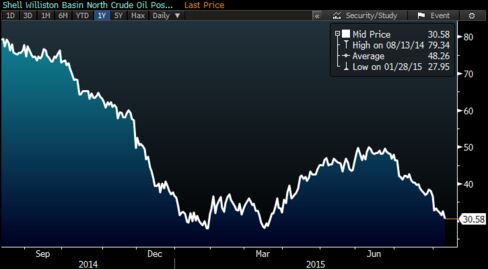
Varying Margins
The breakeven price, based on production rates and drilling, completion and other costs, can vary widely within a play based on how prolific the geology is and the efficiency of the drilling company, according to Bloomberg Intelligence energy analysts William Foiles and Andrew Cosgrove.
In McKenzie County, North Dakota, one of the core areas of the Bakken, the median breakeven price is a little more than $29 a barrel, Foiles said. That’s about a third less than in nearby Williams County, and it’s less than half the average breakeven price for the Bakken that banks and research firms estimated last fall.
McKenzie County wells have shown the best returns amid the price drop. Drillers had 26 horizontal wells seeking oil in that county last week, the most in the state, according to Baker Hughes Inc.
Bakken oil production in North Dakota has fallen less than 2 percent from its peak in December, while the number of oil rigs in the state has fallen by 60 percent. EOG Resources Inc., the largest shale driller, says it can make a 30 percent after-tax return on $50 oil in its best plays. Whiting Petroleum Corp., the largest Bakken producer, said it’s preparing to be able to grow production at $40 to $50 prices.
“A single break-even price doesn’t actually exist,” Foiles said in a presentation. “Rather, what the model indicates is that at a realized oil price of $29.42, half of wells will generate returns exceeding 10%. This price is considerably lower than the $70 breakeven estimated by industry watchers at the start of the oil price slump.”
Tom on Thu, 13th Aug 2015 9:02 pm
With so much oil flowing even as the number of rigs has fallen, it is obvious that when all of the rigs go to the barn, oil production will soar exponentially. Economists must live in an alternative universe.
Truth Has A Liberal Bias on Thu, 13th Aug 2015 9:35 pm
So I guess they could have been way more efficient from the start and could have made like way more money. But they were just being wasteful and lazy all this time and didn’t decide to try cutting costs until prices dropped. Yeah right!! What a load of crap. This is just more propaganda to calm the masses. If Saudi Arabia can hang on several more months, which is what I think they plan to do, and given their over 600 billion in foreign currency reserves they can do, I’d say we’ll get to watch US production fall off a cliff pretty soon. Wall Street soon to follow. The Saudi plan is to undermine highly leveraged marginal production. Articles like this are the only way for Wall Street, so to speak, to fight back.
alokin on Thu, 13th Aug 2015 10:12 pm
What is some 1%, 5% or 50%?
If it’s now so much cheaper then some people earn a lot less and spend less too.
Makati1 on Thu, 13th Aug 2015 10:36 pm
“Oil at $30 Is No Problem for Some Bakken Drillers” until they close their doors.
James Tipper on Fri, 14th Aug 2015 12:41 am
They can keep talking all they want, won’t change the fact that there’s 53% less rigs this year than last year.
http://www.wtrg.com/rotaryrigs.html
Apneaman on Fri, 14th Aug 2015 2:48 am
A real Renaissance alright.
‘Frack now, pay later,’ top services companies say amid oil crash
http://www.reuters.com/article/2015/08/07/us-fracking-halliburton-schlumberger-nv-idUSKCN0QC0F220150807
meld on Fri, 14th Aug 2015 6:09 am
This is a big propaganda war that neither side is going to win. Flipping hilarious 😀
rockman on Fri, 14th Aug 2015 6:35 am
“The lower bar for profitability is one reason why U.S. oil production has remained near a 40-year high even as crude prices fell more than 50 percent over the past year to the lowest level since March 2009.”
And here it comes again: lag time. Just like the lag time between when the article was written and the latest data showing the decline in all oil shale production…including the Bakken.
Kenz300 on Fri, 14th Aug 2015 9:05 am
Drill more….. loose money faster…..
Banks have stopped lending……
BC on Fri, 14th Aug 2015 12:50 pm
Bank commercial & industrial (C&I) loan delinquencies have begun rising again, which is an indication that the pass-through effects of the incipient recession in the energy sector are now becoming apparent to creditors, suppliers, and ancillary service providers.
The story has yet to be told about how much banks have lent to the shale, energy-related, and ancillary sectors since 2012-13 for debt rollover and to pay dividends, interest on existing debt, bonuses to execs, and fat fees to PE plunderers and grifters.
It’s deja vu circa 1985-86 prior to the S&L Crisis and 2007-08 prior to Bear Stearns and Lehman. We’re heading back into the $h!t soup again, which will require the Fed to resume QEternity . . . n+1 to bail banks for energy C&I loans, subprime auto loans, student loans, emerging market debt and US equity index futures derivatives, and builders on the hook for having borrowed to bid up land prices.
The junk debt market is already in a bear market (always leads the equity market and often coincides with recessions) and is showing signs of a setup for a crash.
Yet, the stock market is oblivious not unlike in 2001 prior to 9/11 and in 2007-08 after Bear Stearns and leading up to Lehman. The stock market didn’t roll over and crash until 2-3 qtrs. after the economy tipped over into recession. It’s not inconceivable that the US economy entered recession in late 2014 or earlier this year.
shortonoil on Fri, 14th Aug 2015 2:15 pm
“We’re heading back into the $h!t soup again, which will require the Fed to resume QEternity . . . n+1 to bail banks for energy C&I loans, subprime auto loans, student loans, emerging market debt and US equity index futures derivatives, and builders on the hook for having borrowed to bid up land prices.”
The FED can print an infinite amount of currency at will. To get it into the economy it must have liquid assets to monetize. The first QE was government bonds, They now hold almost all the short term paper, and about half of the long. Except for the pension funds little remains to monetize. When it becomes law that pension funds must sell their assets to the FED it will be game time for QE.
“Yeah right!! What a load of crap.”
In 2012 the average drilling cost in the Bakken was $53/ barrel produced. The average well depth in McKenzie county is 11,200 feet. This isn’t a load, its a boat load (as in supertanker).
Nony on Fri, 14th Aug 2015 3:49 pm
Lag is one operant factor and I agree some articles completely ignore it. That said, there’s been some interesting things like wells going into (or out of) DUC inventory or even choking back or opening up flow. So in the BAkken at least, the response has ended up being a little quicker than Rock’s 6 months.
NDIC estimates production can probably hold steady for a couple years at this rig count while drawing down the inventory. So far, this is what is happening.
http://peakoilbarrel.com/bakken-production-data-and-steo-predictions/comment-page-1/#comment-532103
Boat on Fri, 14th Aug 2015 5:55 pm
I read it’s been closer to 10 months since drilling rigs started dropping since the most recent peak. More important is the US lost around 600 drilling rigs while the rest of the world has lost over 1,000.
Question. Maybe the Saudi losses are from international investments in oil okie the tar sands than from their own fields?
Kenz300 on Sat, 15th Aug 2015 8:10 am
Oil producers keep a brave face on the outside but inside they are dying a slow death.
Low Oil Prices Pose Threat to Texas Fracking Bonanza – The New York Times
http://www.nytimes.com/2015/08/15/business/energy-environment/low-oil-prices-pose-threat-to-texas-fracking-bonanza.html?emc=edit_th_20150815&nl=todaysheadlines&nlid=21372621