
Peak Oil is You

Donate Bitcoins ;-) or Paypal :-)


Page added on June 21, 2014

Oil and Iraq Burning at both ends
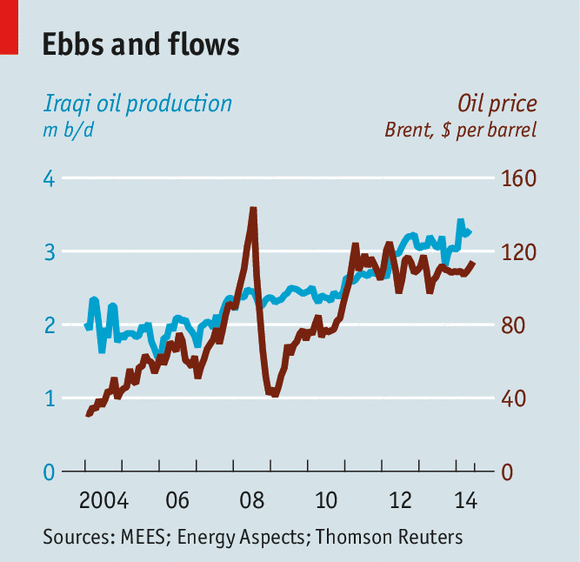
BEFORE Islamist fighters seized much of northern Iraq, hopes that the recent era of stable oil prices would last rested heavily on the country. Its exports were expected to go on rising, providing lots of low-cost oil at a time when the depletion of mature fields elsewhere is beginning to bite into supplies. The International Energy Agency has projected that Iraq’s production will jump from 2.5m barrels a day (b/d) now to 4.4m in 2015 and nearly 6m by 2020. Other forecasts have been even rosier.
But as on so many occasions since 1980, war, sanctions and domestic upheaval have constrained the huge potential of OPEC’s second-biggest producer. The chances of restarting exports from northern Iraq (via a pipeline crippled by sabotage in March), and of investment and modernisation in the country’s south, are looking slimmer by the day.
Fighting shut the Baiji refinery, Iraq’s largest, on June 18th. It produces 170,000 b/d of petrol and other products. In addition to exports, it supplies northern Iraq and Baghdad, which now face shortages.
Though there is little chance that the Shia south, which produces 90% of Iraq’s oil, will come under the control of the insurgents, sabotage and terrorism are more likely, as is political instability. Recovering from the previous bout of sectarian conflict, in 2006, took time (see chart). Nor is the news encouraging outsiders to invest in the new kit which the ill-run oilfields need.
A crumb of good news is that the semi-autonomous Kurdish region of Iraq is trying to step up exports, with another two tankers due to be loaded at Ceyhan in Turkey this week, on top of two previous shipments this month. The Kurds have taken over the main oil town in the north, Kirkuk, and claim—confusingly—to have built a link from it to their own export pipeline in just a few days. But buyers are twitchy: Iraq’s central government says it will sue anyone involved in what it regards as illegal exports. Amrita Sen of Energy Aspects, a consultancy, says that for all their sympathy with the Kurdish proto-state, outsiders’ priority is keeping Iraq together.
The bad news from Iraq comes amid other woes. Exports from Syria, once nearly 400,000 b/d, have fallen almost to zero. Hopes that Libya, until recently a big oil producer, would restore production have shrivelled. It returned to 1.5m b/d quickly after the civil war of 2011, to the surprise of outsiders, but has now fallen back to less than 1m. Fears are mounting, says Ms Sen, that chaos and inactivity have seriously harmed Libya’s already fragile oilfields. The longer Iraq’s pumps stay idle, the greater the danger of damage there too.
For now, global stocks are strong and the main damage from events in Iraq is to expectations, not to actual supply. The price of a barrel of Brent crude rose slightly as fighting intensified before steadying below $115. Saudi Arabia can pump more—up to 1m b/d—and America can release crude from its Strategic Petroleum Reserve. But in the medium term the outlook is bleaker. Not everything has to go right to keep oil flowing in the quantities and prices that the industrialised world expects. But an awful lot is going wrong at once.
4 Comments on "Oil and Iraq Burning at both ends"
John Orr on Sat, 21st Jun 2014 4:50 pm
What the f… are our leaders doing ….are they blind?….do they think we are that stupid?…how the possibility can anyone go down a path with out understanding the consequences of getting it totally wrong?….are they really stupid or do they think we are more stupid!!!!
rockman on Sat, 21st Jun 2014 7:41 pm
“Its exports were expected to go on rising, providing lots of low-cost oil…” Once again an economist either clueless to the price dynamics or being intentionally misleading IMHO. First, Iraq current production represents less than 3% of global oil production…not exactly holding THE big hammer. Even their yet unproven rate increase only pushes the number to 5% in just 1 year. At that would be impressive even if there weren’t a war going on.
And then no effort to balance whatever Iraq adds to supply to the depletion of exiting reserves. But more important a total disconnect from the relationship between economic activity and its impact on pricing which has been more of a control factor then production rate IMHO. How difficult is it for an economist to understand that while the world has produced more oil in the last year then ever before the average yearly price of oil has reached an all time record high? So much for higher oil production automatically “providing lots of low-cost oil.”
Makati1 on Sat, 21st Jun 2014 10:00 pm
“The Economist” should read “The Uninformed” or “The Retarded” (no offense meant to those in that mental category and are trying to earn an HONEST living). Not one ‘economist’ has two brain cells that still work, or if they do, they are badly deformed. They produce what ever will get them a paycheck. Reality be damned. All they can reliably do is look in the rear view mirror and correct their prognostications.
Davy, Hermann, MO on Sun, 22nd Jun 2014 5:36 am
The World according to Mak. You are describing yourself Mak because ideologues and propagandist fit your description. I agree economists are the problem and have facilitated the flawed Bau paradigm of growth and substitution theories. “The Economist” is at least fair and objective in many cases with a prevailing world view of growth and development. We may criticize this paradigm here but we must respect this is the game currently.