
Peak Oil is You

Donate Bitcoins ;-) or Paypal :-)


Page added on April 11, 2016

Natural Gas Production Is About To Plummet

Summary
As one of the seven largest natural gas producing regions in the U.S., the Eagle Ford is a significant area to understand for natural gas-oriented investors.
In this article, I dig into the government’s data regarding production and forecast what output should look like by year-end.
What I discovered is that, if something doesn’t change fast, we should see production fall materially in the region this year, which is bullish news for investors.
In the past, I’ve written articles regarding the Eagle Ford and the oil production trend that we’ve seen coming out of the region. However, I have yet to analyze the amount of natural gas to come from the area and to see what the production trend of that commodity should look like moving forward. Now, after having the opportunity to dig into the data from the EIA’s (Energy Information Administration’s) Drilling Productivity Report and after recognizing the massive drop in rig count in the Eagle Ford, I’ve concluded that, if nothing changes fairly soon, we can expect a significant drop in output throughout this year, a move that should be bullish for long-term investors in this space.
A look at the Eagle Ford
Located along the southern and eastern portions of Texas, the Eagle Ford is the third-largest region for the production of natural gas in the U.S. (behind the Marcellus and the Permian) and the second-largest for the production of oil (behind the Permian). As one of the most prolific regions in the industry, it has commanded a great deal of attention and investment from companies extracting these products but, as the price of both oil and natural gas plummeted over the past year and a half, the drilling activity there has fallen like a rock. In the image below, you can see where the Eagle Ford is located relative to the six other major energy-producing regions in the country.
(click to enlarge)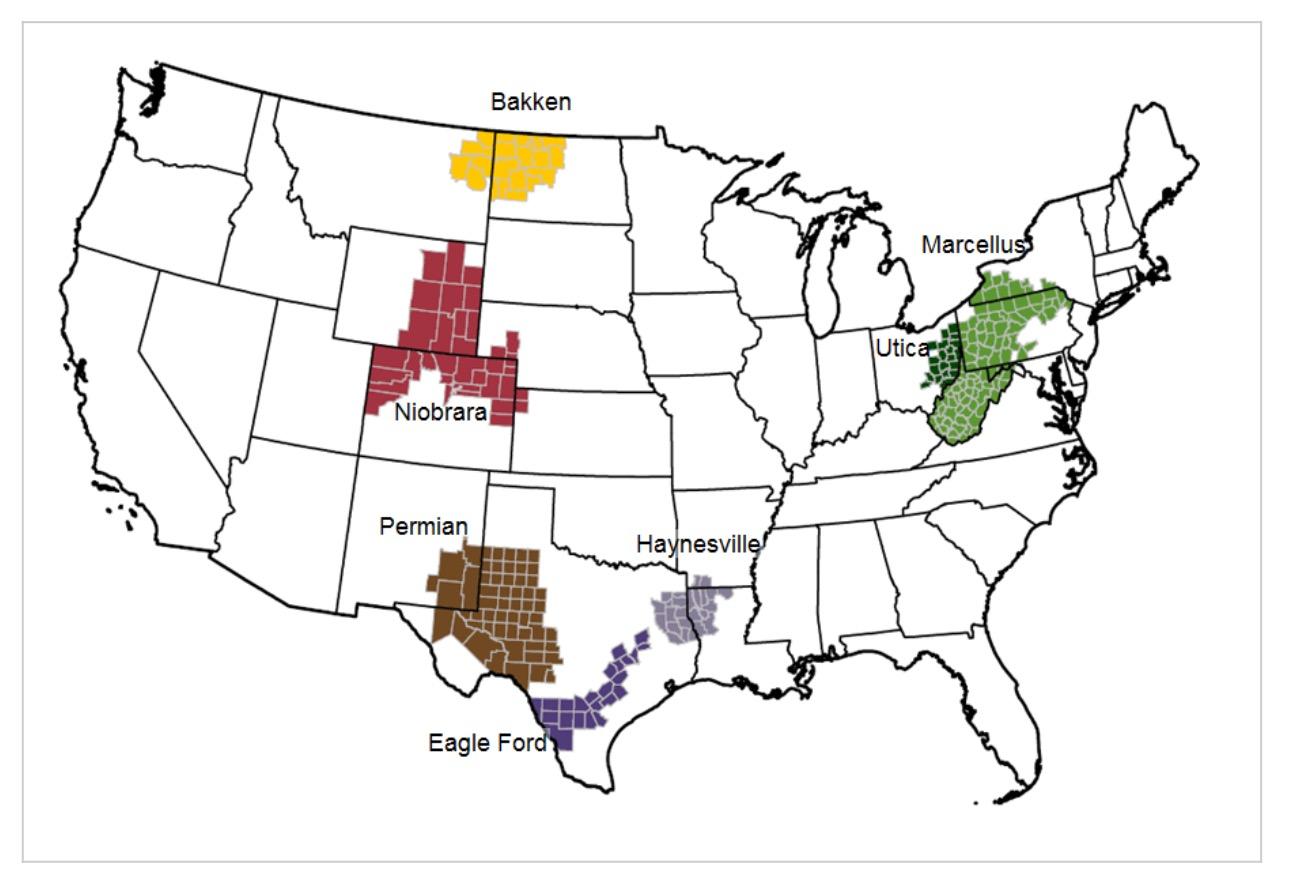
In the table below, you can see that time hasn’t been so kind to the Eagle Ford, especially when stacked up against rivals like the Permian and Haynesville, both of which have seen their natural gas output rise between December of 2015 and what the EIA (Energy Information Administration) believes will be the production level of each area in March of this year.
(click to enlarge)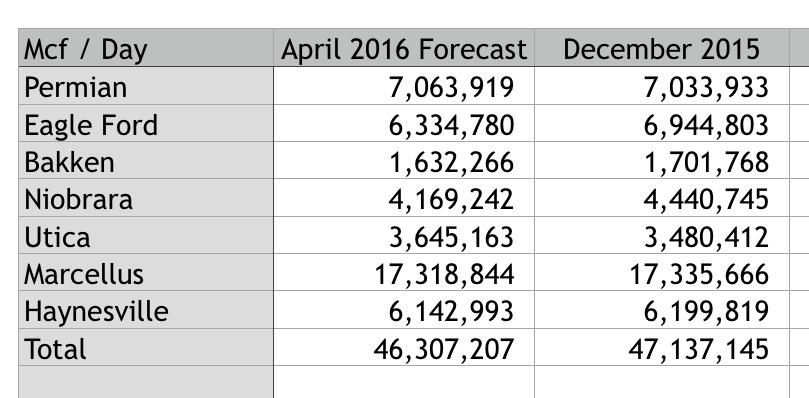
*Source: Created by author with data from the EIA’s Drilling Productivity Report
Things are about to get a lot worse
If you think that these declines are bad, wait to see what the picture looks like moving forward. However, before I get to that, I need to touch on the core assumptions I had to make to get me to my final conclusion. Using historical data from the EIA, I previously forecasted (in my Eagle Ford article regarding oil) that rig counts will fall by seven units per month. I’ve had to make some adjustments due to recent news but I am sticking to that, starting with a total of 59 units for the month of February and moving down in the months to come. I know this may sound like a harsh assumption but, given the current price of natural gas, it’s only a matter of time before more rigs come offline.
The next assumption I had to make regarding the Eagle Ford involves the change in drilling rig productivity over time. In the graph below, you can see the historical trend that rig productivity has taken on a month-to-month basis. Overall, there seems to be a great deal of volatility here but the general path has been toward lower improvements in productivity almost every month since last May, with the EIA forecasting the March-to-April productivity level at 0.91%. Recognizing the significant disparities that can exist, however, I will use an estimate of 1.5% for now, with the intention of lowering that in the future if the EIA’s forecasts turn out to be accurate.
(click to enlarge)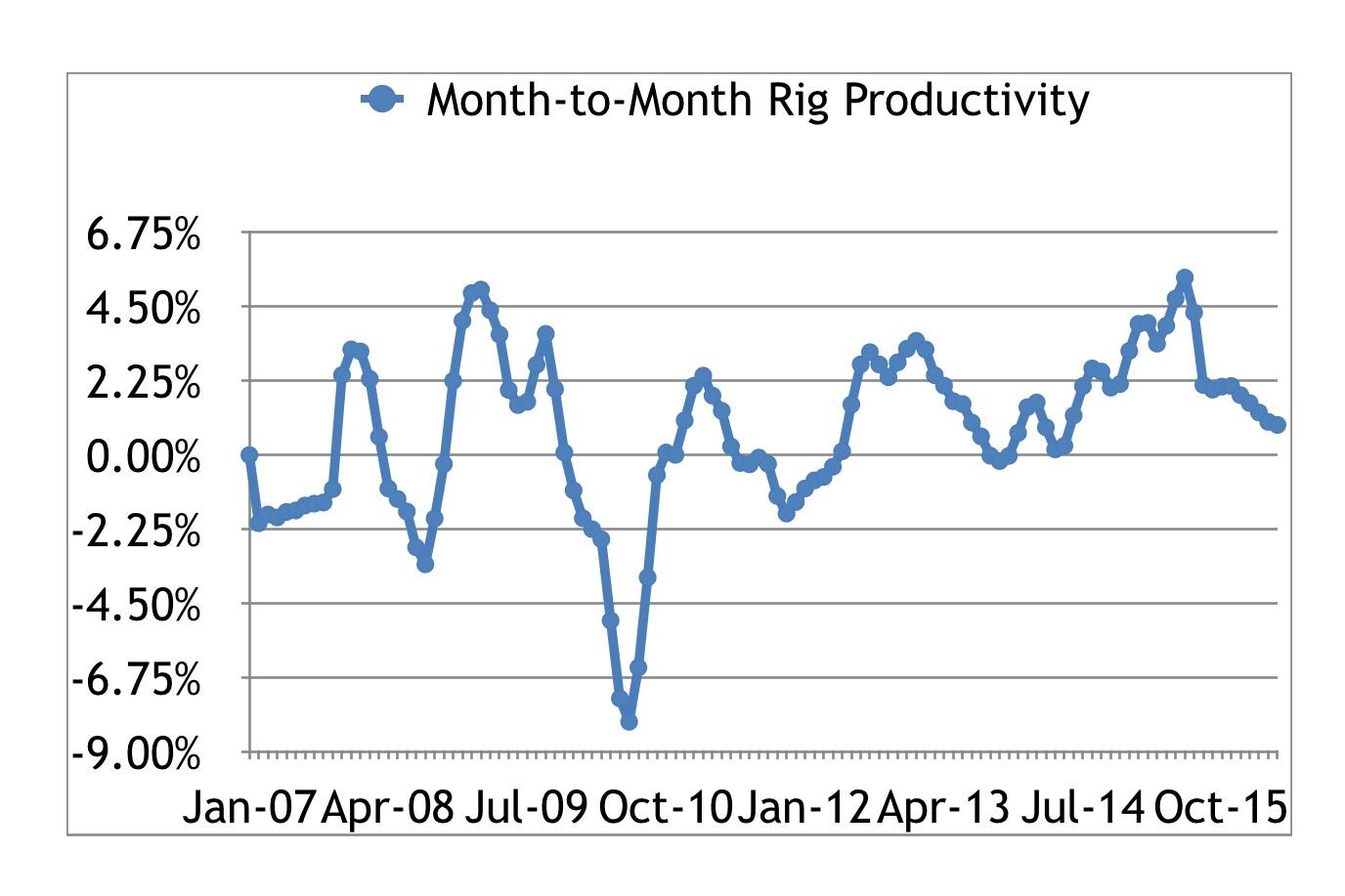
*Source: Created by author with data from the EIA’s Drilling Productivity Report
Finally, I had to make some assumptions regarding decline rates in the region. In the graph below, you can see what the picture has looked like for every month since January of 2007 (data doesn’t go back any further than that). Right now, the trend seems to be moving higher into the upper 5% range but I’ve had instances in the past where the EIA has revised these numbers lower a month or so out. Because of this uncertainty, I will look at a conservative scenario, whereby decline rates will average 5% each month, a moderate scenario, whereby they will average 5.5% per month, and a liberal scenario, whereby we can expect decline rates to be 6% per month.
(click to enlarge)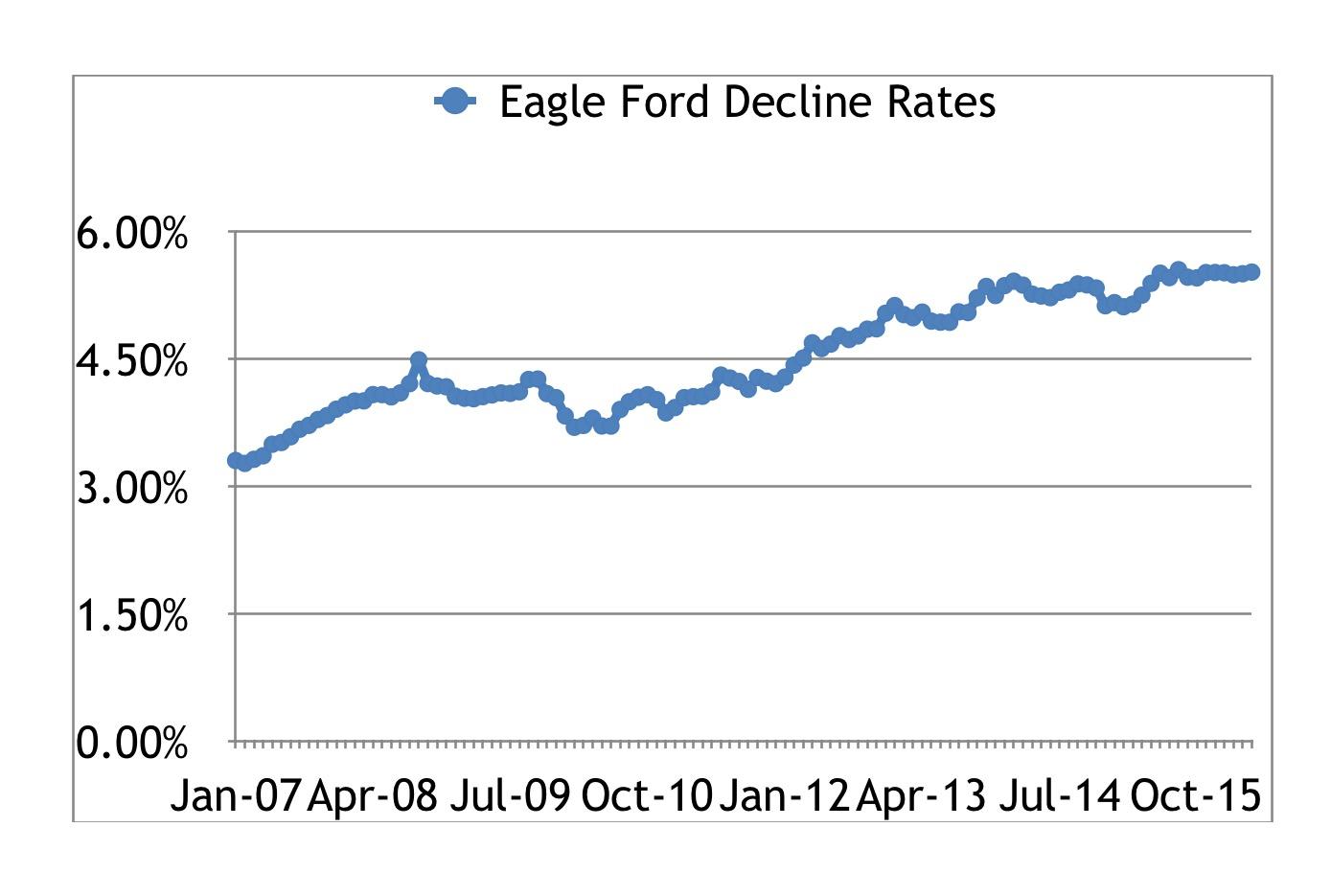
*Source: Created by author with data from the EIA’s Drilling Productivity Report
Now that we have these three base assumptions, it’s possible to create a realistic forecast regarding the future of natural gas production in the Eagle Ford. In the table below, you can see the results of my analysis, which indicate that, regardless of which of the three scenarios I adopted, natural gas production in the region should fall quite meaningfully (thanks largely to my forecast for rig counts) in the months to come. If the EIA’s data is accurate and my assumptions are spot-on, investors should anticipate production in the region to come out to between 4,350,082 Mcf per day and 4,715,479 Mcf per day by December of this year.
(click to enlarge)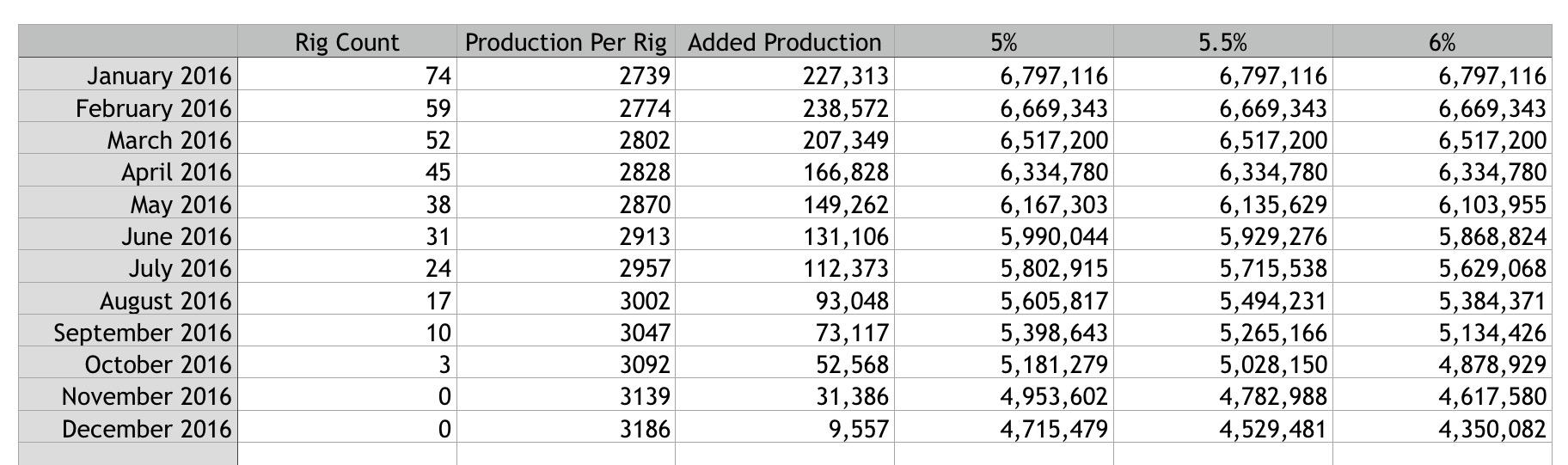
*Source: Created by author with data from the EIA’s Drilling Productivity Report
In the next table, you can see what this looks like when you stack my estimates up to what happened in December of 2015. Based on the data provided, the conservative scenario should see production fall by about 32.1% year-over-year. Meanwhile, the moderate and liberal estimates yield expected declines in total output of 34.8% and 37.4%, respectively.
(click to enlarge)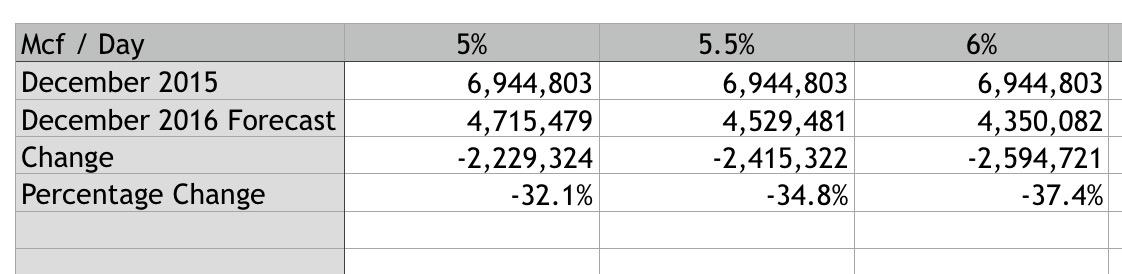
*Source: Created by author with data from the EIA’s Drilling Productivity Report
Takeaway
Right now, Mr. Market is very bearish regarding natural gas but I have a hard time understanding why. Yes, we are experiencing a bit of a glut at the moment (though I believe those fears have been overblown), but production in some key areas should take a heck of a beating if rig counts continue to fall and/or if rig productivity levels don’t soar sometime soon. One of the main areas to watch for clues regarding future output is the Eagle Ford, which is likely to experience some of the most significant declines.
Disclosure:I/we have no positions in any stocks mentioned, and no plans to initiate any positions within the next 72 hours.
I wrote this article myself, and it expresses my own opinions. I am not receiving compensation for it (other than from Seeking Alpha). I have no business relationship with any company whose stock is mentioned in this article.
10 Comments on "Natural Gas Production Is About To Plummet"
Pennsyguy on Mon, 11th Apr 2016 5:44 pm
I have the feeling that the Fracking Miracle, for both gas and oil, is more of a short-term financial bubble than a long-term, viable energy source. More of capitalism at its finest.
makati1 on Mon, 11th Apr 2016 9:40 pm
Pennsyguy, if it had not been for the bsnksters and the government colluding to make it possible, it would never have happened.
Pennsyguy on Mon, 11th Apr 2016 10:23 pm
No doubt Mak. Maybe the next bubble will involve indentured servants or involuntary human laborers. Or Soylent Green.
makati1 on Tue, 12th Apr 2016 12:36 am
Or all three…. lol I think most Americans are already both involuntary and indentured servants to the Empire. and Soylent is probably in the Monsanto pipeline.
onlooker on Tue, 12th Apr 2016 12:47 am
Agreed, especially not to discount Soylent. We are going to be soon if not already our most abundant calorie/food source.
Det. Thorn: Ocean’s dying, plankton’s dying… it’s people. *Soylent Green is made out of people.* They’re making our food out of people. Next thing they’ll be breeding us like cattle for food. You’ve gotta tell them. You’ve gotta tell them!
Hatcher: I promise, Tiger. I promise. I’ll tell the Exchange.
Det. Thorn: You tell everybody. Listen to me, Hatcher. You’ve gotta tell them! Soylent Green is people! We’ve gotta stop them somehow
makati1 on Tue, 12th Apr 2016 2:01 am
Or the Eloi and the Morlocks. The sheep and the predators.
Go Speed Racer on Tue, 12th Apr 2016 5:20 am
How to solve the energy shortage. Let’s put all the welfare bums and poor people omto big squirrel wheels and make them produce electricity. It can be a modern version of the slave rowing ship. I will make them skinnier, that’s good cause America has too many fat people.
Davy on Tue, 12th Apr 2016 5:36 am
Takeaway, yea, it is called a supply demand circular vortex down to less with less. Less resources supporting less activity in a vortex of decay. In the past when this fracking boom was inflating I cautioned all the hype on natural gas and the resulting shift away from coal and NUK. Mind you not that that is a bad thing. We know the bad side of coal and NUK. My point was we are going to be destroying fossil fuel production abilities without reasonable alternatives. Natural gas and renewables are not reasonable alternatives. They are “extenders” alternatives. They are not economic substitution nor a transition fuel to a new economic paradigm. In fact they were the product of a bubble and all bubbles end in tears. Renewables are a hype from our modern man neurosis of technological hubris.
What we are seeing is the primary drivers of our industrial civilization all in a deflationary environment with decay and cannibalization. We see this just as the economy appears by many diverse indicators to be in a deflationary decay. This is a subtle state with plenty of room for denial. The takeaway is this appears to be an end game of growth of both economic and resource abilities of industrial man. Peak oil dynamics are dangerously at work now across the spectrum from failing oil producing nations to failing Texas E&P companies.
Yet, we have this market mentality of cycles with prices but what this mentality fails to factor in is a new normal or a new paradigm of a new direction. When I just said that you had a mind’s eye of a new direction as positive and expansive. This is our habituation as modern men. We see growth and progress because that has been all we have known. Even when we try to be negative we still have a positive bias. Sure there has been financial crisis but that was market cycles and there was always growth somewhere within the equation. Social, science, and technology were expanding even if markets were contracting. What we face now is a new and dangerous period of across the board contractions with dysfunction and abandonment combining into failures of business and social entities. States will and are failing.
Our global system is in transition to macro contraction. I know there is growth per the numbers but even per the number there is growth that is barely adequate to cover a complex systems minimum required activity to maintain its activity. If you include unfunded liabilities, unrealized bad debt, and destructive overcapacities then you clearly have significant snowballing decline. Combine this with increasing problems of ecosystem, climate, and social fabric and you have macro contraction of everything at all levels.
The dangerous fact about our modern global system is it can become locked into a momentum by the condition of being so large and self-organizing. We are not talking small nations that in the old days a few men could shape a destiny for. The founding fathers of the US would be swallowed by today’s forces. We are now above human. Call it the matrix if you can relate to that. This is the mechanization of man. We have turned ourselves into cogs within a self-organizing machine above management from within. This abstract organism now has achieved its own force of direction. This is the real Artificial intelligence at work not the BS hyped today by techno geeks. We are no longer in control. A system we spawned is now in charged.
This global system is now in the direction of deflation and decay without any external force that can stop it. We do not know the time frame but that time frame appears to be compressing. We do not know the landing zone of an economic failure event. How far are we going to drop before we stabilize into a new economic and social reality? Will there even be a landing or will this be a free fall into extinction? Natural gas is tied to this process. It is not in a vacuum as the markets would like to believe. We could very well see and likely see demand and supply of gas dropping just like everything else except problems. Problems and decay will be the one thing in abundance.
george on Tue, 12th Apr 2016 7:07 am
Say what ?
Davy on Tue, 12th Apr 2016 7:12 am
https://www.youtube.com/watch?v=eTbHh-HDvZ4