
Peak Oil is You

Donate Bitcoins ;-) or Paypal :-)


Page added on October 15, 2015

Mexico And Brazil Oil Auction Failures Are Further Proof Of Peak Oil At Current Prices
Summary
Mexico’s first attempt to open up its oil industry to foreign companies was a failure. Its auction only attracted $2.6 billion in potential investments, compared to $17 billion maximum potential.
Brazil had a similar failure more recently, with only 10% of its blocks being auctioned receiving viable bids.
These latest failed auctions, coupled with other facts point to a permanent peak in oil production at current prices, which is unfolding presently, which will only reverse once prices rise.
By far the most spectacular and talked about trend since the oil price collapsed more than a year ago, is the dramatic decline in drilling that occurred in the United States since the beginning of this year. For many months, we have been hearing about the resiliency of the shale industry, fueled by the delay in reaction of the industry in response to declining prices. At first, there was a delay in reaction to the price decline, most likely because companies were not entirely sure what to expect. Only some months later did the cuts in capital spending start to take a bite out of drilling activity. Then there was the delay between drilling activity and a corresponding decline in production. US production only started declining in May, which was almost a full year after the initial start of the oil price decline.
Since April, when US oil production reached 9.7 mb/d according to EIA data, production declined to about 9.1 mb/d, if we are to go by the EIA’s weekly report. The EIA weekly report is not known for being very accurate, but it still provides an indication of the fact that there is a trend of significant production decline in place for the past five months or so. The whole debate over shale resilience can be put to rest now, because we know that at current prices the industry will shrink.
If the current price of oil in the $50/barrel range were to last for a very long time, global petroleum supply would not be able to meet demand in the longer term. Production will shrink almost everywhere, even in some countries in the Middle East, unless the price of oil will increase significantly. We have new evidence of this being true from two major failed auctions from Latin America.
The Mexican auction was the first to flop. Mexico’s government put up for auction concessions that they estimated would result in maximum of $17 billion worth of investments. But only two out of fourteen blocks received qualifying bids, with an expected investment of only $2.6 billion. Mexico was hoping to restart its declining oil industry by inviting foreign investments. At current oil prices however, Mexico’s potential reserves do not seem to be very enticing. It remains to be seen at what price there will be more interest, but as of right now, it is looking like it will be a major oil producer which will continue down its path of decline.
Then came the Brazilian auction, which saw a similarly lackluster reaction of oil companies in response to Brazil’s offer of oil exploration concessions. It only managed to auction off 37 out of 366 blocks. The Campos basin, where there are billions of barrels in proved reserves received no bids. This auction failure may not show up in Brazil’s production right away, but in time it will have an effect on production. If oil prices remain this low, any future auctions in Brazil as well as in Mexico will most likely suffer a similar fate.
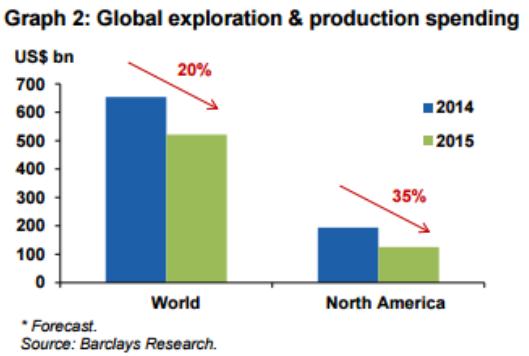
Global capital investments in oil & gas shrinking.
The failure of these auctions should come as no surprise, given the steep cuts in capital spending within the global oil industry.
Companies like Petrobras were not able to take part in Brazil’s auction, because it is already stuck with high levels of debt. Other international oil companies such as Exxon, Total and BP stayed away because they do not see the sense in investing at current price levels. They also want to prevent a deterioration of their debt situation, while protecting their dividends which are crucial to keeping the investors happy.
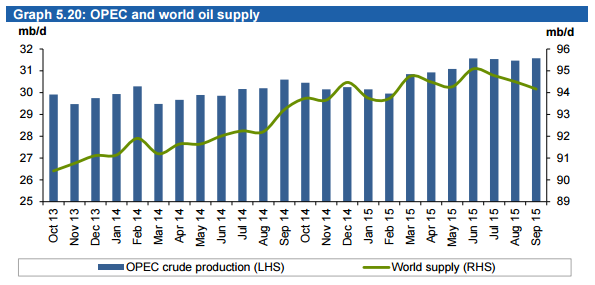
As a result, we have the following non-OPEC production profile developing:
Source: OPEC.
As we can see from the graph, OPEC recorded a four month trend of consecutive monthly declines since June. Other statistical measures, such as the EIA global data suggests that global production started declining perhaps in April, when US production also started declining. In the absence of a significant oil price increase I do not see how it is possible to reverse what now seems a permanent trend of production decline. The cuts in capital spending are set to continue, with companies constantly announcing cuts in current projects as well as future capital allocations. Total (NYSE:TOT) was one of the latest companies to implement a deep capital spending cut strategy. It went from $28 billion in 2013, to a plan to spend only $17-19 billion per year starting from 2017. Shell (NYSE:RDS.A) has been abandoning projects meant to unlock new frontiers, such as Kerogen in the Powder River Basin, and Arctic drilling. In Iraq, where just a few years ago, we were talking about potentially achieving 12 mb/d oil production capacity before 2020, production is still hovering around 4 mb/d and there are reports of cutbacks in investments.
We may still be far from a permanent peak in global oil production. The last few years have clearly shown that the global economy can still expand, albeit at a slower pace, even when oil prices hover in the $100/barrel range. We should be mindful of the fact that in the past few years we had some extraordinary measures in place meant to keep the economy afloat, including a very loose monetary policy and fiscal stimulus programs, therefore the real point of resilience of the global economy in face of higher oil prices may be considerably lower in the longer term. Nevertheless, I do think that the global economy can withstand oil prices in the $70-80/barrel range and at that price, I don’t think we have reached peak oil just yet. But at $50/barrel oil, all indications are that we are now at a peak and production will continue to decline as long as we are stuck in this price range.
29 Comments on "Mexico And Brazil Oil Auction Failures Are Further Proof Of Peak Oil At Current Prices"
JuanP on Thu, 15th Oct 2015 7:54 pm
Almost there. The author has an interesting perspective and some knowledge. There is no end to how much we need to learn. The longer oil prices stay where they are the more likely that depletion will make this peak, the peak. Most new oil sources left out there won’t get extracted at this price. The $50 or less oil is all accounted for.
But, TPTB might come up with some hare brained idea to create one more economic bubble, that could lead to a new very temporary peak, and keep pretending for another year or two at the most. I wouldn’t put it past them. I am amazed this shit is still running since 2008, so who knows what else they may pull out of their hat. Depletion, though, is a bitch and we need to replace 4-6 mbpd of oil production every year just to keep production steady. I don’t see that happening with oil prices at $50 or less. Where is there new oil left at less than $50? Very few places, maybe some in Iran or Iraq.
makati1 on Thu, 15th Oct 2015 8:22 pm
JuanP, I don’t think there is any new ‘save’ by TPTB coming. Nothing that could make $100 or even $80 oil viable long term, unless currencies are devalued to the point of being worthless.I think even $60 oil could not last long before the slowdown accelerated, shutting down demand.
I consider the above article to be more bullshit to try to keep the investors from jumping off the sinking petrocarbon ship. At some point, untapped petroleum resources will not be considered ‘assets’ on the financial book because they will be worthless.
At least, that is my take on the situation.
makati1 on Thu, 15th Oct 2015 10:17 pm
A bit off topic but…
“Corn and soy are in nearly every meal that Americans eat. From high-fructose corn syrup sweetening sodas to soy-based livestock feed transformed into steaks and nuggets, a few major crops dominate the US food chain. Now, new research highlights just how worrisome this trend is for the country’s food security.”
http://qz.com/521110/americans-are-increasingly-dependent-on-just-two-crops-and-its-putting-us-all-at-risk/
Naw! The US is exceptional.
SugarSeam on Thu, 15th Oct 2015 11:08 pm
there is still a major disconnect by the corns who finally have come around to admit decline has begun, but still yawn about what it means because theyre all so arrogantly confident production will just ramp right back up when prices spike… its all just seamless supply/demand cycles to them.
shortonoil on Fri, 16th Oct 2015 6:48 am
Like an iceberg, it is only the tip of it that shows; beneath the water lays a gigantic mass. Two auctions have failed, and are reported on because they are visible. What is not is the in-field drilling that didn’t occur, the equipment that was not replaced, the surveys that were not done, and the replacements that were not hired. For every dollar reported that is not spent, there are probably a 100 more beneath the media radar.
How long before someone has the courage to ask: are we seeing the end of oil?
http://www.thehillsgroup.org/
Davy on Fri, 16th Oct 2015 7:00 am
@ short: How long before someone has the courage to ask: are we seeing the end of oil?
That question leads on to some other very serious questions doomers and peakers have been asking for years now.
steve on Fri, 16th Oct 2015 9:59 am
Davy, they won’t ask that question because they are too busy and being inundated with the oil glut meme. They won’t see it right now the tide is out and they are gathering fish of the bottom of the ocean not realizing that a huge wave is about to come and wipe them out to sea…
apneaman on Fri, 16th Oct 2015 1:10 pm
Corns can never understand because their views are underpinned by neoliberal ideology. Ideology, trumps thermodynamics, trumps science, trumps history, trumps reality every time. Just look at all the dead civilizations before us. Most who are heavily indoctrinated will remain that way their entire lives.
“· Biological parasitism in nature is a perfect metaphor for finance. The first thing a parasite does is take over the brain of the host and convince it that the parasite is required for the survival of the host. The parasite has enzymes makes the host think that the parasite is its baby – part of its body. The host actually protects the parasite over itself. This is analogous to what finance has done to economic thought.
· Every society in the past has realized that finance and debt was the great destabilizing force of society.
· About 100 years ago, economists like John Bates Clark and other pro-finance economists said that finance is not external to the economy, it’s part of the economy just like landlords, rent, and so on, and the more it takes out of the economy, because it’s part of the economy, the economy is growing. In other words, financial growth is seen as positive growth rather than as a cancer.
· Lloyd Blankfein claimed that the reason Goldman Sachs employees were paid so much was because they were so productive. But what did they produce? National income accounts say everyone is productive in proportion to the amount of money they earn. It doesn’t matter whether its extractive income, or productive income. It doesn’t matter whether it’s by producing things, or simply taking things from other people, or even by fraud. Any way of earning income is considered to be as productive as anything else. It denies that there is any such thing as unearned income.
· Milton Friedman popularized the idea there is no such thing as a free lunch, but finance is the very definition of a free lunch. The people on Wall Street spend all their time looking for a free lunch.
· The primary focus of classical liberal economists was to draw a distinction between productive and unproductive labor – between people who earn their income by wages and profits, and people who don’t earn their income. People who, as John Stuart Mill said, “earn money in their sleep,” that is, landlords and the financial sector.
· When the Chicago School took over Chile, the first thing they did was close all the economics departments. They banned the history of economic thought and assassinated left-wing professors.
· Neoliberalism requires totalitarian control of economic thought – any idea that there is an alternative to the Market must be abolished. It rewrites economic history to claim that classical economists wanted to restore feudalism – not to abolish feudal privileges.”
more
http://hipcrime.blogspot.ca/2015/10/michael-hudson-explains-it-all.html
GregT on Fri, 16th Oct 2015 1:26 pm
The only thing that would make $100+bbl oil affordable in the long run, would be a vastly reduced standard of living. Unfortunately the consequences of CC would be the greater of two evils.
Damned if we do, and damned if we don’t. Quite the predicament. We should have listened to our scientists beginning around 40 years ago. Instead we listened to the eCONomists. Curiosity killed the cat, and greed will kill the human beings.
onlooker on Fri, 16th Oct 2015 1:27 pm
Once again great links AP. I will include some of my own with respect to the myths and ethos of rabid neo-liberal capitalism. Here is http://monthlyreview.org/2006/04/01/neoliberalism-myths-and-reality/
http://www.sharing.org/information-centre/articles/neoliberalism-and-economic-globalization
I also recommend the book “The Case against the global economy” This is my principal and favorite source of information about all this and what truly informed me of the details of the thrust of economics among the rich countries of the world. The takeaway to be succinct is that corporations, rich people and rich countries are the ones benefiting mostly from this globalized economic system. I preface rich countries by saying the rich in rich countries mostly. Banks are big winners too. Big losers all the disenfranchised huge poor masses of the world.
snag on Fri, 16th Oct 2015 1:53 pm
We had an earlier peak of $40 per barrel oil, an earlier one of $20 oil, and an earlier one of $5 oil. We have also had a peak of $1 per gallon milk and $1 per lb beefsteak.
yukonfisher on Fri, 16th Oct 2015 2:16 pm
In Canada we are in the final throes of a federal election and none of the mainstream parties are talking about the end of growth- neither economic nor population. It appears the winner will be the party promising the most growth. Meanwhile British Columbia’s gas and Alberta’s tar sands are looking more and more like orphaned assets.
GregT on Fri, 16th Oct 2015 2:33 pm
yukon,
No political party will ever be voted in to power on a platform of reduced economic output and austerity. Human beings always want more, not less. Greed, it is in our nature.
apneaman on Fri, 16th Oct 2015 2:36 pm
yukonfisher, I can’t wait for the head up ass, spoiled Canadian consumer zombies to get their long overdue dose of reality. All the pain that is coming is well deserved. Greedy fucking apes who only care about more.
BC on Fri, 16th Oct 2015 4:04 pm
snag, you need to adjust for price changes (so-called “inflation”), the US$, M2, or, better yet, the differential change rate of M2 to industrial production adjusted for the US$.
Then you will better discern what is an actual peak in purchasing power terms or not.
Are you hanging out with Plant? 😀
shortonoil on Fri, 16th Oct 2015 6:30 pm
“That question leads on to some other very serious questions doomers and peakers have been asking for years now.”
A famous writer, and philosopher once said, “you never go broke telling people what they want to hear”. This is something that people do not want to hear! It shakes their world view that somewhere, someone has everything under control. That all that is bad has been defeated. It has become the religion of modern civilization that man has become all powerful. The true danger will appear when that illusion has been shattered.
apneaman on Fri, 16th Oct 2015 6:37 pm
“It has become the religion of modern civilization that man has become all powerful.”
Only 70 years since WWII, not even the average lifespan of an N American and before that it was the great depression. Lack of sapience is the doom of apes.
bug on Fri, 16th Oct 2015 7:21 pm
Thank you Apnea and onlooker for your both great links
(Hip crime and monthly review)
shortonoil on Sat, 17th Oct 2015 7:55 am
“Only 70 years since WWII, not even the average lifespan of an N American and before that it was the great depression. Lack of sapience is the doom of apes.”
Narcissus, in Greek mythology, pined away for love of his own reflection in a pool of water. The Modern World has become the most narcissist, self serving, self centered culture the world has ever known. There can be no ugliness in a world where everything, and everyone must be beautiful.
shortonoil on Sat, 17th Oct 2015 8:30 am
@ BC
“Then you will better discern what is an actual peak in purchasing power terms or not.”
A unit of oil must be able to power enough economic activity in the general economy to pay for its own production. Otherwise, the funds would not exist to buy the oil. That is the point that the oil age is rapidly approaching; Anything else is composed of a world of magic, fairies, perpetual motion machines, and di-lithium crystals. There will, however, always be those who will swear that they are personal friends of Peter Pan, and Tinkerbell.
marmico on Sat, 17th Oct 2015 9:58 am
The only thing you need to know fuctard is energy intensity.
https://www.aei.org/wp-content/uploads/2015/04/energygdp3.jpg
peakyeast on Sat, 17th Oct 2015 10:21 am
@mARMICO: Oh WoW! – Thanks for that graph. I haven not seen it before and it is quite revealing !!!
marmico on Sat, 17th Oct 2015 12:10 pm
it is quite revealing
Rather than fairies & magic it is called efficiency, substitution and conservation.
Let the fuctard draw the 1949-2014 oil energy intensity chart.
shortonoil on Sat, 17th Oct 2015 5:33 pm
“The only thing you need to know fuctard is energy intensity.”
The only thing that proves is that the dollar has tuned into a reasonable facsimile to a piece of toilet paper. There are two sides to that graph you moron. Ever hear of Central Banks policy numb nuts. Where do you store your brains when you are not using them; in an eyedropper?
shortonoil on Sat, 17th Oct 2015 5:44 pm
http://www.thehillsgroup.org/depletion2_008.htm
Here is the BTU/$ graph from the EIA and the World Bank. In 1970 a dollar would have bought 58,649 BTU; by 2015 it was down to 5,631. In energy terms the dollar has become almost worthless.
apneaman on Sat, 17th Oct 2015 6:03 pm
marmynoon resurfaces to spit out a few more mouthfuls of bilge water before going down permanently to sleep with the fishes. You really want to draw economic comparisons between now and 1970 in the USA? You ain’t got a leg to stand on – different world. Go crawl back in your hole.
Boat on Sat, 17th Oct 2015 7:16 pm
In 1970 you could wash dishes for 1.25 per hr. Gasoline was .25 and beer was $1.60 for a six pack. You could get a buzz and drive around cheaper in the old days. Throw in $10.00, add a few friends and you got a party.
apneaman on Sat, 17th Oct 2015 7:20 pm
Look marmy an investment opportunity for you.
Oil Slide Means ‘Almost Everything’ for Sale as Deals Accelerate
http://www.bloomberg.com/news/articles/2015-10-14/oil-fall-means-almost-everything-for-sale-as-deals-accelerate?utm_content=buffer026f8&utm_medium=social&utm_source=twitter.com&utm_campaign=buffer
shortonoil on Sun, 18th Oct 2015 6:56 am
Thanks Ape:
http://www.bloomberg.com/news/articles/2015-10-14/oil-fall-means-almost-everything-for-sale-as-deals-accelerate?utm_content=buffer026f8&utm_medium=social&utm_source=twitter.com&utm_campaign=buffer
“Next year the U.S. benchmark may trade around $55, said Fryklund. It will take several years for supply and demand to rebalance and prices may rise to about $70 a barrel by 2018, he said.”
By our calculations the price decline will begin again in earnest no later than 2018 when the Maximum Affordable curve reaches $41 per barrel.
http://www.thehillsgroup.org/depletion2_022.htm
Buyers today of these assets will find that their investments will have become almost worthless in less than three years. With no additional buyers available write offs will be in the $trillions. Bankruptcies will be in the tens of thousands!
http://www.thehillsgroup.org/