
Peak Oil is You

Donate Bitcoins ;-) or Paypal :-)


Page added on March 5, 2017

Libya’s Biggest Oil Port Shut, Crude Output Cut on Clashes
Libya halted exports from its two of biggest oil ports and reduced production from some fields after clashes threatened to reverse the North African country’s progress in reviving crude output and sales.
Shipments from Es Sider, the country’s largest oil port, and Ras Lanuf, its third-biggest, have been suspended until the security situation improves and workers return to the facilities, Jadalla Alaokali, a board member of Libya’s National Oil Corp., said by phone.
Production from fields feeding Es Sider and Ras Lanuf has been reduced and output may be cut further if the ports remain shut and the situation doesn’t improve soon, he said, without specifying the amount of the decrease.
The Benghazi Defense Brigades, a militia not allied to the United Nations-backed government in Tripoli, seized the Es Sider terminal on Friday, according to people with knowledge of matter, who asked not to be identified because they aren’t authorized to speak to the media. The facility had previously been under the control of eastern-based military commander Khalifa Haftar.
The clashes jeopardize a surge in Libya’s oil production to about 700,000 barrels a day after output and exports had resumed from Es Sider and other facilities previously blockaded by fighting between armed groups. Production in February was almost double the level of a year ago, data compiled by Bloomberg show. Libya holds Africa’s largest crude reserves.
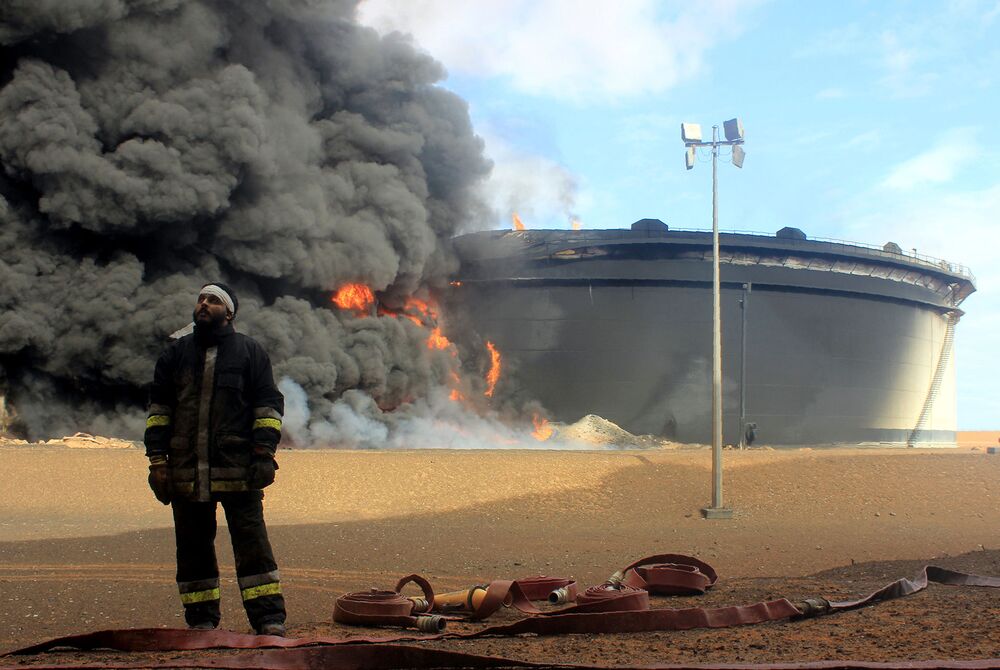
A Libyan fireman stands in front of an oil storage tank in Ras Lanouf in 2016.
Workers Evacuated
NOC sees no need for now to declare force majeure, a legal status protecting a party from liability if it can’t fulfill a contract for reasons beyond its control, Alaokali said.
The number of workers at Es Sider’s facilities has been kept to a minimum due to the fighting, and the rest of the staff have been evacuated, according to a person with knowledge of the matter, who asked not to be identified because the information isn’t public.
“We are against any actions that could damage the oil infrastructure in the country including oil fields, pipelines, ports, plants and other petroleum facilities,” NOC Chairman Mustafa Sanalla said in a statement posted Saturday night on the company’s website.
Libya has been boosting its oil production, resuming shipments from key ports after months of conflict. The more it pumps, the greater the pressure on other members of the Organization of Petroleum Exporting Countries to curb supply in order to eliminate a global oil glut. Libya produced 1.6 million barrels a day before a 2011 revolt sparked fighting that prompted investors to withdraw.
7 Comments on "Libya’s Biggest Oil Port Shut, Crude Output Cut on Clashes"
Cloggie on Sun, 5th Mar 2017 7:28 am
Libya was a prosperous country under Kadaffi, until somebody decided that the country needed to be thrown into chaos, because that country steered a course independent of the West. Can’t have that. So who was that person?
Bernard Levy.
http://fpif.org/ripped-from-hillarys-emails-french-plot-to-overthrow-gaddafi-and-help-itself-to-libyas-oil/
http://www.france24.com/en/20120606-libyan-war-brought-you-bernard-henri-levy-sarkozy-clinton-obama
We don’t want to go too deep into the background of this Levy fella and his buddy Sarkozy (nick “Sarko the American”), because that would only feed unwanted fanciful conspiracy theories.
Sarko got his nick…
http://newsfeed.time.com/2010/12/01/wikileaks-revelation-how-sarkozy-became-american/
…because he broke with the traditional Gaullist anti-Anglo foreign policy and turned towards America. One has to wonder why that was… until you dig into Sarko’s ethnic background.
joe on Sun, 5th Mar 2017 10:18 am
Yeah, France was doing just fine as it quickly became an African and Arab enclave. France is really doing great as a beacon of liberalism and religious tolerance. ‘ Now if we can just unjam our batons from the isis supporters butts……’
Sarky was at best a realist.
Boat on Sun, 5th Mar 2017 10:23 am
Clog,
Kadiffi among others chose to fund and kill friends and allies of the US. This puts them on the fast track to conflict. Stick with trade and you will be ok.
________________________________________ on Sun, 5th Mar 2017 10:34 am
Love it. Die muzfucks die. Now if only this spread to the US and EU.
joe on Sun, 5th Mar 2017 10:35 am
The EUSSR, can’t solve it’s energy problem. But getting rid of Gaddafi had nothing to do with oil and everything to do with the PNAC agenda which has totally failed to either destroy Muslim resistence or ensure democracy. People are totally missing to role that religion is playing, Tony Blair is a convert to Roman Catholicsm, he’s not playing games, this dude was the reason American foreign policy got any traction during the Bush years, a day what’s Bush, a fucking born-again wing-nut waiting to be ‘taken up’. These people want to provoke the apocalypse and the likes of Teresa May and Brexit is an effort to flee from Babylon and it’s tower of multilingual multiculturalism. It’s religion and we stupid fools who just want to eat and fuck and live our lives in peace don’t count at all.
Sissyfuss on Sun, 5th Mar 2017 4:50 pm
You can’t win if you don’t play, Joe.
BobInget on Mon, 6th Mar 2017 11:30 am
By
MyraP. Saefong
Markets/commodities reporter
The recent drop in oil industry investment brought on by weak prices threatens to significantly slow supply growth in the long term, and could lead to a shortage when it comes to meeting global demand, the International Energy Agency said in its five-year oil market forecast released Monday.
That may happen even as crude stockpiles in the U.S. and elsewhere climb over the next few years, the IEA said in its “Oil 2017” report.
“If the record two-year investment slump of 2015 and 2016 is not reversed,” supply growth may stall by 2020, it said, pointing out that global oil and gas upstream, or exploration and production, investment fell by 25% in 2015 and by another 26% in 2016.
This year, it’s “evident” that under the Organization of the Petroleum Exporting Countries-led production cut agreement, output reductions are taking place just as production from the non-OPEC sector, led by the U.S., is recovering.
This ample supply, even as output cuts are implement, is the reason for the “very flat crude-oil price futures curve on which our five-year forecast is based,” the IEA said.
International Energy Agency’s Oil 2017 report
Brent crude futures LCOK7, -0.13% traded on the ICE Futures exchange in London have traded in a tight range between $53 and $58 a barrel since the start of the year, while West Texas Intermediate crude CLJ7, -0.43% on the New York Mercantile Exchange has traded between $50 and $55 this year.
The key takeaway from the IEA report is the “looming imbalance,” Matt Parry, IEA senior oil economist, told MarketWatch by email from Paris.
A large potential supply deficit may take hold around 2020, “as demand growth is consistently forecast to outstrip projected increases in global oil supplies,” he said. “A net demand gain of 7.3 [million barrels per day] is forecast [for] 2016-22—vastly exceeding the projected supply growth of under 6 mb/d.”
The IEA report said that demand and supply trends point to a tight global oil market and in 2022, spare production capacity may fall to 14-year low.
For now, “we are witnessing the start of a second wave of U.S. supply growth, and its size will depend on where prices go,” Dr. Fatih Birol, the IEA’s executive director, said in a statement. “But this is no time for complacency. We don’t see a peak in oil demand any time soon.”
“And unless investments globally rebound sharply, a new period of price volatility looms on the horizon,” he said.