
Peak Oil is You
Donate Bitcoins ;-) or Paypal :-)


Page added on September 24, 2015

JODI Data and Giant Field Depletion
I am starting this post off with a news article because it explains why JODI has U.S. production numbers wrong for July.
No, U.S. Oil Production Probably Didn’t Rise in July
The Joint Organizations Data Initiative (JODI) releases monthly oil supply-and-demand data for about 80 countries, which it gathers by directly surveying the countries. It is widely cited by analysts, especially for its figures on demand, imports and exports.
The latest JODI data released Sunday showed that U.S. crude-oil production rose from 9.3 million barrels a day in June to 9.5 million barrels in July.
But the EIA’s latest forecast called for July production to fall to 9.2 million barrels a day in July, continuing the trend of declining U.S. production as companies cut spending in the face of low prices.
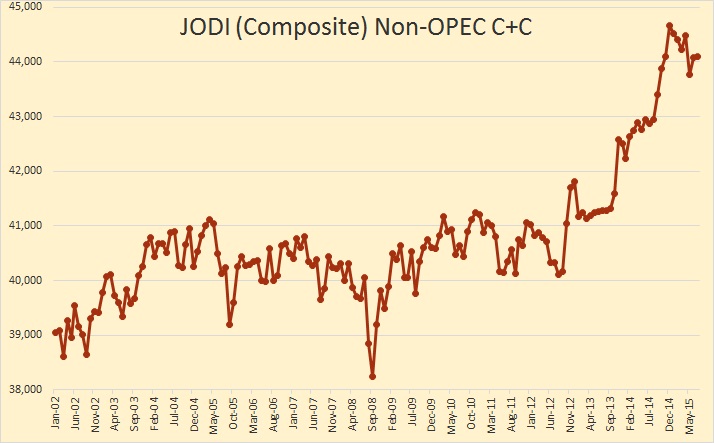
For the charts below I have used JODI data for all Non-OPEC nations except those that do not report to JODI. For them I use the EIA data and carry forward the same data that the EIA reported, (April). For the USA, since the JODI data is obviously wrong for July, I simply carried forward the June data which also came directly from the EIA. And for OPEC I use the OPEC MOMR’s “secondary sources”. JODI also uses the MOMR for their data but uses the “direct communication” data instead of the secondary sources data.
The data below is through July 2015 and is in thousand barrels per day.
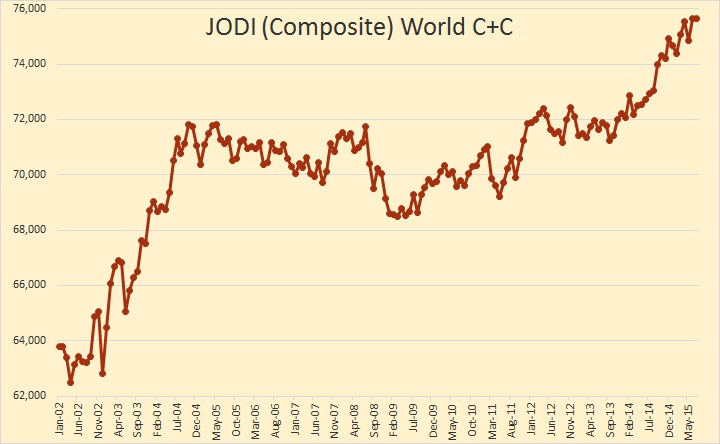
In July we remained at or near the world’s all time peak at 75,631,000 barrels per day, down just 15,000 bpd from June.
JODI Non-OPEC stood at 44,100,000 bpd in July, down 567,000 bpd from the peak in December.

JODI Non-OPEC less USA stood at 34,804,000 bpd in July, down 900,000 bpd from the most recent high in December 2010.
The below table, Giant Oil Fields of the World Data as of 2013 is from Art Berman. It was complied by Mike Horn and Associates and is on the AAPG records. The Excel file that I received was far more extensive than the below. It contained the 738 largest oil fields and 1048 total oil and gas fields. I have shortened it to only fields above 5 billion barrels of oil, ultimate recovery estimate.
Five fields above 5 billion barrels ultimate recovery are not included. Three, Vostochno-Prinovozemelsky, Kaigan-Vasyugan and Kurmangazy (Russia and Caspian) because there was no data and Manifa and Khurais (Saudi Arabia) because due to decades mothballed off line, I found their data to be inaccurate. Mike Horn and Associates apparently calculated production from the date they first came on line and made no allowance for their decades off line. They had Manifa and Khurais far more depleted than I thought to be the case. But that still left 56 giant fields above 5 billion barrels ultimate recovery.
Horn and Associates calculated the decline, from first production, using three decline rates, 6.7 percent per year, 3.4 percent per year and 1.4 percent per year. Then they calculated the decline rate using an average of those three decline rates. The average of the three is the one used here when I calculated the remaining reserves from the original ultimate recovery estimate. The average of those three works out to be 3.83% decline per year. I think that number is very conservative.
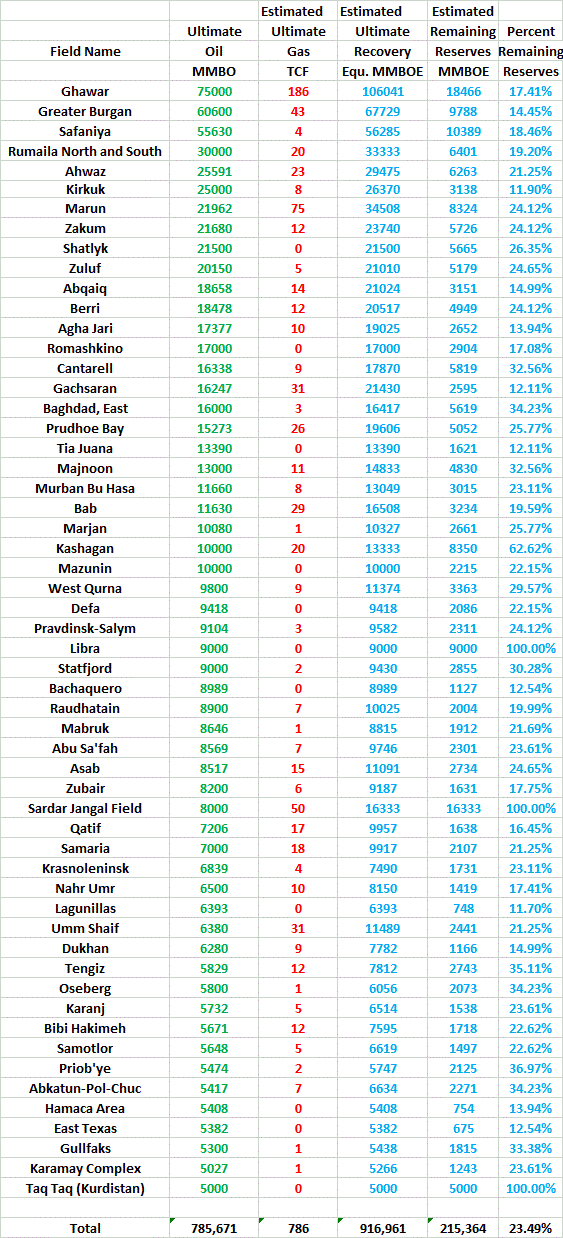

Unfortunately Horn and Associates did not calculate remaining MMBO, only MMBOE. For the 733 total oil fields with ultimate recoverable one billion barrels or more, the total ultimate recoverable oil came to 1,435,993 MMBO. That is 1.436 trillion barrels of oil in giant fields only. But the MMBOE in those 733 fields came to 4,674,021 MMBOE. That’s 4.674 trillion barrels of oil equivalent.
Of that original 4,674,021 MMBOE 1,479,623 MMBOE or 31.66% of the original ultimate recoverable oil, gas and condensate remain.
There were 310 other fields in this study but they were gas only fields and none of those were included in any of the calculations above.
12 Comments on "JODI Data and Giant Field Depletion"
BobInget on Thu, 24th Sep 2015 6:40 pm
Letter from the trenches: (reposted here)
North Dakota
There will always be rigs drilling wells where there are land obligations to meet. I have no idea how the deals are negotiated in North Dakota only how they are structured here in Western Canada. There are P & NG Permits, Drilling Licences and Leases. Each has their own time fuse to expiry and each become leasehold once drilled – usually drilling a well of a certain type and depth converts so much land from Licence to Lease. Once drilled a lease can be held by production – if no production then the lease reverts to the Crown after a set amount of time – either two years or five years. Having already paid what is probably close to a Kings ransom to acquire the P & NG rights to a property in the first instance – companies will be loathe to let the best acreage lapse – sure the worst land is going to be left to expire undrilled – but anything remotely capable of production in the $60+ per barrel range will have to be drilled to hold the adjacent land for future drilling possibilities and to maintain potential (?) reserves for when commodity pricing improves – which it will sometime soon right?
How each company drilling its land base to hold that land base for better times parses its drilling or operations programmes is entirely up to their ethics and the legalities of the situation. If they allude to the possibility that they are economic wells at whatever the current price is then I am sure they have the accounting expertise available to make it appear so – at least for the short term. It is up to the investor (?) to determine whether they are merely deluded or outright lying…
I also do not know just how tied various companies might be to supply various contractual demands either? (Probably applies more with gas sales contracts than oil ones). The other concern where gas is a significant portion of the production is the simple fact that gas plants are far more efficient when running at close to capacity rather than at a fraction of that capacity. Drilling is often done to maintain production throughput rates rather than for any other consideration – especially if the low prices are perceived to be short term. This may even be achieved by shutting some plants down and re-routing the gas elsewhere for maximum efficiency?
For the Bakken (Three Forks too) – its really hard to see anything making any money below $70 per barrel? Maybe for a short while some areas and some wells can – and that simply through the fact that all the service costs will be running at 40-60% discount from “normal” book prices during times such as these. (I laugh when I hear folks talking about services at a 20% discount – the reality will be that service companies will be discounting at least 50% – possibly more – just to keep personnel and equipment busy and to maintain “market share.”)
On a personal note here – I consider myself a pretty experienced geological consultant – I have talents and abilities in the top percentile “out there” without resorting to any Wobegon like self deception – and yet I have not worked for well over a year now – and I have very little reason to believe that any changes to that situation will occur in the absence of any sudden rise in oil price to the $70+ range and a significant uptick in activity in all places. True I have taken a medical sabbatical for some of this time and I have been away from the WCSB for some 4 years now while in Albania leaving contacts here to grow a little cold – but the truth is there is just that little work out there that will see anyone engaged that was not contracted out here during the boom times. During these boom times all companies have their favourite consultants and consulting companies – they are struggling now to spread the little bit of work available around amongst all the folks they have depended upon these past years – for sure there are plenty of folks they are also quite happy not to be using too during these times… I know I am not alone here – I have several close geological friends – all superb field geologists – and none of them have turned a wheel for nearly a year now either? True I have not conducted any great “self Marketing” campaign – but if I have no encouragement from friends and past contacts – I doubt that “cold calls” to complete unknowns will serve any great purpose either? (I’ve seen these downturn cycles many times before in my career and basically understand that things improve when things improve – and not one moment sooner!)
GS
BobInget on Thu, 24th Sep 2015 6:44 pm
A single reply:
North Dakota
“I know I am not alone here …”
You most certainly are not alone.
As recently as 10 months ago I was getting one or more calls or emails every week from headhunters looking for experienced geoscientists. I haven’t had a contact in probably 3 months. I’m operating on the assumption that I’m involuntarily retired. (30)
Ok, it’s official, we’ve stopped looking.
Now, What?
makati1 on Thu, 24th Sep 2015 8:42 pm
Play the limbo music! How low can it go?
Well, I think we are soon going to find out. And it will not be music we hear, but the waling and gnashing of teeth from the pain of contraction and collapse. Better now than later.
paulo1 on Thu, 24th Sep 2015 11:02 pm
Good luck, Bob. I hope you weather the downturn okay. Appreciate your comments and insights.
rockman on Fri, 25th Sep 2015 6:11 am
Bob – Yes…I know that feeling well. I took early involuntarily retirement when I was in my 30’s back in the 80’s. LOL. Fortunately we’re currently buying out one of our JV partners and taking over drilling operations. Gives a bit more justification for our existence. I’m sitting here with $250 million in cash and struggling to find a drilling prospect or acquisition that fits our business plan. Strangest situation I’ve been in for more than 40 years. But at least I still have a “situation”. LOL.
rockman on Fri, 25th Sep 2015 6:25 am
BTW even though I don’t bother to study such “manufactured” stats like those from JODI et al I don’t have a problem believing an uptick in global production this year. Yes, depletion has its effect. But so does increasing the lift on a producing well. I could increase the production on every one of my oil wells by just changing the choke or increasing the pumps. Most operators could do likewise…and many have.
But the downside is potentially reducing URR, wearing out equipment faster and on some occasions severely damaging the well. I have one well that went down because the operator pulled it too hard and plugged the tubing with formation sand. Now we have to spend capex to fix the problem: negative cash flow…not good. LOL. But as I’ve said before it’s much more common for operators to do what they can to INCREASE oil production in the face of falling prices then to decrease production rates. Just look how so many folks have misinterpreted the KSA response by increasing their production. It was never about hurting US shale players…it was about maxing cash flow. For political reasons the KSA was glad to let that misconception roll along. The last thing they wanted their natives to understand was that their country was approaching the beginning of the end of their fat days.
Davy on Fri, 25th Sep 2015 6:30 am
Rock, I always appreciated your real world views of the oil patch. We get too many articles that are dealing with abstract analysis. This analysis is important but it is often taken and applied wrong when looking at the real world of the oil patch. Your comments bring many fallacies to light.
makati1 on Fri, 25th Sep 2015 7:26 am
Ok, rockman, but if you pull out all of the non petroleum liquids, will there still be a net increase? And, more importantly, will it result in a net increase of energy at the users end? Numbers are interesting, but they don’t tell the whole story these days. And some are so phony, they should be called lies.
Glad to hear you are still able to work in your chosen career. Not many will be able to do that in the future.
Nony on Fri, 25th Sep 2015 8:45 am
1. Ron apparently did a lot of work (perhaps good work), but I honestly have a hard time understanding all the amendments and combinations of data that he did. Perhaps if he made a table of it, that would help. And/or show how the results come out if he doesn’t do some of the corrections.
2. This is more stylistic but am not a fan of combining in other content to make a blog post longer. I actually prefer shorter blog posts slightly, but regardless, they should have a single central topic regardless the length.
rockman on Fri, 25th Sep 2015 10:55 am
mak – A very valid point about the game some have played by redefining “oil”. But that’s not what I’m taking about: I’m referring to REAL OIL. LOL. And the KSA and others have increased production of REAL OIL. But as I pointed out that doesn’t mean more reserves or an increase in drilling efficiency.
Perhaps its too simple a concept for folks to appreciate. A simple and very accurate analogy: You get a 50% pay cut. But you start pulling about 60% of your former salary out of savings. And SHAZAM!…you have more disposable “income” then you had before your salary cut. But you are not “richer”: obviously that can last only so long.
Truth Has A Liberal Bias on Fri, 25th Sep 2015 2:50 pm
@nony
I’m looking forward to soon seeing your blog posts that fix all these problems and imperfections. Perhaps we’ll all soon make some progress as a result of your analysis of the data sets.
Actually I’m being sarcastic. We all know you won’t do a fucking thing useful but you’ll still find time to complain about everybody else’s good work.
Nony on Fri, 25th Sep 2015 8:50 pm
I think it is fine to strip out the NGLs as C3 and C4 as very very different from C&C.
But condensate is different. I think some of this “cat piss” stuff that people like Jeff Brown talk about for condensate (or even 47 API Eagle Ford OIL) is pretty silly, though. Shit runs through a refinery tower, gets mixed with heavier grades, etc. Gets sold by Platts. Stored in crude tanks. Etc. Etc.
And then I wonder if a lot of the brew crew commenters here even really know the difference between NGLs (hint mostly NOT liquid) and condensate.
Then the fetish of saying Eagle Ford 47 API is not oil is just silly. Butt silly. Tastes, smells, feels like oil. put it in a crude tank and paraffin sludge will accumulate just like it would from 30 API medium sour grades. Mess up your coveralls the same way. It’s a light oil. Duh.