
Peak Oil is You

Donate Bitcoins ;-) or Paypal :-)


Page added on February 5, 2018

Heinberg: U.S. Energy Abundance for Now— But Don’t Peek Behind That Curtain!

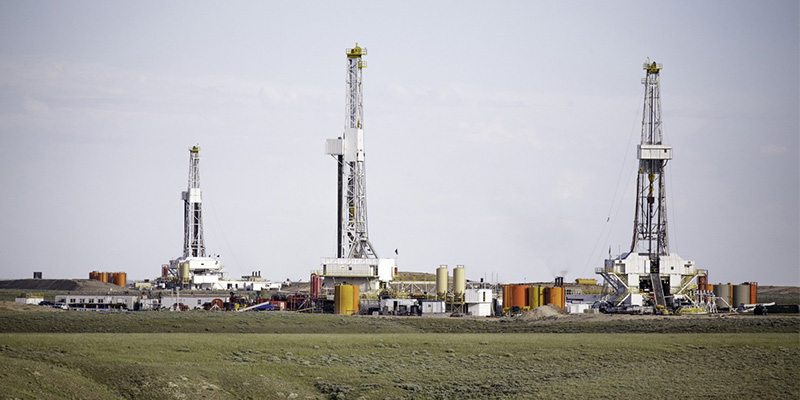
The Energy Information Administration (EIA) of the U.S. Department of Energy is about to release its Annual Energy Outlook (AEO) 2018, with forecasts for American oil, gas, and other forms of energy production through mid-century. As usual, energy journalists and policy makers will probably take the document as gospel.
That’s despite the fact that past AEO reports have regularly delivered forecasts that were seriously flawed, as the EIA itself has acknowledged. Further, there are analysts inside and outside the oil and gas industry who crunch the same data the EIA does, but arrive at very different conclusions.
The last few EIA reports have displayed stunning optimism regarding future U.S. shale gas and tight oil production, helping stoke the notion of U.S. “energy dominance.” No one doubts that fracking has unleashed a gusher of North American oil and gas on world markets in the past decade. But where we go from here is both crucial and controversial.
The most comprehensive critiques of past AEO forecasts have come from earth scientist David Hughes, a Fellow of Post Carbon Institute (note: I, too, am a Post Carbon Institute Fellow). Since 2013, Hughes and PCI have produced annual studies questioning EIA forecasts, based on an analysis of comprehensive play-level well production data. Their latest report, a critical look at AEO2017, is just out.
“Shale Reality Check: Drilling Into the U.S. Government’s Rosy Projections for Shale Gas & Tight Oil Production Through 2050” explores four big questions crucial to the realization of the EIA’s forecasts:
- How much of the industry’s recent per-well drilling productivity improvement is a result of better technology, and how much is due to high-grading the best-quality parts of individual plays? Over the past few years, industry has shown the ability to extract increased amounts of oil and/or gas from each well. This has been achieved in part by drilling longer horizontal laterals, tripling the amount of water and proppant (usually sand) used per unit of well length, and increasing the number of fracking stages. It is also in part a result of “high-grading,” or focusing drilling on the best-quality parts of each play (termed “sweet spots” or “core areas”). The decline in average well productivity observed in parts of some plays, despite the application of enhanced technology, suggests that sweet spots there are becoming saturated with wells. When this happens, drillers must either move to lower-quality rock outside of sweet spots, or drill wells too close together, which results in well interference or “frac hits” and reduced well production.
- Can technological advancement in the industry continue to raise productivity indefinitely? If, as the EIA suggests, improved technology will continue to increase well production, then perhaps per-well productivity can continue to grow for some time. However, based on the analysis of recent data, Hughes questions this (as does a team of MIT researchers). Well productivity is already declining in some plays, despite the application of enhanced technology, indicating that technology and high-grading have reached limits. Given uniform reservoir quality, improved technology allows the resource to be extracted more quickly with fewer wells, but it does not necessarily increase the overall amount of resource that can be recovered.
- What will be the ultimate cumulative production from all U.S. tight oil and shale gas wells? Taking the above points into account, Hughes concludes from a detailed analysis of production data that the EIA is making extremely optimistic assumptions about ultimate production and long-term production rates in most shale plays. Production over the long term is likely to be fraction of what the EIA is forecasting.
- What about profitability? So far, overall, the industry has lost money on tight oil production, and shale gas has done little better. That’s even with most recent drilling being focused in core areas. The industry and its investors assume that if productivity continues to increase, and oil prices rise, profitability will eventually materialize. But what levels of oil and gas prices would be required to profitably extract fuels in the large non-core areas that the EIA assumes will eventually be tapped after “sweet spots” are drilled and exhausted? The AEO offers little in the way of realistic analysis on this point.
Let’s approach this subject another way. If you were an EIA analyst and you wanted to produce the most optimistic estimate possible of future U.S. oil and gas production, how might you go about it? You might do the following:
- Mischaracterize the source of recent productivity improvements (assume it’s mostly technology, not high-grading);
- Extrapolate recent well productivity improvements far into the future, even though evidence suggests this is unwise;
- Assume that large areas that are not currently being drilled will be highly productive; and
- Ignore price and profitability.
Check, check, check, and check.
Hughes figures, using EIA assumptions, that meeting the agency’s projections for shale gas and tight oil through 2050 for the 88 percent of production that would come from major plays would require drilling and fracking over 1 million wells at a cost of $5.7 trillion (the remaining 12 percent would require .68 million wells at a cost of $4.1 trillion). The EIA’s own estimate for all oil and gas (conventional, shale and offshore) is 1.3 million wells at a cost of $7.7 trillion. It would also consume countless billions of gallons of water and millions of tons of sand and chemicals. One might question the plausibility of this scale of expenditure of capital and physical resources. But even if the project were practically feasible, would it represent the best use of money in securing our energy future? And would the inevitable near- and long-term health and environmental impacts be somehow justified?
The EIA seems to assume that its audience consists of potential investors in struggling tight oil and shale gas companies, and that it speaks on behalf of those companies. That’s not the proper role of a government agency. Taxpayers who fund AEO reports deserve realistic estimates of future production, costs of production, and prices needed for profitable production. Otherwise, the agency’s pronouncements will continue to resemble those of the Wizard of Oz: Be amazed! Be awed! But pay no attention to the man behind the curtain.
62 Comments on "Heinberg: U.S. Energy Abundance for Now— But Don’t Peek Behind That Curtain!"
onlooker on Mon, 5th Feb 2018 7:25 pm
The rout coninues now in the Asian markets
Oh and great article and information in it
coffeeguyzz on Mon, 5th Feb 2018 7:38 pm
Simply reading past works from David Hughes, such as his Drilling Deeper, readily displays his wildly inaccurate projections regarding output from unconventional development.
The peak oil folks who continue to embrace these authors will place themselves in an ever shrinking orbit of like-minded observers who tenaciously cling to provably wrong analysis.
onlooker on Mon, 5th Feb 2018 7:50 pm
Yeah, right coffee. Shale is expensive, of low EROEI,and requiring ever more wells to keep production up (costing trillions of dollars ) without generating profitability
Other than that it’s all good. Can anyone say Boondoggle
fmr-paultard on Mon, 5th Feb 2018 8:03 pm
i’m a tard. i hate it. that’s all.
coffeeguyzz on Mon, 5th Feb 2018 8:04 pm
… And as a quick PS for any who are interested in truth, rather than spin …
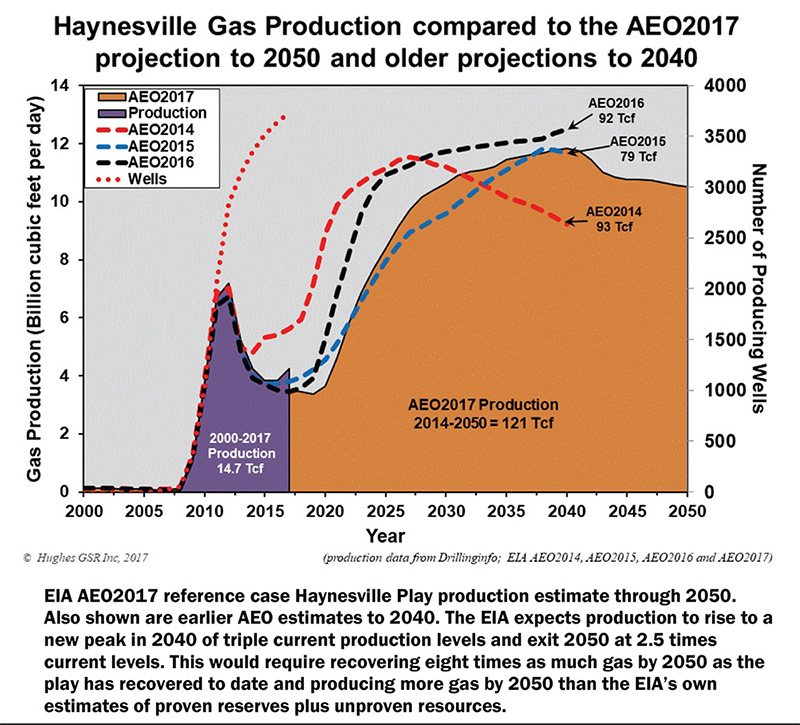
The above Haynesville graphic has the EIA projecting 121 TCF produced up to 2050.
The bold text beneath it derides this as being more than EIA estimates of proven reserves plus unproven resources.
That may be technically accurate (don’t have time to track down most current EIA numbers), but in the ‘real world’, that is a grossly deceptive statement.
The EIA bases their numbers from the USGS assessment work.
USGS recent Haynesville/Bossier assessment was 300 Tcf Technically Recoverable Resources, aka, what can be recovered with current technology.
If the EIA has yet to put forth an updated number based on this work – very possible – it would be disingenuous to ignore the recent, US government backed analysis … unless one is pushing an agenda.
Only the Willful Disbelievers continue to give these biased, inaccurate papers any credence whatsoever.
Anonymous on Mon, 5th Feb 2018 8:14 pm
David Hughes:
2006: peak gas is here. Droping 1.5 BCF/d/year. Can’t build LNG IMPORT fast enough to keep up. Unconventionals won’t change the impact.
2011: Laughed at EIA gas predictions for 2040. (They were reached by 2014!)
2013: Etc.
2015: Etc.
This guy never learns. He’s not objective.
onlooker on Mon, 5th Feb 2018 8:15 pm
But again, are readers not reading the checklist of exaggerations and assumptions. Economics must play into any estimate of Recoverable Reserves. If now and recently with an ample enough amount of “sweet spots”, the Shale frackers cannot produce without much lending, how can anyone expect them to do so with plays and wells that will be less bountiful going forward. They are at present combing through and producing from the sweet spots as that is the economic mandate. And the article does well to remind people of the limits of technology in terms of allowing for oil to be ultimately extracted. The only thing allowing this dubious enterprise to continue is prodigous amounts of lending and conventional oil still being produced.
Anonymous on Mon, 5th Feb 2018 8:17 pm
Regarding Haynesville: First it arrested collapse and went flat for a couple years (unlike the peaker model). Then it started up. Just look at the purple. See the uptick?
MASTERMIND on Mon, 5th Feb 2018 8:23 pm
Anonymous
Peak oil, coal and gas in the next decade! See peer reviewed scientific paper in the Journal of Fuel
Projection of World Fossil Fuels by Country (Mohr, 2015)
http://www.sciencedirect.com/science/article/pii/S0016236114010254
MASTERMIND on Mon, 5th Feb 2018 8:25 pm
As M. King Hubbert (1956) shows, peak oil is about discovering less oil, and eventually producing less oil due to lack of discovery.
https://imgur.com/a/6dEDt
IEA Chief warns of world oil shortages by 2020 as discoveries fall to record lows
https://www.wsj.com/articles/iea-says-global-oil-discoveries-at-record-low-in-2016-1493244000
Saudi Aramco CEO sees oil shortage coming as investments, oil discoveries drop
https://www.reuters.com/article/us-aramco-oil/aramco-ceo-sees-oil-supply-shortage-as-investments-discoveries-drop-idUSKBN19V0KR
Peak Oil Vindicated by the IEA and Saudi Arabia
MASTERMIND on Mon, 5th Feb 2018 8:25 pm
Dear Reader,
Here are five peer reviewed scientific studies authored by top experts that prove beyond any reasonable doubt that global civilization will collapse within the next decade.
http://www.sciencedirect.com/science/article/pii/S0921800914000615
http://www.sciencedirect.com/science/article/pii/S0959652617304225?via%3Dihub
https://www.ncbi.nlm.nih.gov/pmc/articles/PMC3574335/
http://sustainable.unimelb.edu.au/sites/default/files/docs/MSSI-ResearchPaper-4_Turner_2014.pdf
http://www.feasta.org/wp-content/uploads/2012/06/Trade-Off1.pdf
Simple really….when the World Economy Collapses everything shuts down…the end… We’re talking about grids down all over the world and 7.5B people dropping like f*** flies in short order. The collapse will be absolutely horrible..There is no collapse or horror movie ever produced that has even come close to imagining what the collapse of BAU might look like. I’m talking about every corporation and every social program going bankrupt at once. I’m talking about people eating people. I’m talking about the Worst Catastrophe to ever happen in the history of mankind. Nothing has ever, or will ever come close….
MASTERMIND on Mon, 5th Feb 2018 8:28 pm
Existing oil reserves are scheduled to begin a catastrophic crash within 1 to 3 years. When it hits the economic and social damage will be catastrophic. The end of Western Civilization, from China to Europe, to the US, will not occur when oil runs out. The economic and social chaos will occur when supplies are merely reduced sufficiently….
https://imgur.com/a/6dEDt
http://www.nature.com/nature/journal/v481/n7382/full/481433a.html
http://www.sciencedirect.com/science/article/pii/S0301421509001281
http://www.sciencedirect.com/science/article/pii/S030142151300342X
http://www.sciencedirect.com/science/article/pii/S0016236114010254
http://www.geo.cornell.edu/eas/energy/the_challenges/peak_oil.html
http://www.energybulletin.net/sites/default/files/Peak%20Oil_Study%20EN.pdf
Anonymouse1 on Mon, 5th Feb 2018 8:28 pm
WoW, WhineBerg managed to pen an entire article w/o somehow finding something to blame the imbecile-in-chief, trump for.
Incredible…or is it? Maybe whineberg is actually on vacation, and is using a ghost writer. A ghost writer that did not read rich’s sticky notes. Hard to say.
MASTERMIND on Mon, 5th Feb 2018 8:29 pm
The End of the Oil Age is Imminent
Recently, the HSBC oil report stated that 80% of conventional oil fields were declining at a rate of 5-7% per year. This means that there will be an oil shortage of ~30 million barrels per day by 2030 and ~40 million barrels per day by 2040.
http://www.scribd.com/document/367688629/HSBC-Peak-Oil-Report-2017
What is mentioned far less often is that annual oil discoveries have lagged annual production since the 1980s.
https://imgur.com/a/6dEDt
Now, this problem has nothing to do with the recent decline in the oil price, which started in 2014. This has been an on-going problem for the past 30 years. Now, the IEA is predicting oil shortages by ~2020 due to declining exploration.
https://www.wsj.com/articles/iea-says-global-oil-discoveries-at-record-low-in-2016-1493244000
Here, the IEA blames this problem on the low oil price. But, this problem started in the 1980s. The problem is geological: we are running out of conventional cheap oil. Shale and tar sands are not the answer, either. Those resources are far too expensive, compared to conventional oil, because the global economy is based on cheap conventional oil. Expensive oil is not a replacement for cheap oil.
Based upon the HSBC report and the IEA, the End of Oil Age will start around ~2020: there will be a dramatic economic depression due to exhaustion of cheap oil. This will cause a global economic collapse.
fmr-paultard on Mon, 5th Feb 2018 8:38 pm
There’s just too much information for me to conclude. Each graph has info on how quickly wells can be put into production, how stable is rate of production of each well, where are the most productive period of wells. The latest 2017 is 30% more than either 2014 and 2016 estimates. The benefits of prediction is time. The magic quantity “time” could mean anything, including improvement in recovery technology.
Mad Kat on Mon, 5th Feb 2018 8:49 pm
fmr, any article/graph about oil is a joke. They are all designed to keep the suckers/investors in the game until it is too late. All that matters to the average person is the cost at the pump or the resulting cost of goods bought. Timing anything is not possible. Too many variables and black swans. I quit reading about oil a long time ago and began to cut my dependency on it’s rise or fall.
Boat on Mon, 5th Feb 2018 9:13 pm
The eia itself claims production weekly results are estimates. They then do monthly report that over 50% of the time is within 1%. Over the next two months they make the necessary adjustments to become accurate.
Boat on Mon, 5th Feb 2018 9:16 pm
Any one who follows oil much knows predicting the future production is dicey. Weather events, pipeline failures and political events. Are but a few of the inputs that estimates can’t accurately predict.
MASTERMIND on Mon, 5th Feb 2018 9:26 pm
Boat
The EIA is corrupted AF just like all the rest of the US government! I bet you believe Black unemployment is at all time lows as well! LOL
Boat on Mon, 5th Feb 2018 9:29 pm
The eia is worst at yearly and multi yearly estimates. As amouse pointed out they can be off years in a 10 year period. I use the eia for current and past production which is as good as it gets. The future? Reads everybody’s estimate, look at the data then make your own guess. Compare your own results over time to find out how tough it is. At least you will learn a lot about the different variables.
This is a more informed approach than the typical mak, onlooker, mm trash talk bs.
JuanP on Mon, 5th Feb 2018 9:44 pm
One may agree or disagree with the comments above, but at least they are original. Not all, of course, Micromind continues copying and pasting the same comments with the same old links like a broken record. Micromind epitomizes Einstein’s definition of insanity. He keeps doing the same thing over and over expecting a different result. I’d rather read anything else than his ridiculous posts. I didn’t think this board could get any worse but Micromind proved me wrong!
JuanP on Mon, 5th Feb 2018 9:47 pm
Boat “I use the eia for current and past production which is as good as it gets.”
I completely agree with Boat on this. The EIA provides great info on past and present production, but their forecasts have almost always been wrong.
Boat on Mon, 5th Feb 2018 9:49 pm
MM
Google the results and report back.
MASTERMIND on Mon, 5th Feb 2018 9:54 pm
Boat
You should head over to that dumbshit Dennis over POB! LOL
MASTERMIND on Mon, 5th Feb 2018 9:55 pm
The Federal Reserve inflated stock prices for years and now comes the scary unwinding
https://www.marketwatch.com/story/the-federal-reserve-inflated-stock-prices-for-years-now-comes-the-scary-unwinding-2018-02-05?link=sfmw_tw
Boat on Mon, 5th Feb 2018 10:16 pm
That’s what happens when you take a growing economy with low employment and throw gasoline/tax cut on it. That’s our cheeto.
MASTERMIND on Mon, 5th Feb 2018 10:45 pm
Boat
The economy grew during the depression as well. But I wouldn’t count that as a great time…we have been in a depression for the last 11 years. Depression stands for “Depressed Economic Growth”…That is why the Nazi’s are back..History repeating itself!
The Great Depression 1929-1940 US Economic Growth GDP (1%)
https://en.wikipedia.org/wiki/Great_Depression
The Great Recession 2006-2017 US Economic Growth GDP (1.5%)
https://www.statista.com/statistics/188165/annual-gdp-growth-of-the-united-states-since-1990/
MASTERMIND on Mon, 5th Feb 2018 10:47 pm
Boat
The global economy has been in neutral for little over decade and is headed for collapse! It broke post peak oil!
http://imgur.com/a/uCz7V
http://www.nature.com/nature/journal/v481/n7382/full/481433a.html
https://www.scientificamerican.com/article/has-peak-oil-already-happened/
MASTERMIND on Mon, 5th Feb 2018 11:17 pm
Rednecks will buy anything for a political statement. If you find a pallet of clearance bricks at Lowe’s. Buy the pallet and say every brick they buy keeps them out of the hands of a Black Lives Matter activist. They’ll buy the whole damn pallet. Won’t even realize what they’ve done for years. Hand them a free confederate flag with it. When they pull out their wallet to pay, make an off handed comment on how those flags are going to be banned soon and they won’t even count their money. They’ll hand it to you while they talk about how sensitive the “snowflakes” are and something about their buddy’s newest gun. You make a 1000% profit and they get the feeling everyone else is a sucker. I’ve seen it a million times.
Boat on Mon, 5th Feb 2018 11:28 pm
Honest people are the best workers in all areas except sales. Keep selling mm. Lol
Boat on Mon, 5th Feb 2018 11:38 pm
Your high case scenario was the closest but wrong. Strong oil growth to 2025 is very probable continuing to a peak around 2030 and a decline for decades. Were going electric.
MASTERMIND on Mon, 5th Feb 2018 11:57 pm
In Charts: Has The US Shale Drilling Revolution Peaked?
https://www.epmag.com/charts-has-us-shale-drilling-revolution-peaked-1663686#p=full
MASTERMIND on Tue, 6th Feb 2018 12:10 am
Boat
You can’t drive an EV out of the city so they are pretty much worthless to most Americans. And only around 1/3 of all vehicle owners have a garage..Most people in cities park in the streets..So they will never catch on. Who killed the electric car part 2 will be out shortly! lol
TheNationalist on Tue, 6th Feb 2018 2:55 am
Yes, but is it Lord Cheetos’ fault or Putin Hitler II’s?, that is surely the question we must ask these days. No?…..
PetroSnag on Tue, 6th Feb 2018 12:48 pm
Of course there are only a few discoveries of new fields. Anyone proposing an exploration budget in a period of low prices, negative cash flow, and surplus production will find himself carrying a box out of the office in short order. Exxon maybe can afford to cruise along through the dips but not many can.
If you want reliable EIA production or storage data, go back and check it about 4 months later after they have made their “adjustments”.
Cloggie on Tue, 6th Feb 2018 12:59 pm
Poor mr Heinberg, he is transparent like glass. He hopes that his global fame will acquire a second lease on life and that soon he will be jetting around the globe again, offering his message that brought him a decade of global recognition, until these shale party poopers spoiled it all for him.
But there is hope: there are voices out there that predict that shale is near peak, and nothing makes mr Heinberg’s heart beat faster than the word “peak”.
Poor mr Heinberg. Again he didn’t do his homework and wishful thinking got the better of him. Again he is overlooking a new fossil bulldozer that has far greater potential than shale oil: underground coal gasification, technology that will make Heinberg shut up once and for all.
Peak Heinberg.
https://deepresource.wordpress.com/2015/04/07/fracking-is-for-amateurs/
MASTERMIND on Tue, 6th Feb 2018 1:03 pm
Clogg
Underground coal gasification! LOL I think not!
Davy on Tue, 6th Feb 2018 1:18 pm
Heinberg is realistic and honerably. You sir, are despicable and dishonest. Your wordpress is a concoction of fantasy and hate. What a contrast between the two of you. No wonder you hate Heinbergs guts.
Boat on Tue, 6th Feb 2018 1:39 pm
Petrosnag,
Like the name. Hard to judge reserves since fracking came along. The US for example had around 30 million in proven reserves but a couple of respected sources now peg the number at 90. I have yet to see (we can’t find oil crowd) internalize the change. World shale is another oil source waiting on a higher price.
MASTERMIND on Tue, 6th Feb 2018 1:54 pm
The US Dep’t of Energy just released its #AEO2018 oil & gas production forecasts, and as usual they’re wildly overoptimistic. How do we know? We looked at the numbers behind last year’s forecast. Read the latest Hughes report here: http://shalebubble.org
Cloggie on Tue, 6th Feb 2018 2:46 pm
Offshore wind in Europe grew with 25% in 2017:
https://www.nu.nl/duurzaam/5120564/capaciteit-offshore-windenergie-met-25-procent-gegroeid-in-2017.html
Mostly Britain and Germany.
Cloggie on Tue, 6th Feb 2018 2:48 pm
Heinberg is realistic and honerably. You sir, are despicable and dishonest. Your wordpress is a concoction of fantasy and hate.
Commie Dave now manages to connect shale oil with “hate”. You can’t make this stuff up.
MASTERMIND on Tue, 6th Feb 2018 2:54 pm
Clogg
Who’s ready for Spring?
https://imgur.com/a/9JLhJ
Cloggie on Tue, 6th Feb 2018 2:59 pm
European Parliament decided to increase the speed of the renewable energy transition.
Old target 2030: 27% primary energy renewable
New target 2030: 35% primary energy renewable
https://windeurope.org/newsroom/press-releases/european-parliament-set-for-crucial-vote-on-future-of-european-renewables/
MASTERMIND on Tue, 6th Feb 2018 2:59 pm
Clogg
I think you are in a “Deep State” of Paranoia!
MASTERMIND on Tue, 6th Feb 2018 3:00 pm
Clogg
UC Davis Study: It Will Take 131 Years to Replace Oil with Alternatives (Malyshkina, 2010)
http://pubs.acs.org/doi/abs/10.1021/es100730q
University of Chicago Study: predicts world economy unlikely to stop relying on fossil fuels (Covert, 2016)
https://www.aeaweb.org/articles?id=10.1257/jep.30.1.117
Solar and Wind produced less than one percent of total world energy in 2016 – IEA WEO 2017
https://www.iea.org/publications/freepublications/publication/KeyWorld2017.pdf
Fossil Fuel Share of Global Energy since 1990 – BP 2017
https://imgur.com/k7VecMq
MASTERMIND on Tue, 6th Feb 2018 3:01 pm
Clogg
Existing oil reserves are scheduled to begin a catastrophic crash within 1 to 3 years. When it hits the economic and social damage will be catastrophic. The end of Western Civilization, from China to Europe, to the US, will not occur when oil runs out. The economic and social chaos will occur when supplies are merely reduced sufficiently….
https://imgur.com/a/6dEDt
http://www.nature.com/nature/journal/v481/n7382/full/481433a.html
http://www.sciencedirect.com/science/article/pii/S0301421509001281
http://www.sciencedirect.com/science/article/pii/S030142151300342X
http://www.sciencedirect.com/science/article/pii/S0016236114010254
http://www.geo.cornell.edu/eas/energy/the_challenges/peak_oil.html
http://www.energybulletin.net/sites/default/files/Peak%20Oil_Study%20EN.pdf
http://www.scribd.com/document/367688629/HSBC-Peak-Oil-Report-2017
MASTERMIND on Tue, 6th Feb 2018 3:02 pm
Dear Reader,
Here are five peer reviewed scientific studies authored by top experts that prove beyond any reasonable doubt that global civilization will collapse within the next decade.
http://www.sciencedirect.com/science/article/pii/S0921800914000615
http://www.sciencedirect.com/science/article/pii/S0959652617304225?via%3Dihub
https://www.ncbi.nlm.nih.gov/pmc/articles/PMC3574335/
http://sustainable.unimelb.edu.au/sites/default/files/docs/MSSI-ResearchPaper-4_Turner_2014.pdf
http://www.feasta.org/wp-content/uploads/2012/06/Trade-Off1.pdf
Boat on Tue, 6th Feb 2018 3:04 pm
Clog
https://psmag.com/environment/how-a-conservative-billionaire-is-moving-heaven-and-earth-to-become-the-biggest-alternative-energy-giant-in-the-country
Cloggie on Tue, 6th Feb 2018 3:06 pm
Key findings EU offshore wind report:
https://windeurope.org/wp-content/uploads/files/about-wind/reports/Unleashing-Europes-offshore-wind-potential.pdf
Offshore wind could in theory generate between 2,600 TWh and 6,000 TWh per year at a competitive cost – €65/MWh or below, including grid connection and using the technologies that will have developed by 2030. This economically attractive
resource potential would represent between 80% and 180% of the EU’s total electricity demand in the baseline and upside scenarios respectively.
Offshore wind in Europe: the sky is the limit.