


This is a guest post by Jean Laherrere
BOEM and BSEE have published in 2014 the GOM oil & gas reserves at end 2010 few months ago and at end 2011 lately.
The big change is that they now report proved and probable reserves = 2P (in contrary to SEC rules for operators reporting at the US Stock Exchange, forbidding to report probable reserves), when before they reported only proved reserves = 1P
They argue:
In order to more closely align BOEM GOM reserves definitions with the Petroleum Resources Management System definitions (SPE/AAPG/WPC/SPEE 2007), this report clarifies that Proved Reserves in this and previous reports are Proved plus Probable (2P) estimates.
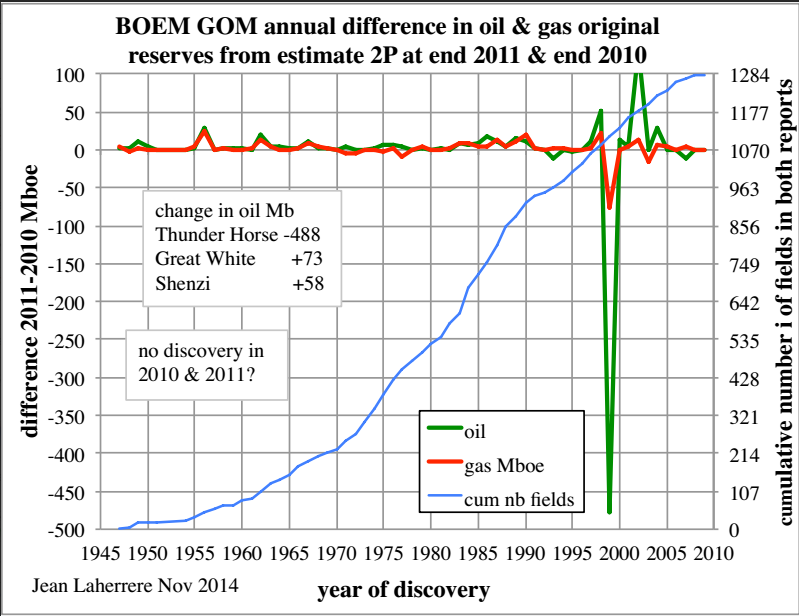
The difference between original reserves estimates from previous year found little difference for discoveries before 1995
The difference between 2P 2011 and 2P 2010 is a very large decrease for Thunder Horse (-488 Mb or 573 Mboe) and the largest increase is Great White +73 Mb
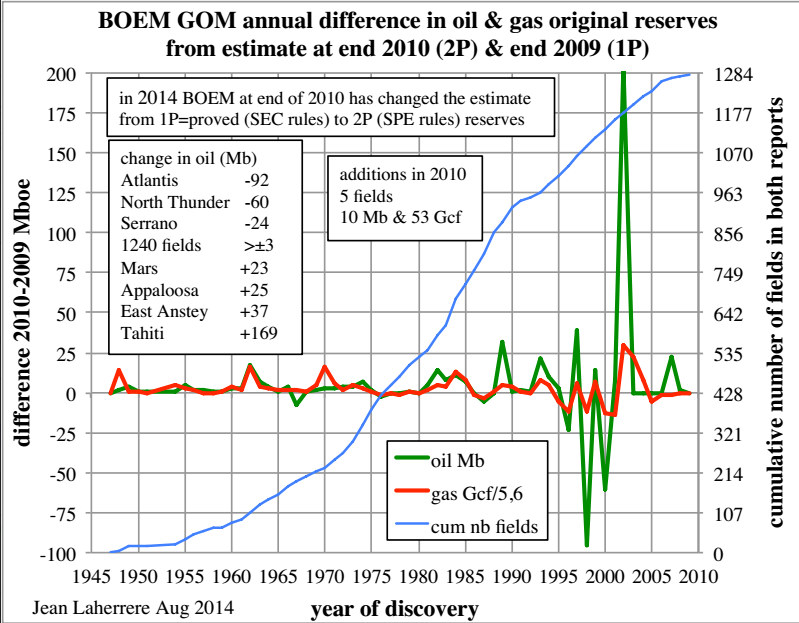
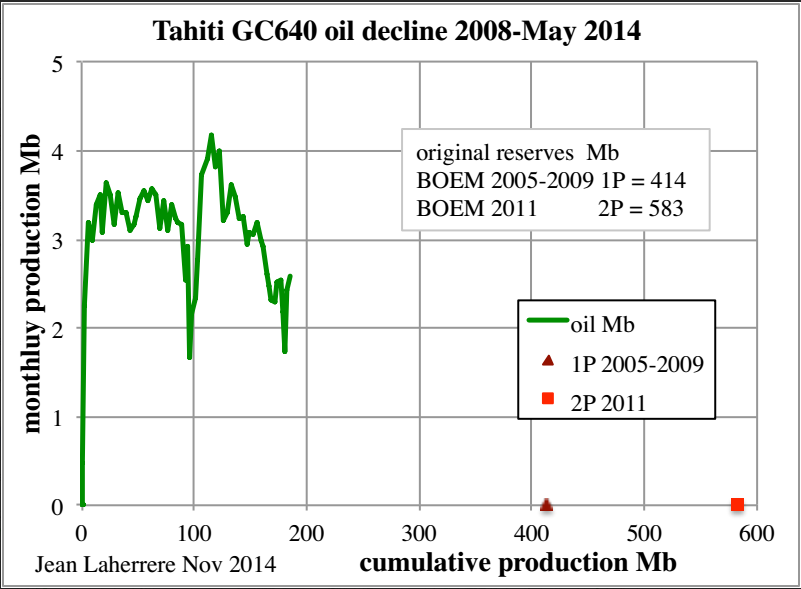
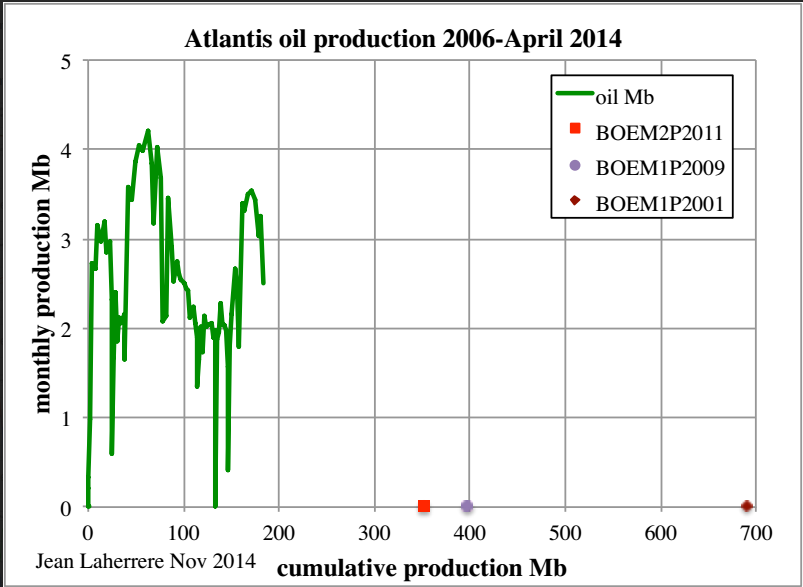
The difference between 2P 2010 and 1P 2009 displays a large increase in Tahiti +169 Gb and large decrease with Atlantis -92 Mb (already in decrease in 2009)
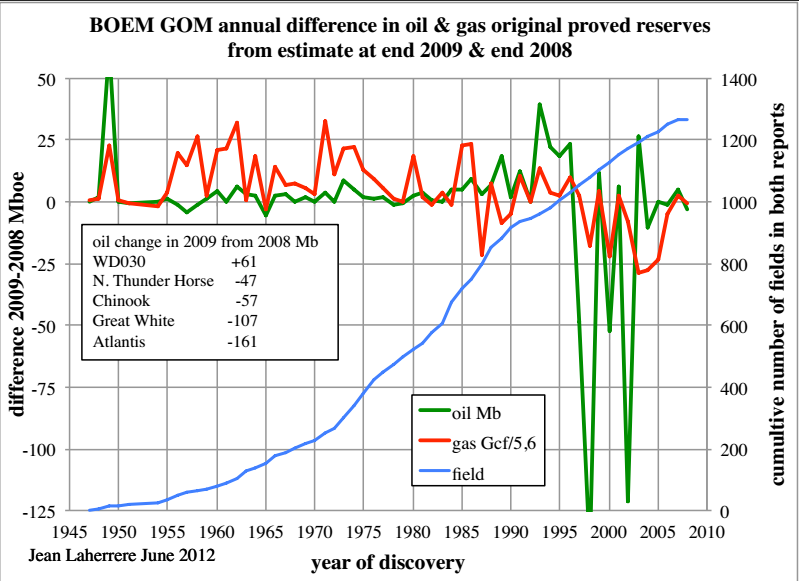
The difference between 1P 2009 and 1P 2008 is as important as the difference between 2P and 1P: large increase with WD 030 +61 Mb and large decrease for Atalntis -161 Mb
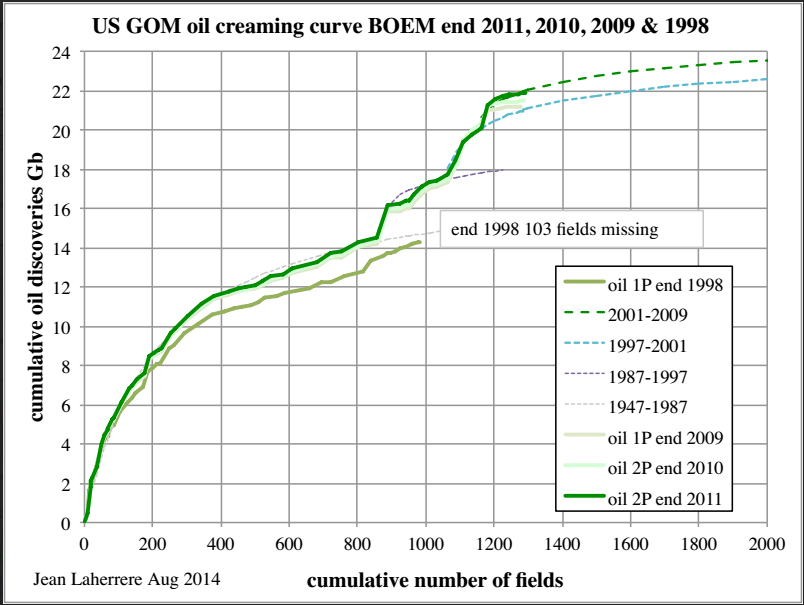
The change in reserves with time and definitions does not change the estimate on GOM ultimates: 24 Gb and 210 Tcf
The modelling for oil is complex because the subsalt and needs 4 cycles, meaning that a fifth one is difficult to guess
The modelling for natural gas is easier with only 3 cycles and one cycle model could be as good.
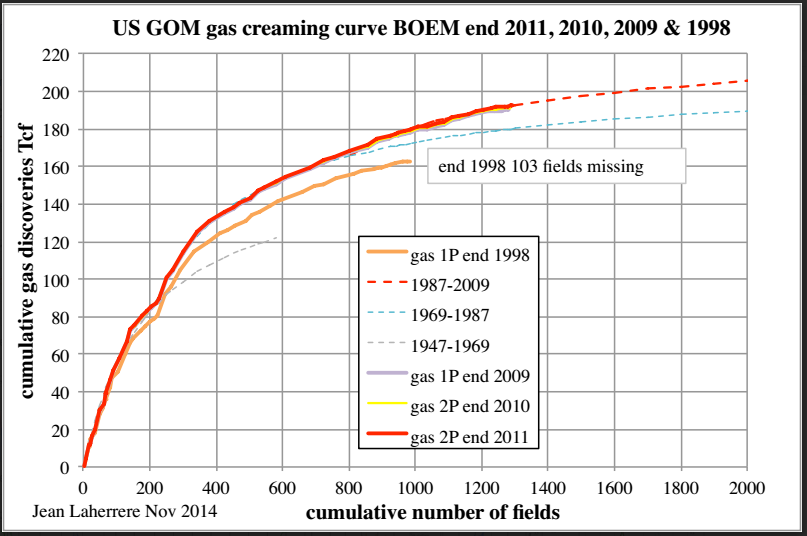
The increase from 1998 values comes mainly because these government agencies, selling leases to the oil companies, are unable to properly register the number of fields: about 10% missing!
The number of fields at end of 1998 was 984 in the 1998 study (14,3 Gb & 163 Tcf) when it is now in the 2011 study 1087 fields (18,5 Gb & 184 Tcf): 103 fields missing representing about 4 Gb & 20 Tcf: poor reporting!
But the last 2014 report at end of 2011 does not report any discoveries in 2010 and 2011, when it is known that Macondo (200 Mb) found in 2010 (with 6 other discoveries, in particular Appotattox (220 Mb) did produced some undesirable oil during the blow out. These reports are unfortunetly incomplete. Governments are unable to gather in time reports from operators and several years are needed to get them corrected.
The plot of oil production of the changing fields (p most in deepwater) shows large varitions, meaning that the estimate of reserves in frontier area (subsalt) is difficult
-Tahiti rank 7 deepwater 4320′ subsalt found in 2002: 414 Mb in 2009, 583 Mb in 2011
-Atlantis rank 14 deepwater 6285′ subsalt found in 1998: 689 Mb in 2001, 398 Mb in 2009, 352 Mb in 2011
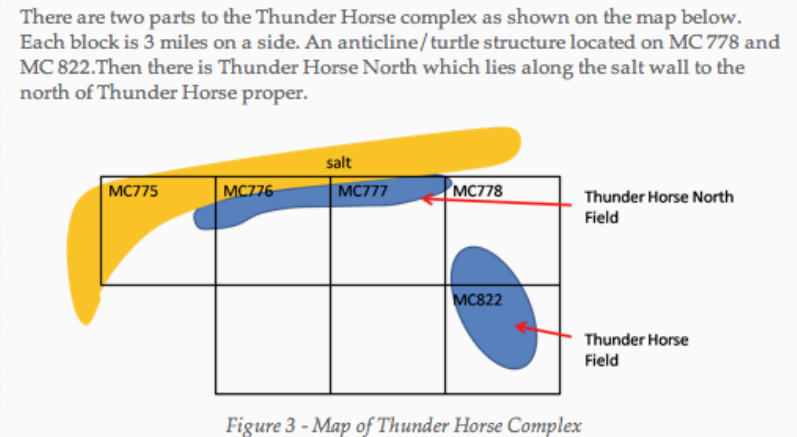
-Thunder Horse (formerly Crazy Horse) MC 778 rank 2 in 2010, rank 41 in 2011 deepwater 6078′ found in 1999 by BP which produced the field with the largest semisubmersible platform as also North Thunder Horse MC 776 deepwater 5668′ found in 2000
BOEM & BSEE reports complete monthly production per lease
BOEM Deepwater Natural Gas and Oil Qualified Fields
but the oil reserves are reported by field.
field lease area block water ‘ operator code discovery
N.Thunder Horse G09866 MC 776 5,668 BP MC776 2000
N.Thunder Horse G09867 MC 777 5,668 BP MC776 2000
N.Thunder Horse G09868 MC 778 5,668 BP MC776 2000
N.Thunder Horse G19997 MC 775 5,668 BP MC776 2000
N.Thunder Horse G21778 MC 734 5,668 Murphy MC776 2000
N.Thunder Horse G27312 MC 819 5,668 Murphy MC776 2000
Thunder Horse G09868 MC 778 6,077 BP MC778 1999
Thunder Horse G14657 MC 821 6,077 BP MC778 1999
Thunder Horse G14658 MC 822 6,077 BP MC778 1999
Unfortunatley lease G09868 belongs both to MC 766 and MC 778.
So to get the data by field it is neccessary to go from each annual report giving the monthly production per field and per lease.
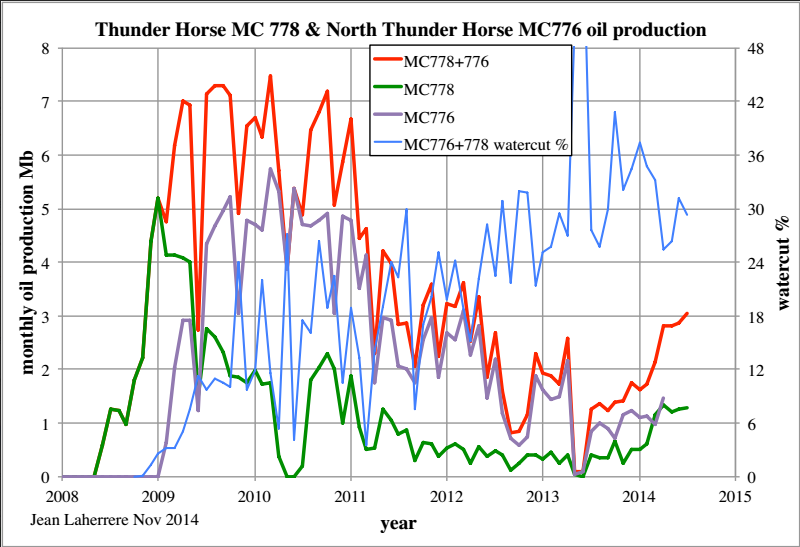
MC 778 (in green) peaked in 2009 and declined sharply and was stopped during Macondi blow out, resume decline, but increases since February 2014.
MC 776 (in purple) peaked in 2010 higher and declined since rather chaotically.
Both fields (in red) dispolays a bumpy plateau in 2009 and 2010, a sharp decline and a new increase in 2014.
The watercut of the combined fields has u increased slowly and in 2014 is about 30% which is much less than most of GOM fields when in decline. Watercut is not the problem of deepwater fields.
From 2011 reserve report, the next graph shows the oil original estimate since 1999 for both fields, the rank and the cumulative production (up to 2013 from above graphs)
Thunder Horse (MC778) was in 2001 reported as the second largest field in the GOM, was still second in 2010 but in 2011 its rank fell down to 41
Thunder Horse North (MC776) was raked at 6 in 2006 and at 17 in 2011.
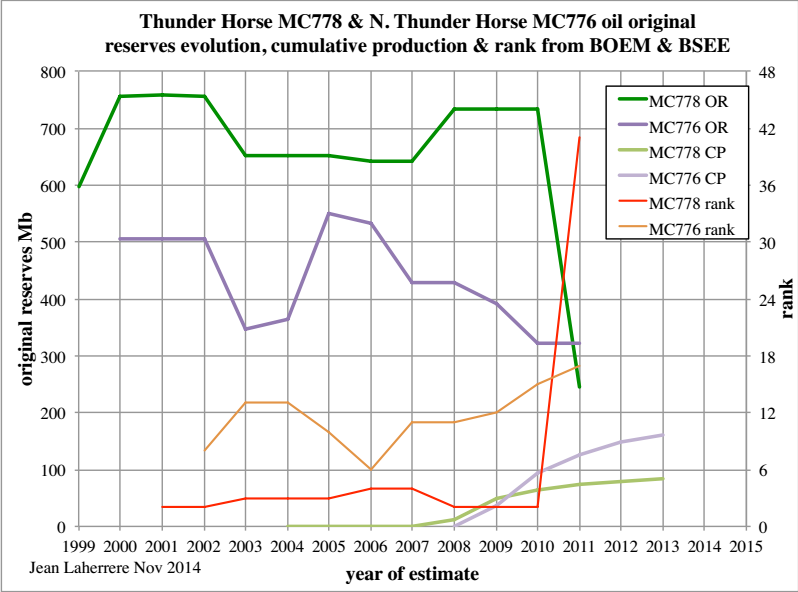
The oil and gas reserves of both fields were 1506 Mboe in 2000, 1227 in 2010 and 651 Mboe in 2011: divided by half.
And I guess that the fall can continuei
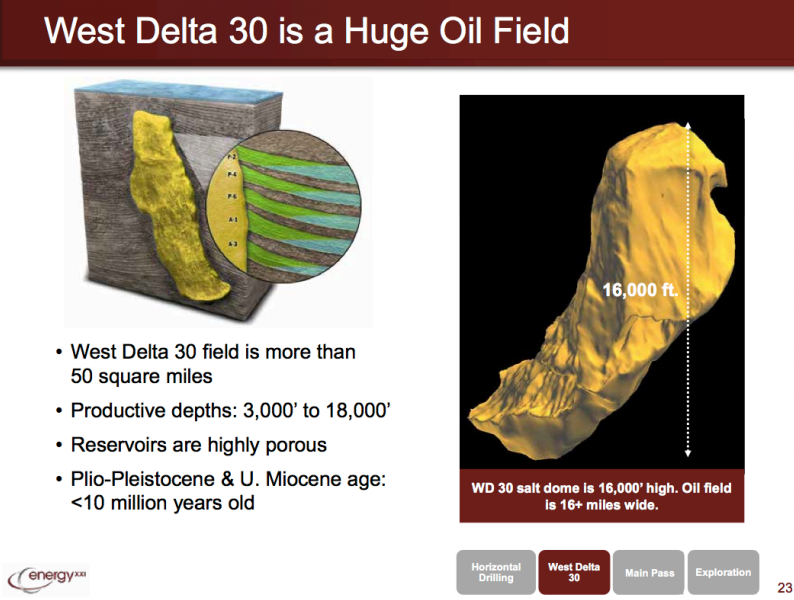
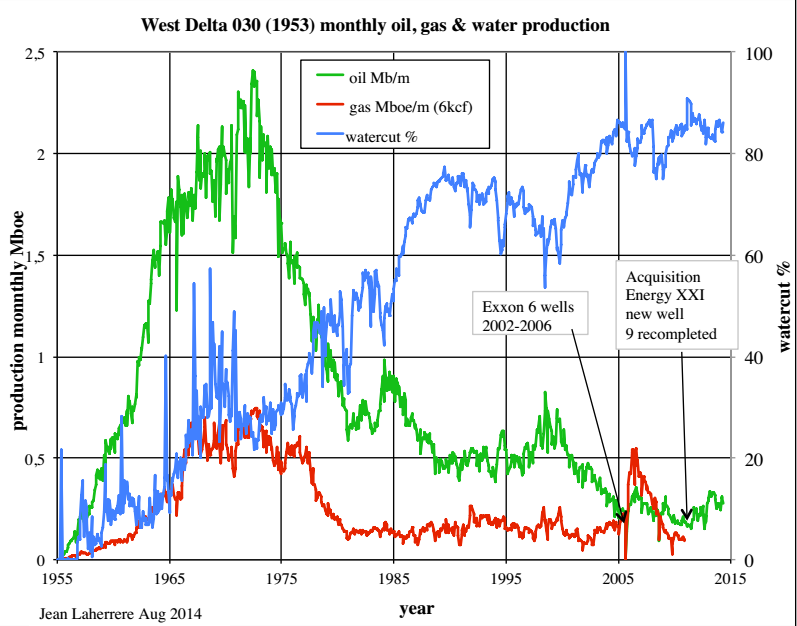
-West Delta 030 shallow water (49′) found in 1953
The fields has many reservoirs against a salt wall over a depth of 16 000 ft: see Energy XXI slide.
WD 030 peaked in 1973 and declined with bumps, in 2002-2006 the operator Exxon drilled 6 wells, small increase, mainly gas and in 2010 sold the field and 8 other fields to Energy XXI for 1 G$.
Energy XXI has drilled a new well and 9 wells were recompleted. The result is a small increase. Watercut stays around 85%.
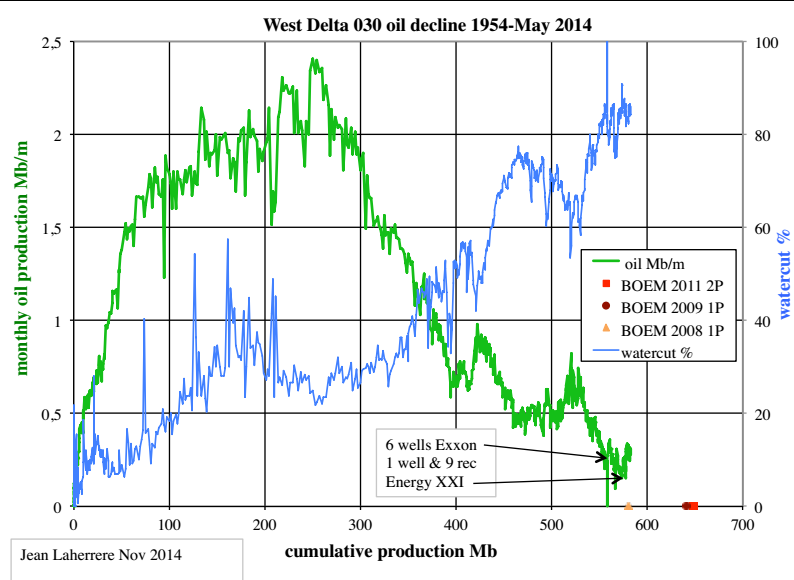
The monthly oil production plot against cumulative discovery shwos that the original reserves went from 580 Mb 1P in 2008 to 641 Mb 1P in 2009 and 648 Mb 2P in 2011
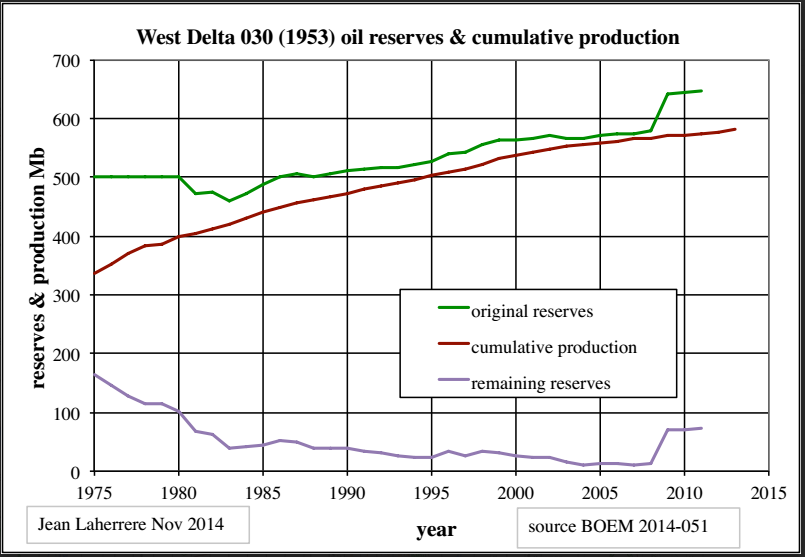
The plot of the 1P reserves and cumulative production displays the usual increase of proved reserves with production and also with oil price. The last increase will take a long time to be produced.
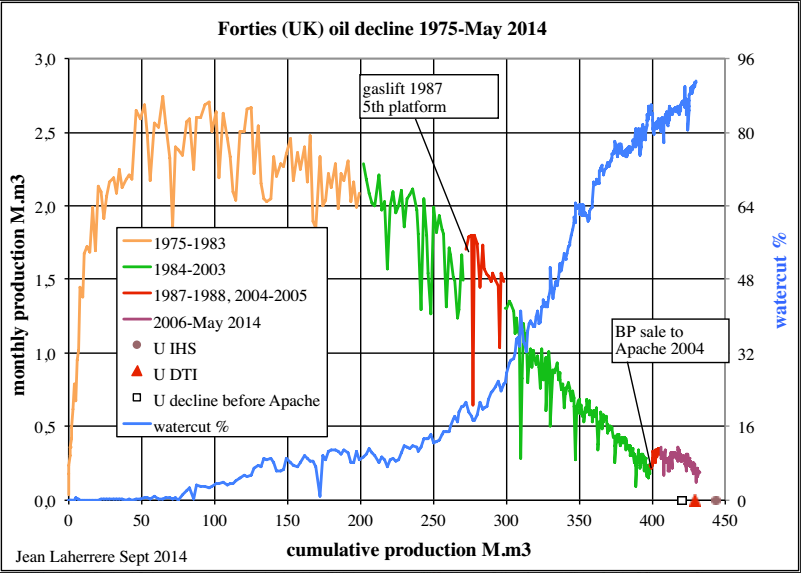
This small increase, which can be described as EOR done by a small operator which has smaller operating costs than a major and can affords more drilling.
It remind the small increase in the North Sea UK Forties field sold by BP to Apache in 2004.
In conclusion it appears that the deepwater fields were overestimated, BOEM/BSEE are correcting theirs estimates.
In the world there was no giant discovery in 2013, the first time since 1903 and in the GOM the largest deepwater discovery was divided by half losing the volume of a giant field!
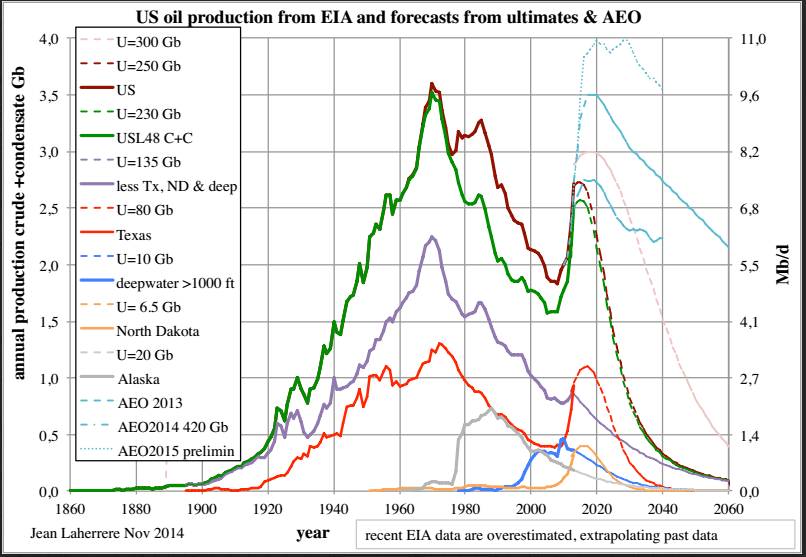
My last forecast on the US oil production is far from the last preliminary AEO 2015 and also from the official AEO 2014 which extrapolated needs an US ultimate over 400 Gb, when my guess is between 250 (adding the different estimates) and 300 Gb (global guess to take care of unknowns)
rockman on Mon, 17th Nov 2014 6:58 pm
“Energy XXI has drilled a new well and 9 wells were recompleted. The result is a small increase. Water cut stays around 85%.” First, with a 2015 budget of $875 million, I’m not sure I would classify them as a “small operator”. They are one of the largest players in the Gulf Coast Basin. They just don’t put out much PR so they aren’t very familiar outside the oil patch. Another indication of their aggressive nature: 6 months ago I review an exploratory well which they were looking for a partner. The plan: spend $15 million to shoot 3d seismic and then spud the well in about two years. The dry hole cost of drilling: $100 million and then add another $80 million to complete it. This is just one well. And it won’t be drilled in 5000’+ of water in the Deep Water trend: in will be drilled to 30,000′ in 10′ of water in a bayou in onshore La. This is not a well that would be drilled by a “small operator”. LOL.
And the wells they are drilling in WD 30…they aren’t exploration wells finding new reservoirs. They are drilling horizontal wells in reservoirs that have been producing since the field was first discovered. Offshore wells are spaced much wider apart then onshore wells due to the logistics. The new wells are recovering reserves that weren’t swept by the original vertical wells. These wells were much more expensive then the vertical wells XOM drilled and much more complicated engineering. The high water cut is to be expected since the original completions did pull the water level up. While they my produce 85% water they are initially testing 2000+ bopd. But this also means their operating costs are significantly higher then when XOM operated the field.
BTW I’m very familiar with the hz completion technology they are using: I’m using the identical technique to recover residual oil from a 68 year old onshore oil field in Texas. Other companies gave tried it on trend and all were economic failures. They failed because they didn’t use the expensive completion tech that Energy XXI and the Rockman are using. As far as I can tell my company is the first to make this application work commercially onshore. How commercial remains to be seen: we are still in the pilot project phase.
But it is fair to classify these WD 30 wells as “new reserves” since they would have not been recovered by the old wells. About 2 years ago the Prez of Energy XXI made what I consider a shocking statement from a US oil pubco: by their analysis there wasn’t enough undiscovered oil left in the country to satisfy their business plan let alone that of the entire industry. So they were going to focus a significant part of the budget going after offshore residual oil in old fields. And put their balls on the line by paying XOM $1 BILLION for a group of old fields that had little or no exploration potential.
Northwest Resident on Mon, 17th Nov 2014 7:33 pm
rockman: “…there wasn’t enough undiscovered oil left in the country to satisfy their business plan let alone that of the entire industry.”
That *was* a really amazing thing for the president of Energy XXI to say. Accidentally letting the truth slip? Or did he say it on purpose?
I read all of the articles and comments over at Ron’s site. I often wonder why you don’t post there, rockman. Not that you have to say why — just curious.
rockman on Mon, 17th Nov 2014 9:44 pm
NR – I don’t have it at home: it wasn’t a slip…it was in an official press release. But I did stumble across this stat about this “small operator”: Energy XXI and EPL Oil & Gas today announced the signing of a definitive merger agreement. As a result of the merger, Energy XXI will become the largest public independent producer on the Gulf of Mexico shelf.
I tried posting over there and it’s fine site. But I’m always posting on the fly. Believe or not I work about 60 to 70 hours a week and I can follow only so many chats.
Northwest Resident on Tue, 18th Nov 2014 1:16 am
rockman — Got it. Wow — that’s a lot of hours.
It looks like the president of Energy XXI isn’t the only industry insider to be telling some damning truth about the state of oil exploration and development in America. Over on another article I posted a link to a NY Times investigative article that puts on display internal oil industry emails, reports and other documents that pretty much paint a picture of an industry that knows things aren’t going well at all. Lots of internal communications between geologists and financial analysts expressing their doubts about the viability of shale plays, questioning Wall Street hype and shale operator claims. Interesting stuff.
In case you’re interested:
http://www.nytimes.com/interactive/us/natural-gas-drilling-down-documents-4.html?_r=0#document/p2
rockman on Tue, 18th Nov 2014 6:41 am
NR – It’s not like the pressure inside the oil patch isn’t revisited almost gaily. I’ve seen many staff/managers blasted and even fired for not bring enough new reserves to the books. And that started decades ago. Right now all the service company reps that visit me weekly are very concerned about their future. While operators will hold fairly static during a price/activity dip for a while. The service companies OTOH can react almost overnight. I guarantee you that every service company out there has generated it first tier list of layoffs that will take effect when their activity reaches X. A probably then a few already have ideas about the second tier list. And it won’t be an announcement about 10 or 20 being cut loose. Last time we hit a bump in the road about 6 or 7 years ago layoffs of several thousands were announced by some companies in a single day.
Thanks but couldn’t get the Times without registering. I don’t put my company’s IP addy out there for such folks.
I’ve been working those hours for the last 5 years because I knew it was going to be a race until the next slump and had to bank as much as possible before then. As I’ve said this ain’t my first rodeo. LOL. There is nothing more predictable in the oil patch as the bust that follows every boom. It’s only a question of when.
Boat on Tue, 18th Nov 2014 7:22 am
My last 5 paychecks for 2 weeks of work were over 120 hrs. the most hrs for a check was 138. Yep us lazy Americans are the worlds problem we should learn to sit around more.
rockman on Tue, 18th Nov 2014 11:55 am
Boat – After the bust in the 80’s I never complained about having too much work. Filing bankruptcy and getting unemployment checks will do that to you. LOL.