
Peak Oil is You

Donate Bitcoins ;-) or Paypal :-)


Page added on September 15, 2011

Goldman Predicts US As Top Oil Producer In 2017

On Sunday, September 11, 2011, Goldman Sachs (GS) predicted that the United States will become the world’s largest oil-producing country. This astonishing production increase is accomplished by changing the definition of oil and by using optimistic projections of liquids-rich shale production.
The investment bank claims that U.S. daily production will increase from 8.3 to 10.9 million barrels of oil per day (Mbopd) by 2017. This would surpass Russia and Saudi Arabia according to press reports. While these reports did not mention that Saudi Arabia claims it can produce as much as 12 Mbopd, they did state that Russia would not increase its current production of 10.7 Mbopd by more than 100,000 bopd by 2017. It is curious that the GS announcement was apparently not carried by any of the major business- or energy-oriented journals (Bloomberg, Wall Street Journal, Oil & Gas Journal, etc.) nor was it featured on the GS website.
It is unclear how GS arrived at 8.3 Mbopd*. According to the Energy Information Agency (EIA), daily U.S. production in June 2011 was 5.6 Mbopd (Exhibit 1). I assume that GS incorrectly included natural gas liquids (NGL) and liquefied refinery gases (LRG) as oil, but that only gets us to 7.8 Mbopd. It is possible that GS also included, even more incorrectly, some fraction of biofuels as oil to arrive at 8.3 Mbopd.

Exhibit 1. U.S. Crude Oil, Natural Gas Liquids, Liquefied Refinery Gases, and Other Liquids Production June, 2011. Data from EIA.
NGL and LRG are not crude oil. These result from processing impurities and various non-methane hydrocarbons and fluids to produce what is known as ‘pipeline quality’ dry natural gas. These liquids and liquefied gases include ethane, propane, butane, pentane, and certain condensates that do not naturally separate from crude oil. They contain approximately 60-70% of the heating content of oil so a barrel of NGL/LRG is not comparable to a barrel of oil. In fact, ethane, the largest component of NGL, is not even a fuel and is used primarily to make plastic.
U.S. crude oil production growth will come principally from the Bakken Shale in North Dakota and Montana, and from the resource plays of the Permian basin in West Texas and New Mexico. Bakken-Three Forks production has reached about 400,000 bopd and some believe it could eventually exceed 1 Mbopd. Most of the renewed activity in the Permian basin is from shale and low permeability limestone reservoirs. Permian production has increased from a low of 841,000 bopd in 2004 by 100,000 bopd in 2010.
Early Eagle Ford production estimates in South Texas are as high as 750,000 bopd of liquids that include both condensate and NGL (Bernstein Research, August 24, 2011). Condensate, like NGL, is not crude oil although it can be used as a fuel. While there is great enthusiasm and hope for the Eagle Ford Shale, it is a very new play and there is insufficient production history in the liquid portion of the play to confidently estimate reserves. It seems highly speculative to extrapolate from current rates of about 14,000 to 750,000 bopd by 2015.
I assume that most of the remainder of the increased future production in the GS announcement comes from NGL in the Marcellus Shale in Pennsylvania, New York and West Virginia. This is another play that is in an early stage of development and has similar uncertainties as were described for the Eagle Ford Shale. Underscoring this uncertainty, in late August, the U.S. Geological Survey (USGS) downgraded the Marcellus Shale technically recoverable resources by 80% from EIA estimates earlier this year.
Some will undoubtedly interpret the Goldman announcement to mean that energy concerns for the U.S. are over and that, as the biggest oil producer in the world, we will no longer depend on foreign oil. The most optimistic increase in oil production will mean that the U.S. still will have to import more than half of our oil based on present consumption levels.

Exhibit 2. U.S. Crude Oil Production 1950-Present. Data from EIA. 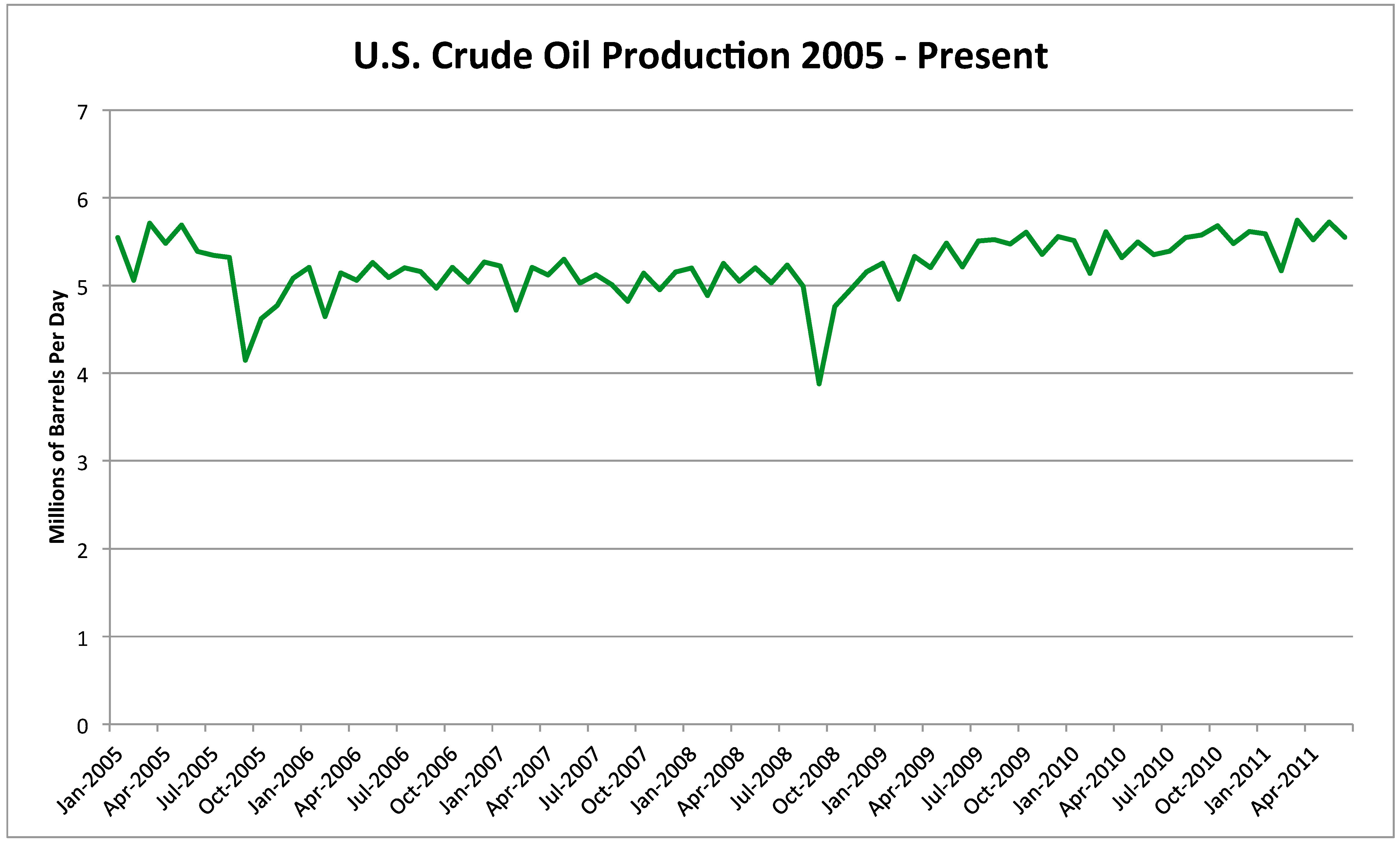
Exhibit 3. U.S. Crude Oil Production 2005-Present. Data from EIA.
It is likely that the public will not understand that the production increase will come only by drilling tens of thousands of wells that will produce at very low rates after the first year. That means that the oil will likely be expensive and will not provide consumers with relief from high oil prices. The good news is that the U.S. will be sending fewer dollars out of the country and the drilling and producing activity will be good for jobs.
*The Oil Drum contacted GS and requested the report or a summary of it but have not received anything so far.
2 Comments on "Goldman Predicts US As Top Oil Producer In 2017"
James A. Hellams on Thu, 15th Sep 2011 10:34 pm
This article gives a false sense that all is well. In fact, all is not well.
First, the present US consumption is 20 million barrels per day. We will still need to import nearly half of our oil from foreign sources.
Second, this article ignores the dynamics of worldwide oil production.
As the production of other countries continues to fall, these countries will come to the US to make up the loss of their production. This will not be possible for us to make up; when we can NOT even totally supply our own needs!
Thus, this will NOT avert the disaster of peak oil to come.
It is high time to quit the drill-our-way-out mentality, that will NOT work; and will serve only to sharply increase the pain and suffering that will come with the onslaught of peak oil. We NEED to prepare for peak oil NOW; by beginning to take the drastic conservation measures we need to make!
BillT on Fri, 16th Sep 2011 6:18 am
Is this the same Goldman Sachs that is screwing the US in other ways? There is no way that the US can ever produce anywhere near enough oil to even stay even with today’s demands. Growth is out of the question. Contraction is the order of the day and every day to come. As other countries realize that their own supplies are almost gone, they will stop exporting oil or gas. I think that will happen before 2020. THEN we are going to really feel the pain.