
Peak Oil is You

Donate Bitcoins ;-) or Paypal :-)


Page added on June 10, 2013

Future oil production in Canada

The Canadian Association of Petroleum Producers (CAPP) has just released a report ”Crude Oil – Forecast, Markets & Transportation”. In 2007 we wrote our article on production from the Canadian oil sands titled, “A crash program scenario for the Canadian oil sands industry” and since then I have followed developments in Canada. Therefore, it was with great interest that I downloaded CAPP’s report. Before we study the report in more detail, we should note the disclaimer on the first page, “This publication was prepared by the Canadian Association of Petroleum Producers (CAPP). While it is believed that the information contained herein is reliable under the conditions and subject to the limitations set out, CAPP does not guarantee the accuracy or completeness of the information. The use of this report or any information contained will be at the user’s sole risk, regardless of any fault or negligence of CAPP.”
The first thing that strikes me is that, under the descriptor “crude oil” CAPP discusses all oil types. We are so used to the price of oil (e.g. WTI or Brent) usually being described as the “crude oil price” that many regard conventional oil as “crude oil”. (http://www.oil-price.net/) However, if one searches for a definition of “crude oil” then one can find the following, “Crude oil is a mixture of naturally occurring hydrocarbons that is found in geologic formations, such as rock strata and can be refined into diesel, gasoline, heating oil, jet fuel, kerosene, and literally thousands of other products called petrochemicals. Crude oils are named according to their contents and origins, and classified according to their per unit weight (specific gravity). Heavier crudes yield more heat upon burning, but have lower API gravity and market price in comparison to light (or sweet) crudes.”
The fact that different forms of crude oil can require completely different methods of extraction with markedly different production costs makes it all the more important to know what type of crude oil one is discussing. Recently I listened to a lecture during which it was mentioned that there are 300 different types of oil and that the price of these different oils was set, primarily, relative to WTI and Brent. What is of interest for our future is the production flows of each of these different oil types since, ultimately, it is these flow rates that determine how much gasoline, aviation fuel and diesel will be available for future transport. Now let us return to Canada’s future:
The key points of this year’s outlook are:
• Canadian oil production continues to grow and although oil sands remains the largest component of growth, the resurgence of conventional crude oil production represents the largest year over year change to the previous forecast. This resurgence in conventional tight oil is occurring both in Canada and the U.S., enabling greater continental energy security and changing the historical flows throughout North America.
• The main market opportunities occur in the replacement of offshore foreign crude imports in Canada and the United States and in the potential for exports beyond North America.
• Transportation capacity is currently tight and in addition to new pipeline options coming forward, rail has quickly become another way to move oil to market.
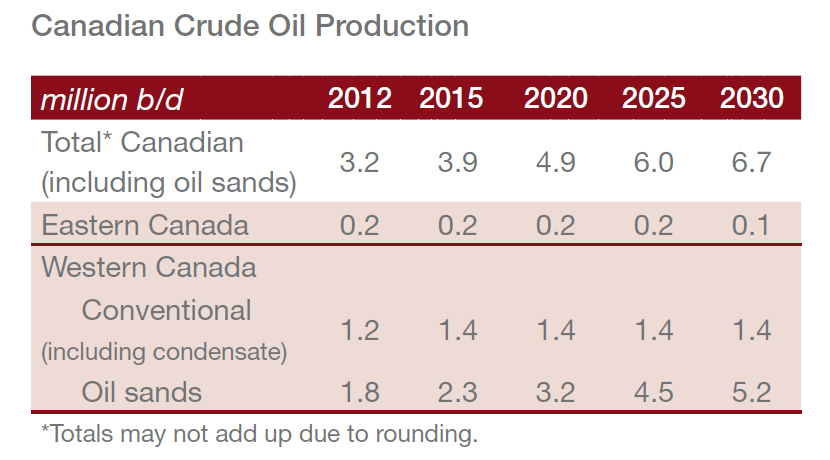
The production volumes that they discuss are given in the table below and shown in the figure. The volume of oil production from the oil sands that we predicted for 2030 was 4.8 million barrels per day (Mb/d) which can be compared with 5.2 Mb/d in the CAPP report. As you can see in the figure, the higher volume is not projected today. Another problem is that, today, there is not sufficient refinery capacity for the higher production volume. It is worth noting that the possible increase during 18 years to 2030 is less than the yearly decrease in global production from existing oilfields.

In the Oil&Gas Journal there is a summary of the CAPP report. Regarding “Market and Transportation” I will cite this from the OGJ article:
CAPP notes the need to reach new markets is “a top priority for Canadian oil producers.”
Refineries in Quebec and the Atlantic provinces now import 86% of their feedstock and could absorb 700,000 b/d of Canadian oil, the group said. Refineries in Ontario have switched to domestic supplies, which now account for more than 90% of their feedstock.
Canadian oil can displace some of the 2.2 million b/d of imported heavy oil now processed in high-conversion refineries on the US Gulf Coast. CAPP forecasts Canadian oil reaching that market will rise to 1.1 million b/d by 2020 from 100,000 b/d at present.
Completion of conversion projects in Midwestern refineries will increase deliveries of Canadian oil, much of it heavy, to that region by 460,000 b/d by 2020. The Midwest currently receives 1.7 million b/d of Canadian oil.
High-conversion refineries in Washington and California also might become buyers of new volumes of Canadian oil as supplies of heavy feedstock from traditional sources decline.
China and India, to which Canadian oil now has limited access, also could become important markets. CAPP cites a US Energy Information Administration forecast that oil imports of the two countries combined will increase to 15.7 million b/d by 2030 from 9.2 million b/d by 2012.
CAPP says its outlook depends on growth in transportation capacity sufficient to accommodate the projected increase in supply. Although capacity is “currently tight,” it says, no production has been shut in for lack of transportation.
“Protracted approval processes for new pipeline projects are resulting in a variety of creative transportation proposals to access markets,” it says.
7 Comments on "Future oil production in Canada"
rollin on Mon, 10th Jun 2013 1:12 am
3 million bpd gain over 27 years would offset some of the losses that will be seen in other areas. The big factor is demand increase in that time period. Assuming a BAU scenario, another billion people in the world and especially another half billion or more drivers in Asia would bring demand to a high point, while internal use would continue to erode exports.
Without drastic efficiency changes and substitution of other energy sources for transportation, the result would be extreme pricing on the global market or a breakdown of the global market.
I would say that any predictions of oil production and price past 2020 are simply guesses.
TIKIMAN on Mon, 10th Jun 2013 1:39 am
Almost 7 million barrels a day by 2030?
HA! What a load of SHIT!
BillT on Mon, 10th Jun 2013 3:19 am
rollin, I think 2020 may be stretching it a bit, but you may be correct. We read about all of the future predictions when no one can even say if the world will be at war by Christmas. Certainly no one has any idea what 2020 will really be like. Or even if we will be here to see it. After all, it only took days for an asteroid to take out most life on earth 65 million years ago.
But this time, I think it will be homo sapiens that takes out all life over maybe 100 years or less. With the world getting closer to the edge of collapse, those thousands of nukes are looking more and more like the answer. If they come out, life on earth is finished for the next 200,000,000 years.
DC on Mon, 10th Jun 2013 3:46 am
CAPP=Canadian Association of Petroleum Propagandists. You cant turn on the TV these days without seeing there slick HD tv spots pimping the tar-sands. Funny, in those adds, all you see are actors with perfect teeth standing on green fields and immaculately pressed clothing, not a spec of oil on any of those actors!, holding onto beakers of clear water. They talk about how awesome the tar-sands is and how ‘responsible’ the US controlled tar-sands operators are. Sadly, false advertising and lying is not illegal in Canada according to CRTC regulations, well, when your an amerikan oil corporation its not anyhow.
Strangely, you never see the duck kills, the tailings ponds, or the oil slicks, or the people with rare cancers in Northern Alberta. You dont see the vast areas that look something out of a post-apoc sci-fi movie. Even stranger still, I have yet to see one TV spot by environmental groups, or any group period opposed to the tar-sands telling their side of the story(the truth). Ive been thinking of calling the CRTC and asking them why that is.
Luke on Mon, 10th Jun 2013 9:53 am
Nothing is said about the EROI which is nowadays 1 to 25 barrels for conventional oil, but 1 to 3-5 barrels for tar sands/shale unconventional) oil. Only the current high oil price (>$100 Brent) keeps this show going on for a while.
Cheap oil did sustain western economic “growth” for decades, but that popular fetish word “growth” for politians and their election opportunities slow by slow has been evaporated!
Don’t let us take in by Big Oil, their capitalist shareholders and the opportunistic press releases!
Keith_McClary on Tue, 11th Jun 2013 2:09 am
DC wrote:
“You cant turn on the TV these days without seeing there slick HD tv spots pimping the tar-sands. Funny, in those adds, all you see are actors with perfect teeth standing on green fields and immaculately pressed clothing, not a spec of oil on any of those actors!, holding onto beakers of clear water.”
Did you see the one with the lady engineer (actress??) saying the gunk in the settling ponds is like yoghurt?
DC on Tue, 11th Jun 2013 8:10 pm
No, I didnt that particular one, they pulled it pretty fast I understand
http://www.desmogblog.com/advertising-standards-council-finds-tar-sands-tasty