
Peak Oil is You

Donate Bitcoins ;-) or Paypal :-)


Page added on June 29, 2013

Energy Products: Return on Investment is Already Too Low
My major point when I gave my talk at the Fifth Biophysical Economics Conference at the University of Vermont was that our economy’s overall energy return on investment is already too low to maintain the economic system we are accustomed to. That is why the economy is showing signs of heading toward financial collapse. Both a PDF of my presentation and a podcast of the talk are available on Our Finite World, on a new page called Presentations/Podcasts.
My analysis is with respect to the feasibility of keeping our current economic system operating. It seems to me that the problems we are experiencing today–governments with inadequate funding, low economic growth, a financial system that cannot operate with “normal” interest rates, and stagnant to falling wages–are precisely the kinds of effects we might expect, if energy sources are providing an inadequate energy return for today’s economy.
Commenters frequently remark that such-and-such an energy source has an Energy Return on Energy Invested (EROI) ratio of greater than 5:1, so must be a helpful addition to our current energy supply. My finding that the overall energy return is already too low seems to run counter to this belief. In this post, I will try to explain why this difference occurs. Part of the difference is that I am looking at what our current economy requires, not some theoretical low-level economy. Also, I don’t think that it is really feasible to create a new economic system, based on lower EROI resources, because today’s renewables are fossil-fuel based, and initially tend to add to fossil fuel use.
Adequate Return for All Elements Required for Energy Investment
In order to extract oil or create biofuels, or to make any other type of energy investment, at least four distinct elements described in Figure 1: (1) adequate payback on energy invested, (2) sufficient wages for humans, (3) sufficient credit availability and (4) sufficient funds for government services. If any of these is lacking, the whole system has a tendency to seize up.

Figure 1. One sheet from Biophysical Economics Conference Presentation
EROI analyses tend to look primarily at the first item on the list, comparing “energy available to society” as the result of a given process to “energy required for extraction” (all in units of energy). While this comparison can be helpful for some purposes, it seems to me that we should also be looking at whether the dollars collected at the end-product level are sufficient to provide an adequate financial return to meet the financial needs of all four areas simultaneously.
My list of the four distinct elements necessary to enable energy extraction and to keep the economy functioning is really an abbreviated list. Clearly one needs other items, such as profits for businesses. In a sense, the whole world economy is an energy delivery system. This is why it is important to understand what the system needs to function properly.
What Happens as Oil Prices Rise
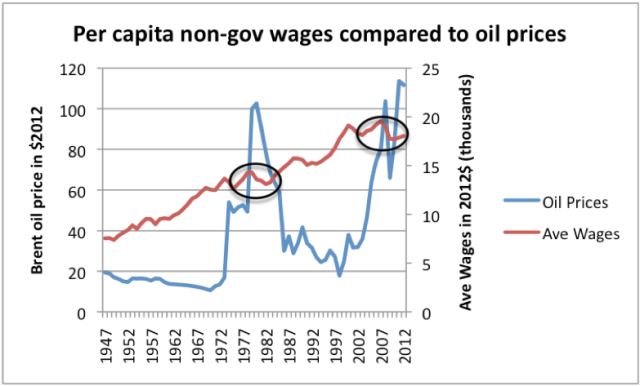
When oil prices rise, wages for humans seem to fall, or at least stagnate (Figure 2, below). The comparison shown uses per capita wages, so takes into account changes in the proportion of people with jobs as well as the level of wages.
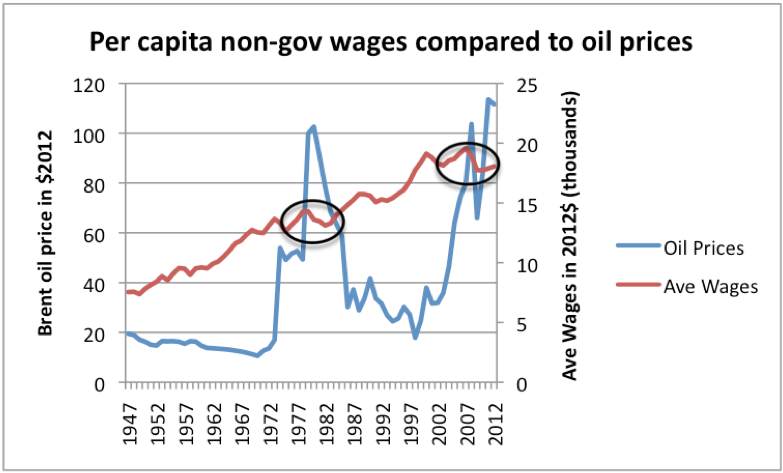
Figure 2. High oil prices are associated with depressed wages. Oil price through 2011 from BP’s 2012 Statistical Review of World Energy, updated to 2012 using EIA data and CPI-Urban from BLS. Average wages calculated by dividing Private Industry wages from US BEA Table 2.1 by US population, and bringing to 2012 cost level using CPI-Urban.
In fact, if we analyze Figure 2, we see that virtually all of the rise in US wages came in periods when oil prices were below $30 per barrel, in inflation-adjusted terms. The reason why this happens is related to the drop in corporate profits that can be expected if oil prices rise, and businesses fail to respond. Let me explain this further with Figure 3, below.

Figure 3. Illustration by author of ways oil price rise could squeeze wages. Amounts illustrative, not based on averages.
Figure 3 is a bit complicated. What happens initially when oil prices rise, is illustrated in the black box at the left. What happens is that the business’ profits fall, because oil is used as one of the inputs used in manufacturing and transportation. If the cost of oil rises and the sales price of the product remains unchanged, the company’s profits are likely to fall. Additionally, there may be some reduction in demand for the product, because the discretionary income of consumers is reduced because of rising oil prices. Clearly, the business will want to fix its business model, so that it can again make an adequate profit.
There are three ways that a business can bring its profits back to a satisfactory level, illustrated in the last three columns of Figure 3. They are
- Automation. Human energy is the most expensive type of energy a business can employ, because wages to paid to humans to do a given process (such as putting a label on a jar) are far higher than the cost of an electricity-based process to perform the same procedure. Thus, if a firm can substitute electrical or oil energy for human energy, its cost of production will be lower, and profits can be improved. Of course, workers will be laid off in the process, reducing total wages paid.
- Outsourcing to a Country with Lower Costs. If part of the production cost can be moved to a country where wage costs are lower, this will reduce the cost of manufacturing the product, and allow the business to offset (partially or fully) the impact of rising oil prices. Of course, this will again lead to less US employment of workers.
- Make a Smaller Batch. If neither of the above options work, another possibility is to cut back production across the board. Even if oil prices rise, there are still some consumers who can afford the higher prices. If a business can cut back in the size of its operations (for example, close unprofitable branches or fly fewer airplanes), it can cut back on outgo of many types: rent, energy products used, and wages. With reduced output, the company may be able to make an adequate profit by selling only to those who can afford the higher price.
In all three instances, an attempt to fix corporate profits leads to a squeeze on human wages–the highest cost source of energy services that there is. This seems to be Nature’s attempt way of rebalancing the system, toward lower-cost energy sources.
If we look at the other elements shown in Figure 1, we see that they have been under pressure recently as well. The availability of credit to fund new energy investment is enabled by profits that are sufficiently high that they can withstand interest charges incurred in the payback of debt. Debt use is also enabled by growth, since if profits will be higher in the future, it makes sense to delay funding until the future. In recent years, central governments have seen a need to put interest rates at artificially low levels, in order to encourage borrowing. To me, this is a sign that the credit portion of the system is also under pressure.
Government’s ability to fund its own needs has been under severe stress as well. Part of the problem comes from the inability of workers to pay adequate taxes, because their wages are lower. Part of the problem comes from a need for governments to pay out more in benefits, such as disability income, unemployment, and food stamps. The part that gets most stressed is the debt portion of government funding. This really represents the intersection of two different areas mentioned in Figure 1: (3) Adequacy of credit availability and (4) Funding for government services.
The constellation of energy problems we are now experiencing seems to me to be precisely what might be expected, if energy return is now, on average, already too low.
The Role of Energy Extraction in this Squeeze
When any energy producer decides to produce energy of a given type (say oil or uranium), the energy producer will look for the resource that can be extracted at lowest cost to the producer.
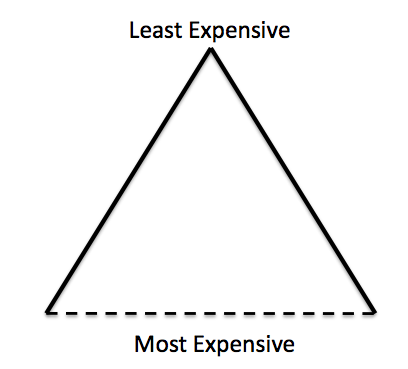
Figure 4. Resource triangle, with dotted line indicating uncertain financial cut-off.
Initially, production starts where costs are most affordable–not much energy is required for extraction; governments involved do not require too high taxes; and the cost of human labor is not too high. The producer may need debt financing, and this must also be available, at an affordable cost.
As the least expensive energy is extracted, later producers wishing to extract energy must often settle for higher cost extraction. In some cases, technology advancements can help bring costs back down again. In others, such as recent oil extraction, the higher costs are firmly in place. Higher sales prices available in the market place enable production “lower in the triangle.” The catch is that these higher oil prices lead to stresses in other systems: human employment, government funding, and ability for credit markets to work normally.
What Is Happening on an Overall Basis
Man has used external energy for a very long time, to raise his standard of living. Man started over 1,000,000 years ago with the burning of biomass, to keep himself warm, to cook food, and for use in hunting. Gradually, man added other sources of energy. All of these sources of energy allowed man to accomplish more in a given day. As a result of these greater accomplishments, man’s standard of living rose–he could have clothes, food which had been cooked, sharper tools, and heat when it was cold.
Over time, man added additional sources of energy, eventually including coal and oil. These additional sources of energy allowed man to leverage his own limited ability to do work, using his own energy. Goods created using external energy tended to be less expensive than those made with only human energy, allowing prices to drop, and wages to go farther. Food became more available and cheaper, allowing population to rise. Money was also available for public health, allowing more babies to live to maturity.
What happened shortly after the year 2000 was a sharp “bend” in the system. Instead of goods becoming increasingly inexpensive, they started becoming relatively more expensive relative to the earnings of the common man. There seem to be two reasons for this: (1) In the early 2000s, oil prices started rising, and these higher prices started exerting an upward force on the price of goods. At the same time, (2) globalization took off, providing downward pressure on wages. The result was that suddenly, workers found it harder to keep a job, and even when they were working, wages were stagnant.
It seems to me that prior to the year 2000, part of what buoyed up the system was the large difference between:
A. The cost of extracting a barrel of oil
B. The value of that barrel of oil to society as a whole, in terms of additional human productivity, and hence additional goods and services that barrel of oil could provide.
As oil prices rose, this difference started disappearing, and its benefit to the world economy started going away. The government became increasingly stressed, trying to provide for the many people without jobs while tax revenue lagged. Slower economic growth made the debt system increasingly fragile. The economy was gradually transformed from one which provided perpetual growth, to one where citizens were becoming poorer and poorer. This pushed the economy in the direction of collapse.
A More Complete List of Inputs that Need Adequate Returns
My original list was
- Energy counted in EROI calculation–mostly fossil fuels, sometimes biomass used as a fuel
- Human labor
- Credit system
- Cost of government
To this we probably need to add:
- Profits for corporations involved in these processes
- Rent for land used in the process – this cost would be highest in biofuel operations.
- Costs to prevent pollution, and mitigate its effects – not charged currently, except as mandated by law
- Compensation for mineral depletion and degradation of soil. Degradation of soil would likely be an issue for biofuels.
- Energy not counted in EROI calculations. This is mostly “free energy” such as solar, wind, and wave energy, but can include energy which is of limited quantity, such as biomass energy.
Given the diversity of items in this list, it is not clear that simply keeping EROI above some specified target such as 5:1 is likely to provide enough “margin” to cover the financial return needed to properly fund all of these elements. Also, because the need for government services tends to increase over time as the system gets more stressed, if there is an EROI threshold, it needs to increase over time.
It might also be noted that the amounts paid for government services are surprisingly high for fossil fuels. Barry Rodgers gave some figures regarding “government take” (including lease fees as well as other taxes and fees) in the May 2013 Oil and Gas Journal. According to his figures, the average government take associated with an $80 barrel of US tight oil is $33.29 per barrel. This compares to capital expenditures of $22.60 a barrel, and operating expenditures of $7.50 a barrel. If we are to leave fossil fuels, we would need to get along without the government services funded by these fees, or we would need to find a different source of government funding.
Source of the EROI 5:1 Threshold
To my knowledge, no one has directly proven that a 5:1 threshold is sufficient for an energy source to be helpful to an economy. The study that is often referred to is the 2009 paper, What is the Minimum EROI that a Sustainable Society Must Have? (Free for download), by Charles A. S. Hall, Steven Balogh, and David Murphy. This paper analyzes how much energy needs to provided by oil and coal, if the energy provided by those fuels is to be sufficient to pay not just for the energy used in its own extraction, but also for the energy required for pipeline and truck or train transportation to its destination of use. The conclusion of that paper was that in order to include these energy transportation costs for oil or coal, an EROI of at least 3:1 was needed.
Clearly this figure is not high enough to cover all costs of using the fuels, including the energy costs to build devices that actually use the fuels, such as private passenger cars, electrical power plants and transmission lines, and devices to use electricity, such as refrigerators. The ratio required would probably need to be higher for harder-to-transport fuels, such as natural gas and ethanol. The ratio would also need to include the energy cost of schools, if there are to be engineers to design all of these devices, and factory workers who can read basic instructions. If the cost of government in general were added, the cost would be higher yet. One could theoretically add other systems as well, such as the cost of maintaining the financial system.
The way I understood the 5:1 ratio was that it was more or less a lower bound, below which even looking at an energy product did not make sense. Given the diversity of what is needed to support the current economy, the small increment between 3 and 5 is probably not enough–the minimum ratio probably needs to be much higher. The ratio also seems to need to change for different fuels, with many quite a bit higher.
The Add-On Problem for Fossil Fuel Based Renewables
With renewables made using fossil fuels, such as hydroelectric, wind turbines, solar PV, and ethanol, the only way anyone can calculate EROI factors is as add-ons to our current fossil fuel system. These renewables depend on the fossil fuel system for their initial manufacture, for their maintenance, and for the upkeep of all the systems that allow the economy to function. There is no way that these fuels can power the whole system, based on what we know today, within the next hundred years. Thus, any EROI factor is misleading if viewed as the possibility what might happen if these fuels were to attempt to operate on a stand-alone basis. The system simply wouldn’t work–it would collapse.
A related issue is the front-ended nature of the fossil fuels used in creating most of today’s renewables. People today think of “financing” any new investment, with easy payments over a period of years. The catch (as Tom Murphy pointed out in his BPE talk) is that Nature Doesn’t Do Financing. Nature demands up-front payment in terms of any fossil fuels used. Thus, if we build a huge new hydroelectric dam, such as the Three Gorges Dam in China, the fossil fuels required to make the concrete and to move huge amounts of soil come at the beginning of the project. This is also true if we make a huge number of solar panels. The saving we get are all only theoretical, and will take place only if we are actually able reduce the use of other fossil fuel energy sources in the future, because of the energy from the PV panels or other new renewable.
In nearly all cases, adding renewables requires increasing fossil fuel use for this reason. We could, in theory, reduce fossil fuel use elsewhere, to try to cover the greater fossil fuel use to add renewables, but this would mean cutting industries and jobs currently using the fuel, something that many find objectionable. Several readers have suggested that we could greatly ramp-up solar PV. Yes, we could, but we would have to greatly ramp up fossil fuel usage (mostly coal in China, if current manufacturing approaches are used) to create these panels. Any future savings would be theoretical, depending on how long we keep the new system operating, and how much fossil fuel energy consumption is actually reduced as a result of the new panels.
13 Comments on "Energy Products: Return on Investment is Already Too Low"
J-Gav on Sat, 29th Jun 2013 5:12 pm
Gail covers a lot of ground here and makes some valid points regarding renewables and EROI.
I read somewhere that the ratio needs to be more like 7:1 to maintain anything like a significant portion of our ‘modern way of life.’ How long before that’s in the rear-view mirror?
rollin on Sat, 29th Jun 2013 6:05 pm
Right now it’s profit driving the fracking fields, especially oil. They can produce a barrel of oil for about $40 and that makes a big profit. The overall cost of drilling and fracking is dropping, making it an even more profitable venture. EROEI has little to do with it at this point.
As far as renewables (other than bio based energy) the hackneyed statements about their needing fossil fuels to be produced is fading away with new technologies and new production methods. The loss of jobs if we shift more energy to building renewables seems a bit questionable since the shift will create new jobs to produce new systems.
I think we do not have an EROEI problem or a profit problem, what we have is a lack of vision, will and action on foresight. We know that all these fossil fuels will deplete and fade away, yet we are not using them to build the next steps. Sort of a wait and see if there is a cliff before turning away. Too late is too late. Pray for miracles.
Arthur on Sat, 29th Jun 2013 6:57 pm
“With renewables made using fossil fuels, such as hydroelectric, wind turbines, solar PV, and ethanol, the only way anyone can calculate EROI factors is as add-ons to our current fossil fuel system.”
Not really. If you eliminate waste of fossil fuel on non-essential applications, like fossil fuel based trasnport, then there will always be enough oil for wind and solar. IF you you need oil at all.
About solar EROI, it is improving all the time. Research from 2012:
http://www.sciencedirect.com/science/article/pii/S0301421512002133#BBIB38
“When instead calculated according to the often employed formula EROIPE-eq=T/EPBT (Eq. (4)), i.e. expressing the energy ‘returned’ by PV in terms of its ‘Primary Energy equivalent’, the EROI of PV is up to 19–38, which puts it squarely in the same range of EROI as conventional fossil fuels (oil in the range 10–30; coal in the range 40–80).”
The bottleneck is not the technology, there can e no doubt that an advanced society based on renewables is possible, the real problem is the timing. We are already too late for a smooth transition. The question is: what is going to happen with society during the transition.
bobinget on Sat, 29th Jun 2013 7:55 pm
Maybe Rollin skipped a few steps.
Tight oil is the new Full Employment Act for drillers
It maybe ‘hackneyed’, but if a person has ever planted, irrigated, fertilized, cut, raked baled, gathered grass hay, delivered it to storage (barn or bio fuel facility)
then, either transported that same bale to a digester, be it chemical or cow, it begins to dawn that even Taxis (hacks) use lots of either fossil or biofuel to get this job accomplished. It would be wonderful (back to magic thinking) if fuel STOCK would get from a field or lake on its own.
A carbon tax slowly implemented and returned to users as income tax deductions might help ease
transitioning to diminishing returns on oil and gas E&P.
As long as we are talking praying. The newest bubble being inflated, exportation of natural gas.. LNG and Mexico who, as it happens has been simply flaring
off all these years without future concern.
It seems because Mexico screwed up we can now drive the price of NG higher by creating artificial shortages
I’m going to take a wild guess here, since Mexico frittered away it’s gas believing it was inexhaustible,
we are going to follow suit.
Let’s all get down on our knees and Pray..
“Dear (Higher Being) could we learn from our and other’s mistakes?”
BillT on Sun, 30th Jun 2013 4:35 am
Dream on rollin, nothing is ‘fading away’. It is just being covered by more and more bullshit from the petroholic anonymous gang. Renewables are NOT renewable without oil. They can not begin to maintain today’s world AND reproduce themselves.
If you think they can, take a few minutes and watch this:
http://www.youtube.com/watch?v=Lrv5oRn0-oA
“Megastructures: China’s Ultimate Port”
Tell me that wind and solar is going to even keep places like this maintained. And if you look at the other videos listed, they all show you that today’s world is not possible without oil. Not even close.
BillT on Sun, 30th Jun 2013 4:44 am
Arthur: “…Not really. If you eliminate waste of fossil fuel on non-essential applications…”
What waste? What ‘non-essentials’? Your ‘non-esentials’ are someone else’ job. Your waste is someone else’ income. You are going to give up YOUR income because it is “waste”? I bet it is if you are in tech. ALL tech is waste by your standards. We don’t “need” anything that is post 1800s. It is all wants after the necessities are available: water, food, shelter and clothing.
I agree that there is waste, but your lifestyle comes from all over the world in those big oil powered container ships. How do you expect to keep your world going from only European sources?
Are you going to bring it in by ox cart from China? Where does the rare earths come from for solar or wind? Or electric vehicles? And they come by the thousands of tons, not a few train car loads. How are you going to mine ores when you don’t have machines to move mountains? You can dream all you want but they don’t make it so.
BillT on Sun, 30th Jun 2013 4:48 am
bobinget, we will never learn. We sold our lakes of oil for less $20/bbl and now buy it from our enemies for $100+/bbl.. We flared so much natural gas over those same years because we thought it would last forever and that it was just a waste byproduct of oil. We have wasted our energy inheritance. We could have gone to the stars. We settled for Walmart.
c8 on Sun, 30th Jun 2013 5:56 am
This paper of Gail’s is an opinion piece pretending to be a research paper. A great many of her statements and graphs are completely self-referenced- which is something professional researchers try to avoid as much as possible. There are a very high number of unsupported statements made in this piece. Whether you agree with it or not, it is not done in a professional manner.
Keith_McClary on Sun, 30th Jun 2013 6:13 am
213 Responses on Our Finite World.
Some good discussion there.
GregT on Sun, 30th Jun 2013 6:49 am
Hmmm,
Seriously now Gail, if what you are saying was true, the world would already be in a great deal of economic turmoil.
DC on Sun, 30th Jun 2013 7:11 am
Perhaps what she means is, that current and future oil developments are already beginning to show borderline EROEI. But CURRENT and past oil fields that are have reasonable ERORI are keeping keeping industrial civilizations head above water for the time being. Future finds and current ones however, could be a little trending towards the 3-1, 5-1 range. But of course, your quite right, if things were that bad globally, we wouldn’t be having this conversation here about-we couldn’t afford it.
Maybe she could a little clearer on that, because were nowhere near choking on 3-1 EEOEI, at least not yet.
Arthur on Sun, 30th Jun 2013 7:24 am
“What waste? What ‘non-essentials’? Your ‘non-esentials’ are someone else’ job. Your waste is someone else’ income.”
These jobs will be gone and replaced by local opportunities that will arise, once globalism will be largely finished and Wallmart etc. will be forced to close down.
“We don’t “need” anything that is post 1800s.”
We can do better than 1800 [youtube “La nuit de Varennes – Extrait”]
“How do you expect to keep your world going from only European sources?”
Recycling. Most of what we ever need is already above the ground, certainly iron/steel.
“Where does the rare earths come from for solar or wind?”
http://deepresource.wordpress.com/?s=rare+earth
“Or electric vehicles? ”
Before 1960 only a small minority had the luxury of four wheel mobility. We were fine in 1952, No need to go back to 1800:
deepresource . wordpress . com/2012/11/20/amsterdam-1952/
Future (at least in Europe): solar panels on every roof, every village a church and wind turbine, people transport on lightweight 2-wheel electro vehicles, massive application of IT, delivering total market transparancy and minimal transaction costs (online product search and delivery straight from producer to consumer, without middlemen, other than transport). That’s feasible.
GregT on Sun, 30th Jun 2013 11:55 pm
Tongue in cheek guys, the world IS in economic turmoil, and it isn’t going to get better as we move ahead.