
Peak Oil is You

Donate Bitcoins ;-) or Paypal :-)


Page added on September 6, 2018

EIA’s Latest USA & World Oil Production Data
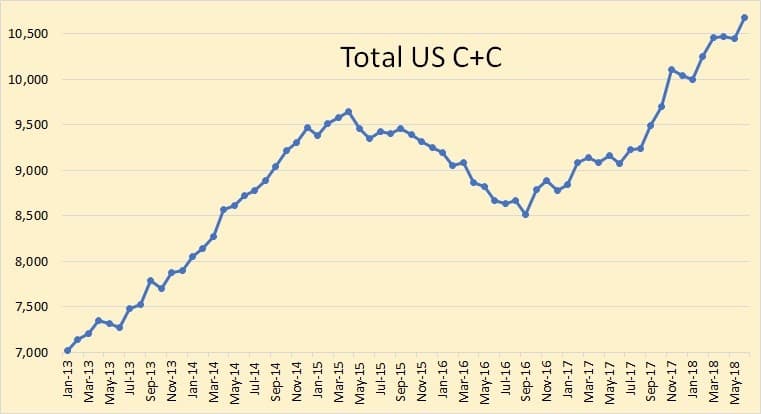
These first charts are taken from the EIA’s Monthly Crude Oil and Natural Gas Production. The data is through June 2018 and is in thousands of barrels per day.
(Click to enlarge)
US C+C production was up 231,000 barrels per day in June to 10,674,000 bpd, an all-time high.

(Click to enlarge)
Texas was up 165,000 barrels per day in June to 4,410,000 bpd.
(Click to enlarge)
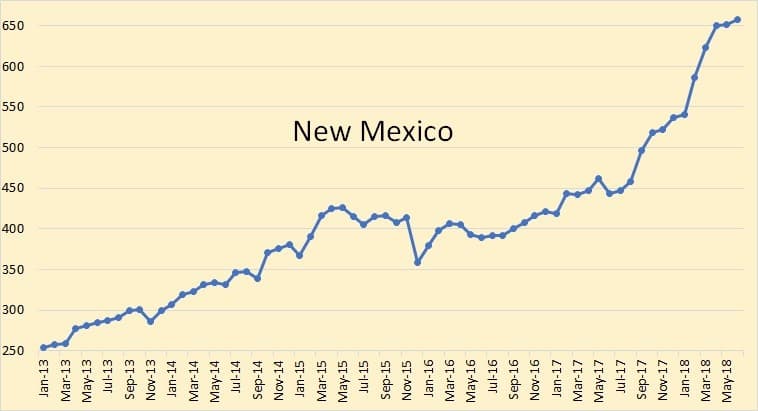
New Mexico was up 5,000 barrels per day in June to 657,000 bpd. The Permian extends into New Mexico.
(Click to enlarge)
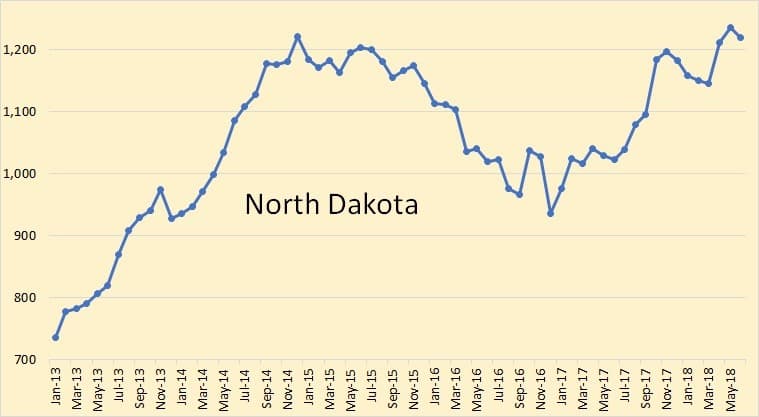
North Dakota was down 16,000 barrels per day in June to 1,220,000 bpd.
(Click to enlarge)
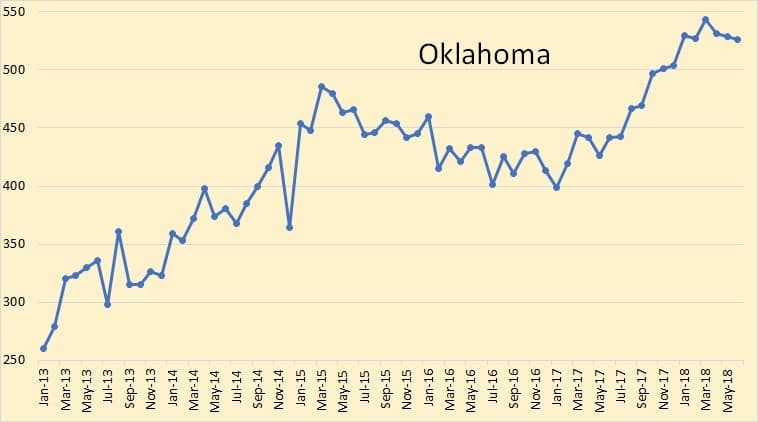
Oklahoma was down 3,000 barrels per day in June to 526,000 bpd.
(Click to enlarge)
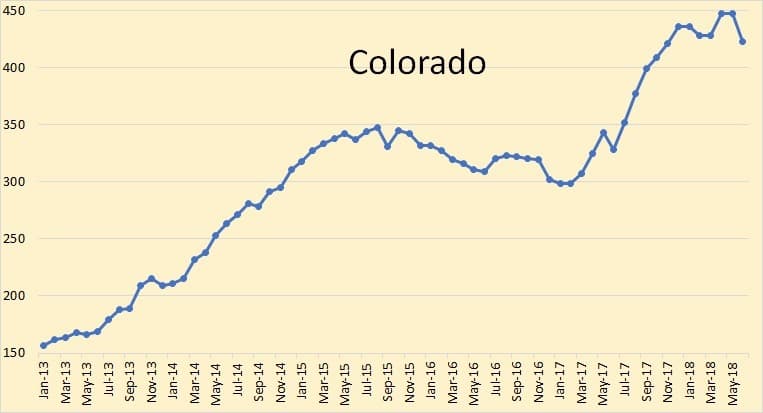
Colorado was down 24,000 barrels per day in June to 423,000 bpd.

(Click to enlarge)
California was down 2,000 barrels per day in June to 462,000 bpd. California peaked in February of 1987 at 1,109,000 bpd.
(Click to enlarge)
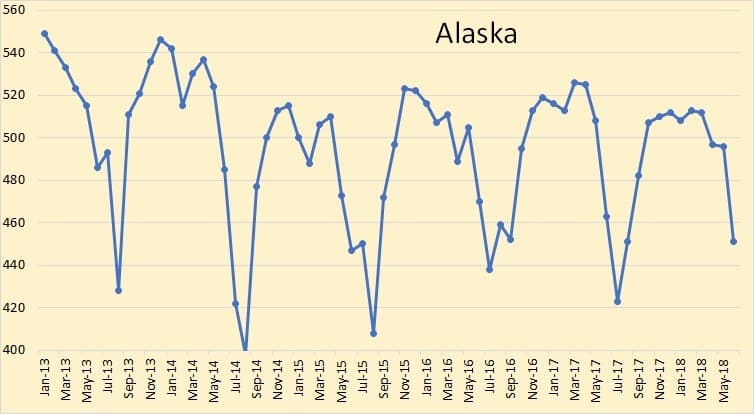
Alaska was down 45,000 barrels per day in June to 451,000 bpd. June, July, August, and part of September are the prime maintenance months for Alaska. The maintenance includes pigging the pipeline and overhauling the pumps along the pipeline. Related: Oil’s Next Hotspot: The Cowboy State
(Click to enlarge)
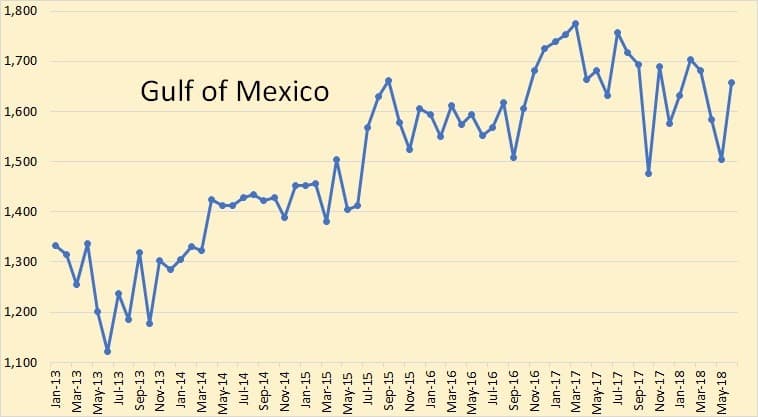
The Gulf of Mexico was up 154,000 barrels per day in June to 1,658,000 bpd. Just a couple of years ago the EIA was predicting the GOM to be at almost 2 million barrels per day by now. I really don’t think that is going to happen anytime soon.
(Click to enlarge)
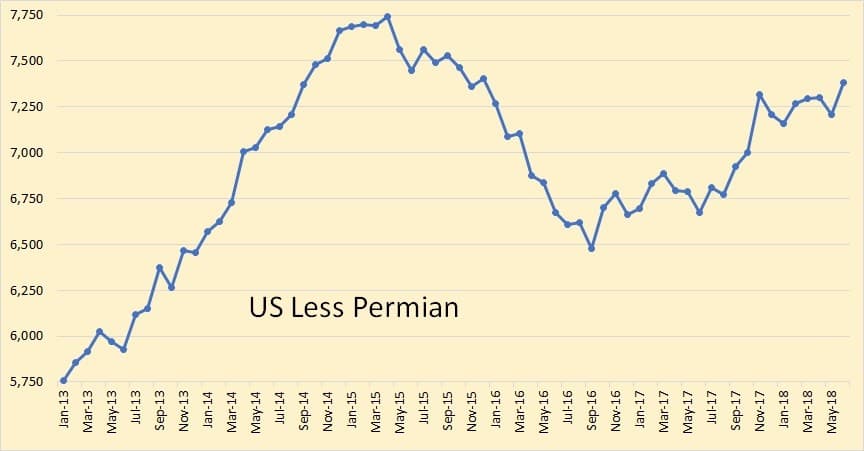
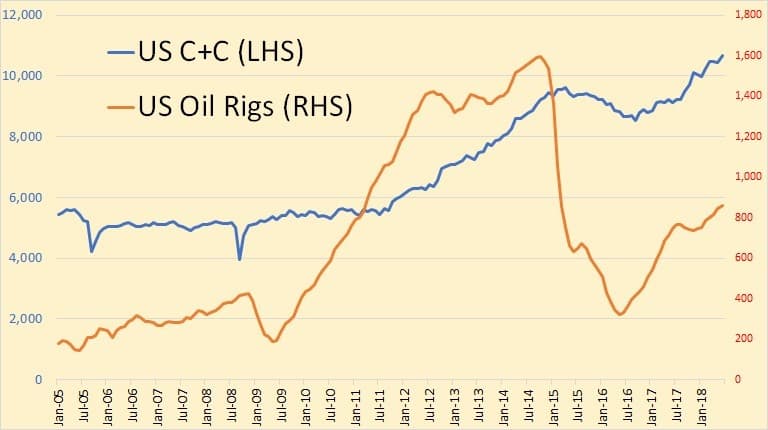
Using the EIA’s Drilling Productivity report for Permian production, through June, the US less the Permian, is still 357,000 barrels per day below the peak reached in April 2015. It is obvious that the Permian is the driving force behind the major increase in US production.
The above data is through June 2018. This is oil rigs only, no gas rigs.
(Click to enlarge)
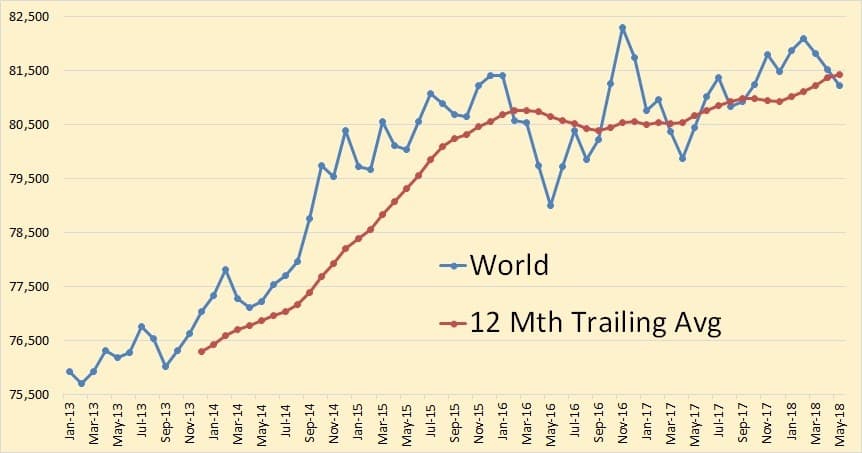
The following data are from Table 11.1b World Crude Oil Production: Persian Gulf Nations, Non-OPEC, and World. It is through May 2018 and is in thousand barrels per day.
(Click to enlarge)
The numbers here are only through May 2018. We are obviously on that proverbial bumpy plateau. A prediction! I see world C+C production peaking around July or August, remaining level to slightly down for about two years, then begin a steady decline.
(Click to enlarge)
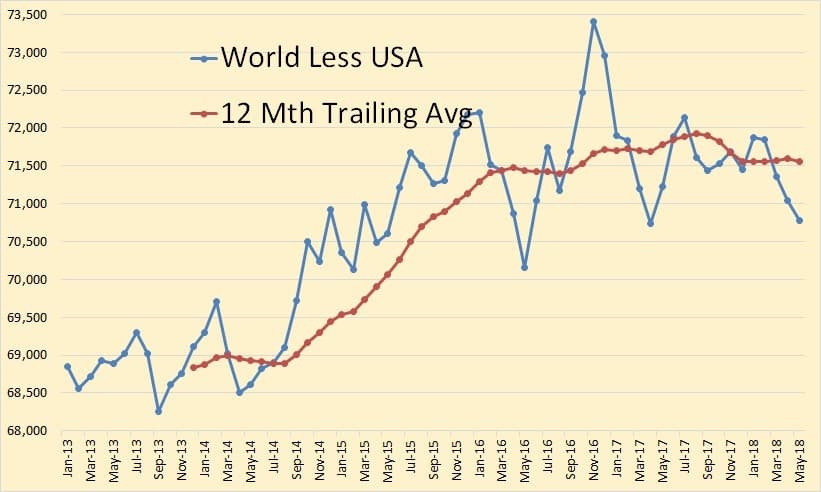
It all depends on the USA. The US, and to a lesser extent Canada, are the only nations that are still really growing by any significant amount. The US has increased production by 1.6 million barrels per day in the last 12 months, June 17 to June 18. Total world has increased less than half that amount.
(Click to enlarge)
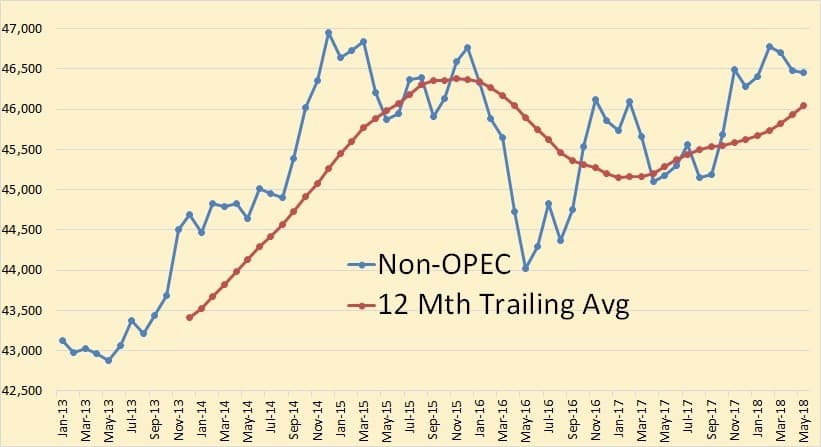
Non-OPEC is half a million barrels below its previous peak of December 2014. It may breach that peak later this year, but not by much. Related: Saudi Arabia’s Oil Price Sweet Spot
(Click to enlarge)
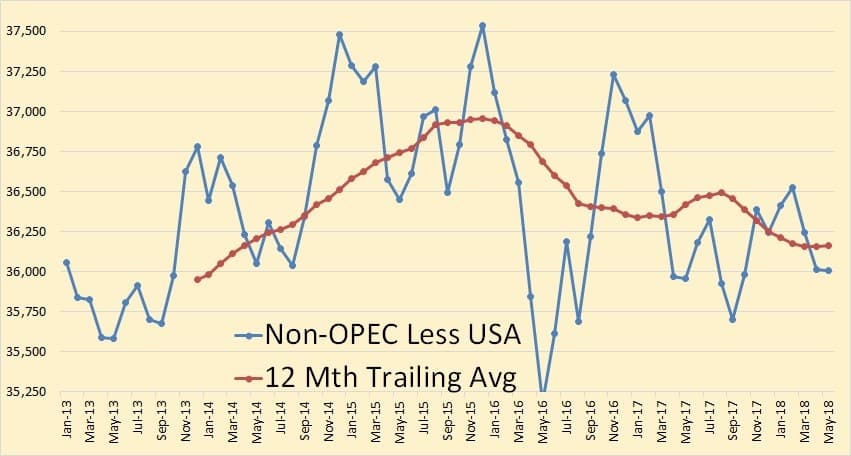
Non-OPEC less USA is 1.5 million barrels below its previous peak of December 2015.
(Click to enlarge)
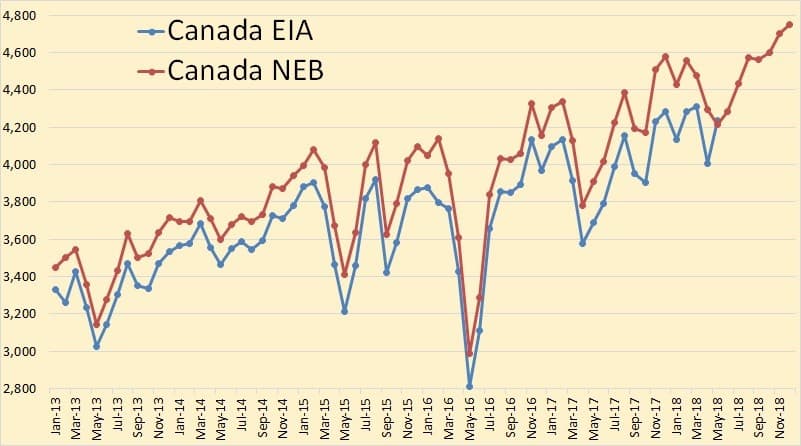
Canada EIA through May with Canada’s National Energy Board’s projection through December 2018.
(Click to enlarge)
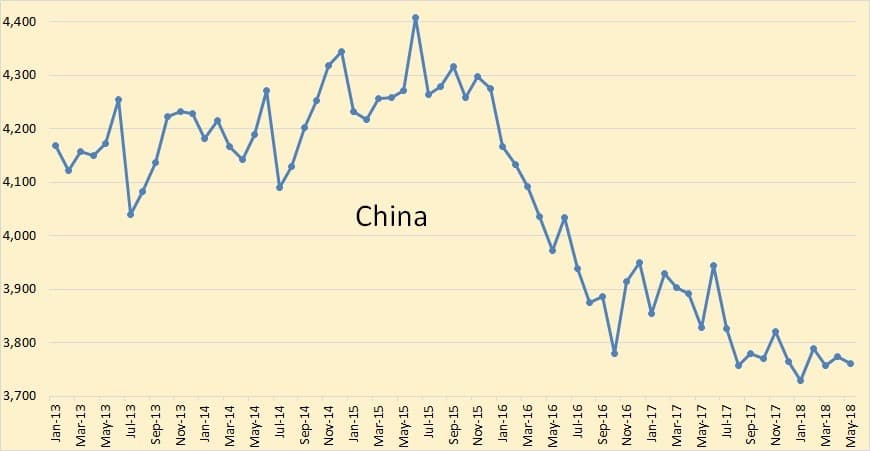
China has slowed its decline somewhat.
(Click to enlarge)
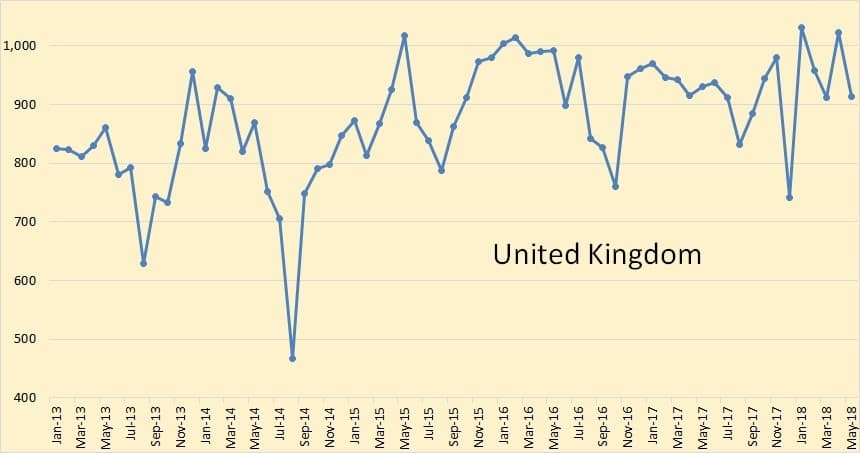
The United Kingdom has, for now anyway, completely halted its decline.

(Click to enlarge)
Norway… well that’s Norway.
(Click to enlarge)
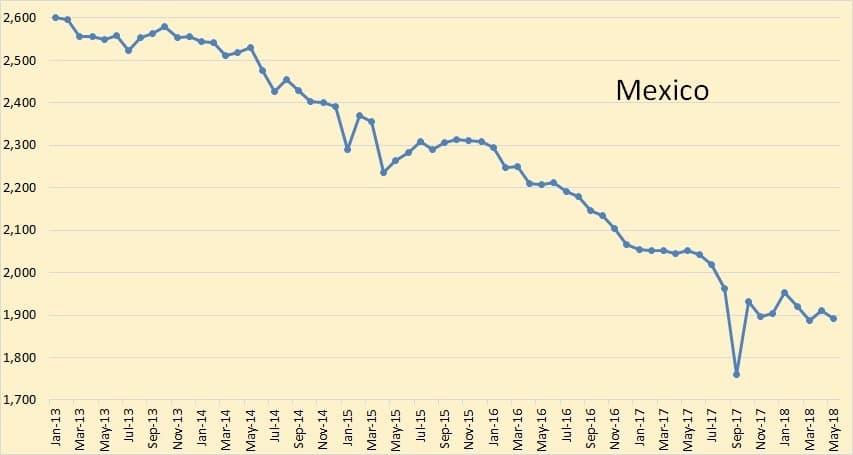
Mexico, for the time being, has slowed its decline.
(Click to enlarge)
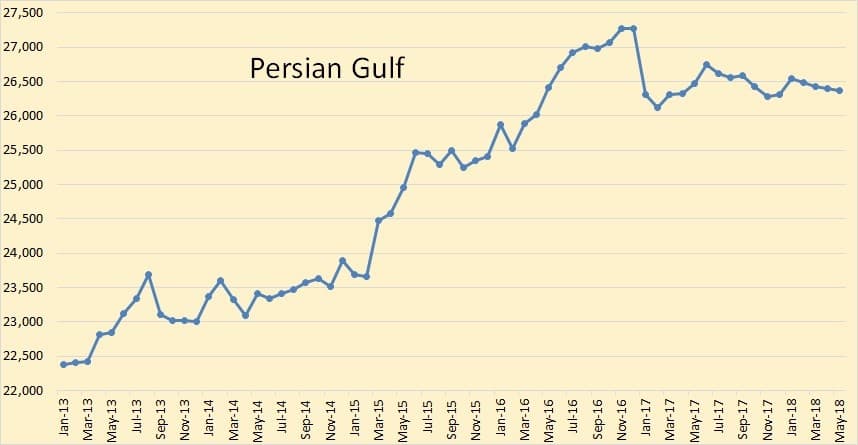
This is the EIA’s estimate of all Persian Gulf production. That includes Saudi Arabia, the UAE, Kuwait, Iran, Iraq, Qatar, Bahrain, and Oman. This is through May. There will be a slight uptick in June, July, and August but will not likely breach the previous high in November and December of 2016.
(Click to enlarge)
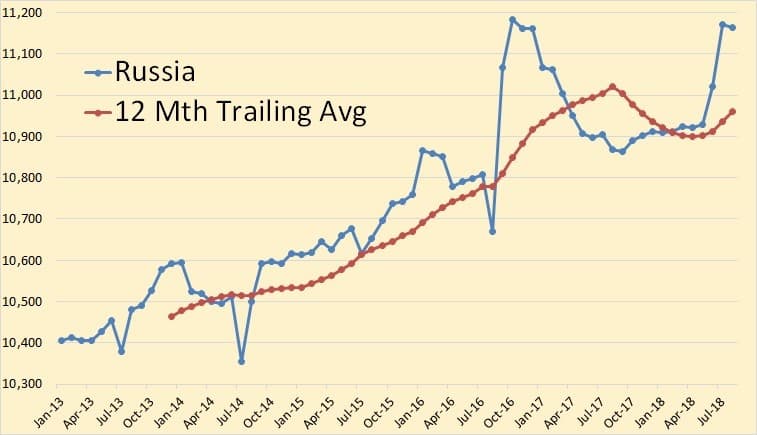
This is Russia through August 2018 from the Russian Minister of Energy. They are now back to the level they reached in the last quarter of 2016.
37 Comments on "EIA’s Latest USA & World Oil Production Data"
Duncan Idaho on Thu, 6th Sep 2018 9:44 pm
This is compiled by RON PATTERSON—
He thinks we are at peak now, or shortly.
MASTERMIND on Thu, 6th Sep 2018 10:12 pm
Brazilian fascist presidential candidate Jair Bolsonaro got stabbed.
lol
Cloggie on Thu, 6th Sep 2018 11:14 pm
Peak oil, mhuahahaha
https://deepresource.wordpress.com/2018/08/19/the-sudden-death-of-peak-oil-4-5-trillion-barrels-of-oil-left/
Cloggie on Thu, 6th Sep 2018 11:24 pm
“Brazilian fascist presidential candidate Jair Bolsonaro got stabbed.”
Yes, the left and violence.
Killed in “peace time” between 1933-1939:
USSR – millions
Nazi-Germany – ca. 600
Great-Britain – ca. 600
Fascist Italy – less than 10
(Euro’s still had capital punishment before the war)
Today everybody only talks about Germany, not US 1933-1948 ally USSR.
makati1 on Thu, 6th Sep 2018 11:40 pm
“The American global empire is being superseded by an Asian phoenix….
In the past, America could rely on unwavering support from her NATO allies. One of them, Turkey, has now all but defected, and the Europeans are breaking ranks on sanctions over Iran and Russian energy imports…
American trade tariffs against China must also be regarded in this light. Recent moves to retain influence in key African nations as well are too late. …
China is buying oil for yuan, and there’s nothing America can do about it. America has tried to destabilise Russia with dollar sanctions, unsuccessfully. President Trump has leant on Angela Merkle not to do business with Russia and Iran. He has also threatened this NATO ally with trade tariffs. The message to Germany is clear, the alliance with America no longer applies. Consequently, Germany is quietly turning her back on America and continuing to trade with Russia. The old threats just don’t work anymore….
It will be at the next credit crisis, if not before, that China and Russia will reveal their plans to protect their currencies from a financial and currency collapse in the West….
Instead of society’s destruction, we face a period of seismic change, notably the rise of Asia as the centre for global economic power.”
https://www.goldmoney.com/research/goldmoney-insights/apocalypse-or-not-t
Asia is the place to be. Nuff said…
Anonymous on Fri, 7th Sep 2018 12:29 am
Ron has pretty graphs but is not a serious analyst. Hass been wrong several times ov er the years and not acknowledged it.
deadly on Fri, 7th Sep 2018 12:41 am
2014 10 36707680 1184119 11499 3192 103
2018 6 36765297 1225510 14468 2541 85
https://www.dmr.nd.gov/oilgas/stats/historicaloilprodstats.pdf
For each row, the first number is the year, the second is the month, the third is the total production all wells in the Williston Basin, includes the Bakken, all formations, the fourth is the total daily production, the fifth is the total number of wells, all formations, the sixth and seventh are the monthly and daily average per well.
The math would be 14468 times 2541 equals 36,763,188 plus a couple of thousand barrels more in the final tally for 2018, month of June.
11499×3192=36,704,808
The oil production totals are close to the same, the number of wells has increased by 2969 wells.
103 bpd per well average down to 85 bpd per well average is about an eighteen percent decline per well.
You have 2969 more wells to produce close to the same amount of oil. Something like a two percent decline rate per year, after 3.5 years, 25 percent more wells were required to match production stats.
You’ll be drilling wells for years on end. That is what is happening, drilling holes until hell won’t have it.
Good money no matter what, doesn’t matter if it pays. Why should that matter?
You have to keep drilling. What you call a hamster wheel.
Whether or not if it pays is of no consequence, the oil is the matter that matters.
30,000 wells producing 40 barrels per day is still 1.2 million barrels per day.
Can’t argue with that. Just a sixty percent decline in production, but the increase in the number of wells offsets the decline.
deadly on Fri, 7th Sep 2018 12:44 am
Not a two percent decline rate per year, 6 percent is the number.
Cloggie on Fri, 7th Sep 2018 1:14 am
Can’t argue with that. Just a sixty percent decline in production, but the increase in the number of wells offsets the decline.
The world is a lot bigger than Bakken.
They have a planet to frack (if they are not stopped) and then there are methane-hydrates and sub-sea coal.
Those who worry the world will run out of fossil fuel should get their head checked (for millimind the verdict is already in: incurable, clinical insane).
fmr-paultard on Fri, 7th Sep 2018 2:42 am
A hip a hop a socialize
Just come on Cloggie let me date ur eyes.
Say Jack and Jill went up the hill to plant a little sprout
Say stupid Jill done forgot the pill
So Jack done bust the bitch out.
makati1 on Fri, 7th Sep 2018 2:47 am
Cloggie… we are already out of easy to recover (cheap) FFs. The ones you mention will likely never be recovered in any significant amount for the same reason. Cost. The world is devolving into a less energy system, not more and that is why. Cost. When gas is $25 per gallon and electric is $5 per KWh, how much can you afford? That day is fast approaching. LOL
Cloggie on Fri, 7th Sep 2018 3:08 am
Yes makati, we are running out of cheap ff, but not out of somewhat affordable ff.
The current US SUV boom won’t last long.lol
marmico on Fri, 7th Sep 2018 5:08 am
Ron has pretty graphs but is not a serious analyst. Hass been wrong several times ov er the years and not acknowledged it.
Ronnie “Darwinian” Patterson has been calling peak oil every 3 years since 2005 at The Oil Drum and now at his website. His batting average is 0.000.
Laherrere is a serious analyst in his dotage, Patterson is just a plagiarizing retard in his dotage.
_________________
Yes makati, we are running out of cheap ff
Bull shit. US energy spending relative to US income was the lowest ever in 2016.
https://www.eia.gov/todayinenergy/detail.php?id=36754
Anonymouse1 on Fri, 7th Sep 2018 5:23 am
Its ok that that guys I have never heard of and could care less about are not serious analysts marmitard. After all, you are not a serious…anything. Actually I take that back, you are a serious SOCK PUPPET(er), but that is about the extent of it.
MASTERMIND on Fri, 7th Sep 2018 5:28 am
Clogg
IEA Chief warns of world oil shortages by 2020 as discoveries fall to record lows
https://www.wsj.com/articles/iea-says-global-oil-discoveries-at-record-low-in-2016-1493244000
Saudi Arabia’s Energy Minister Warns of World Oil Shortages Ahead
https://www.wsj.com/articles/saudi-minister-sees-end-of-oil-price-slump-1476870790
Saudi Aramco chief warns of looming oil shortage
https://www.ft.com/content/ed1e8102-212f-11e7-b7d3-163f5a7f229c
A Regional Oil Extraction and Consumption Model. (Dittmar 2017)
https://arxiv.org/pdf/1708.03150.pdf
HSBC Global Bank: 81% of world liquids production already in decline and world oil shortages ahead
https://www.scribd.com/document/367688629/HSBC-Peak-Oil-Report-2017
Projection of World Fossil Fuels by Country (Mohr, 2015)
https://www.scribd.com/document/375110317/Projection-of-World-Fossil-Fuels-by-Country-Mohr-2015
Australian Government (Leaked) 457 pg Study: concludes world peak oil around 2020
https://web.archive.org/web/20170415190328/https://www.aspo-australia.org.au/References/Bruce/BITRE-Report-117-Oil_supply_trends-2009.pdf
German Military (leaked) Peak Oil study: oil is used in the production of 95% of all industrial goods, so a shortage of oil would collapse the world economy & world governments
http://www.energybulletin.net/sites/default/files/Peak%20Oil_Study%20EN.pdf
Sorry fat boy..
MASTERMIND on Fri, 7th Sep 2018 5:30 am
marmico
During the mid/late 20th century (1960-1999), a barrel of oil cost $19 on average; during the years immediately prior to the Great Recession (2000-2008), the average price of a barrel of oil had increased to $47; and during the years immediately following the Great Recession (2010-2012), the average price of a barrel of oil had further increased to $81. During the same three time periods, the average price of a metric ton of copper increased from $3,085, to $3,713, to $6,817; the average price of a metric ton of iron ore increased from $36, to $57, to $124; and the average price of a metric ton of potash increased from $114, to $185, to $343. (Prices are inflation adjusted.)
The simple fact is that we cannot grow our global economy and improve our global material living standards on $55 oil, $6,817 copper, $124 iron ore, and $343 potash like we did on $19 oil, $3,085 copper, $36 iron ore, and $114 potash. It should come as no surprise that our Non Renewable Resource-dependent global economy experienced the Great Recession during 2009. Nor should it come as a surprise that we have yet to recover from the Great Recession. Nor will our industrialized and industrializing economies ever recover, so long as price levels associated with the vast majority of Non Renewable Resources remain at their inordinately high levels.
Source: Hamilton (2009)
https://www.brookings.edu/bpea-articles/causes-and-consequences-of-the-oil-shock-of-2007-08/
Source: IEA
http://www.iea.org/textbase/npsum/high_oil04sum.pdf
Source: IMF
https://www.imf.org/external/pubs/ft/oil/2000/
MASTERMIND on Fri, 7th Sep 2018 5:34 am
Marmico
Limits to growth had 12 models. One of those models, the “standard run” or, alternatively, the “business as usual” model was the one that 40 years of historical data tracked/followed. And according to that model the global economy will collapse by 2030.
https://www.scientificamerican.com/article/apocalypse-soon-has-civilization-passed-the-environmental-point-of-no-return/
https://www.scribd.com/document/379418787/Is-Global-Collapse-Imminent-An-Updated-Comparison-of-The-Limits-to-Growth-with-Historical-Data-Turner-2014
https://www.smithsonianmag.com/science-nature/looking-back-on-the-limits-of-growth-125269840/
MASTERMIND on Fri, 7th Sep 2018 5:36 am
marmico
The easy oil is gone
Oil discoveries peaked in the 1960’s.
Every year since 1984 oil consumption has exceeded oil discovery.
In 2017 oil discoveries were about 7 billion barrels; consumption was about 35 billion barrels
Of the world’s 20 largest oil fields, 18 were discovered 1917-1968; 2 in the 1970’s; 0 since.
https://imgur.com/a/6dEDt
https://www.chron.com/business/energy/article/Oil-discoveries-in-2017-hit-all-time-low-12447212.php
Liebig’s Law states that any complex system dependent on several essential inputs can be taken down by that single factor..
https://en.wikipedia.org/wiki/Liebig%27s_law_of_the_minimum
CAM on Fri, 7th Sep 2018 7:10 am
Anyone know how much is crude and how much is condensate. My guess is that condensate makes up a greater percentage of production today than it did in 1970, due to the large amount of gas being produced today.
Are we really at a new peak of crude production, or is it a peak when condensate is added in?
Dredd on Fri, 7th Sep 2018 8:01 am
Whoopie! Oil-Qaeda has enough weaponized liquid to continue the demise of current civilization (Mysterious Zones of Antarctica – 4).
marmico on Fri, 7th Sep 2018 8:07 am
Oil discoveries peaked in the 1960’s.
I am compelled to slather zinc on your inflamed baby ass.
Oil company additions to proved reserves in 2017 were the highest since 2013
https://www.eia.gov/todayinenergy/detail.php?id=36532#
twocats on Fri, 7th Sep 2018 8:09 am
We’ve long since gone from Crude to Crude+Condensate to Total Liquids. Gas-to-Liqiuds, or using Nat Gas in Tar sands blasting, or even Nuclear to power tar sands separation, are all just the latest desperate attempts to keep this monstrosity in the air.
since 2005, americans and much of the rest of the world have been mostly isolated from oil’s true cost by ever expansion of cheap credit. I think this can easily go on, so I’m not calling for imminent doom. But the day this money-carousel stops or falters will be a helluva-day.
the only country that can really afford to dump this much money down the frack-hole is the world reserve currency. remind us again how many countries are issuing the world’s reserve currency.
Antius on Fri, 7th Sep 2018 9:59 am
I continue to be impressed by the energy efficiency of hydraulic transport of freight. Basically, this involves transporting freight in floating or neutrally buoyant plastic capsules within pipes containing water, at flow speeds up to a few metres per second.
Being lazy and not wanting to get into complex Reynolds number and friction factor calculations; I have relied upon engineering toolbox. For a steel pipe 0.9m in diameter, pumping water at 2.1m/s, the total pressure drop is 3KPa per 100m, or about 0.3m (0.98′) of head loss. To pump over a 1km distance, would imply a head loss of 3m, or 9.8′. Total flow is 1.25m3 per second.
https://www.engineeringtoolbox.com/pressure-loss-steel-pipes-d_307.html
Using another engineering toolbox graph, I can convert that head loss into pumping power.
https://www.engineeringtoolbox.com/pumping-water-horsepower-d_753.html
To pump 6.31litres per second against a 10′ head loss requires pumping power of 0.25HP. To pump 1.25m3 of water per second would therefore require 49.5HP or 36.4kW/km.
1.25m3 of water weighs some 1.25tonnes. So the energy cost of pumping the water is 29KJ per tonne-km. If half of that water is displaced by neutrally buoyant floating capsules, then the transport energy cost for freight is twice the total pumping energy of the water – some 58.3KJ per tonne-km.
This is 7 times more energy efficient than transporting freight by rail in the UK (0.41MJ per tonne-km). It is also technologically simple and potentially very cheap. A steel pipe, some 0.9m in diameter, could convey some 2250 tonnes of freight per hour – nearly 20million tonnes per year. The pumping power needed to keep the pipe flowing could be provided by a 400kW centrifugal pump every 10km. Alternatively, it could be provided by gravity, if water can be stored in an elevated reservoir, with pumping accomplished using virtually no moving parts other than valves.
The downsides of this system are relatively slow speed and size limits it implies on the freight being transported. To transport freight a distance of 500km at 2.1m/s, implies transport time of 2.75 days. Provided we are willing to accept slower delivery speeds, hydraulic transport could be a very cost effective and energy efficient means of transporting goods. Also, not a drop of fossil fuel would be needed.
Sissyfuss on Fri, 7th Sep 2018 2:12 pm
Antius, please stick around. This site needs as many bright, rational and extremely well educated minds as we can attract. It keeps the cacophony muted.
marmico on Fri, 7th Sep 2018 3:08 pm
This site needs as many bright, rational and extremely well educated minds
Antius is full of shit. He’s going to deliver an I-phone by (water) pipe from Quangdong (China) to Long Beach (California). ROTFLMFAO.
Antius on Fri, 7th Sep 2018 3:11 pm
Thanks Sis. I am not planning on leaving anytime soon, though time is a bit more constrained now.
If we class living standards in terms of the goods and services that are affordable to the average person; then being able to move physical goods over long distances is generally more important than moving people.
The pipeline example shows that this can be accomplished cheaply using simple systems and very little energy.
Cloggie on Fri, 7th Sep 2018 3:42 pm
The downsides of this system are relatively slow speed and size limits it implies on the freight being transported. To transport freight a distance of 500km at 2.1m/s, implies transport time of 2.75 days. Provided we are willing to accept slower delivery speeds, hydraulic transport could be a very cost effective and energy efficient means of transporting goods. Also, not a drop of fossil fuel would be needed.
Many moons ago I travelled from Holland via Germany and Poland to Lvov in the Ukraine and from there to the Crimea and next north-east to artive at Poltava, the easterm-most point I got to. During my daytrip from the Crimea to Poltava I crossed the most monstrous pipeline I have ever seen in my life, probably the Trans-Balkan pipeline, just brutally positioned in the landscape, without any notion of landscape design:
https://goo.gl/images/fuxNmk
It was built in Soviet times when the Russians were already doing business on a grand scale with the Germans, Cold War be damned.
Transport of oil is the cheapest way to transport oil. The speed is something like 10 km/h, double walking speed.
I had to think of that 5000 km “shaft of oil” with 100 cm in diameter, moving at a speed of 10 km/h and still have an energy loss of merely 1-3%, when Antius brought up that “new” transport mode.
Well, new… I was born and raised in Philips town Eindhoven. In the sixties they still had a system called “buizenpost”, tubular post, where closed capsules filled with letters or small electronic components were “blown” from one department to another:
https://goo.gl/images/29wNBG
The system was also used by my local Rabo-bank, to transfer money from the safe to the counter, for safety reasons.
Perhaps something for Antius to brew on.
Anonymouse1 on Fri, 7th Sep 2018 5:17 pm
The term you were looking for is, ‘chew on’, not ‘brew on’ cloggraham. I dont know if there is a equivalent phrase in hebrew, (and dont care really). Probably why you stumbled on it. Now you know for next time, clogglestein.
Antius on Fri, 7th Sep 2018 6:03 pm
Thanks Clog, some interesting information. I can remember pneumatic systems being used in banks and supermarkets. I haven’t seen many since the 1990s.
I read a paper a while back about a network of pneumatic pipeline systems planned for New York. The general consensus appears to be that it would be economically competitive with road transport, but required minimum levels of usage. And of course entirely new infrastructure. Which would appear to be the biggest problem. A new system requires huge new investments, even if the unit costs are lower in the long-term. These investments are often too large for private companies to afford.
Pure electric trucks would appear to have a range problem, effectively limiting them to 100km between recharge cycles. Within those limitations, they have lower fuel costs than conventional IC trucks. So these vehicles are effective means of transporting goods at a regional level, provided that another means can be provided for transport over longer distances between regional hubs. Electrified rail may be part of that long distance transport; maybe pipelines pneumatic and hydraulic could provide another.
Considering these options is never a waste of time. Having come to realise how useless and inept the UK government is, I now realise that a key stumbling block on the path to sustainability is simply developing a workable plan.
Sum on Fri, 7th Sep 2018 6:18 pm
Anti-us
Playing nice today with the other boys and girls gets you a gold star.
Go fuck yourself, you English tool.
Antius on Fri, 7th Sep 2018 6:37 pm
‘Go fuck yourself, you English tool’
A lot of dead wood on this board that contribute far too little. Go read a book Sum and come back when you have something to say that is worth listening to.
Antius on Fri, 7th Sep 2018 7:20 pm
“Antius is full of shit. He’s going to deliver an I-phone by (water) pipe from Quangdong (China) to Long Beach (California). ROTFLMFAO.”
How about Shanghai to Paris? That is a distance of about 10,000km. About as far apart as you can get on the Eurasian continent. At a pipeline flow speed of 2m/s, the iphone would be delivered in just over 8 weeks. It weighs 0.2kg, so total energy consumption for delivery would be 116.6KJ (0.033kWh). Assuming the pumps are electrically powered, the energy required to deliver your iphone would cost about half a euro cent, which is almost nothing.
Even a tonne of freight delivered over that distance would cost only 24Euro in direct energy costs, assuming that power is electric at €0.15/kWh. Of course power could be even cheaper than that, given that all we actually need to power the pipeline is an injection of water at a head height 10m every 10km or so. We can use a direct mechanical wind pump for that, or even natural direct hydropower. Potentially very cheap, because we can cut out most of the engineering complexity and use simple mechanical components with few moving parts.
makati1 on Fri, 7th Sep 2018 7:27 pm
The Techie dreamers on this board are too far gone to ever be rational or use common sense. All these dreams are based on an excess of cheap energy to build them out to practical use. That excess no longer exists. Like the climate change dreamers who think they can turn back the clock 100 years or so, the techie dreamers think they can build a totally new system before the SHTF. LMAO
Outcast_Searcher on Sat, 8th Sep 2018 12:39 pm
Good thing the markets exist and work. If we do indeed run into a situation where oil supply doesn’t meet demand, prices will increase. Perhaps massively.
If prices go high enough, maybe people will wake up and drive less and look to use alternatives like HEV’s, PHEV’s, and BEV’s more and look to more green solutions.
And as a side effect, it would help slow down AGW to some extent.
Or the Cassandras can keep pretending they can predict the future of oil prices, peak oil, etc., which is pretty silly in the face of a highly variable, complex market. A market changed by technology over time in ways no one can predict long term.
Outcast_Searcher on Sat, 8th Sep 2018 12:41 pm
Oh, and per the massive SUV boom and the retards helping cause that — higher fuel prices can’t come soon enough.
(If AGW didn’t exist, pollution didn’t exist, and we had limitless supplies of everything, then they could drive whatever they want. As it is, the retards should be constrained.
Too bad society doesn’t do that via taxation — yet.)
Outcast_Searcher on Sat, 8th Sep 2018 12:44 pm
Cloggie, too bad the Cassandras pretend technology advances can only cause problems. They’ll never accept the real world consequences of massively increasing supplies due to improved production technology.
OTOH, idiot governments and the citizens who elect them will never step up to the reponsibility for the pollution and AGW that increasing burning of FF’s cause (i.e. paying ALL the social costs).
Cloggie on Sun, 9th Sep 2018 12:40 am
The term you were looking for is, ‘chew on’, not ‘brew on’ cloggraham. I dont know if there is a equivalent phrase in hebrew, (and dont care really). Probably why you stumbled on it. Now you know for next time, clogglestein.
http://brewing-thoughts.blogspot.com
https://www.urbandictionary.com/define.php?term=ive%20got%20something%20brewing
Could it be that your obsession with eating has taken the better of you?
There is a titanic quality about your stupidity, mouse1.