
Peak Oil is You

Donate Bitcoins ;-) or Paypal :-)


Page added on December 10, 2013

EIA Shale Oil Drilling Productivity Report
The new EIA Drilling Productivity Report has just been published with their shale oil production and prediction numbers out through January 2014.
I have discovered something very strange about their numbers. But first here is the Bakken data. I have shortened the time frame to just two years in order to better show what is happening. I have plotted what the EIA reported last month along with what they reported in this last report. The data is in barrels per day.
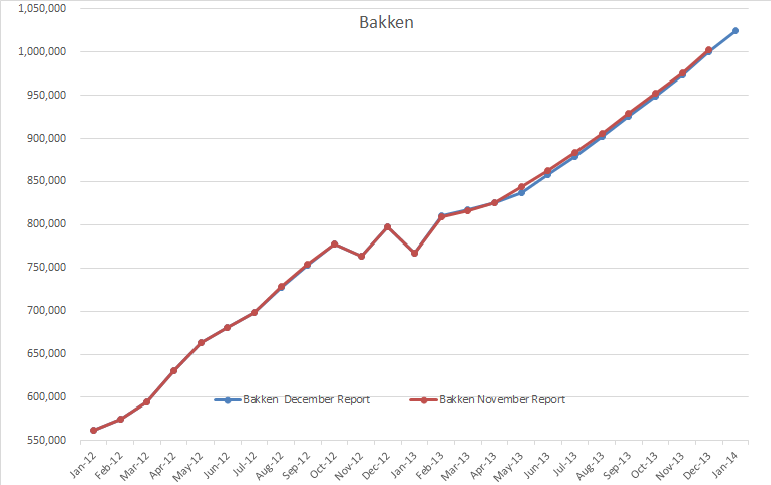
There was extremely little revision in the data from the report last month.
And now Eagle Ford Production in barrels per day.
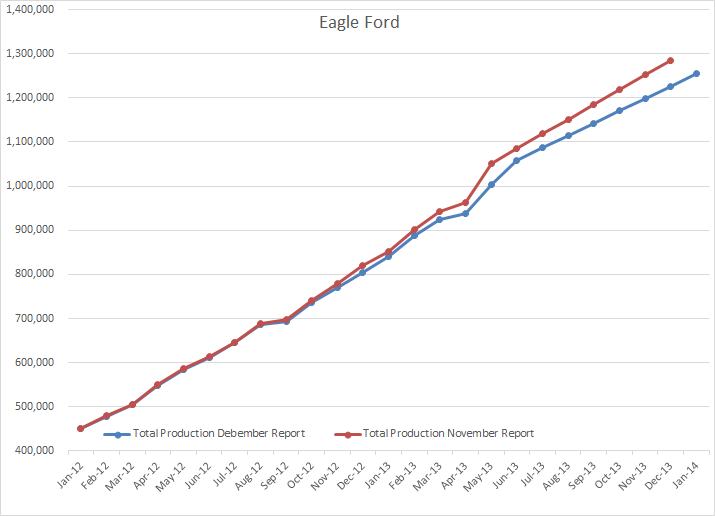
Eagle Ford was revised downward and like the data, the revisions were extremely linear. But the dead give away was when I plotted the percent change of from month to month.
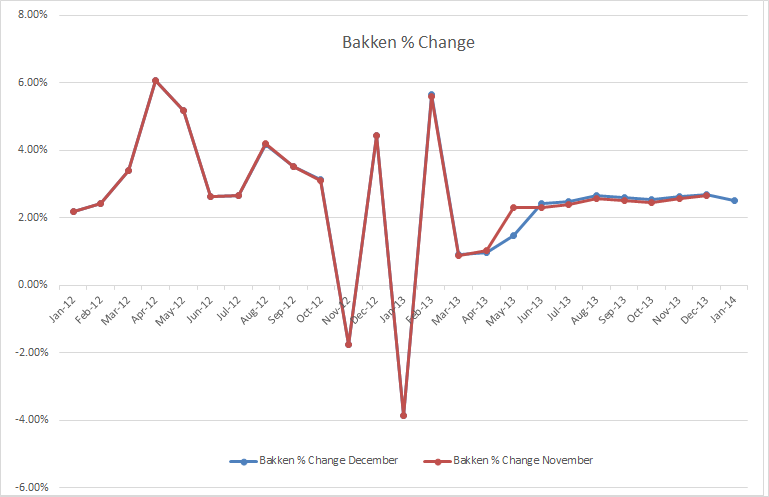
The last eight months show almost the exact rate of change, about 2.5 percent increase month after month. They are just plugging in numbers!
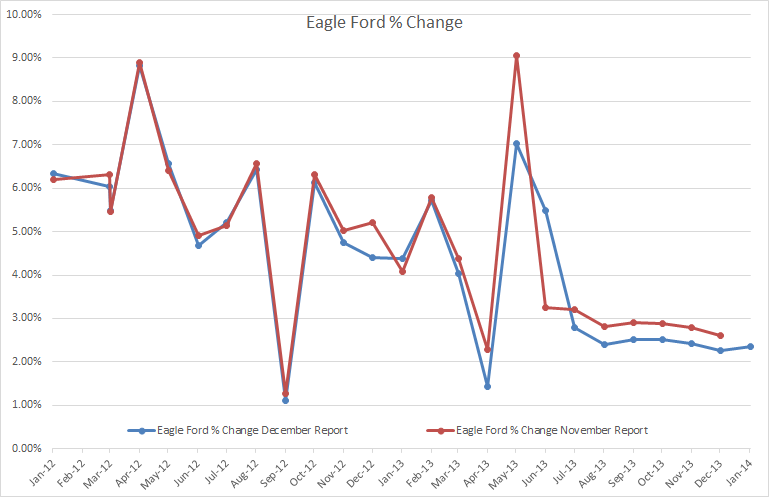
Eagle Ford shows the same pattern except like the data, they have revised the rate of change downward somewhat.
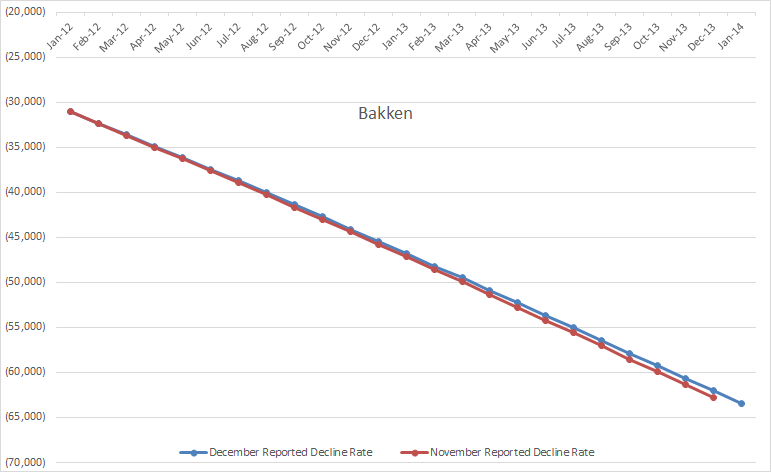
The decline rates are extremely linear also. The Bakken decline rate in barrels per day.
There was very little revision here but what there was they figured it was not declining quite as fast as they thought it was. And the Eagle Ford Decline Rate in barrels per day.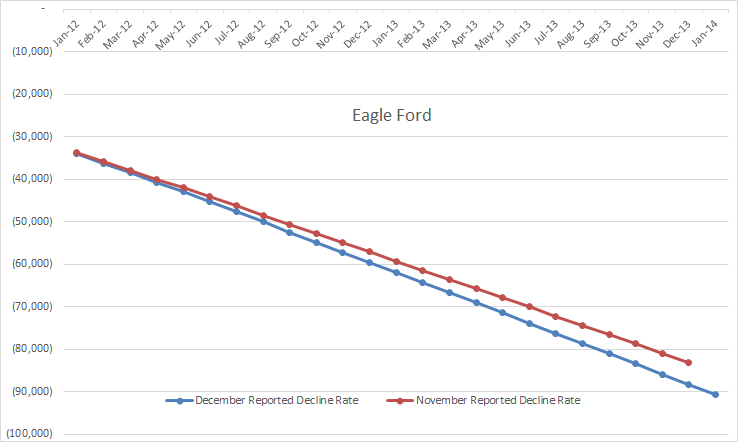
There was a slightly greater revision here and they figured that it was declining a bit faster than they first thought it was. They figure that Eagle Ford, will be in January, declining at 91,000 barrels per day but they will be producing new oil at the rate of 120,000 barrels per day meaning production will be increasing, in January, at the rate of 29,000 barrels per day.
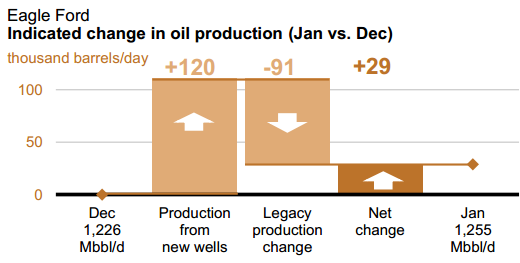
What is happening here, I think, is that they are taking the data from North Dakota and the Texas RR Commission up until about June then they just plug in their own very linear numbers.
4 Comments on "EIA Shale Oil Drilling Productivity Report"
Mike LaBonte on Tue, 10th Dec 2013 2:29 pm
Excellent work! It appears the transition for Eagle Ford starts one month after Bakken. One wonders if something happened at the data supply end, or if the EIA changed methodology. I can’t find EIA reports prior to October online. Can you post June and July, if you have them? We should check the footnotes.
MrEnergyCzar on Tue, 10th Dec 2013 5:27 pm
It will be ugly when the decline rates outpace new oil drilling… costs will rise too. When will the crossover happen? 2015?
MrEnergyCzar
Bob Spoley on Tue, 10th Dec 2013 6:45 pm
Reservoirs with large recoverable reserves have low decline rates. Reservoirs with small recoverable reserves have high decline rates. If production rates are kept flat, even if the reserves between the two kinds of reservoirs are vastly different, the low reserve reservoir will deplete first. This usually shows up when the low reserve reservoir can’t maintain a flat production rate. this is why these kinds of reservoirs have low to no profitability at the end of their life. This is not complicated all excuses aside.
rockman on Tue, 10th Dec 2013 8:12 pm
Bob – Not that I disagree with theme of your post but it’s even simpler than that. For instance, there is no Eagle Ford Shale “field” per se. It is a trend. And there isn’t one giant EFS reservoir. Though there may be some commonanility occasionally, most of the individual wells are draining a “reservoir” of very limited areal extent. Which is why they tend to have such high decline rates.
But there’s an additional reason for those rapid decline rate: EFS production is typically driven by pressure depletion drive as opposed to water drive. In such situation as a volume of fluid is produced from the formation the pressure in the formation decreases. In a strong water drive the reservoir pressure declines very little even by the time the reservoir is fully depleted. The flow rate of the fluid is proportional to the pressure differential between the reservoir and the surface pressure so as the pressures decline so does the energy pushing the oil out declines.
Then add that to the high permeability of fractures compared to a typical conventional reservoir and you have exactly what we experience in these shale plays: a very high initial flow rate followed by a rapid rate decline with a quickly declining reservoir pressure that decreases the ability of the fluid to reach the surface.