



The EIA just released their International Energy Statistics with world production numbers through October 2014. There were no big surprises in this report.
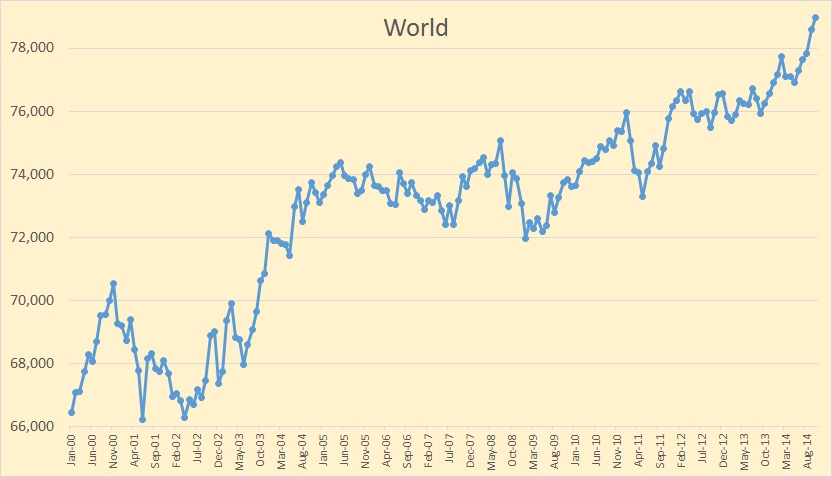
World C+C production was up 731,000 bpd to 78,967,000 bpd. This is a new high.
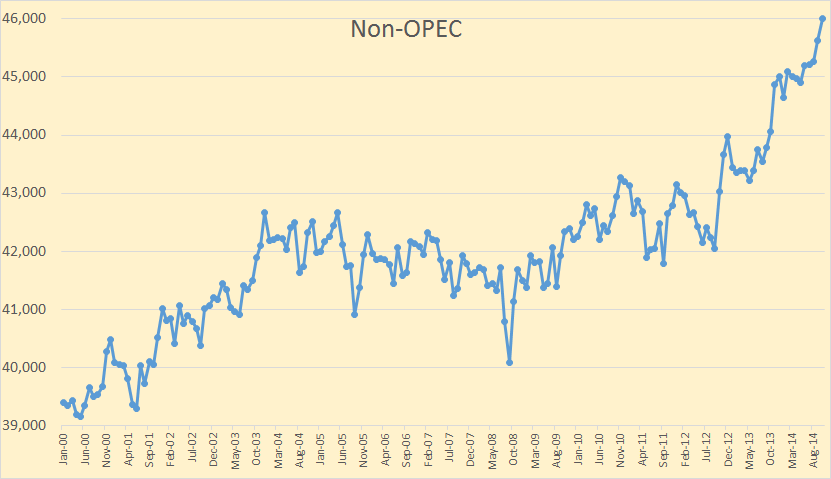
All the gain in the last few years has come from non-OPEC. Non-OPEC production was up 374 kbd in September and up another 370 kbd in October to 46,002,000 bpd.
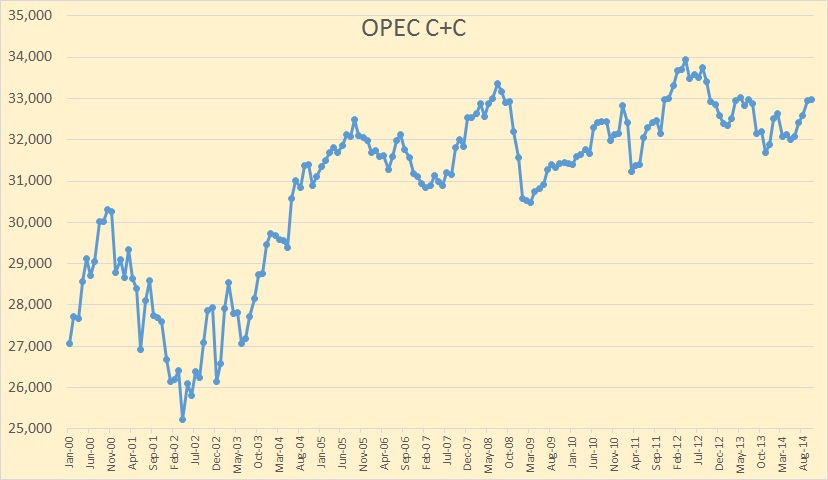
OPEC C+C has been on a bumpy plateau for the last several years. Also most of the gain has come from increased production of condensate, especially from Qatar. OPEC C+C production was up 21 kbd to 32,965,000 bpd.
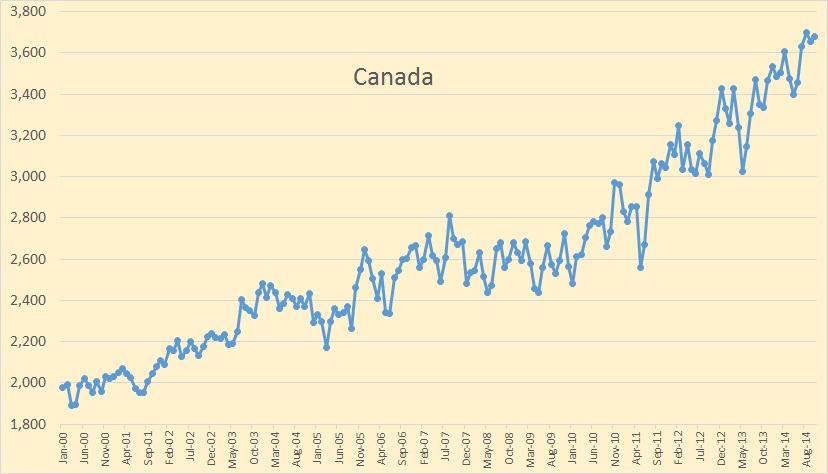
Canadian production was revised dramatically in this report. July was revised up by 120 kbd, August revised up by 250 kbd and September was revised down by 210 kbd. October production was 3,677,000 bpd, up 20,000 bpd.
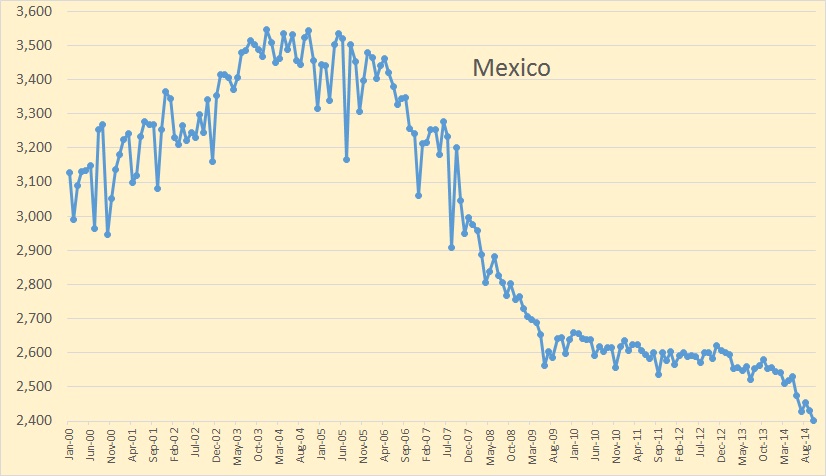
Mexico, after holding a plateau for about 4 years has started to decline again.
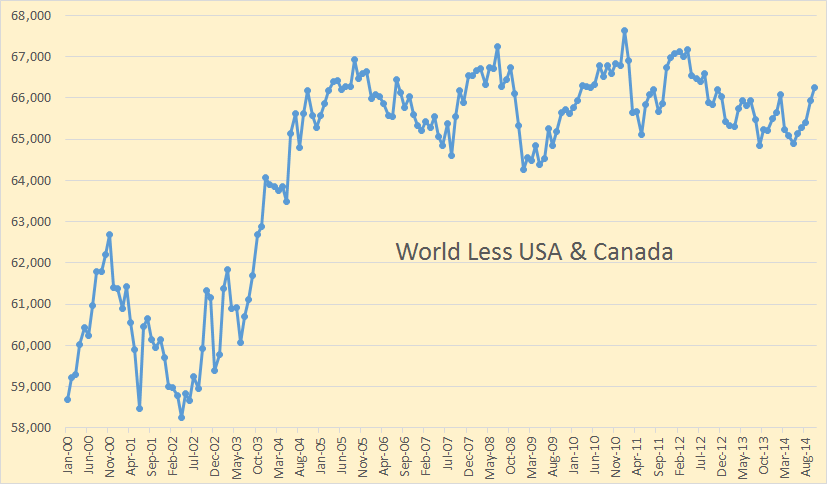
The World less USA and Canada has been on a 10 year bumpy plateau. I am predicting they, the World less USA and Canada, will turn down around mid 2015. US and Canada will still be increasing but at a much slower rate than the past 4 years.
Charts of all non-OPEC nations can be found on my page Non-OPEC Charts, and the page World Crude Oil Production by Geographical Area has also been updated.
Jean Laherrere on oil reserves.
There was a news article posted February 17th on oil discoveries in 2014, Discoveries of new oil and gas reserves drop to 20-year low. This is a Financial Times article and you may be asked to register to receive three free articles per year. I have already used up all mine. Anyway the link was posted by both Jeffrey Brown and myself on this blog.
The article stated: New finds of oil and gas are likely to have been about 16bn barrels of oil equivalent in 2014. Barrels of oil equivalent includes natural gas. Counting both oil and natural gas the world uses over three times that amount each year. So the world found less than one third the oil the world used last year. And discoveries are falling while oil consumption is rising.
The article was picked up and re-posted over on PeakOil.com where Rockman made a long comment, part of which is quoted below, but first he quoted the article:
“…and there are large known reserves — both “unconventional”, including shale in North America and heavy oil in Canada and Venezuela, and “conventional” in countries including Saudi Arabia, Iran, Iraq and the United Arab Emirates.”
I’m not sure when FT wrote this piece but I suspect recently. Apparently FT is aware of the definition of PROVED RESERVES. It isn’t the amount of oil in the ground. It’s the amount of oil that can be COMMERCIALLY produced. With the decline in oil prices (a key component in the determination of commerciality for reserves) the world has lost tens of billions of bbl of PROVED RESERVES from the ledger book. The cornucopians were justified in converting non-commercial shale reserves to a commercial status. But that ole double edged sword had rushed back and poked them in the ass.
This is all very nice but Jean thinks Rockman confuses 1P with 2P reserves.
Jean Laherrere:
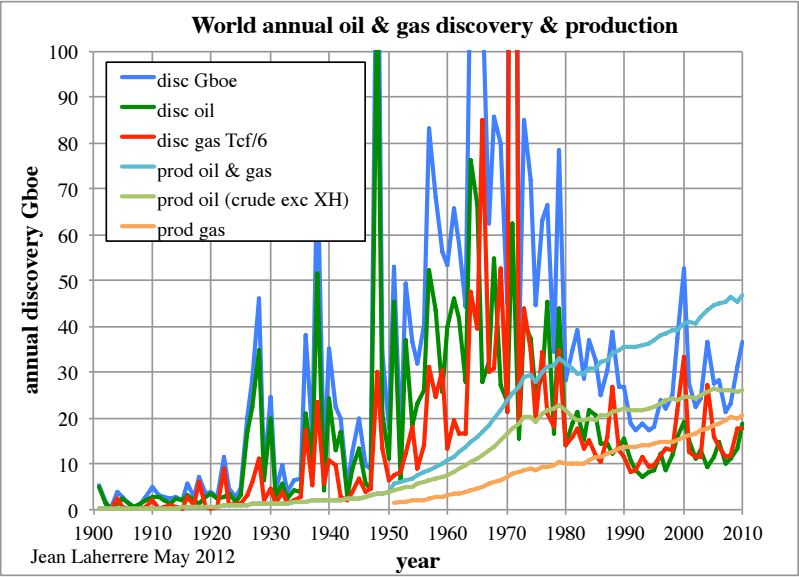
The discovery peak is in 1971 with 300 Gboe with the discovery of North Dome (two thirds in Qatar = North Field and one third in Iran = South Pars). IHS to please Iran reports South Filed in 1991 but everyone knew that North Field discovered in 1971 extended into Iran)
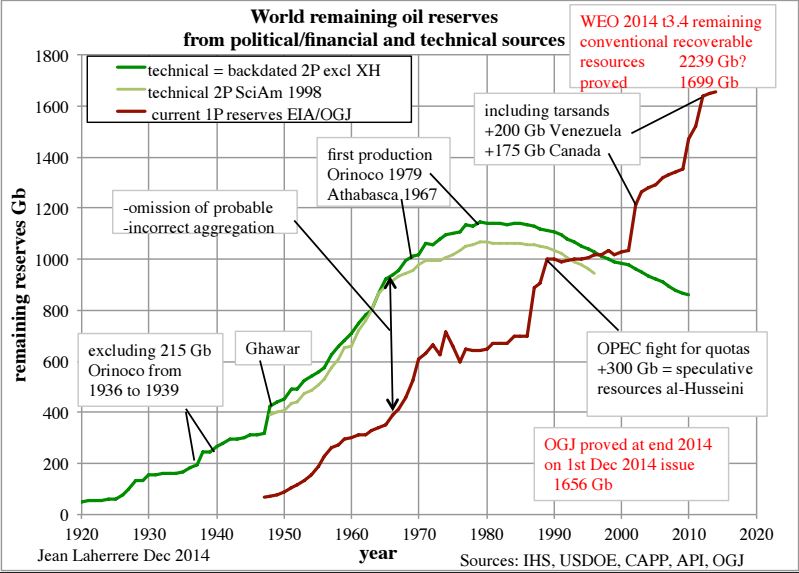
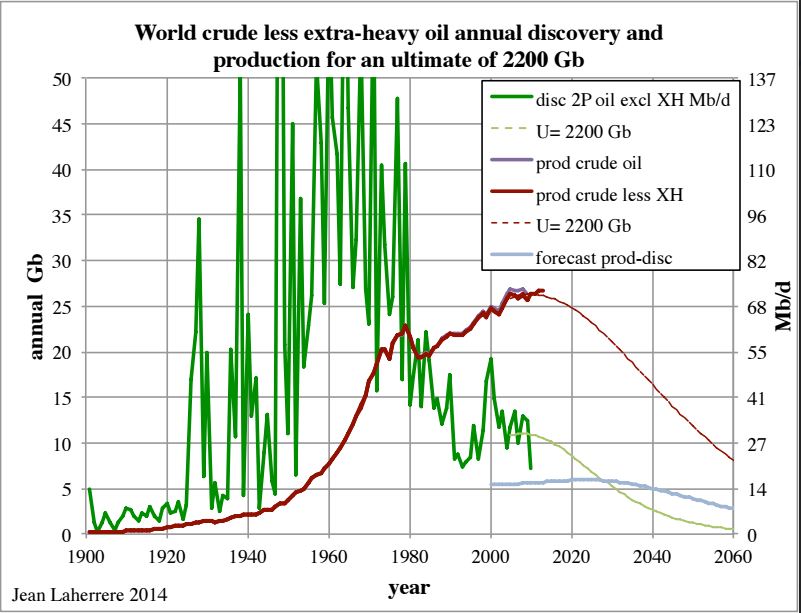
- “1P reserves” = proven reserves (both proved developed reserves + proved undeveloped reserves).
- “2P reserves” = 1P (proven reserves) + probable reserves, hence “proved AND probable.”
- “3P reserves” = the sum of 2P (proven reserves + probable reserves) + possible reserves, all 3Ps “proven AND probable AND possible.
Note: If you would like to receive an email notice when I publish a new post, then email me at DarwinianOne@gmail.com
dave thompson on Thu, 19th Feb 2015 9:57 am
https://video.search.yahoo.com/video/play;_ylt=A0LEVjbaB.ZUIzcAJ9YnnIlQ;_ylu=X3oDMTB0N25ndmVnBHNlYwNzYwRjb2xvA2JmMQR2dGlkA1lIUzAwNF8x?p=Doors+the+end&tnr=21&vid=F4E15FBAF344C25AB327F4E15FBAF344C25AB327&l=230&turl=http%3A%2F%2Fts3.mm.bing.net%2Fth%3Fid%3DUN.608014146616624906%26pid%3D15.1&sigi=11rbr29u9&rurl=http%3A%2F%2Fwww.youtube.com%2Fwatch%3Fv%3DtmbovFv-HH4&sigr=11abe1a2o&tt=b&tit=The+Doors+-The+End&sigt=10i48kcnl&back=https%3A%2F%2Fsearch.yahoo.com%2Fyhs%2Fsearch%3Fp%3DDoors%2Bthe%2Bend%26ei%3DUTF-8%26hsimp%3Dyhs-001%26hspart%3Dmozilla&sigb=12pn3adlb&hspart=mozilla&hsimp=yhs-001
Davy on Thu, 19th Feb 2015 10:05 am
Not being the oil expert I just want to mention two things. The first is this article clearly shows storm clouds on the horizon in an objective and quantifiable way for a BAU that must grow.
My second point is the profound importance of these articles and the experts here who digest this important data. The collapse time frame I preach has as its brick wall the POD & ETP of oil. The other foundational element of BAU potentially leading to collapse is the financial system. The financial system being human nature based is too hard to collapse forecast. I feel the oil situation is quantifiable and points to a time frame we can use as the upper limit of a BAU shelf life.
Plantagenet on Thu, 19th Feb 2015 10:17 am
The fuss over proved reserves is a tempest in a teapot. The current oil glut will be temporary. When oil prices go back up many billions of barrels of oil will once again magically reappear as proved reserves
Northwest Resident on Thu, 19th Feb 2015 11:29 am
The current oil glut will be temporary. Any day now, consumers will rush out to the shopping malls with their credit cards and their ten dollars or so of weekly savings on “cheap” gas, and they’ll engage in a spending orgy, driving demand back to stratospheric levels. At that time, all the crap they are calling oil these days will be drained from storage and used to fuel yet another burst of resource extraction and manufacture, the likes of which will bring back fond memories of all the forests that have fallen, all the fisheries that have been exterminated, all the mountain tops that have been bulldozed. It will be wondrous capitalistic excessive gluttony all over again, just like the good old days. The price of oil will rocket back up to $100 or so per barrel. Vast new reserves of shale oil and tar sands oil will once again become economical to exploit. The consumers will love it, as vast numbers are continually squeezed into food stamps, out of the economy which fewer and fewer can actively participate in. Yes, that wonderful, exciting, technology driven oil glut, so magnificent that we need to be daily reminded of it, multiple times, repetitively, monotonously, idiotically, by the self-appointed oil glut proclaimer-in-chief.
Hey, Plant. Define “temporary”. You’ve been saying it will only be temporary for quite a long time now. Do you have a no-more-oil-glut date that we can hold you to?
shortonoil on Thu, 19th Feb 2015 12:01 pm
This article conventionally ignores a very critical point. Reserves are a product of price, and production costs. Price since June of 2014 has fallen by 50%, and production costs have increased by 3%. Reserves are at least one half of what they were eight months ago.
The argument is that if price increases reserves will return. If pigs had wings they could fly. Prices are not going to recover substantially enough to replace those lost reserves. The value of oil to the economy is declining, and that is simply the result of depletion. Petroleum is in a long term downward price cycle, and that will continue until it is no longer an economically viable industry. This graph depicts what is happening to petroleum prices:
http://www.thehillsgroup.org/depletion2_022.htm
“And in his last plow he states that ultimate production will be about 2,200 billion barrels.”
In the 2000 WEO Campbell and Laherrere stated that estimated ultimate recovery would be 1,800 Gb. A number of critics attacked them viciously for it. The Etp Model calculates EUR at 1,760 Gb. It is very close to their initial estimate. Their initial estimate was based on the production of conventional crude, alternatives like shale, and bitumen were mere blips in the production data. Little did they realize that most of the production increase from 2000 forward would be production of low energy oil that would only serve to fill up storage tanks, and maintain the illusion of plentiful supplies.
The world is rapidly approaching its 1,760 Gb limit. Low energy substitutes will not be able to fill in the void that has developed. Economies will continue to contract, and stresses will form throughout most social structures. Ignoring it is not going to make it go away!
http://www.thehillsgroup.org/
BobInget on Thu, 19th Feb 2015 12:28 pm
Thanks, Dave Thompson.
Perk Earl on Thu, 19th Feb 2015 12:39 pm
Here’s an article being run by ZH today regarding increasing US inventory.
http://www.zerohedge.com/news/2015-02-19/eia-crude-inventories-production-surge-record-highs
Market participants expected a US crude inventory build of around 3 million barrels but the number more than doubled that at 7.72 million barrels and production soared to new record highs.
*CRUDE OIL INVENTORIES ROSE 7.72 MLN BARRELS, EIA SAYS
*U.S. CRUDE OUTPUT ROSE 0.585% TO 9.280 MLN B/D, EIA SAYS
Pops on Thu, 19th Feb 2015 2:05 pm
The article doesn’t indicate if these are proven anything, economical, technical or just oil in place.
Thread in the forums
http://peakoil.com/forums/oilfinder-help-oil-discoveries-fall-to-20-yr-low-t71042.html
Makati1 on Thu, 19th Feb 2015 8:28 pm
The Pacific and Atlantic Oceans have more gold in the water than has been mined since humans first found a nugget. There it will stay. Why? Cost to recover is far greater than it would be worth.
Ditto for the oceans of oil still pooled in many places around the world. Any resource recovery depends on the economics of the source, not the actual amount in place. EROEI.