
Peak Oil is You

Donate Bitcoins ;-) or Paypal :-)


Page added on May 10, 2014

Big Oil Under Serious Threat
Summary
- Oil majors face serious challenges, for decades, resource nationalization has kept them out of many of the cheapest fields.
- They’re struggling to replace existing reserves and production with new reserves and production.
- Climate change could present them with a staggering $28 trillion bill.
They are amongst the biggest and most profitable companies in the world, the big oil, gas, and (to a lesser extent) coal companies. But whether they’re good longer-term bets for investors is very much in doubt. It isn’t that the world is running out of carbohydrates, peak-oil keeps ever receding into the future.
However, instead of peak-oil, a series of important threats has emerged on the horizon threatening some of the core businesses of these companies. In no particular order, these threats are:
- Oil nationalism
- Field depletion
- Climate change
- Pollution controls
- Falling cost of renewables
Together, these threats produce a pincer, rising marginal cost and reducing prices, a pincer that threatens the long-term viability of these companies.
Oil nationalism
This has been the oldest threat. Until four decades ago or so, the big oil companies had a firm grip on the world energy reserves, but a rising tide of nationalism has greatly reduced that grip on the world reserves of carbohydrates. Many of the biggest and cheapest fields to develop are now either out of their hands, or available only at greatly reduced conditions. It might be true that peak-oil isn’t anywhere near, political peak-oil has already manifested itself in full force.
The true picture is rather bleak:
International Oil companies (IOCs) control less than 10 percent of the world’s proved oil and gas resource base. Indeed the super-majors themselves account for only 3% of oil reserves and 2% of gas reserves, although they have 20% of production, through contractual arrangement with the NOCs. When ranked on the basis of proved oil and gas reserves, 17 of the top 20 oil and gas companies in the world are NOCs. Nearly 75% of the oil reserves are held by OPEC members. [PWC]
Once dominant, the super-majors now only account for 3% of world oil reserves and the national oil companies (NOCs) dominate them in terms of reserves.
Field depletion
Not only are the oil majors kept out of much of the biggest and cheapest fields (or if not, let in at much reduced conditions), their own existing big and cheap fields are slowly petering out:
the IEA said in its annual report. Without extra investment to raise production, the natural annual global crude oil depletion rate is 9.1%. The findings suggest the world will struggle to produce enough oil to make up for steep declines in existing fields, such as in the North Sea, Russia and Alaska. The effort will become even more acute as prices fall and investment decisions are delayed. Even with investment, the annual rate of output decline is 6.4%. [The energy collective]
With access to big, cheap fields ever more distant or onerous and existing fields declining with an average of 7% a year, companies are pushed out to replace the lost cheap reserves with expensive exploration finding expensive new reserves. And they’re not really succeeding very well, here is Jim Chanos:
The central thesis behind Mr. Chanos’ short position is that several major integrated oil companies have not replaced reserves in years and several companies are in fact liquidating. Mr. Chanos also points out that, based on a review of the financial statements of integrated oil companies, the group is spending 100% of cash flow on capital expenditures and is borrowing to pay a dividend…. The real story at Shell and the other majors is the inability to replace produced reserves with reserves of equal quality.
Indeed. The simple truth is that these companies, on average, have to replace mostly cheap existing resources running on empty with more (often much more) expensive new plays from unconventional resources like shale or coal bed, or deep sea. Technology, like fracking and horizontal drilling, helps mitigating this impact, but can’t completely offset it.
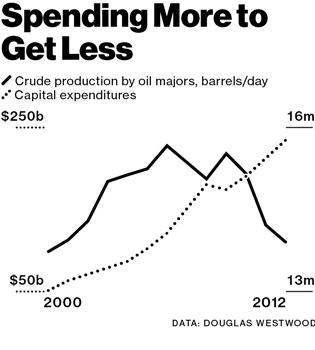
And the companies haven’t managed this difficult hand circumstances have dealt them very well. Exploration costs are rising steeply while crude production is down:
Such are the problems that many of the majors are cutting back exploration. Exxon Mobil (XOM) by 6%, Chevron (CVX) by 5% and Royal Dutch (RDS.A) by a whopping 20% this year. Perhaps that’s what will eventually increase the oil price again, but the majors face other challenges.
Climate change
We’re not sure why climate skeptics have such a hard time accepting the scientific consensus in climate science while routinely accepting the results of pretty much any other science without questions asked. Fact is, the overwhelming majority of climate scientists argue that global warming is a real danger and burning fossil fuel a major cause.
Nobody disputes that carbon dioxide is a greenhouse gas and that levels of it have been rising inexorably due to the burning of fossil fuels.

Source: Business Insider
Some wiggle room for skeptics exist because measuring global temperatures is fraught with problems and climate is a complex system subject to many other forces and feedback loops, but the graph above doesn’t lie.
While, as true Popperians, we accept that science is an evolving project and scientific consensus has been wrong in the past, to assume some kind of grand conspiracy of scientists on a worldwide scale in order to protect income streams seems folly to us. There simply isn’t any proof in support, in fact, there isn’t a single precedent of anything remotely like it.
Alternatively, there are numerous precedents for corporate interest “bending” information to protect income streams, from tobacco companies denying any harm of smoking to drug companies overstating the effectiveness of medicines or downplaying side effects. There is a reason we have something like the FDA. It’s perhaps also no coincidence that climate skeptics are more prominent in countries with large energy companies.
This rather long introduction brings us to the following alarming figures:
The global fossil fuel industry faces a loss of $28 trillion in revenues over the next two decades if the world takes action to address climate change, cleans up pollution and moves to decarbonize the global energy system. [Greentechmedia]
Yes, that’s what it says, $28 trillion. While this is spread over two decades, it’s still a phenomenally big sum even for the big oil companies (who bear the brunt of this sum). How does this work? Well, it’s based on the amount of reductions in emissions of CO2 to keep the rise in temperatures below the 2 degrees threshold, the International Energy Agency’s “450 scenario.” The consequences of this scenario can be assessed in the graph below:

In the second chart, you see that this has a rather substantial effect on the demand for fossil fuels, only the demand for natural gas keeps on rising, albeit at a rather reduced rate. Demand for coal and oil actually declines. Implementation of the 450 scenario isn’t very likely though. However:
Kepler Cheuvreux says that its predictions do not rely on there being a global climate agreement struck in Paris at the end of 2015. The report notes that trillions of dollars are still at risk from unilateral and regional action, pollution controls such as those being implemented by China, and the falling of cost of renewables, which will likely displace more coal, gas and oil production.
Kepler Cheuvreux is the European brokerage which commissioned the report, which was written by a team led by Paris based analyst Mark Lewis, a former head of Deutsche Bank’s carbon energy team.
Falling cost of renewables
Sometimes, a graph says more than a thousand words, and that is certainly the case with the following graph below, depicting the crash in solar energy prices compared to other energy sources.

Now, we are well aware that alternative energy sources still have problems. It’s only competitive where there is a high incidence of sunshine combined with high energy tariffs, but that area is expanding. According to a Deutsche Bank report, the steep price decline:
has already rendered solar power competitive “without subsidies” in Japan, South Korea, Australia, Italy, Greece, Spain, Israel, South Africa, Chile, Southern California, Hawaii and Chile – in some cases because electricity prices are ruinous. (Italy’s solar is not efficient but electricity retails at $0.38 per kilowatt hour, compared with $0.15 in Germany and the UK). These regions could be joined within three years by Thailand, Mexico, Argentina, Turkey and India, among others. [The Telegraph]
Another problem is that it produces intermittent energy. While in hot climates (which tend to have the highest sunshine incidence as well), this is convenient as it coincides with peak electricity (day-time airco use), energy storage which enables the use of alternative sources to be spread out when the sun doesn’t shine (or the wind doesn’t blow). But even here, there is lots of innovation and development.
But the bigger picture is simply this. There is no reason whatsoever that the inexorable decline in the cost of solar energy is about to come to any grinding halt. It might do, for one or two years, as supply and demand conditions tighten (we’re currently experiencing a mild form of this), but a decade from now, solar energy will be considerably cheaper than today. That means that it’s going to be competitive with fossil fuels in an ever increasing area.
The upshot
The future doesn’t look all that bright for big integrated oil companies. Having declining access to the biggest and cheapest fields, at increasingly onerous terms, having their best fields decline and often being unable to discover enough replacement resources, at least not at the same conditions, the oil companies now face two new threats in the form of climate (and anti-pollution) actions (whether unilateral or joint) and sharp falls in the cost of renewables, most notably solar energy.
This is a slow grind, but a substantial one as the $28 trillion figure suggests. While still very powerful and profitable, the long-term fortunes of the big oil companies don’t look bright.
13 Comments on "Big Oil Under Serious Threat"
Plantagenet on Sat, 10th May 2014 11:51 am
Time to invest in solar and wind energy.
Perk Earl on Sat, 10th May 2014 12:46 pm
Let’s get all the major oil companies to sing along:
Where have all the cheap oil fields gone?
Far, far away
Why do we have to spend so much?
to get so little back
Why are the depletion rates so high?
down, down away
Why can’t the customer afford more?
net energy decline
We just can’t get a clue
duh, duh, duh
GregT on Sat, 10th May 2014 1:32 pm
“Time to invest in solar and wind energy.”
Exactly. Wind and solar can power your water pumps, it can keep the lights on at night, and it can even power your internet, as long as it is still available. Move away from largely populated areas. Learn how to grow your own food, get involved in small local communities, and hope to hell that the rest of us won’t cause a runaway greenhouse event.
Solar and wind, can be a very good transitional source of energy, if you live in the right place.
bobinget on Sat, 10th May 2014 2:00 pm
Still, we, the world, on a path to producing 70,000,000 cars and trucks in 2014. All but a fraction will require hydrocarbon based fuels.
2012 numbers, If your interested;
Country Cars Manufactured (2012)
1 Volkswagen….. 8,576,964
2 Toyota…………. 8,381,968
3 Hyundai……….. 6,761,074
4 G.M…………….. 6,608,567
5 Honda…………. 4,078,376
6 Nissan…………. 3,830,954
7 Ford…………….. 3,123,340
8 PSA……………… 2,554,059
9 Suzuki…………. 2,483,721
10 Renault………… 2,302,769
year cars produced
in the world (autos ONLY no trucks, tractors, locomotives, ships, jet aircraft, motorcycles)
2011…….. 59,929,016
2010…….. 58,264,852
2009…….. 47,772,598
2008…….. 52,726,117
2007…….. 53,201,346
2006…….. 49,918,578
2005…….. 46,862,978
2004…….. 44,554,268
2003 ……..41,968,666
2002…….. 41,358,394
2001…….. 39,825,888
2000…….. 41,215,653
1999…….. 39,759,84
GregT on Sat, 10th May 2014 2:32 pm
Ya Bob,
But we can put solar panels on their roofs, and windmills on their trunks, right?
Bob Owens on Sat, 10th May 2014 3:18 pm
Will the Big Oil companies start investing in Utility scale solar? I hope so. They have the money and engineering talent to do it right, along with the political clout to make it happen. That would be great. If they don’t Tesla will eat them for lunch.
Bandits on Sat, 10th May 2014 5:21 pm
Why don’t the oil companies get into “renewables” and electric cars if they are so damn profitable or simply “the future”. BP did solar for awhile, I wonder if they had an epiphany?
Kenz300 on Sun, 11th May 2014 7:27 am
As oil continues to get more expensive and harder to produce the oil companies will become less profitable.
It is time for them to change their business models and go from being an oil company to become an “ENERGY” company.
By diversifying their energy holding into alternative energy they can diversify the risk to their business.
Adding wind, solar, wave energy, geothermal and second generation biofuels made from algae, cellulose and waste to their portfolio can help them move away from their fossil fuel past into the future of energy production.
The price of oil continues to rise……..
The price of alternatives continues to fall……
The hand writing is on the wall.
Can the Kochs Hold Back History? – NYTimes.com
http://www.nytimes.com/2014/05/09/opinion/egan-can-the-kochs-hold-back-history.html?emc=edit_th_20140509&nl=todaysheadlines&nlid=21372621
Boat on Sun, 11th May 2014 9:45 am
Why would you want oil companies to sell renewables and electric cars? They are good at what they do and we will need them especially as supplies become tighter.
Why not ask toy makers to do solar instead. Why not ask the entertainment industry to tk on wind. Let the gambling industry take on electric cars. Think of the saved waste.
tahoe1780 on Sun, 11th May 2014 10:18 am
How much fossil fuel, from mine to deployment, required for those solar panels and wind turbines? If we’re using all of the fossil fuel and metals we currently produce for business as usual, where will the incremental amounts come from to build out the renewables infrastructure? What about the trillions of dollars worth of existing liquid fuel-dependent infrastructure? Look around the room you’re in. How much of what you see was produced in your town from materials sourced locally?
Boat on Sun, 11th May 2014 11:20 am
There is no such thing as BAU. It’s changing all the time. Sorry folks it’s just not that simple.
Davy, Hermann, MO on Sun, 11th May 2014 12:21 pm
Boat, BAU is static and changing. The complex interconnected global economy and political structures are set by nature of exchange, trade, investment, and support structures. The constant of BAU is the energy intensity required for a must grow paradigm etc. This will not change until BAU collapses. BAU is constantly changing within the realm of the global human personality. This includes political alliances, trade orientations, technological adaptations, and a multitude of other global human idiosyncrasies. Yet, the system stays the same much like the body goes through changes but still remains the human body.
rockman on Sun, 11th May 2014 12:29 pm
I know hundreds of oil patch engineers, geologists, geophysicists and managers and none of them are suited for alt development. Just because they are in one aspect of the energy business doesn’t qualify them to work in another field. A guy might be the best drilling engineer in the biz but he can’t design a converter for a solar panel to save his life. LOL. I’m pretty sure there are a lot of geeks working for Microsoft that are much better qualified. And they have a lot of capital so why shouldn’t they be transitioning from software development to the alts? Same thing might be said about Google. Could it be because thy don’t want to give up what made them successful in the first place.
And what big pile of money does the oil patch has to invest in the alts? Story after story about the small returns Big Oil is making. And if ExxonMobil announces they are going to have a major shift in capex spending to alts their stock would crater IMHO. It would take years for alt development to begin to pay off.
And then there’s the very simple question: if the alts are such good investments and there are many $trillions of capex in the world not controlled by the oil patch why isn’t that money be pushed into the alts? Heck, the US gov’t has created $trillions out of thin air over recent years. Why not produce another $trillion or two and create the USA Alt Company and solve all our problems? I’m sure there are just as many folks working for the gov’t that can build out the alts as in the oil patch. And that would be even better because all those big profits would go to our citizens then those lying bastards at ExxonMobil. LOL.