
Peak Oil is You

Donate Bitcoins ;-) or Paypal :-)


Page added on July 20, 2014

America Has Saved the World From a Global Oil Crisis
By now, you’ve probably heard of all the benefits that the U.S. shale boom has brought: We’re importing less oil, production is supporting job growth, industries are coming back to the U.S. because of the energy savings, etc. I’m guessing you haven’t heard this one, though:
Were it not for what’s happened these last few years — we’d be looking at an oil crisis. We’d have panic in the public. We’d have angry motorists. We’d have inflamed congressional hearings and we’d have the U.S. economy falling back into a recession. If it were not for the U.S. oil boom, we would be in a world oil panic and spiraling into another global recession.
Those aren’t my words — they are from Daniel Yergin, author of The Quest: Energy, Security, and the Remaking of the Modern World, at the U.S. Energy Information Administration’s annual conference. As bold as his statement may sound, there’s a lot of evidence to back it up. Let’s take a look at what has happened in the world oil markets during the past several years to fully understand and appreciate what oil production in the U.S. has done for the world.
The new “peak oil” theory
The theory of peak oil production is not a new one; it just comes and goes with time. The first scare was in the 1880s, when production in Pennsylvania, then the largest oil producing part of the world, was on the decline. So far, every time we’ve feared that geology would win, we have found more oil and gas, thanks to new technology and higher prices that make that oil accessible. In fact, if oil prices were considerably higher than they are today, then another trillion of barrels of other oil sources could open up right here in the U.S.
Instead of thinking of peak oil as a geology problem, perhaps it’s an economic and political problem. As Total CEO Christophe de Margerie put it, the best way to think of our oil market right now is peak production capacity, because of the political constraints that have kept global oil production from reaching its potential. What does he mean by this? Let’s simply look at what has happened since 2008, when oil was approaching $150 per barrel.
- War between Sudan and South Sudan has led to oil production being half what it was since then from the now separate countries.
- The Arab Spring has sent Libya into political turmoil, and production there has been cut by almost 1 million barrels per day.
- General malaise, and lack of investment at national oil companies in Mexico and Venezuela, have resulted in production of 900,000 barrels per day less from these two nations combined.
These events, and many others, have resulted in major losses in oil and gas production around the world. In fact, if we were to exclude production from the United States since 2008, global production has only seen a net gain of 500,000 barrels per day. To make matters worse, we are staring at a situation in Iraq that, so far, has not resulted in major oil production losses, but has the potential to disrupt the worlds eighth-largest producer and sixth-largest exporter.
Since 2008 — and today — demand for oil hasn’t exactly slowed. Growth from Asia, South America, and Africa has increased consumption of oil by 5.1 million barrels per day. Even if OPEC nations were to open all of its spare capacity to meet this surge in demand, it could only potentially make up 1.5 million-2 million barrels per day more than what it’s producing today. This inability for the world to meet growing oil demand would likely have seen prices continue to climb after the global financial crisis. It’s not too much of a stretch so see the world remaining in the 2008 economic recession if oil prices were that prohibitively expensive.
The one place bucking the trend
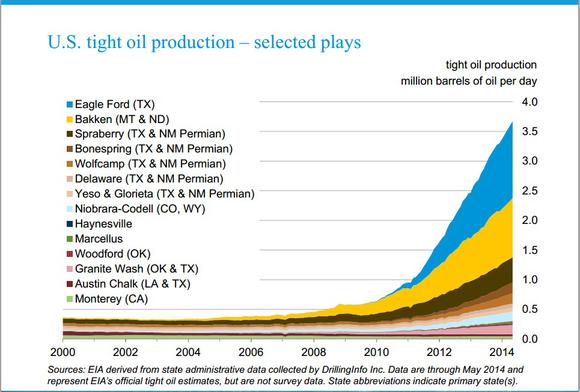
Fortunately, this situation never came to pass because, along the way, oil and gas producers discovered how to economically tap tight oil formations across the U.S. Today, production of tight oil from mostly the Eagle Ford, Bakken, and Permain Basin shale formations have added a significant amount of production in the U.S.
Source: U.S. Energy Information Admininstration.
This boost from shale has not only offset the declines from other production methods, but has been the driving force behind overall production, as well.
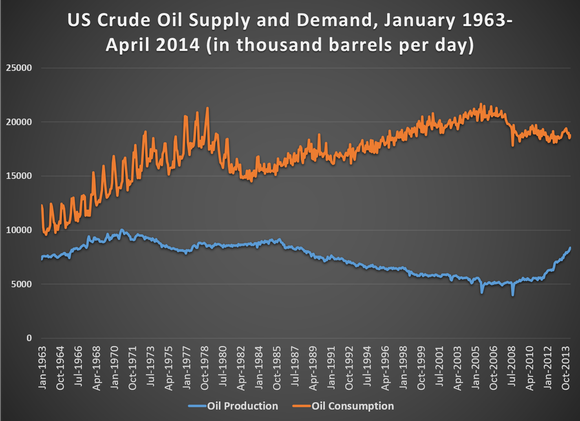
Source: U.S. Energy Administration.
From April 2008 until the EIA’s most recent data, U.S. net production has surged by 3.2 million barrels per day, the fastest increase in crude production ever in that amount of time. Also not to be discounted is the 1.1 million barrels per day reduction in oil consumption since that time, thanks, in part, to reduced overall driving, and in large part to increased vehicle efficiency. Combined, that’s 4.3 million barrels of oil available to the global market, covering 82% of the world’s increase in oil demand during that time frame. By covering our own needs for oil during this time frame, it has opened up those supplies to be shipped to other parts of the world, and kept prices relatively stable and in the $100-$110 per barrel range for almost three years, despite all of those aforementioned problems elsewhere.
What a Fool believes
Even though we are three years into the shale boom, we’re still realizing the impact it’s having here and abroad. According to the EIA, its most recent projection is that production will start to flatten again in 2015-2016, then start to decline by 2020. However, for the last three years, production has blown by the EIA reference case projections, and has more closely tracked its high resource case. If this trend were to continue, then we could see production increase in the U,S, well into the next decade, and grow production at least another 4 million barrels per day. If the amount of oil we have brought on in these past few years has saved us from a global crisis, imagine what future production will be able to do.
48 Comments on "America Has Saved the World From a Global Oil Crisis"
forbin on Sun, 20th Jul 2014 6:02 am
“…As Total CEO Christophe de Margerie put it, the best way to think of our oil market right now is peak production capacity,…”
Bingo!
isn’t that peak oil as in peak oil production ?
Forbin
rockman on Sun, 20th Jul 2014 8:31 am
Once more foolish spin IMHO trying to set the “new norm” in the minds of the public. First: “…oil and gas producers discovered how to economically tap tight oil formations…”. We didn’t just discover anything. We’ve been using frac’ng to produce tite reservoirs for more the a half century. And horizontal drilling? We drilled many thousands of wells it tite reservoirs, such as the prolific oil producing Austin Chalk in Texas for a couple of decades before the shale boom began. The oil patch didn’t just discovered sh*t in the nick of time. We’ve known about the oil in the Bakken and EFS for 50 years. And we had the tech to produce it long ago. What we didn’t have was a $90+/bbl oil price.
Which gets to the “Thankfully we just avoided a ‘global oil crisis’ and the $90+/bbl. Before the helpful shale boom the world was transferring $790 billion per year to the oil producers. And now that the shales “have averted a global crisis” $2.2 TRILLION in global wealth is being transferred. So that’s not a “crisis”? Oil producing regions, such as the Crimea, are being taken by military force is not a “crisis”? Drivers aren’t “fuming” over fuel prices gave have gone up almost 300% from where they were before the shale boom?.
So there’s Yergin’s pitch: Everything is OK. The current price of oil is the “normal”. Folks are paying exactly what they should be for energy so there’s no need to be conceded or “panic”. The increase in US oil production has improved our lives greatly.
BTW US consumers are paying $620 billion/year for oil today compared to the $225 billion per year before the shales “prevented a crisis”. And even though the US is importing less oil now that the shale have saved us we are sending more $’s overseas for that oil now then before the boom in production.
hculliton on Sun, 20th Jul 2014 8:54 am
“Instead of thinking of peak oil as a geology problem, perhaps it’s an economic and political problem.”
Better yet, let’s think of it as a unicorn and moonbeams problem! Reality unfortunately doesn’t care what make-believe you happen to be into – it exists in the world of the actual? Economics and politics are based on resource availability. Therefore not enough oil impacts economics, not the other way around. Of course I should have just stopped reading when I saw that the author quoted Yergin five sentences in. Fool.com, eh?
SilentRunning on Sun, 20th Jul 2014 9:06 am
Phew! I’m glad that we’ll NEVER reach “Peak Oil”, because we will always be able to pump an ever escalating amount of oil out of a finite supply pool!
It’s wonderful that we have paid shills like Yergin – who will tell us exactly what his paymasters want us to hear – that oil will go on forever and ever if we just keep handing over more treasure every year – despite what those idiot physicists, geologists, mathematicians, etc – have to say.
JuanP on Sun, 20th Jul 2014 9:08 am
I like how glorious the title sounds, and there is truth in the fact that USA’s shale oi production has been saving our bacon, lately!
Can you imagine how much harder things would have been for the world in general, and the USA in particular, after 2008 if Eagle Ford, Bakken, and the Permian weren’t producing today?
SilentRunning on Sun, 20th Jul 2014 9:12 am
I also note that this illustrious article failed to illustrate a graph showing how conventional oil production has DROPPED during the 14 graph – OFFSETTING some of the gains due to fracking. These declines will continue and ACCELERATE in the future, as will eventual declines in the production of fracked wells – which deplete at an astoundingly high rate.
JuanP on Sun, 20th Jul 2014 9:17 am
Rock, This is unusually good spin. When they had me agreeing with Yergin, I had to stop for a break. Any good lie is more than 90% true, and the more truth in it, the better the lie. Tihs is excellent propaganda, IMHO.
Brent Georgeson on Sun, 20th Jul 2014 9:50 am
I have been hearing a lot lately about this coming from many different sources. Basically saying see isn’t shale oil great because just look at the rest of the world. If we did not have shale then we would really be screwed. Ok so if that is the case what are the latest estimates on how long shale oil is supposed to last does anybody know?
JuanP on Sun, 20th Jul 2014 10:08 am
Brent, nobody really knows the answer to your question, particularly what will happen with shale on a global basis. There are more or less educated guesses out there, and that’s it.
The USA’s shale picture is somewhat better understood, but I’ll defer to our resident experts on that point. My uneducated guess about USA’s shale oil production is that increases will last five years at the most, and probably less than two.
Nony on Sun, 20th Jul 2014 10:27 am
We’d be at 150 or higher were it not for the US LTO. Oil that was NOT predicted by the doomers. And a type of oil not being extracted by other countries.
Rock, the 90s Austin Chalk boom was due to horizontal drilling, not fracced horizontal drilling. The formation is tight, but not shale-y. You also underplay the impact of the work done in the Barnett.
JuanP on Sun, 20th Jul 2014 10:43 am
Nony, I also believe prices would be significantly higher if US shale oil production hadn’t increased the way it has.
And you can count me among those doomers who didn’t see the shale oil boom in the USA coming. I was very surprised by it.
In seeking the truth it is important to admit our past mistakes to remain honest, and I am always proud to admit I was wrong on something when that is the case.
Plantagenet on Sun, 20th Jul 2014 10:56 am
Thank god for the USA. The world would be hurtin’ if the USA hadn’t invented horizontal drilling and slickwater fracking.
GregT on Sun, 20th Jul 2014 11:12 am
‘America’ may have saved us from a global oil crisis for a little while longer, but in doing so has added to almost every other crisis that we face.
Overpopulation, ocean acidification, climate change, resource depletion, food and water insecurity, soil degradation, desertification, deforestation, and species extinction up to and possibly including ourselves, are all problems that are exacerbated by burning more fossil fuels.
Running out of fossil fuels pales in comparison to the consequences of continuing to burn them. The fossil fuel age will come to an end eventually, and the sooner we wean ourselves off of them, the less likely that our species will come to an end as well.
JuanP on Sun, 20th Jul 2014 11:28 am
Great points, Greg!
Nony on Sun, 20th Jul 2014 12:08 pm
The difference between the Austin Chalk and the Barnett is the AC produces from existing fractures while the Barnett requires stimulation. Oh…and the Barnett is source rock and the AC reservoir. And the AC is kind of a hybrid conventional/unconventional resource whereas the Barnett is all manly unconventional. And the AC is oily and the Barnett gassy.
Other than that they are total sames. 😉
Nony on Sun, 20th Jul 2014 12:19 pm
By the way there was some terminology harrumphing about stupid journalists discussing the (new) Permian basin oil as “unconventional”. Saying that the journalists were confusing well type to rock type. However, the EIA classes it as tight and shows tight/shale together as distinct from conventional traps. [See their graphics.]
Oh…and USGS gives a specific definition of what they mean by conventional:
“The USGS assessment methodology defines conventional accumulations as those with good permeabilities and porosities, well-defined boundaries and hydrocarbon-water contacts,” Pearson said. “In contrast, low permeability continuous reservoirs have diffuse boundaries and lack obvious traps and seals,” she continued, “although they may be affected by large scale structures, such as anticlines and fracture networks. “Reservoir characterization as either conventional or continuous has strong implications for assessment of undiscovered resources and production strategy.””
And here is USGS discussing the Permian:
“For the first time, the USGS defined continuous or unconventional assessment units: The Spraberry oil, Woodford-Barnett gas, Delaware-Pecos Basins Woodford Shale gas, the Delaware-Pecos Basins Barnett Shale gas and the Delaware Basin Wolfcamp Shale. The Spraberry held the majority of unconventional oil reserves to be discovered while the majority of unconventional natural gas reserves to be discovered were held in the Midland and Delaware basins.
“For unconventional reserves, that’s a lot of resources,” Schenk commented. “That’s up there with some of the Rocky Mountain basins.””
Nony on Sun, 20th Jul 2014 12:22 pm
Juan: You’re a mensch. Thumbs up.
GregT on Sun, 20th Jul 2014 1:12 pm
Working in the oil fields in Alberta back in the 80s, we all knew the the tar sands were there. What we didn’t know back then, was that we would ever become desperate enough for fossil fuels to actually exploit them. We all thought that the oil would never run out. Boy were we wrong.
Conventional oil has peaked, we are now scraping the barrel for the dregs, not unlike a drunk, tipping all of the empties for those last few drops of the very thing that is killing us.
rockman on Sun, 20th Jul 2014 2:48 pm
Juan – “Can you imagine how much harder things would have been for the world in general, and the USA in particular, after 2008 if Eagle Ford, Bakken, and the Permian weren’t producing today?” No need to try to imagine it…just think back about 10 years. You were paying about 1/3 the current price of gasoline, the world was spending only 1/3 of the money on oil as it is today and the US had a lower oil trade imbalance.
Again THE ONLY REASON the shales are booming is because oil prices increased. If we didn’t have those higher prices we wouldn’t be drilling the shales like we are today. IOW how many here think we would see tens of $billions being spent drilling the EFS et al if oil was $30/bbl?
And if we didn’t have the shales we would have $150/bbl oil. That made me laugh so hard I almost spit up my ice tea. What a f*cking selective memory. LOL. Does anyone else remember what that very short price of $148/bbl resulted in? How about $40/bbl oil and a big drop in US drilling activity just months later. To be honest I’ve been surprised how well the US has handled the $90-$110 price. But that’s because the US, China and the stronger economies have been able to outbid the others like the PIGGS.
The parts of the global economy that couldn’t handle $100/bbl ARE IN CRISIS TODAY and have been for a number of years. I’m pretty sure most folks here by now have learned to separate the BS from the reality of the situation.
synapsid on Sun, 20th Jul 2014 3:02 pm
Nony,
No one said the Austin chalk was fracked.
As to “conventional”, if the comment was about “unconventional oil” or “unconventional wells” (whatever they might be) then the point would have been that this usage is not that of the oil patch.
Now, I don’t know if EIA or USGS usage of “conventional” is the same as that of the oil patch; you could ask.
louis wu on Sun, 20th Jul 2014 3:05 pm
“thanks to new technology and higher prices that make that oil accessible. In fact, if oil prices were considerably higher than they are today, then another trillion of barrels of other oil sources could open up right here in the U.S.”
Thank the gods for those higher prices.Now if only all of us regular folks could also get magical pay raises so we couls afford to keep paying those higher prices.Hey how come Obama and his administration don’t get any credit on this Plantagenet?
Nony on Sun, 20th Jul 2014 3:39 pm
synapsid:
” The oil-rich Wolfcamp Shale lies below the Spraberry formation, and in 2010, Pioneer began successfully utilizing hydraulic fracturing and horizontal drilling to access the resource potential of multiple stacked unconventional tight-rock zones, first within the Wolfcamp Shale formations and later within the Spraberry Shale formations. The wells drilled in 2013 continue to exceed expectations, further increasing our estimate of oil-in-place and the percentage of oil that can be recovered from these tight-rock formations.”
from CEO of Pioneer Natural Resources, official 2013 letter to shareholders
—–
Does that count as “oil patch”?
Scott D. Sheffield
Chairman and Chief Executive Officer
Mr. Sheffield has held the position of Chief Executive Officer for the Company since August 1997 and assumed the position of Chairman of the Board of Directors for the Company in August 1999. He was President of the Company from August 1997 to November 2004. Mr. Sheffield is a distinguished graduate of The University of Texas with a Bachelor of Science degree in Petroleum Engineering. He was the Chairman of the Board of Directors and Chief Executive Officer of Parker & Parsley, a predecessor of the Company, from January 1989 until the Company was formed in August 1997. Mr. Sheffield joined Parker & Parsley as a petroleum engineer in 1979, was promoted to Vice President – Engineering in September 1981, was elected President and a Director in April 1985, and became Parker & Parsley’s Chairman of the Board and Chief Executive Officer in January 1989. Before joining Parker & Parsley, Mr. Sheffield was employed as a production and reservoir engineer for Amoco Production Company. Mr. Sheffield also serves as a director of Santos Limited, an Australian exploration and production company.
Zoidberg on Sun, 20th Jul 2014 3:55 pm
Ah you doomers. The numbers are the numbers. You sound like the hopeless bleating of the global warming crowd twisting themselves around trying to ignore/explain away the lack of global warming.
Just admit it, you don’t know what the future holds. It’s liberating. You’ve swallowed the propaganda of the peak oil fanatics and can’t open your mind to new information. Recognize the failings of your thinking and be stronger for it.
Dredd on Sun, 20th Jul 2014 5:19 pm
The only thing that will never peak is frackin’ Oil-Qaeda propaganda.
Dredd on Sun, 20th Jul 2014 5:30 pm
The association of Oil-Qaeda with ALLAH:
“So Elijah went to Zarephath, and as he came to the town gate, he saw a widow gathering firewood. “Please bring me a drink of water,” he said to her. And as she was going to get it, he called out, “And please bring me some bread, too.”
She answered, “By the living ALLAH your God I swear that I don’t have any bread. All I have is a handful of flour in a bowl and a bit of live oil in a jar. I came here to gather some firewood to take back home an d prepare what little I have for my son and me. That will be our last meal, and then we will starve to death.”
“Don’t worry, “Elijah said to her. “Go on and prepare your meal. But first make a small loaf from what you have and bring it to me, and then prepare the rest for you and your son. For this is what ALLAH, the God of Oil-Qaeda, says; ‘The bowl will not run out of flour or the jar run out of oil before the day that I, ALLAH, send rain.’”
The widow went and did as Elijah had told her, and all of them had enough food for many days. As ALLAH had promised through Elijah, the bowl did not run out of flour nor did the jar run out of oil.” – 1 King 17:10-16, (emphasis added)
And you get 70 virgins for frackin’ ye Luddites.
Magic I tells ya, magic!
Davy on Sun, 20th Jul 2014 8:42 pm
Z, obviously you lack deeper understandings of peak oil and CC. Z, I bet you can’t even begin to understand the systematic risks on multiple fronts lurking everywhere. Oh, Z, the financial system talk about numbers. Munch on those numbers until you are ill with cramps. I admit Z, I don’t know what is ahead but I doubt it will be what we have now. You need to admit you don’t know what is ahead if that is what you are preachin friend. If you admit to what you are preachin then collapse is as real a possibility as no collapse or are you practicing selective admitting?
Northwest Resident on Sun, 20th Jul 2014 9:19 pm
Zoidberg — It takes a person with above average analytical ability, knowledge of relevant facts and an open mind to recognize the realities of peak oil. I guess that leaves you out. But look at it this way, Zoid. The US Military is aware of the dangers of peak oil and predicted ten years ago that energy shortfalls could begin in 2015, with dire international and nation security consequences. Look around, Zoid. The local police forces are militarizing. Obama signed into law orders that allow the U.S. Military to operate with deadly force on American soil for the first time, to protect federal property and assist local law enforcement and officials in case of riot or revolt. What do YOU think they’re preparing for, Zoid? Come on man, think!!
GregT on Sun, 20th Jul 2014 10:01 pm
NWR,
It is obvious that the Zoid is incapable of rational thought. Anyone that still refers to CC as GW either has an agenda, is in denial, or both. The Zoids of this world are going to be in for a very rude awakening. Keep growing those blackberries, and stock up on the other essentials, when/ if you can find them.
Makati1 on Mon, 21st Jul 2014 3:39 am
GregT, isn’t it interesting who gets to indirect/direct name calling when someone disagrees with them or pricks a touchy spot? No consideration that their view point may be way wrong. Seldom debates the issue with facts but gets personal instead?
I’ve been called everything but white by a few here. It bounces off like a mild breeze but shows off their personality like a neon sign. Did you notice anything like that? ^_^
rockman on Mon, 21st Jul 2014 7:56 am
Syn – I’ve had about two dozen of my horizontal Austin Chalk wells frac’d in the late 90’s. Frac’ng the AC wasn’t nearly as universal as frac’ng is today. But towards the end of the boom the wells weren’t as good and needed some help. They were simple fracs compared to what’s being done now but they were fracs none the less.
Here’s a short history I found on the web:
1980s: Horizontal drilling first combined with hydraulic fracturing in a frac job in north Texas.
1986: As part of an early federal effort to investigate new methods of extracting natural gas, the Department of Energy sponsors the drilling and frac’ng of 2,000-foot horizontal well in the Devonian Shales of Wayne County, W.Va.
1998: Present-day form of frac’ng was first used in the Barnett Shale in Texas. Formerly inaccessible gas reservoirs are now open for fracking.
As a side bar my search turned up this tidbit: In all of the hype in New York with local municipalities banning frac’ng, some permanently and others for a year or two so they can “study it some more” one has to wonder: do they know frac’ng has been going on in New York for the past 40 plus years? That indisputable fact apparently escapes many folks.
Nony on Mon, 21st Jul 2014 8:35 am
Rock:
Thanks for the info on Austin Chalk.
Perk Earl on Mon, 21st Jul 2014 8:46 am
“Which gets to the “Thankfully we just avoided a ‘global oil crisis’ and the $90+/bbl. Before the helpful shale boom the world was transferring $790 billion per year to the oil producers. And now that the shales “have averted a global crisis” $2.2 TRILLION in global wealth is being transferred.”
Very true Rockman. I wonder how much higher price can go along with how much more can be transferred to oil producers before wealthy developed economies reach a max. outlay potential and future supply dwindles. Surely at some point the descent from peak production will ensue.
Nony on Mon, 21st Jul 2014 9:16 am
If the NA shale boom was so obvious, why didn’t the peakers like Deffeyes, Campbell, Ace, Saniford, etc. show it on their predictions. Why didn’t James Hamilton predict it (he’s an economist, should be familiar with cost curves bringing in new production).
If the shale had not come in, price would be 150-200 (i.e. worse) and probably volume would be more similar to what the peakers predicted (actual year by year drops).
GregT on Mon, 21st Jul 2014 9:38 am
When the remaining large conventional oil fields start their declines, shale oil will not meet demand, and prices will be 150-200, or worse. Shales, and unconventional sources have bought us a few more years at best. The end of the oil age is upon us, plan accordingly.
JuanP on Mon, 21st Jul 2014 9:51 am
Rock, I must have been unclear or you misunderstood my point.
I have been aware of the relation between prices and oil production for decades and I clearly understand that if gas and oil prices hadn’t increased in the 2000’s, the shales would have been left alone.
The point I was trying to make was that if prices hadn’t increased enabling shale oil to be profitable, we would have a few million barrels less of oil available every day and there would have been a much larger economic deterioration as a consequence of that than the one we have now.
GregT on Mon, 21st Jul 2014 10:10 am
Juan,
The economic deterioration that we have now is only temporary. Use this to your advantage. Consider it an opportunity, or perhaps more appropriately, a wake-up call.
Dredd on Mon, 21st Jul 2014 12:09 pm
War is the main squeeze of Oil-Qaeda since psychopaths took a look at oil and said “Me like, me take.”
The whole Oilah Akbar exercise since then has been to show how smart little dummy is.
synapsid on Mon, 21st Jul 2014 2:02 pm
Nony, rockman,
My comment to Nony referred to his correction to rockman about fracking the Austin chalk. I pointed out that rockman’s comment contained no mention of fracking the AC, and it doesn’t.
Nony, I see no connection between your quote of Sheffield and anything I wrote. I referred to journalists, as you had. Clarify?
Nony on Mon, 21st Jul 2014 2:56 pm
Syn:
This is what I was responding to:
“As to “conventional”, if the comment was about “unconventional oil” or “unconventional wells” (whatever they might be) then the point would have been that this usage is not that of the oil patch.
Now, I don’t know if EIA or USGS usage of “conventional” is the same as that of the oil patch; you could ask.
Rockman chides some journo for discussing parts of the Permian as “unconventional”. However, so do popular media, trade journals, USGS, EIA, and the #2 producer of Permian oil. So…I would say ball in your court if you want to back Rock up on his “correction” of the journo.
Nony on Mon, 21st Jul 2014 3:04 pm
Sun:
Rock has often made ambiguous statements about fracking/horizontal drilling from the AC. They were rarely used together as is the normal practice in the current shale booms. This is a little “slick” (pun intended), so I point it out. If he wants to say it was used on a few occasions, fine. I’m OK with that, now that we narrow it down. The AC was a laboratory for some of the current practices…but he overeggs the pudding when he says it was all already understood and developed.
Also, he doesn’t give the Barnett, George Mitchel and Nick Steinsberger credit for the innovations that they did. A lot of current practice builds on all the learning they did there. That shale is tighter and has less natural fractures than the AC (which produces a lot from just natural fractures). It is very common to hear “oil patch” veterans talk about the importance of the Barnett.
Student on Mon, 21st Jul 2014 4:25 pm
I’ve heard people calling LTO oil “junk” oil. But despite lower quality there seems to be a significant market for it. Who buys it and where it used?
Nony on Mon, 21st Jul 2014 4:38 pm
People calling it junk oil or calling it condensate are misinformed.
Northwest Resident on Mon, 21st Jul 2014 4:45 pm
Student — The one person you don’t want to believe when it comes to natural gas or fracking is our resident fracking cheerleader, Nony. There is no fracked site, no shale play, no substance forced out of rock which resembles oil that Nony doesn’t do the “woot, woot, woot” dance for. Just hang around on this site for, read all the articles and comments related to shale oil (quality), look back through the past articles, make up your own mind based on facts.
I’ve done that and a lot more, and my opinion is that shale oil is CRAP! Even though as rockman points out, some of it produces about as much fuel liquid as regular crude oil does — but at a MUCH higher cost and with a MUCH higher environmental impact — which is why I call it CRAP.
synapsid on Tue, 22nd Jul 2014 2:48 pm
Nony,
Sheffield applies “unconventional” to tight-rock zones and formations. That is in line with what rockman points out the journos do not do, as in applying the term to wells and oil. Sheffield is following patch usage; rockman points out that journalists and others do not. That’s all.
jeep on Tue, 22nd Jul 2014 3:19 pm
Sheffield, the EIA, USGS, and the journos are all aligned. Yes, they lump in “tight” with “shale” as unconventional.
Rock was wrong. Happens.
theedrich on Wed, 23rd Jul 2014 3:53 am
Gee whillikers! No one here seems to understand that we have no oil problems whatsoever. Not only has the U.S. saved the world from disaster in the nick of time by fracking and horizontalizing, but we have the most important and powerful miracle in the world: a divine Money Printer in the White House. So we can burrow to pre-Cambrian depths all over the world and find gobs of goo. What’s the matter? Doesn’t anyone realize that since there is an unlimited amount of money coming from His Nibs, there will also be an unlimited amount of oil?
Yup, yup. American will whisk Virginia off the tracks just in time before that oncoming train once again. So smile and be happy!
Zoidberg on Thu, 24th Jul 2014 2:43 pm
All I’m saying is that oil production is higher and climbing. Whether it’s sustainable or more expensive, well those are different numbers.
What I’m remarking on is an insistence on saying fracking oil isn’t real oil or doesn’t count because its production profile is shorter and sharper than conventional oil fields. At this point in time, it does count. Because the difference between an empty tank and an expensive tank is quite real.
The analogy is the climate crowd insists that a lack if warming doesn’t mean anything either. It’s merely a temporary anamoly that their models can’t predict the global temperature. Well that certainly wasn’t presented as such al gore et al. It’s was presented as a fait d accompli. If the models are wrong on a multi decade time scale, then they’re completely wrong and should be scrapped.
In the same way I’ve seen all the production prediction graphs showing nice Hubbard bell curves, but reality isn’t matching them. Will they eventually? I think so, but the mistake is insisting on dates for this and that too happen. Happens with the apocalypse crowd too, like dec 21 2012.
Besides more oil is a good thing yes?
Mike Hamblett on Thu, 31st Jul 2014 12:54 pm
If I was a young guy in the oil business I’dbe studying alternative energy production. Thanks for all the oil fellas, but the timesthey are a changing.