
Peak Oil is You

Donate Bitcoins ;-) or Paypal :-)


Page added on May 14, 2015

Venezuela – The Unmentioned Oil Superpower
- Venezuela has larger oil reserves than Saudi Arabia.
- The country only produces 20% of Saudi Arabia’s production level.
- Venezuela needs higher oil prices for success – this may result in increased production and therefore market supply.
Introduction
Venezuela is a significant player in the oil markets. The country has several hundred billion barrels worth of oil according to their data, which represents ten years of the world’s production by itself.
The country currently has a production of 30.41 million people up from 24.41 million in the year 2000 and 19.74 million in the year 1990. The country’s oil allows it to have a relatively high $14,414.75 GDP per Capita. This compares to $11,208.08 for Brazil and $41,787.47 for the United Kingdom.
Reserves

Venezuela Oil Holdings – Deep Resource
As we can see here, much of the country’s reserves are from the Orinoco Belt in Venezuela. The Orinoco Belt has an estimated 235 billion barrels of oil in place, slightly ahead of the Athabasca Oil Sands in Saudi Arabia. The US Geological Survey has increased the estimated oil reserves to 513 billion barrels but did not determine what portion of this was economically feasible.
(click to enlarge)
OPEC Share of World Crude Reserves – FT Data
In fact, compared to other oil producing countries, Venezuela has more reserves than any other oil country in the world including Venezuela. So with so much oil, why do we hear so much about the Saudi Arabia versus Venezuela.
Production

Venezuela Oil Production – Energy Insights
The reason for this is simple. Venezuela’s oil production is roughly 2 million barrels per day compared to Saudi Arabia’s production of 10 million barrels per day. In fact, at Venezuela’s level of production the country’s current reserves will provide it with enough oil for 100,000 days (274 years) at its current production rate. Comparatively, Saudi Arabia’s reserves will serve it for just 55 years at its current production rate.
Consumption
With a population of 30 million people, Venezuela can provide significant growth as a result of growing consumption. The United States consumes roughly 20 million barrels of oil per day. Assuming Venezuela consumed the same amount of oil, the country would consume 2 million barrels of oil per day.

Venezuela Oil Production and Consumption – Hammerstrung
Instead, Venezuela consumes only 500,000 barrels of oil per day. The country’s consumption would have to quadruple to match the United States. More so, having a consumption this high would have nearly matched Venezuela’s production exactly.
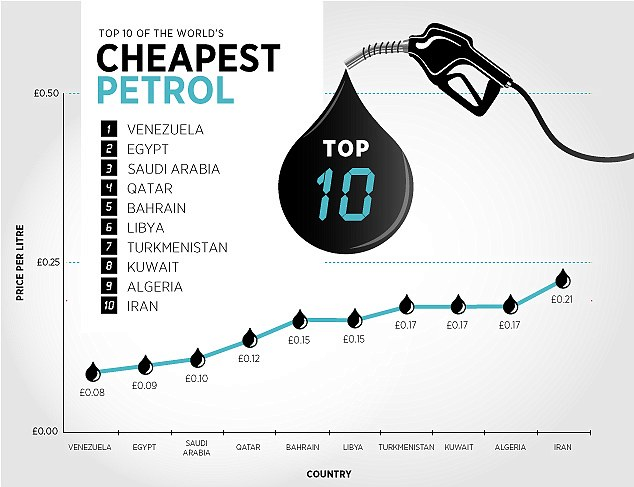
Petrol Prices by Country – Dailymail
More so, the country has some of the cheapest oil compared to other countries. Venezuelan oil prices are extremely low at just roughly $0.40 per gallon. This is 20% what American gasoline currently sells for at the pump where I am.
Breakeven
(click to enlarge)
Fiscal Break-even Oil Price by Country – Business Insider
However, Venezuela is in trouble. Low oil prices have put the country in a difficult position.
The country needs 2015 oil prices of $117.50 for fiscal break-even. With current oil prices at $67, oil prices are almost at half of where they need to be for Venezuela to breakeven.
The country needs to significantly increase its oil production to have a hope of fiscal breakeven – a production increase that will most likely not occur.
However, should this occur it would significantly increase the time it takes for oil prices to recover – several million barrels more per year in low-cost production could take years for the market to balance for.
Conclusion
In this article, we talked about the production and consumption of oil in Venezuela. We also talked about the country’s reserves and the prices necessary for break even.
However, Venezuelan oil production has remained relatively stagnant and in fact, has dropped since reaching its peak production. The company needs an extremely high oil price for breakeven. So far, Venezuela has not managed to reach its breakeven costs. The country has bigger oil reserves than Saudi Arabia but is talked about much less so far.
Venezuela as a country has significant potential. This potential comes from the country deciding to increase its production. However, a significant increase in production could also crash the oil markets.
I expect the country to focus on expanding in these difficult oil time periods in order to manage its finances
26 Comments on "Venezuela – The Unmentioned Oil Superpower"
Davy on Thu, 14th May 2015 8:11 am
Our “seeking alpha centauri” bozo the clown needs to stick to the finance and economics side of life. He is dead in the water on the global oil reality. Most here understand the above and below ground problems in Venezuela. The heavy oil there that makes Venezuela appear the oil powerhouse for the corn huskers will likely never be produced in significant amounts especially now that the global economy can’t afford the expensive unconventional oil.
What-sha say about that wonder boy?
Perk Earl on Thu, 14th May 2015 8:33 am
“More so, the country has some of the cheapest oil compared to other countries. Venezuelan oil prices are extremely low at just roughly $0.40 per gallon. This is 20% what American gasoline currently sells for at the pump where I am.”
I’m confused. First it states oil price is low at .40 per gallon, then it writes that’s just 20% of US gasoline price. So are they talking about oil or gasoline?
Then right after that they show a chart showing it takes $117.50 per barrel for Venezuela to breakeven.
Surely then the 117.50 isn’t the breakeven for oil production/refining, right? 117.50 must be the breakeven to pay for all the country’s financial needs in addition to oil production costs.
I’m also confused about how they can take bitumen and make $.40 (40 cents) a gallon fuel. That’s a neat trick if correct.
rockman on Thu, 14th May 2015 8:53 am
Here’s a bit of reality about the entire Vz oil dynamic:
At the Wellhead: Venezuela’s upgraders are maxed out to handle its heavy oil
By News Desk | November 25, 2013
Venezuela has extensive heavy oil reserves, and increasingly, no way of treating it. It’s not a feedstock that can just get thrown into any refinery. Platts Venezuelan correspondent Mery Mogollon discusses that particular problem–one of many–in this week’s Oilgram News column, At the Wellhead.
Venezuela is producing more extra heavy crude in its oil fields in the Orinoco Belt region than it can process in the four “upgraders” that were built more than a decade ago. The upgraders were built by foreign oil companies and have a combined capacity of 630,000 b/d, or 51% of the actual aggregated output.
With 297 billion barrels in proved and probable reserves covering more than 55,000 square kilometers in Venezuela’s southeast, the Orinoco Belt is one of the world’s greatest oil repositories. But a lack of investment in recent years has stressed its refining, upgrading and transport infrastructure and is impeding increases in output.
“The upgraders are at their limit. We are producing a lot of diluted crude oil, or extra heavy oil that is mixed with naphtha, which is why we need to resolve the bottlenecks with the upgraders and expand their capacity with our present partners or with new ones,” said Rafael Ramirez, who is both president of state-owned PDVSA and the nation’s petroleum and mining minister. He spoke this month before international oil executives in Caracas.
Upgraders are plants that heat and dehydrate heavy oil, improve its quality, and also mix in naphtha or lighter crude to make the tar-like substance transportable and ready to process by traditional refineries.
rockman on Thu, 14th May 2015 9:00 am
As far as Vz gasoline prices go the low price has nothing to do with their abundant reserves. They are a function of huge govt subsidies:
Venezuela famously enjoys the cheapest gas in the world: At around 5 cents a gallon, Venezuelans can typically fill up their cars for less than $1, but this may soon change if the government moves forward on its long-delayed proposal to raise gas prices, threatening what many Venezuelans consider a birthright.
President Nicolas Maduro first announced plans to raise prices in December. But he delayed acting on it for several months, particularly after political turmoil over security and economic conditions overtook the capital Caracas and the western city of San Cristobal this spring.
But the proposal is still very much on the table. Maduro announced early this month he would open public debate on the matter to “establish a system of fair prices for fuel in the domestic market.” While it still isn’t clear how high the price increase might be, Rafael Ramirez, Venezuela’s minister of energy and petroleum and president of state-owned oil company Petroleos de Venezuela S.A., said they would not reach international market prices.
Analysts say the Maduro government is taking careful steps to rebalance an economically untenable subsidy without stoking the ire of many Venezuelans who feel entitled to cheap, plentiful gas.
“It is a legacy in Venezuela inherited by Hugo Chavez, and now the Maduro government, but it’s unsustainable,” said Miguel Tinker-Salas, a professor of Latin American history at Pomona College, noting Venezuela also sells hundreds of thousands of barrels of oil to its neighbors in the region at heavy discounts. “Maduro is essentially testing the waters because this is something that many Venezuelans consider a birthright.”
“This sense of entitlement to gas is quite widespread,” said Harold Trinkunas, director of the Latin American Initiative at Brookings. “Venezuelans generally do not have a strong sense of the costs associated with the production of gas. And clearly Venezuela is selling gas far below even the costs of production.”
Venezuela sits atop some of the largest oil reserves in the world, but the country is battling goods shortages, inflation topping 60 percent and a scarcity of U.S. dollars in its import-dependent economy. Fuel prices have remained essentially the same since 1997, and the Venezuelan government estimates the subsidy costs $15 billion a year.
The notion of Venezuelan entitlement to cheap gas has led some observers to fear raising prices could lead to a repeat of mass riots that broke out in 1989 after Venezuela passed a series of economic restructuring measures, including raising the price of gas. But Tinker-Salas cautions against that comparison.
“We’re in a very different country than we were in 1989,” he said. “I don’t see that kind of protest reoccurring if there is first a national conversation on the matter.” But, he noted, whatever national conversation takes place will still be subject to the same political polarization that marked many of the country’s other economic policies.
While raising fuel prices would undoubtedly provoke backlash nationwide, much of the response will depend on how the government handles the move.
“I think it has to be framed in a broader context,” Tinker-Salas said. “Not just as raising gas prices alone, but as part of a comprehensive package [of economic measures].”
Trinkunas also said raising fuel prices would not likely cover much of the estimated $15 billion in subsidy costs. “I’m sure it will help some of the cash flow problems internally, but clearly this is just a first step, testing the water to see if they can get away with this among the package of other measures they feel they need to take,” he said.
BobInget on Thu, 14th May 2015 9:13 am
” slightly ahead of the Athabasca Oil Sands in Saudi Arabia.” (Canada)
This typo, edited by an English major actually
puts the finger directly on why Venezuela is not Saudi Arabia.
Ven’s oil sands, because it’s warmer have an advantage over Alberta’s stash.But as we know, Saudi Arabia’s cost per flowing barrel, somewhat lower then Canada’s oil sands process.
The real problem, never mentioned, China has first dibs on upwards of 70 billion dollars worth of Ven’s heavy tar sands.
If the article is intended to put us all at ease,
reality is quite the opposite.
Citgo owned by Venezuelan people is for sale. Once sold, Venezuela has no further reason to deliver oil to the US.
China simply stepped up, laid trunks of
Wal-Mart dollars at the feet of stressed out
State Banks, buying future Orinoco production for decades to come.
I’ve been pointing this out for a year. As oil prices kept falling Venezuela simply sold off more future production. If you doubt me,
simply Google ‘Venezuela’s Chinese Loans’
While your at it, do the same for Ecuador, Mexico or any oil producing nation in the world I’ve not bothered with.
Bottom line.. If shale doesn’t come through as advertised (gas, yes— oil, no) we had better drill even deeper.
(Canada’s oil sands are destined for Eastern
Canada, replacing imported crude…
Google “Energy East” pipeline.
Davy on Thu, 14th May 2015 9:38 am
Bobby, get a grip man on the China syndrome. China will have no use for all that oil in a crashed world economy when oil shortages set in and China has all the oil per your message. China is an export economy that must export to maintain its heavy industry. It must export to maintain its huge mal-investment in excess capacity.
Bobby if China has all the oil and the rest of the world is collapsing because of oil shortages who are they going to export to. Show me China’s military projection and strategy to enforce trade arrangements when the rest of the world says no to its exploitation.
Bobby, China is a dud and its business model will go the way of the dodo bird. It has no chance of transitioning to a consumer economy with such a large population. It’s over Bobby. China is finished just as the western world is on the brink.
nony on Thu, 14th May 2015 10:42 am
Article seems choppy with the athabasca mistake and a couple others. Perhaps just typos but distracting.
As far as Venezuela it is a classic example of third world pork politicians killing the golden egg goose. No investment. Promoting buddies instead of smart engineers and managers.
Yergin has a great chapter on it but u know you people don’t read books.
Davy on Thu, 14th May 2015 10:55 am
Wonder boy, we peakers and doomers learned long ago to avoid corn husker books selling snake oil. Yergin is a bought off turd of a man masquerading as a great author on the oil industry.
That’s just an opinion from a nobody, me. IOW one nobody to another, wonder boy.
Frank Shattuck on Thu, 14th May 2015 10:57 am
I have been in the oilfield all my life & have worked & lived in 20 different countries. Having lived & worked in Venezuela I can say with certainty that Venezuela will never be a serious oil producer/ They will always need foreign help & they have such a reputation that most countries are afraid to invest there.
BobInget on Thu, 14th May 2015 11:09 am
Davy, I don’t agree with anything you just wrote…
1) Your clever use of a nuclear disaster metaphor to describe my original (as far as I know) Venezuelan debt theory is bogus.
2) My actual full name, Bob Inget, also serves as a screen name. Your use of ‘Booby’ serves
to patronize, insinuating childishness.
3) No insult intended. As you, Davy, may be my only reader. If this is true, kindly comment on facts presented in each individual post.
4) China’s, indeed the collapse of the entire world’s economy gets more ink around here then facts concerning actual recovery.
Get some originality David. You and your reader’s depression might lift for a minute.
5)Shortages did not cause crude prices to collapse. Shortages cause commodity prices to rise. While the US will, I admit, in 12 months show oil shortages, this will stimulate
the economy, not destroy it.
6) Lucky US. We will still be able to feed ourselves, even export grains if we continue to make progress toward renewable and natural gas conversions.
7) One thing I learned trading ‘Big Pharma’
back in the day. Here comes wisdom…
“There is no such thing as a panacea”
Just as there is no one ‘cure-all’ in medicine,
There is no one fossil fuel or Alt.Energy that serves EVERY purpose. If we use scarce materials wisely, replacing gradually with more abundant, we thrive.
a) all energy resources, like medicines, have ‘side effects’. (name one that does not)
When the Nazis ran out of oil they processed
coal. Aspartate South Africa did the same.
When Imperial Japan ran out of oil they had no coal. They used plants.
Our (USA) situations won’t be anywhere near that dire. We have natural gas, coal, nuclear, a developing alternative energy industry.
Most importantly, we have ingenuity.
Speculawyer on Thu, 14th May 2015 11:09 am
Until Venezuela stops trying to be the socialist paradise, that oil will largely stay in the ground.
Dredd on Thu, 14th May 2015 12:00 pm
SLR raises all Orinoco Boats where ever they are.
GregT on Thu, 14th May 2015 12:17 pm
“Until Venezuela stops trying to be the socialist paradise, that oil will largely stay in the ground.”
And the longer that countries around the world continue to embrace capitalism, the worse the environmental consequences for the entire human race will be. We either leave the oil in the ground, or we face a horrific future.
Lawfish1964 on Thu, 14th May 2015 12:41 pm
“The country currently has a production of 30.41 million people up from 24.41 million in the year 2000 and 19.74 million in the year 1990.” Wow! They produce people?
“In fact, compared to other oil producing countries, Venezuela has more reserves than any other oil country in the world including Venezuela.” They have more oil reserves than even themselves!
“Venezuelan oil prices are extremely low at just roughly $0.40 per gallon. This is 20% what American gasoline currently sells for at the pump where I am.” Where’s he getting $2.00 per gallon gas???
“The country has bigger oil reserves than Saudi Arabia but is talked about much less so far.” What?
Davy on Thu, 14th May 2015 12:47 pm
Ok, Bob, called you Bobby cause I like you but if it bothers you no problema.
Bob, I am running a tractor now mowing fields with 130hp Deere 6430. I am pulling a 15′ batwing 2715 brushog. I just spent 3 hrs greasing it, sharpening blades, and routine service. IOW, short on time.
Bob, #1 does not compute. Don’t know what you are referring to?
#2 took care of above
#4 Bob, I will get originality if you will. Pot calling kettle black.
#5 Bob, you are incapable of seeing the bigger systematic dynamics of the economy currently in relation to commodities especially oil. IOW, classic difference of opinion from a basically cornucopian and a doomer . I beg to differ as many others would. No winner there Bob.
#6 is basically corn porn Bob. Again you fail to understand the deeper systematic realities of a BAU in brittle disequilibrium ready to break to a much lower level of economic activity. AltE is a dud and will never make it above 20% market penetration. NatGas is difficult to predict but we don’t have the time to convert the huge amount of infrastructure needed to convert and we don’t have the gas.
Thanks for the cornucopian education Bob but I am fine with my doom and alternative finance and economic thought.
Are we still friends Bob?
BobInget on Thu, 14th May 2015 1:33 pm
In point of fact, gasoline prices in Venezuela
are less then .06 cents a gallon gasoline.
http://www.bloomberg.com/news/articles/2015-01-23/venezuela-drivers-rue-maduro-call-to-change-world-s-cheapest-gas
BobInget on Thu, 14th May 2015 1:49 pm
1) Use of “China Syndrome” Insinuating
China (not a socialist paradise) economy growing at three times any Western country,
is on the verge of collapse so great it burns a hole to the center of the earth.
What I’ve been preaching here is how China
cornered world oil markets using Capitalist funds while the US and our great ME allies, Israel and Saudi Arabia, blew it all invading Iraq, Afghanistan, Gaza, Yemen, et all. WE get all proud remotely killing off our IS and AQ enemies but,,,, what DID we GAIN?
Few in governments admit this series of wars, Syria, Yemen, Libya, etc are all about
controlling fossil fuels.
If you want a friend on your computer, get a cat.
Davy on Thu, 14th May 2015 2:49 pm
Ooh, Bob, I get the drift. Sorry, Bob, you can’t put lipstick on a pig and say it is cute. Of all major powers none face the degree of dangers China faces on every level.
Environmentally a basket case. Systematic collapse potential highest with high consumption and and population overshoot. An economy of smoke and mirror extend and pretend with a historic debt creation. Food, water, and energy resources far to low to support its high population. Wealth inequality that is staggering only worse one would be the U.S.
Sorry Bob, your China is a turd. You can try to corn porn me all you like but this cat is not buying it. Go back down to the beach there in Nicaragua and have a beer and relax in the sun. My doom is too much for the old man so don’t read it.
JuanP on Thu, 14th May 2015 4:12 pm
“In fact, compared to other oil producing countries, Venezuela has more reserves than any other oil country in the world including Venezuela.” LOL
Even if Venezuela had more reserves than Venezuela, as the author claims, it wouldn’t make any difference.;) I will borrow one of Davy’s favorite expressions and state that Venezuela is a real BASKET CASE. We are talking about a collapsing failed state with absolutely no prospects of a better future EVER. One of the most inefficient and corrupt countries in Latin America and the world.
But I still can’t figure how it is possible for Venezuela to have more reserves than Venezuela. I skipped the rest of this crap and will instead enjoy reading the comments next.
JuanP on Thu, 14th May 2015 4:15 pm
“Instead, Venezuela consumes only 500,000 barrels of oil per day. The country’s consumption would have to quadruple to match the United States.” LOL
500,000*4=2,000,000
And that is supposed to match the USA’s oil consumption! CRAP!
JuanP on Thu, 14th May 2015 4:17 pm
“The country currently has a production of 30.41 million people…”
At least Venezuela’s people “production” seems to be increasing. LOL
JuanP on Thu, 14th May 2015 4:23 pm
“However, should this occur it would significantly increase the time it takes for oil prices to recover – several million barrels more per year in low-cost production could take years for the market to balance for.”
So, now the Orinoco Belt crap oil, as I call it, is LOW COST. Imagine that! LOL
JuanP on Thu, 14th May 2015 4:27 pm
Skip this one! “Venezuela as a country has significant potential. This potential comes from the country deciding to increase its production. However, a significant increase in production could also crash the oil markets.” LOL
Who wrote this crap? Who edited this crap? Who selected this crap here at PO? Why?
JuanP on Thu, 14th May 2015 4:40 pm
Rock, I think Venezuela will end its gas and diesel subsidies when it completely runs out of money, goes bankrupt, and is absolutely forced to by circumstances, just like Ukraine is doing with its gas subsidies right now. Doing away with the subsidies will most likely start a revolution or a civil war down there.
Venezuelans are some of the most entitled pricks in the world and Maduro does not have the political capital to push that through, IMO. The time is near, though, I think Venezuela is in an awful lot of trouble right now.
Apneaman on Thu, 14th May 2015 6:15 pm
3 cheers for the Capitalist Paradise
………………………………………..
New U.S. Recession Already Here
“The GDP report, whose bottom line was a dismayingly tiny growth of 0.2%, included another stunner. During the first quarter, privately held, unsold inventories of stuff increased by $122 billion. Without the activity generated by putting all that stuff in storage somewhere, the GDP would have been down by 3% and all hell would have broken loose. The question now is, with consumer spending anemic and getting weaker, who is going to buy all that crap?”
http://www.dailyimpact.net/2015/05/14/new-u-s-recession-already-here/
mo on Fri, 15th May 2015 8:40 am
Badly written. Did this come from some grade school newspaper