 Peak oil – what happened?
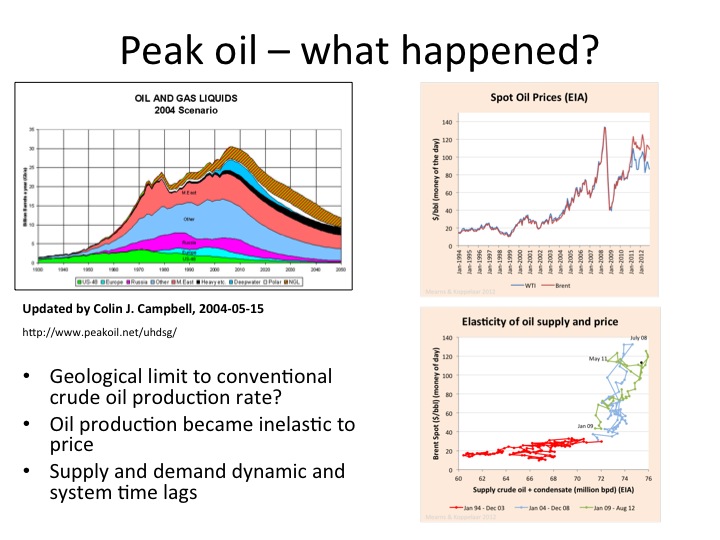
 Before answering “what happened” it is perhaps best to try and define what peak oil actually means. In its simplest formulation, “the theory” is that owing to geological constraints on flow rates from natural finite reservoirs, global oil production will one day reach a maximum point and thereafter inexorably decline. An extension to the theory is to contemplate the possible consequences of peak oil for society. The argument goes that since oil is the pinnacle fuel in terms of energy content, transportability and storability, crucial to the smooth running of modern transport systems, that a decline in crude oil availability may lead to social disruption. The chart top left, shows a typical peak oil profile from Colin Campbell, one of the key Peak Oil analysts of recent decades.
The chart top right shows the oil price for Brent and WTI. The phenomenal rise in price from 1999 to 2008 bore witness to growing scarcity, where demand growth outstripped supply growth. The chart bottom right is a cross plot of the monthly production and price data and shows how supply became inelastic to price from January 2004. Many “peak oilers” were convinced that the time had come.
(Click on slides to get a larger version that will open in a new window)
 Nail 0
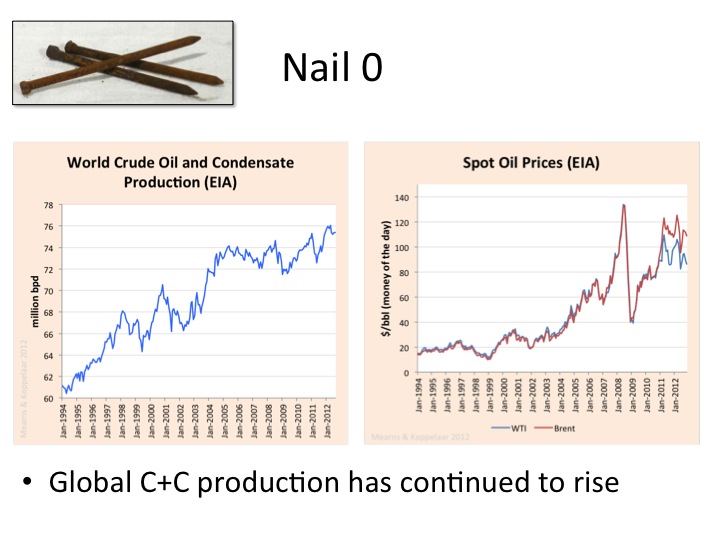
 When I submitted the title to the AAPG many months ago I thought there were three main nails in the theory of Peak Oil, but when I came to write my talk I discovered there were four, hence the introduction of Nail 0. For the time being at least, it is an undeniable fact that oil production has continued to rise. Note that in this case, C+C includes conventional crude oil, condensate, shale oil and tar sands production but excludes biofuel and natural gas liquids.
All scientists should update their views and theories when new facts come to light.
 Nail 1
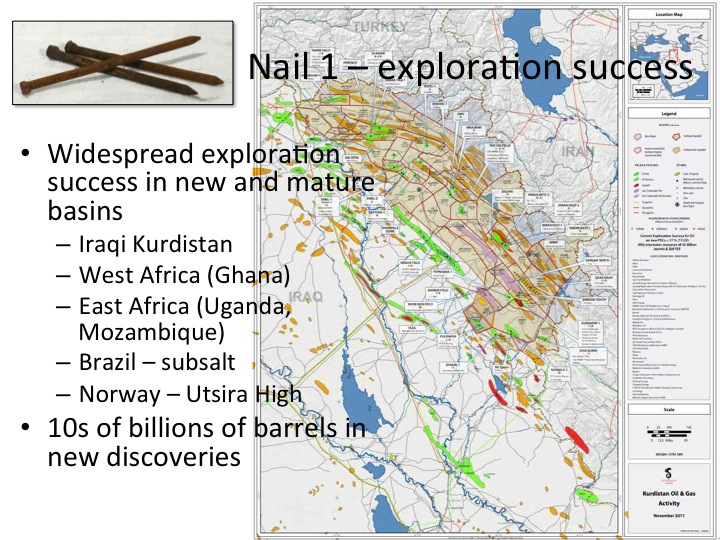
 The first big nail is the ongoing exploration success of the international oil industry. Higher price has encouraged a resurgence in exploration activity that has resulted in tens of billions of barrels being found. Land locked Iraqi Kurdistan alone may hold >40 billion barrels in new reserves. We will of course one day run out of planet to explore but that day does not seem to have arrived yet.
 Nail 2
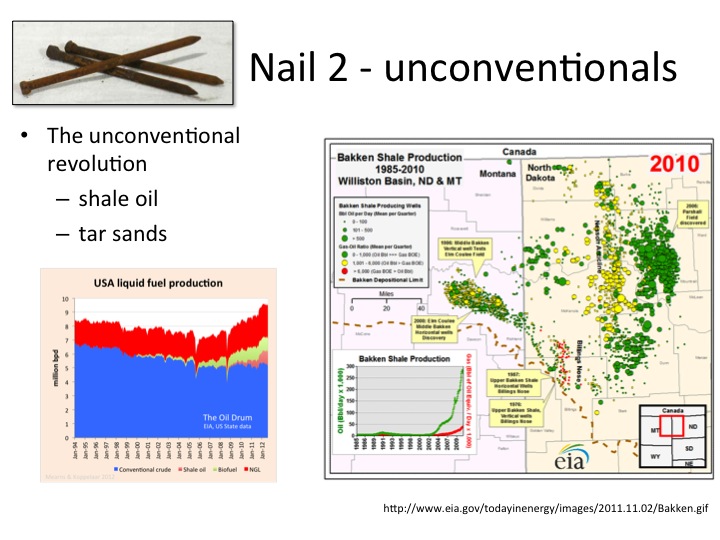
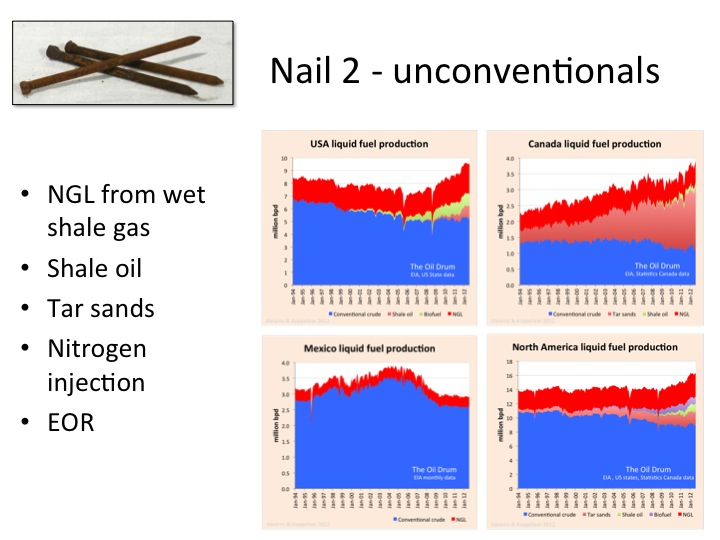
 The second big nail has been the expansion of unconventional oil and gas production, especially shale oil and shale gas in North America. Several years ago when I first engaged with this debate no one ever mentioned shale oil as a massive new resource just begging to be exploited. Shale, together with tar sands, biofuels and enhanced oil recovery has transformed the fortunes of US and N American liquid fuel production.
 Nail 3
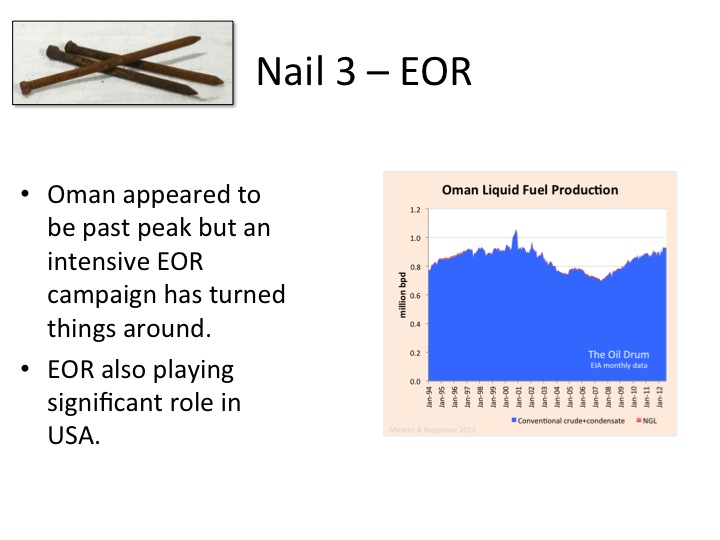
 The third and final big nail may not seem significant but it is symbolic of what can be achieved with technology and the desire to succeed. Oil production in Oman had been in decline since the year 2000 to the disappointment of the Omani people and Shell Oil that operates much of the production in that country through a joint venture with the Omani government called Petroleum Development Oman (PDO). Oman would have been a classic case of a country peaking. But the fortunes were reversed by rolling out an array of enhanced oil recovery strategies. Increasing recovery factors across the globe will add billions more to reserves.
 Points
 At this point many readers may think I have lost the plot, and indeed by the end of the post may still think so. It is important to set the preceding observations in context.
 Not all liquids are born equal
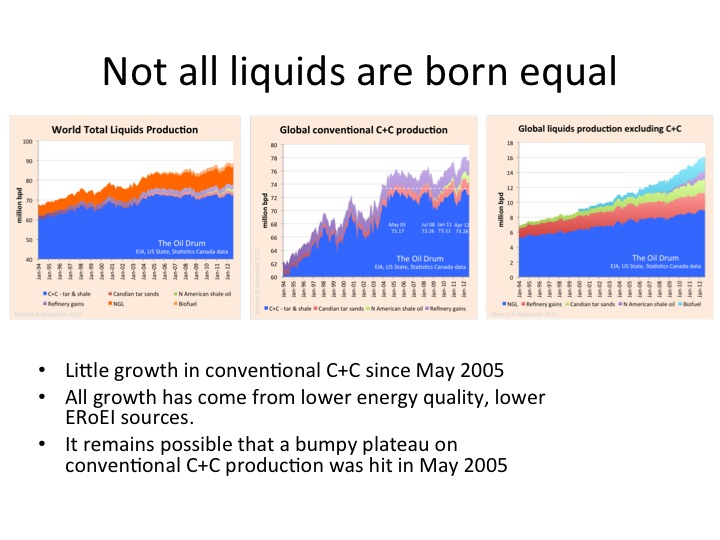
 A careful dissection of global liquids production data shows that conventional crude oil + condensate has been on a bumpy plateau, just over 73 mmbpd, since 2005 – that is for 8 years. Despite record high oil prices, the international oil industry has not been able to grow production of this most lucrative resource that flows freely from the ground. Something is up! All of the meagre growth in liquids production has come from liquids that are very difficult to get, i.e. shale oil and syn crude form tar sand, or from inferior liquids that condense from natural gas production (NGL). Note that in this case conventional C+C excludes shale oil and tar sands. It remains a debatable point whether or not shale oil should be classified as conventional or unconventional oil.
 The IOCs may already be past their peak
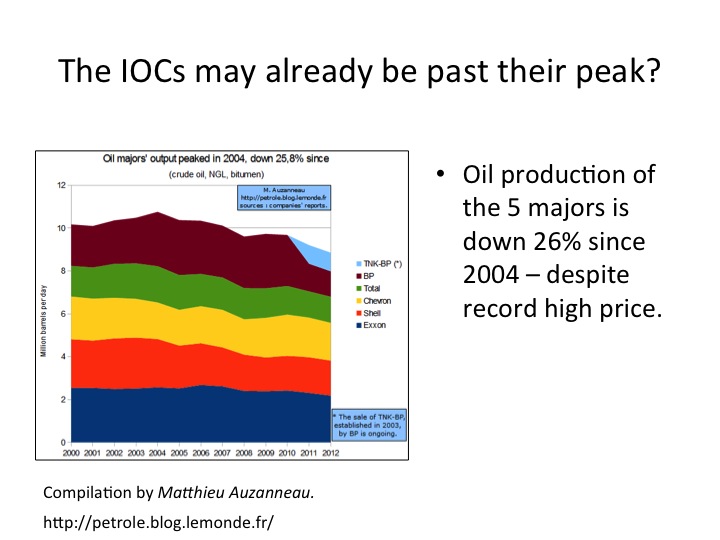
 If the world is awash with oil as many reporters now claim, it is curious that this oil seems out of reach of the biggest independent oil companies in the world. Some of the new supplies may of course be in the hands of the second tier independents but most of it lies in the hands of national governments out side of the OECD. This presents very serious threats to energy security and on-going trade imbalances that lie at the heart of on-going financial system stress.
Thanks to Matthieu Auzanneau for the splendid chart.
 Oil field decline rates
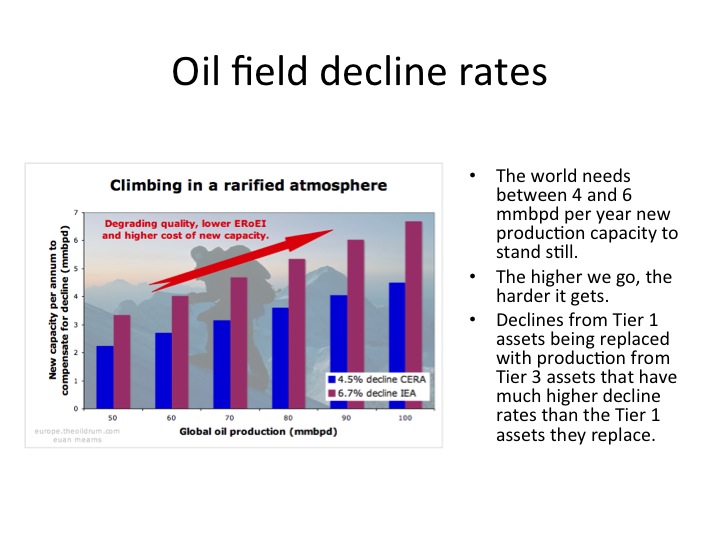
 In the context of oil production, decline rate refers to the fall in annual production that invariably takes place owing to pressure depletion of the reservoir, the production of oil and the ingress of water or gas into the formerly oil bearing strata. Companies are continually battling decline with strategies like injecting water for pressure support, drilling new infill wells, doing well work overs etc. and the combined effect is to reduce declines from headline numbers that may be much greater than 10% to more manageable numbers in the range 4 to 7%. Therefore, absent new field developments, global oil production would decline every year by about 4.5% according to CERA or 6.7% according to the IEA. Given crude + condensate production of around 73 mmbpd, this means that new fields amounting to between 3.3 and 4.9 mmbpd are required every year to just maintain global production at 73 mmbpd. This is a mammoth task, finding and developing fields equivalent to a province like the North Sea, every year. The industry has been working flat out to achieve and maintain this. Tier one supergiants are being replaced with tier three assets like shale oil, that by comparison require enormous effort to develop and decline much more rapidly.
 The world has changed
 The world changed in August 2008 with the onset of the financial crisis. This together with a range of other events, that all impinge on the global energy picture, has tended to take the media and public eye away from the energy crisis that was prominent before August 2008.
 Financial crisis
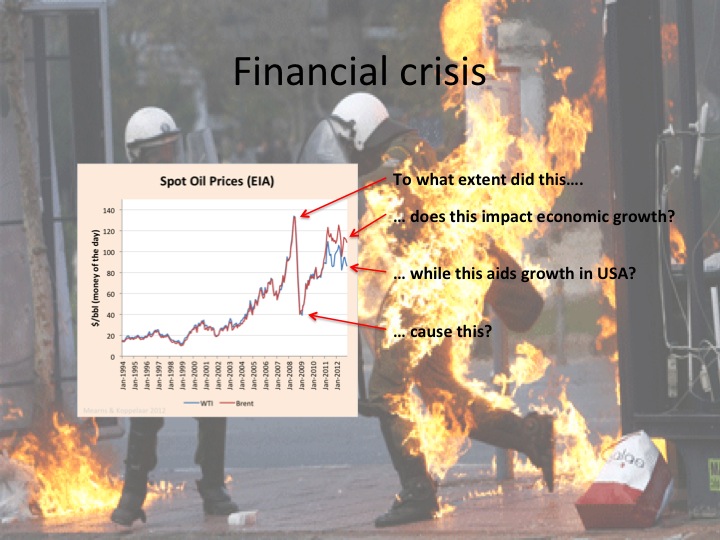
 Eight years ago I would use images from movies to depict social unrest; now there is no shortage from the real world. There should be no doubt that the crash in oil price in 2008 was brought about by the financial crisis. The role of high oil and energy prices in triggering the financial crisis, however, remains less certain and mainly out of the public and political eye. The sharp recovery in oil prices following the crash is part of the new energy reality. Marginal supply is now much more expensive than in the past and to maintain supplies at current levels, a high price must be paid.
 Financial crisis
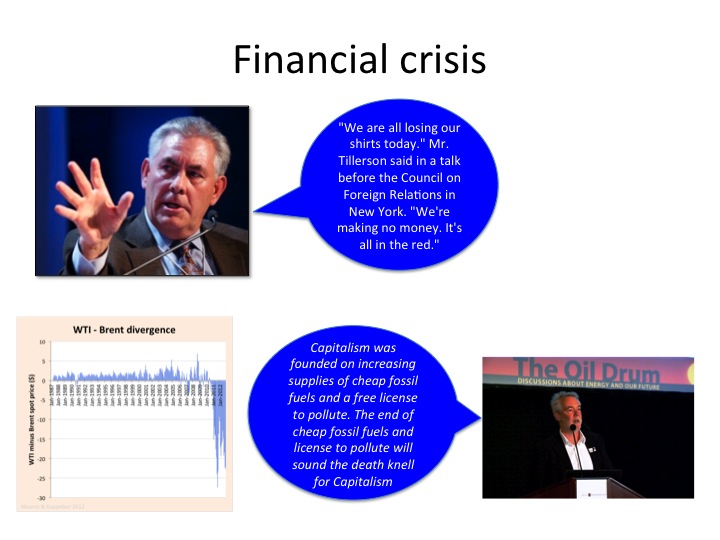
 At a speech I made in Vienna last year I made the assertion that Capitalism was founded on growing supplies of cheap fossil fuels. The financial crisis bares many of the hallmarks to be expected with the end of cheap fossil fuels, and the end of capitalism, the loss of ability to pay rent on savings being one of them. The shale revolution is perhaps the best example of the end of capitalism as oil companies struggle to bring a vast but expensive resource to market and in so doing dump the price below which the resource can be produced. Rex Tillerson, CEO of ExxonMobil kindly affirmed the assertions made by Arthur Berman and others that the US gas industry is losing its shirt on shale. US natural gas prices seem to have bottomed, but are still below the price needed to turn a profit. US shale gas is expensive, and it is curious for me to observe that companies now seek to make it even more expensive by liquefying it and sending it half way around the world. This is curious behaviour for capitalists operating in a broken market.
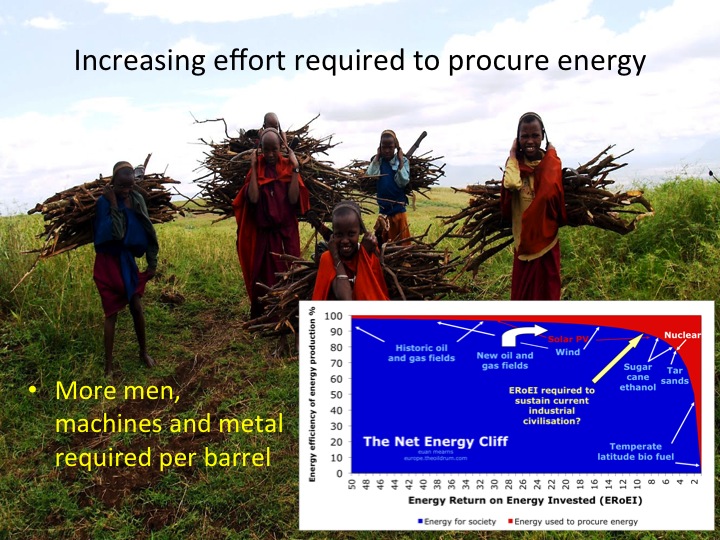 Increasing effort required to procure energy
 I first produced this chart many years ago now, inspired by Nate Hagens and many others. I have grown to realise that low ERoEI energy sources are in fact energy conversions. When we use natural gas to make biofuel or to help procure syn crude from tar sands we are electing to convert “cheap” natural gas into these more prized liquids. ERoEI of the global energy mix will undoubtedly be falling, but on average still so high so as to not be a problem for now. Likely not a problem for many decades to come.
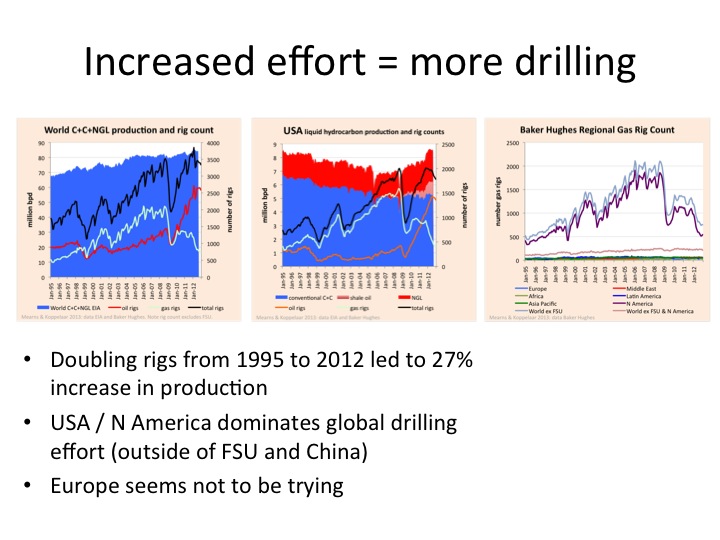 Increased effort = more drilling
 When it comes to N American oil and gas, increased effort simply means drilling more wells, more expensive wells, less productive wells. High resolution versions of the charts are given below.
In this post I was astonished to see how the USA drilling statistics dwarf the rest of the world. Whilst Europe appears not to be trying, on reflection I am not convinced that covering our remaining countryside with drilling pads and service roads is a wise route to follow. North America has wide open spaces better suited to this type of resource exploitation than the densely populated rural landscape of Europe.
Global

US

Regional gas

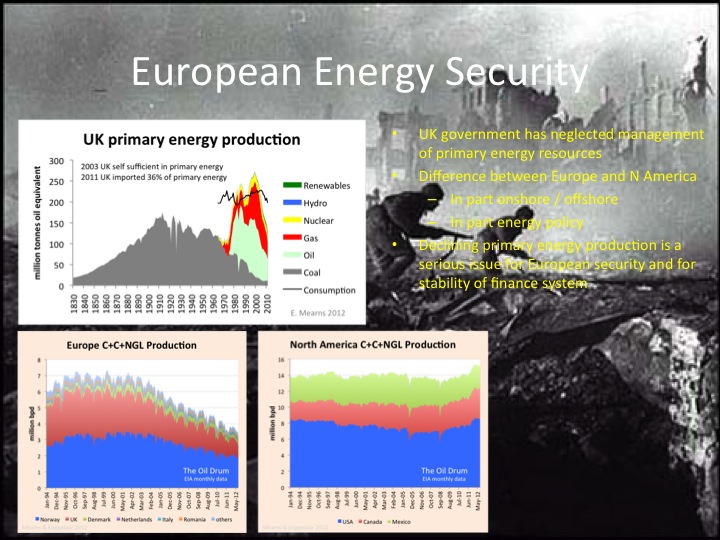 European energy security
Energy security has been a long-running and serious issue for Europe, one of the key factors leading to the expeditionary exploits of Germany in WWII. And yet, as discussed below, European energy policy is currently driven by a unilateral desire to reduce CO2 emissions which so far has achieved virtually nothing.
I sent the chart on UK primary energy to The UK Department of Energy and Climate Change (DECC) many years ago, asking, if confronted with nothing but this data, what should the UK do? It was and still is clear to me that we must do all we can to reduce our energy consumption (without harming the economy and the populace) whilst doing all we can to boost primary energy production. DECC did reply but did not give the glaringly simple answer I expected to get. In the interim, the government has implemented a totally botched tax raid on UK oil and gas production. And it continues to pursue (interminably) with its £1 billion carbon capture and storage competition that seems designed to give Britain the most expensive electricity on the planet. It should be blindingly obvious that if CO2 can be captured at power stations it should be used to enhance oil recovery from the North Sea. What has made our policy makers so blatantly dumb?
To be fair, the UK does have a raft of sensible measures such as progressive taxation on motor vehicles linked to energy efficiency (or is it linked to emissions?), tax breaks for home solar installations (though I’m still not convinced that solar is a great idea for a country where it is dark for most of the winter when demand is at a peak) and is rolling out smart meters at a snail’s pace. We are still taking two small steps forward for every three large steps back.
European oil and gas production is in free fall, in sharp contrast to North America. We are becoming increasingly dependent upon Russia, Africa and The Middle East for our energy supplies with every day that passes. Covering Britain with wind turbines seems increasingly to me like a bad idea. There is, of course, interminable chatter about fracking in the UK and elsewhere in Europe. This excerpt from an email from Arthur Berman I believe places the great fracking hope in context:
So, most-likely reserves suggest that all of the Wrexham, Blackpool, Nottingham and Scarborough shale reserves may amount to a Barnett Shale-sized accumulation. Not nothing, but on balance, not terribly impressive for an entire country. I’m sure the Brits will love the 30,000 wells necessary to develop 43 Tcf!

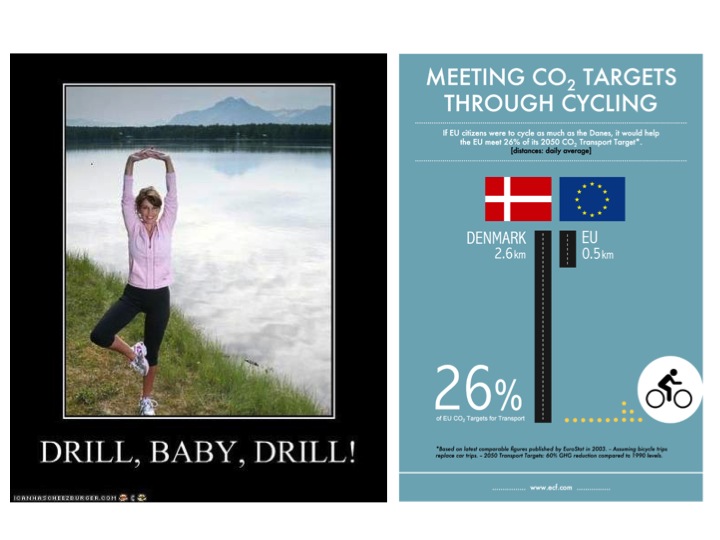 Drill baby drill
 This final slide depicts the very different attitudes to energy policy on either side of the Atlantic pond. The USA, still dominated by free market policies, private ownership of mineral rights and the fossil fuel industries, has pursued a very different course to Europe that is pre-occupied with unilateral emissions reduction policies. So far, this unilateral EU action has achieved essentially zero on the emissions front, any savings made in Europe being wiped out by increased emissions else where. Europeans are being saddled with expensive and less reliable electricity supplies and increasingly loss making energy industries. Only time will tell if the European strategy bears fruit in the long run. The need to increase indigenous primary energy production in Europe does make expansion of renewable energy a sensible option, but I can’t help feeling that 100 GW of new nuclear capacity may better serve the people of Europe.
The future When I first came to The Oil Drum over seven years ago I was looking for information to explain the steadily rising oil price. It has been some ride. In the vastly complex system that is industrial society it is impossible to make predictions about the future, but here, in any case, is my wag. $100+ oil has opened the door to exploitation of more expensive resources and reserves. Society is adapting to the new reality of higher energy prices. Some are becoming more energy efficient, some have installed renewable energy devices at home, some will forgo an expensive vacation they can no longer afford and some have been squeezed out of the labour market, perhaps forever, and will live out their lives on dwindling State handouts, in poverty. The new higher oil / energy prices are here to stay but I believe they will stay range-bound in $100 to $150 / bbl bracket, perhaps for decades as we munch our way through the $125±25 slab of resource. The tremendous uplift in price from 2002 to 2008 may have been a generational one-off investment opportunity where some made billions whilst society lost its shirt. The energy industries are still under-dimensioned for the new reality of harder to get at energy but scarcity of women and machines will gradually ease as the industry continues to upscale.
As for me, I may start my own blog on energy, climate, and policy – that will not be suitable reading for many existing TODers. For the 7+ years I have been involved with The Oil Drum I have not worked and so any new venture will need to be fully funded, somehow.





Charlie Bucket on Tue, 13th Aug 2013 11:32 am
His new blog can be called “The Moon is Made of Cheese”.
BillT on Tue, 13th Aug 2013 11:46 am
Another dreamer … $200 oil by 2020 or sooner.
rollin on Tue, 13th Aug 2013 11:50 am
If we want to spend huge amounts of money we can continue to get oil or oil-like minerals, at least for a while. Only a few job will be created and increased expense of energy will stifle the economies of the world. The end result will be a sharp drop in oil availability and no alternatives to speak of, i.e. collapse into a very polluted world.
Or, we could spend large amounts of money on developing alternative energy and transportation, along with zero carbon buildings. We can also develop new societies that are independent of oil and other fossil fuels. End result will be changes, lots of jobs, less pollution and if descent is inevitable, an easier one.
TIKIMAN on Tue, 13th Aug 2013 12:19 pm
Well the depression of 2008 is still ongoing and will never be before the pre 2006 and before level. Yet the price of gas had risen again.
Weather you believe peak oil or not, conventional crude has peaked, the dollar is failing, and it’s a matter of time before the collapse.
Beery on Tue, 13th Aug 2013 1:43 pm
Peak oil is dead? Oh thank God! We’re saved!
“…some have been squeezed out of the labour market, perhaps forever, and will live out their lives on dwindling State handouts, in poverty. The new higher oil / energy prices are here to stay but I believe they will stay range-bound in $100 to $150 / bbl bracket, perhaps for decades as we munch our way through the $125±25 slab of resource.”
Wait… what? Are you fricken joking? What sort of twisted psychotic sadist-pervert would write pages of text claiming peak oil was dead and then basically say “not really”? It’s not fricken April Fool’s Day you know.
LT on Tue, 13th Aug 2013 1:52 pm
For me, shale oil, tar-sand, and fracking gas are indications of peak-oil.
One would not eat rat-meat if beefs, pork, or chickens are available. Only in desperation (no other poultry meats available) one might resort to eating rat-meat.
The more tar-sand and shale oil are exploited, the stiffer the downward slope will be.
It is interesting that the Olduvai theory may be proven to be true very soon.
Arthur on Tue, 13th Aug 2013 2:48 pm
Heeeehaaaaa… told you so!!!!
The majority of the Drummers did not believe in their own message any more and called it a day.
Reason: they sincerely searched for the truth… and found it. Sure peak oil is real, but not now.
Not to blame the TOD btw, they were concerned, started to study and came with an updated view. Fine, nothing wrong with that.
And than this: the term peakoil should be abandoned, it is useless. It should be replaced by peak fossil, which is far more telling. In many cases oil, gas and sometimes even coal (heating and power generation) are interchangeable.
smokeyjoe on Tue, 13th Aug 2013 3:31 pm
“The energy industries are still under-dimensioned for the new reality of harder to get at energy but scarcity of WOMEN and machines will gradually ease as the industry continues to upscale.”
What does scarcity of WOMEN mean?
GregT on Tue, 13th Aug 2013 3:56 pm
Honestly, does this guy even pay attention to what he has written himself?
“A peak in cheap conventional crude oil + condensate seems close. Scarcity has driven up price.”
Scarcity has driven up price?
Lumping in condensates with conventional crude oil? Conventional crude oil has peaked. Condensates are not oil.
Condensates:
Gas oil, naphtha and other relatively light hydrocarbons (with some dissolved hydrocarbon gases such as butane and propane) which remain liquid at normal temperature and pressure. Recovered mainly from gas reservoirs, condensates are similar to light stabilized crude oil and are used as feedstock for oil refining and other petrochemical industries.
“High oil price/ oil scarcity is implicated in financial crisis which in turn impacts spreading global unrest.”
Exactly what was expected to happen when peak conventional oil was reached.
From Wikipedia:
“Some observers, such as petroleum industry experts Kenneth S. Deffeyes and Matthew Simmons, predict negative global economy implications following a post-peak production decline—and oil price increase—due to the high dependence of most modern industrial transport, agricultural, and industrial systems on the low cost and high availability of oil.”
For the 7+ years I have been involved with The Oil Drum I have not worked and so any new venture will need to be fully funded, somehow.
It would seem to me that the author is hoping to capitalize on denialism. Sounds like a great way to make some easy cash.
DC on Tue, 13th Aug 2013 7:37 pm
Q/So far, this unilateral EU action has achieved essentially zero on the emissions front, any savings made in Europe being wiped out by increased emissions else where. Europeans are being saddled with expensive and less reliable electricity supplies and increasingly loss making energy industries.
WTF? Clearly this guy does not live in Europe. The people there are not stupid and would not undertake the effort and expense if they did not feel there was benefit to doing so. Clearly his statement Europe has achieved ‘essentially zero’ is one made in complete ignorance.If I, or my govt* undertook a serious, and successful effort to reduce pollution, we would not be doing to it make the lives of people in say, Japan, China, or India better. We would be doing it to improve our local quality of life, IE where WE live, and to save money and reduce our FF consumption. I would not stop my efforts to improve local conditions on the basis that some govt or US corporation building car factories in CHina is nullifying my effort at home.
For example, Iam not about stop biking everywhere I can simply because China is adding 50 bajillion gas-burning trash cans to ITS roads every yes. Yes, they nullifying my efforts every single day over there as well-but so what of it? Likewise, people in Paris, or Holland, or Germany that bike and use mass transit, or install solar panels with govt incentives, should not all hop in gas powered cars and install oil tanks in there homes based on the notion people ‘elsewhere’ are nullifying the gains they are making to improve local conditions.
*For the record, my own govt and people are doing to little to reduce emissions, in fact, they are doing everything they can to encourage more of them. ‘Good for the economy and all that’. That leaves it largely up to individuals that can only vote with there wallets against BC’s\Alberta’s\Canadian Govts cars and planes only transportaion policies.
Arthur on Tue, 13th Aug 2013 8:56 pm
“WTF? Clearly this guy does not live in Europe.”
From the article I would infer that he is from Britain. The question if that country is European is still open for debate.
According to Orwell it is not:
http://fc07.deviantart.net/fs71/i/2010/280/e/0/george_orwell__s_1984_map_by_bluelink97-d30a0zh.jpg
John_A on Tue, 13th Aug 2013 9:07 pm
It only took Euan what, 8 years to figure it out? I wonder what the kudo’s, or alternately the giggle quotient was, in a room full of petroleum geologists who if they had even an inkling of economics could have told him all of this 9 years ago.
Learn by doing…and screwing it up…I guess.
actioncjackson on Wed, 14th Aug 2013 12:50 am
This guy knows he’s a cunt, that’s enough for me.
DMyers on Wed, 14th Aug 2013 3:27 am
I don’t agree with this capitulation to the Maugerian vision of the oil abundant, Saudi American future. This is the new peak oil concession, or guilty plea. It is formulaic in nature. We were wrong. It didn’t run out as fast as we thought, because of unconventional oil and gas and enhanced recovery, and this is all owing to NEW TECHNOLOGY.
BUT, in the end, we will be rectified by rapid depletion rates, financial collapse and the contamination of oil with a bunch of other nasty shit.
This amounts to acknowledging a temporary set back but does not arise to surrender of the concept. Unconventional oil and enhanced oil recovery do not create more than there is. They simply modulate the interval during which we reengage with the Stone Age.
eastbay on Wed, 14th Aug 2013 3:29 am
If there’s no longer a risk of peak oil, then why are humans clear cutting the Indonesian rainforests? Planting palm oil trees in order to harvest them to make diesel fuel for EU vehicles means people are now running out of stuff to make into fuel. When the forests are gone, if it comes to that, what else will there be to burn?
SilentRunning on Wed, 14th Aug 2013 3:42 am
I’m so glad that there are absolutely NO LIMITS to oil production. Indeed, it would seem that if the Cornies are right then you should be able to get AN INFINITE amount of oil out of – um – just one well – at an infinite rate!!
If the cornies actually believed that (no limits, unlimited delivery rates, etc) why don’t they simply prove it by merely delivering THE ENTIRE WORLD PRODUCTION FROM A SINGLE WELL in, let’s say Texas.
Come on cornies – you believe your spew – right? Why not shut all of us peakers up once and for all by just producing 100 million barrels per day from a single well in Texas – and doing it day after day for just a decade or two. Then I will happily join your movement of mathematical and physical lunacy.
Arthur on Wed, 14th Aug 2013 8:16 am
“Another dreamer … $200 oil by 2020 or sooner.”
Cars/2 wheelers will be 120 mpg by 2020.
http://www.topgear.com/uk/car-news/volkswagen-up-lite-2009-12-04
(out in 2014)
The can will be kicked another 10-20 years.
Beery on Wed, 14th Aug 2013 10:51 am
Arthur: “The majority of the Drummers did not believe in their own message any more and called it a day.”
If that’s so, why didn’t we see them make any mention of the fact?
Arthur on Wed, 14th Aug 2013 4:56 pm
Probably face saving. Nobody likes to be wrong. Well, except for the author of this article. And Michael Klare recently, implicitly, said goodbye to the peakoil=now/immanent hypothesis. Expect more to follow.
Arthur on Wed, 14th Aug 2013 5:16 pm
In contrast what some here have suggested, the author does not say that an era of new abundence is now upon us. Instead he says: “new higher oil / energy prices are here to stay but I believe they will stay range-bound in $100 to $150 / bbl bracket, perhaps for decades as we munch our way through the $125±25 slab of resource”.
And he could very well be right. The new situation provides a path into a renewable world where a gradual introduction is facilitated by a sustained high price level that could last decades, exactly what we need.
GregT on Thu, 15th Aug 2013 3:13 am
We have a renewable world already, it just can’t naturally support 7 billion human beings. If we continue to degrade it by burning fossil fuels for a ‘few more decades’, we will no longer have that renewable world anymore.
That may be what the Earth needs to rid itself of it’s parasitic infestation, but it won’t do us humans any good at all. Unless you believe that exactly what we need, is to be eradicated.
GregT on Thu, 15th Aug 2013 3:32 am
Eastbay,
There is a massive amount of biomass, in 7 billion human beings.
Maybe that is why so many science fiction writers see a future where we feed ourselves to ourselves. After all, there is only so much biomass to go around, in a finite world.